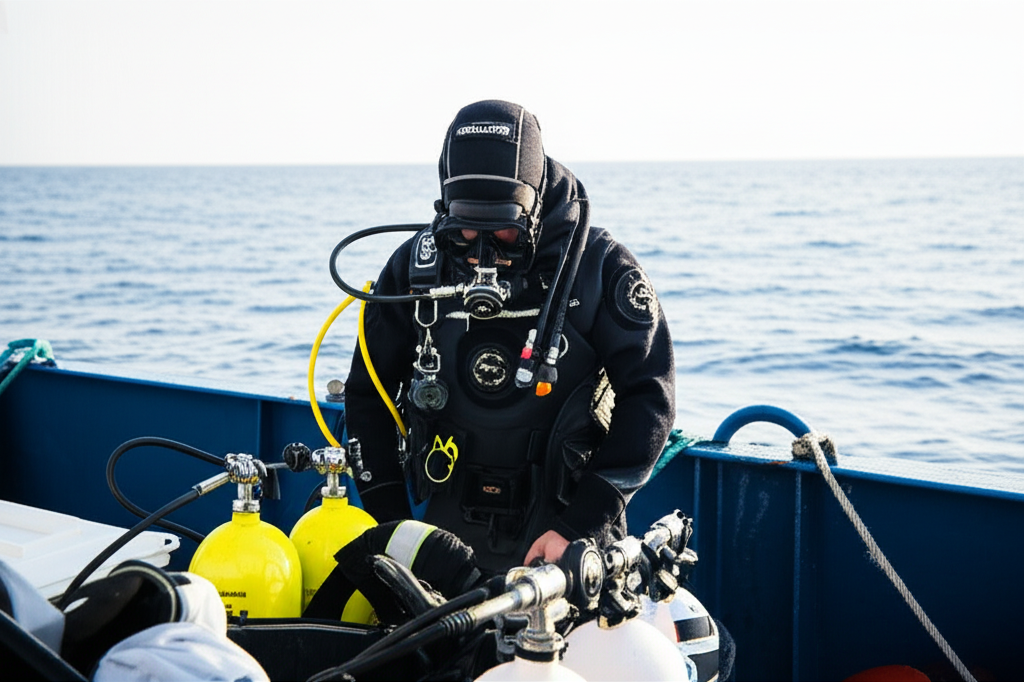
Master in Scientific Deep Diving

Why this master’s programme?

The Master in Deep Scientific Diving

This program equips you to lead complex underwater research. Learn to plan and execute safe and efficient dives, using cutting-edge technology such as ROVs and advanced life support systems. Master the collection of biological and geological data, the analysis of deep-sea ecosystems, and the interpretation of scientific results to contribute to ocean conservation. This program prepares you for a future in marine research and the exploration of the underwater frontiers.

This program equips you to lead complex underwater research. Learn to plan and execute safe and efficient dives, using cutting-edge technology such as ROVs and advanced life support systems.

Differential Advantages

  • Professional Certification: Obtain the necessary certifications for deep-sea technical and scientific diving.
  • Hands-on Experience: Participate in real research expeditions and apply your knowledge in the field.
  • International Collaboration: Connect with experts and participate in projects with leading institutions worldwide.
  • Cutting-Edge Technology: Access state-of-the-art diving equipment and specialized data analysis tools.
  • Multidisciplinary Approach: Integrate knowledge of marine biology, geology, oceanography, and underwater technology.
Buceo

Master in Scientific Deep Diving

Availability: 1 in stock

Who is it aimed at?

  • Marine biologists and oceanographers seeking to expand their research capabilities to significant depths.
  • Underwater archaeologists and explorers interested in documenting and preserving submerged heritage at greater depths.
  • Marine conservation professionals who need to monitor and protect vulnerable ecosystems in deep-sea areas.
  • Technicians and engineers specializing in the development and operation of advanced underwater equipment for science.
  • Experienced divers aspiring to professional certification in deep-sea scientific diving.

Academic Flexibility Adapted to the demands of the field: combination of theory intensive online, laboratory practices and internationally scheduled diving expeditions.

Buceo

Objectives and skills

Lead innovative underwater research projects:

To foster creativity and risk management to overcome unprecedented technical and scientific challenges.

Implement advanced data sampling and analysis methodologies:

Design and implement statistically robust sampling plans and apply exploratory analysis and predictive modeling techniques to extract valuable information and optimize decision-making.

Documenting and communicating scientific findings effectively:

“Prepare clear and concise reports, tailored to the audience, using impactful data visualizations and actively participating in conferences and publications.”

Apply rigorous safety protocols in challenging diving environments:

“Implement predefined emergency plans, effectively manage unexpected risks, and maintain constant communication with the team and surface support.”

Operate specialized diving equipment and state-of-the-art technology:

Manage ROVs and autonomous underwater vehicles (AUVs) during inspections and maintenance, interpreting complex data and solving technical problems on site.

Assess and mitigate risks inherent in deep diving:

“Identify sources of risk (physiological, environmental, equipment) and establish mitigation protocols (gases, ascent procedures, equipment redundancy).”

Study plan – Modules

  1. Fundamentals of Advanced Underwater Exploration: Physical and Chemical Principles of the Deep Aquatic Environment and Their Impact on Biological Processes
  2. Structured Sampling Techniques for Deep Marine Ecosystems: In situ and Remote Sampling Methods, Instrument Selection, and Standardized Protocols
  3. Experimental Design in Scientific Diving: Establishing Variables, Replication, and Control in Deep-Sea Studies
  4. Advanced Instrumentation for Sampling Physicochemical Parameters: CTD, ADCP, Oxygen, Fluorescence, and Turbidity Sensors; Integration with Autonomous and Manned Diving Systems
  5. Methods for Capturing and Cataloging Biological Samples: Planktonic Nets, Baited Traps, Manual and Robotic Collectors, Preservation and Transport Techniques
  6. Taxonomic and Ecological Analysis of Deep-Sea Organisms: Identification, Classification, and Study of Morphological and Physiological Adaptations
  7. Processing and Analysis of scientific data obtained in the field: use of specialized statistical software, interpretation of results, and modeling of benthic and pelagic communities.

    Advanced applications of underwater photography and videography in research: lighting techniques, stabilization, and quantification of biological metrics from images.

    Environmental impact assessment in scientific diving areas: reference parameters, biological indicators, and assessment of anthropogenic damage.

    Specific safety regulations and protocols for diving in deep-sea scientific environments: risk management, medical emergencies, decompression, and specialized underwater communication.

    Interdisciplinary integration in underwater studies: collaboration with oceanographers, marine biologists, geologists, and meteorologists for a holistic view of the ecosystem.

    Trends and technological advances in scientific diving: underwater drones, advanced rebreathers, and deep-sea navigation and positioning systems.

    Preparation and presentation of scientific reports and Publications: Quality criteria, structuring, and effective communication of findings to the international community

    […]

  1. Introduction to Advanced Technologies: Evolution, Trends, and Specific Applications in Deep Scientific Diving
  2. Life Support Systems: Detailed Analysis of Closed and Semi-Closed Rebreathers, CO2 Control, Oxygen Management, and Automatic Monitoring for Extended Dives
  3. Precision Instrumentation: Pressure, Temperature, Conductivity, and pH Sensors; Calibration, maintenance, and real-time data management

    Underwater communication equipment: acoustic and optical technologies, transmission protocols, integration with surface systems, and interference management in extreme environments

    Robotics and ROVs: design, operation, and maintenance of autonomous and teleoperated systems for exploration and sampling in inaccessible areas

    Strict safety protocols: specific risk assessment, emergency plans, decompression procedures, and use of redundant equipment

    Advanced predictive and corrective maintenance practices: diagnostic techniques, critical spare parts, validation, and documentation according to international standards

    Integration of biomedical monitoring systems: vital signs telemetry, early detection of complications, and immediate intervention in critical and saturated environments

    Operating protocols in extreme environments Extreme: Adaptation of equipment for high-pressure, low-temperature, and reduced-visibility conditions, including ISO and IMCA standards

  4. Lifecycle management of scientific equipment: Acquisition, technical validation, standardization of procedures, and protection of scientific data during dives
  1. Fundamentals of marine biology in deep-sea environments: adaptation, biodiversity, and functional ecology
  2. Experimental design for sampling under extreme conditions: protocols, replicability, and variable control
  3. Advanced techniques for collecting biological samples: use of specialized instruments (benthoscams, trawls, ROVs)
  4. Application of in-situ sensors for environmental monitoring: real-time physicochemical and biotic parameters
  5. Methodologies for preserving and transporting samples for subsequent genetic and biochemical analyses
  6. Multivariate statistical analysis applied to underwater sampling data: interpretation and validation of results
  7. Integration of geospatial data with GIS to map biological communities and habitats at depth
  8. Modeling and simulation of population dynamics and benthic ecosystems under environmental stress
  9. International standards and ethics in deep-sea research: permits, responsible management, and scientific outreach

    Development of high-level technical reports for scientific publications and submission to regulatory bodies

  1. Fundamentals of strategic planning for deep-sea scientific campaigns: defining objectives, scope, and success criteria
  2. Comprehensive logistics: management of human resources, materials, specialized equipment, and technical supplies for highly complex dives
  3. Selection and preparation of operational platforms: ships, submarines, and ROV/AUVs adapted to extreme conditions
  4. Design and structuring of the multidisciplinary team: scientific, technical, and support personnel profiles, with clearly defined and coordinated roles
  5. Operational leadership: advanced team management models in high-pressure environments, conflict management, and real-time decision-making
  6. Specific safety and emergency protocols for deep-sea scientific diving: drills, contingency plans, and dynamic risk assessment
  7. Hyperbaric medicine: pathophysiology of decompression, Early diagnosis of pressure-related illnesses, treatment in hyperbaric chambers, and medical evacuation protocols.

    International regulations and regulatory compliance: comprehensive analysis of IMCA, NOAA, and local legislation applicable to deep-sea scientific activities.

    Environmental management and scientific permits: procedures for campaign authorization, environmental impact, and ethics in underwater exploration.

    Operational monitoring and control: advanced tools for real-time monitoring, dive data logging, and feedback mechanisms for continuous campaign optimization.

    Final report and post-campaign evaluation: preparation of technical reports, analysis of results, lessons learned, and planning of subsequent campaigns based on scientific and operational evidence.

  1. Physical and chemical foundations of deep-sea ecosystems: pressure, temperature, salinity, and their vertical gradients
  2. Hydrodynamic dynamics in deep waters: thermoaline currents, thermocline, mesoscale eddies, and their impact on biological distribution
  3. Computational modeling of benthic and pelagic systems: numerical techniques, coupled process modeling, and spatiotemporal resolution
  4. Advanced applications of remote sensing in oceanographic studies: multispectral, underwater lidar, side-scan sonar, and innovative acoustic technologies
  5. Integration of in-situ and remote data: calibration, validation, and fusion of sensors for high-precision environmental reconstruction
  6. Oceanographic sounding methodologies: CTD profiles, biogeochemical sampling, currents, and autonomous instruments (gliders and AUVs)
  7. Statistical and Machine learning applied to modeling biodiversity and ecological processes in abyssal zones

    Assessment of anthropogenic impact: study of pollutants, underwater noise, and climate change in deep-sea ecosystems

    Design and supervision of underwater scientific expeditions: planning, logistics, sensor selection, and sampling protocols

    Advanced interpretation of results and generation of scientific reports for publication and application in environmental policies

  1. Fundamentals of Sampling in Extreme Underwater Environments: Selection Criteria and Methodological Adaptability
  2. Advanced Sampling Techniques: Stratified, Random, and Systematic Depth Sampling
  3. Specialized Instrumentation: Multiparameter Sensors, Hyperbaric Chambers, and ROV/AUV Systems for Data Collection
  4. Standard Protocols and Sample Validation: Preservation, Contamination Control, and Traceability under Extreme Pressure and Temperature Conditions
  5. Data Processing and Analysis: Multivariate Statistical Tools and Predictive Models Specific to Oceanographic and Biological Data
  6. Integration of GIS Systems and Specialized Software for the Spatial Interpretation of Underwater Data
  7. Secure Management and Storage of Scientific Databases: International Standards and Best Practices
  8. Methodologies for Assessment and Mitigation
  9. Risk assessment during explorations in hostile environments

    Implementation of automated workflows for real-time analysis and scientific decision-making in the field

    Case studies of underwater scientific projects in high-pressure zones: challenges, results, and practical applications

  1. Fundamentals of exploration in deep-sea ecosystems: physical, chemical, and biological characteristics
  2. Advanced technologies in scientific diving: HID equipment and safety grids for abyssal dives
  3. Life support systems in extreme environments: atmospheric management, CO2 control, and helium-gas mixtures
  4. Instrumentation for in-situ sampling: multiparameter sensors, underwater Raman spectroscopy, and autonomous hyperbaric chambers
  5. Applications and limitations of remotely operated vehicles (ROVs) and autonomous underwater vehicles (AUVs) in ecological monitoring
  6. Integration of geolocation and navigation systems under pressure using inertial and acoustic systems
  7. Analysis and processing of oceanographic data collected in real time using digital platforms Decentralized
  8. Operational safety protocols for scientific dives in high-pressure, low-visibility conditions
  9. Methodologies for assessing anthropogenic impact and conserving deep-sea habitats using emerging technologies
  10. Design and execution of scientific campaigns: strategic planning, technical execution, and validation of results in deep-sea exploration projects
  1. International and national regulations applicable to deep scientific diving: comprehensive analysis of IMCA, NOAA standards, and NOAA Diving Program protocols
  2. Specific risk assessment: identification, quantification, and mitigation of hazards in deep hyperbaric environments, including decompression sickness, extreme cold pathology, and gas toxicity
  3. Design and optimization of emergency protocols: development of standardized procedures for critical events, such as bailout, life support system failure, and loss of surface communication
  4. Advanced safety equipment: technologies and maintenance of redundant gas supply systems, diving suits, and remote biometric monitoring devices
  5. Comprehensive planning of extended and multi-stage dives: bottom time management, gas mixing, and strategies to avoid oxygen narcosis and toxicity
  6. Communication and coordination in deep diving operations:
  7. Acoustic signaling protocols, use of smart lifelines, and underwater ultrasonic communication systems
  8. Immediate incident response training: simulation of complex scenarios such as arterial gas embolism, severe decompression syndrome, and underwater confined space rescues
  9. Medical evacuation and advanced life support protocol: integration of hyperbaric procedures with air ambulance transport and coordination with referral hospitals
  10. Hyperbaric chamber operation and maintenance: standards for artificial decompression, identification of technical failures, and preventive maintenance
  11. Post-incident documentation and analysis: detailed activity log, collection of biomedical data, and statistical analysis for continuous optimization of safety protocols
  1. Fundamentals of Scientific Planning in Deep Marine Environments: Objectives, Hypotheses, and Experimental Design
  2. Risk and Contingency Assessment in Extreme Conditions: Analysis of Environmental, Physiological, and Technical Variables
  3. Advanced Methodologies for the Selection and Preparation of Study Sites in Abyssal and Hadal Environments
  4. Comprehensive Logistics Management: Team Mobilization, Multidisciplinary Coordination, and Resource Optimization
  5. Safety Protocols and Specific Emergency Mitigation in Scientific Deep Diving
  6. Cutting-Edge Instrumentation and Technologies for Sample and Data Collection in Underwater Campaigns
  7. Subsea Navigation and Positioning Techniques for the Precise Re-establishment of Study Areas: Use of USBL, LBL, and DVL Systems
  8. Real-Time Environmental Monitoring: Integration of Ocean Sensors and Data Acquisition Systems
  9. Control and supervision of scientific dives: management of dive profiles, physiological data, and operational timings
  10. Processing, documentation, and preliminary analysis of campaign data: preparation of technical reports and post-mission recommendations
  11. Ethical and regulatory aspects of underwater research campaigns: permits, conservation, and environmental responsibility
  12. Training and effective communication in multidisciplinary work teams for extreme environments
  13. Innovation in the design of scientific campaigns: adaptability to dynamic conditions and unforeseen results
  1. Conceptualization and justification of the final project: scientific objectives and practical application in deep-sea ecosystems
  2. Comprehensive review of emerging technologies in scientific diving: design, functionalities, and operational advantages
  3. Integration of multispectral data acquisition systems and environmental sensors for precise in-situ monitoring
  4. Advanced design of dive protocols to maximize efficiency and safety in high-pressure and low-visibility conditions
  5. Application of remotely operated vehicles (ROVs) and autonomous underwater vehicles (AUVs) in support of deep-sea diving missions
  6. Implementation of digital tools for the collection, storage, and real-time analysis of underwater scientific data
  7. Advanced methodologies for the creation of high-resolution topographic and bathymetric maps in hard-to-reach areas
  8. Integration of acoustic and optical communication systems for linking divers and control stations during dives
  9. prolonged

  10. Biosafety and environmental conservation protocols: minimizing human impact and monitoring ecosystem changes
  11. Preparation of technical and scientific reports: structuring, data quality, validation, and presentation for academic and professional dissemination
  12. Comprehensive management of the final project: time planning, resource allocation, and risk assessment associated with the research
  13. Practical case studies and virtual simulations for developing skills in technological integration and data management
  14. Ongoing advice and supervision for methodological guidance and updates on innovative technologies
  15. Critical evaluation of results and development of proposals for future research and applications in deep-sea scientific diving

Career prospects

“`html

  • Underwater Scientific Researcher: Design and execution of research projects in deep marine environments.
  • Marine Environmental Consultant: Environmental impact assessment and development of conservation strategies in deep-sea areas.
  • Underwater Exploration Project Manager: Planning and coordination of scientific and technological expeditions in deep waters.
  • Deep-Sea Underwater Archaeology Specialist: Research and preservation of submerged archaeological sites in deep-sea areas.
  • ROV/AUV Operations Technician: Operation and maintenance of remotely operated and autonomous underwater vehicles for scientific research.
  • Underwater Filming and Documentation Expert: Production of scientific audiovisual content in deep-sea environments.
  • Scientific Advisor for the Offshore industry: Consulting on marine renewable energy projects, deep-sea mining, and other deep-water activities.

    Scientific diving instructor/trainer: Conducting courses and workshops on scientific diving techniques and deep-sea diving safety.

    “`

Entry requirements

Academic/professional profile:

Bachelor’s degree in Nautical Science/Maritime Transport, Naval/Marine Engineering or a related qualification; or proven professional experience on the bridge/in operations.

Language proficiency:

Functional Maritime English (SMCP) recommended for simulations and technical materials.

Documentation:

Updated CV, copy of qualification or seaman’s book, national ID/passport, motivation letter.

Technical requirements (for online):

Device with camera/microphone, stable internet connection, monitor ≥ 24” recommended for ECDIS/Radar-ARPA.

Admissions process and dates

Online
application

(form + documents).

Academic review and interview

Admissions decision

Admissions decision

(+ scholarship offer if applicable).

Place reservation

(deposit) and enrolment.

Induction

(access to the virtual campus, calendars, simulator guides).

Scholarships and financial support

  • Explore the Depths: Master advanced scientific diving techniques for marine research.
  • Professional Certification: Gain the accreditation needed to lead large-scale underwater research projects.
  • Cutting-Edge Technology: Learn to operate state-of-the-art equipment, including ROVs and underwater communication systems.
  • Applied Research: Participate in real-world projects and contribute to the advancement of knowledge in marine biology, geology, and underwater archaeology.
  • International Collaboration: Connect with experts and participate in expeditions to unique marine environments around the world.
Prepare for a Career exciting and contributes to the conservation of marine ecosystems.

Testimonials

Frequently asked questions

Yes. The itinerary includes ECDIS/Radar-ARPA/BRM with harbor, ocean, fog, storm, and SAR scenarios.

Online with live sessions; hybrid option for simulator/practical placements through agreements.

Recommended functional SMCP. We offer support materials for standard phraseology.

Yes, with a relevant degree or experience in maritime/port operations. The admissions interview will confirm suitability.

Optional (3–6 months) through Companies & Collaborations and the Alumni Network.

Simulator practice (rubrics), defeat plans, SOPs, checklists, micro-tests and applied TFM.

A degree from Navalis Magna University + operational portfolio (tracks, SOPs, reports and KPIs) useful for audits and employment.

  1. Conceptualization and justification of the final project: scientific objectives and practical application in deep-sea ecosystems
  2. Comprehensive review of emerging technologies in scientific diving: design, functionalities, and operational advantages
  3. Integration of multispectral data acquisition systems and environmental sensors for precise in-situ monitoring
  4. Advanced design of dive protocols to maximize efficiency and safety in high-pressure and low-visibility conditions
  5. Application of remotely operated vehicles (ROVs) and autonomous underwater vehicles (AUVs) in support of deep-sea diving missions
  6. Implementation of digital tools for the collection, storage, and real-time analysis of underwater scientific data
  7. Advanced methodologies for the creation of high-resolution topographic and bathymetric maps in hard-to-reach areas
  8. Integration of acoustic and optical communication systems for linking divers and control stations during dives
  9. prolonged

  10. Biosafety and environmental conservation protocols: minimizing human impact and monitoring ecosystem changes
  11. Preparation of technical and scientific reports: structuring, data quality, validation, and presentation for academic and professional dissemination
  12. Comprehensive management of the final project: time planning, resource allocation, and risk assessment associated with the research
  13. Practical case studies and virtual simulations for developing skills in technological integration and data management
  14. Ongoing advice and supervision for methodological guidance and updates on innovative technologies
  15. Critical evaluation of results and development of proposals for future research and applications in deep-sea scientific diving

Request information

  1. Complete the Application Form.

  2. Attach your CV/degree certificate (if you have it to hand).

  3. Indicate your preferred cohort (January/May/September) and whether you would like the hybrid option with simulator sessions.

    An academic advisor will contact you within 24–48 hours to guide you through the admission process, scholarships, and compatibility with your professional schedule.

Please enable JavaScript in your browser to complete this form.
Click or drag a file to this area to upload.

Faculty

0
    0
    Tu carrito
    Tu carrito esta vacíoRegresar a la tienda
    Scroll to Top


