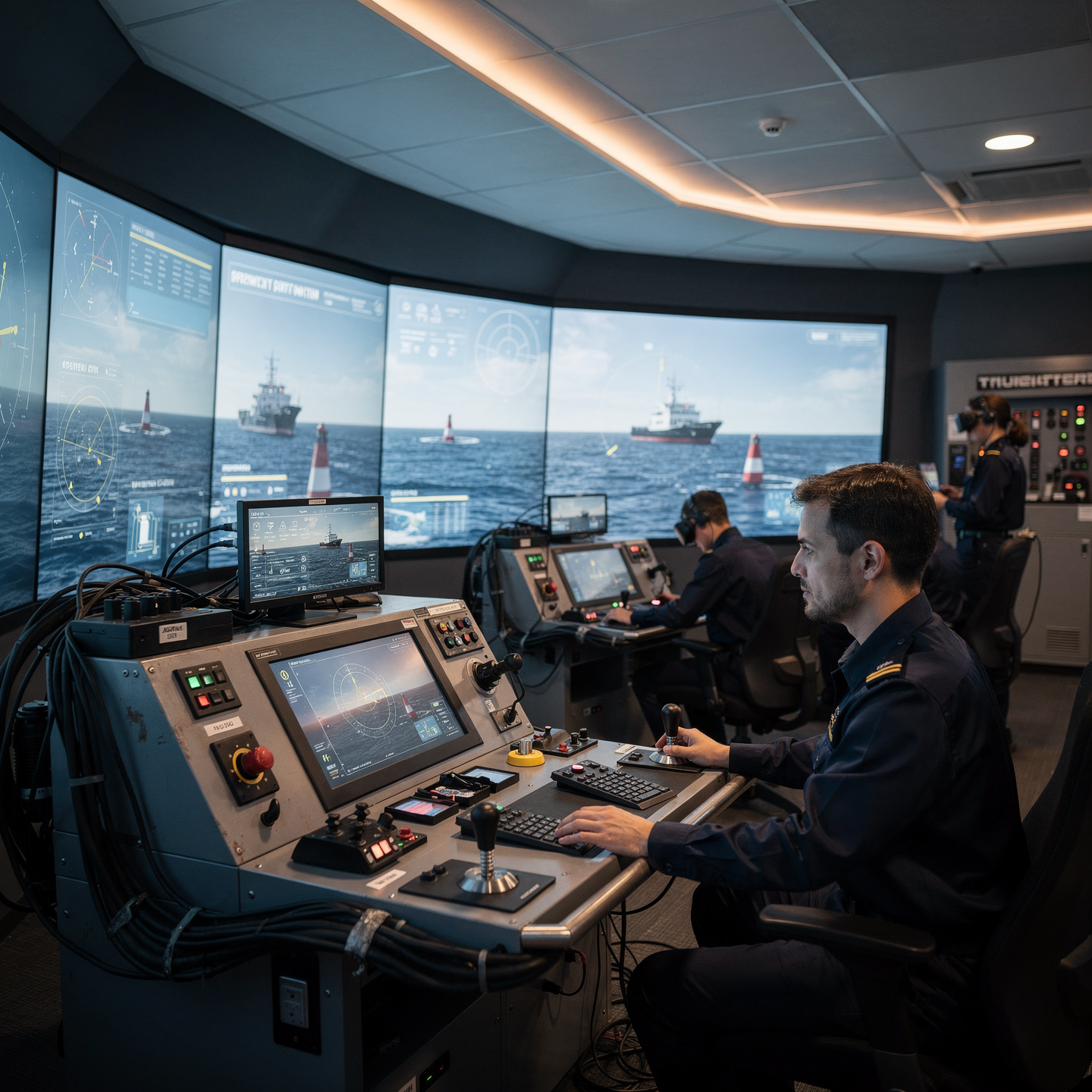
Master’s Degree in Virtual Reality Engineering and Navigation Simulation
Why this master’s programme?
The Master’s Degree in Virtual Reality Engineering and Navigation Simulation
Immers you in the future of immersive technology and its application in the naval industry. Learn to design, develop, and implement realistic virtual environments and interactive simulations for training navigators, optimizing maritime operations, and researching new technologies. Master the most advanced tools and techniques, from 3D modeling and simulator programming to sensor integration and data analytics, preparing you to lead innovation in a constantly evolving sector.
Differentiating Advantages
- Practical Approach: Development of real-world projects and case studies that simulate complex navigation scenarios.
- Cutting-edge Technologies: Use of state-of-the-art software and hardware to create immersive experiences.
- Expert Teaching Team: Professors with extensive experience in the naval industry and in the development of virtual reality solutions.
- Professional Networking: Connection with leading companies in the sector and professional internship opportunities.
- Skills Development: Comprehensive training in programming, modeling, simulation, and project management.
- Modality: Online
- Level: Masters
- Hours: 1600 H
- Start date:
Availability: 1 in stock
Who is it aimed at?
- Engineers and architects interested in applying virtual reality and simulation in the design, construction, and operation of infrastructure.
- Video game and immersive application developers seeking to specialize in simulating complex environments and realistic interaction.
- Maritime and naval professionals wishing to optimize training and safety using state-of-the-art navigation simulators.
- Researchers and academics exploring the new frontiers of virtual reality and its application in engineering and transportation.
- Graduates in computer engineering, telecommunications, or related fields seeking a career boost in a sector with high demand for specialists.
Flexibility Training
Adapted to the needs of professionals: live and recorded online classes, practical projects with personalized feedback, and access to state-of-the-art software and resources.
Objectives and skills

Develop innovative VR solutions for naval simulation:
Implement realistic hydrodynamic and meteorological models to simulate extreme navigation conditions (waves, wind, currents) and integrate advanced AI systems for the autonomous behavior of unmanned vessels.

Designing intuitive interfaces for interaction in virtual navigation environments:
“Implement usability heuristics and user-centered design principles to facilitate navigation and understanding of the virtual environment.”

Optimizing the performance and efficiency of naval systems through virtual simulation:
Integrate predictive models to optimize energy management, predictive maintenance, and route planning, reducing operating costs and maximizing system availability.

Accurately model the behavior of ships and vessels in various maritime scenarios:
Consider the characteristics of the vessel (draft, stability, maneuverability) and environmental conditions (wind, current, waves) to anticipate and correct the trajectory effectively and safely.

Assessing and mitigating risks in complex maritime operations through simulation:
“Analyze simulated scenarios of high traffic density and adverse weather conditions to optimize decision-making and minimize the probability of incidents, prioritizing navigational safety and the protection of the marine environment.”

Implement advanced algorithms for the realistic simulation of ocean phenomena:
“Develop a 3D hydrodynamic model that incorporates the influence of winds, tidal currents, and salinity/temperature gradients to simulate the dispersion of pollutants with high fidelity.”
Study plan – Modules
- Advanced Foundations of Immersive Systems: VR, AR, and MR for Maritime Simulation
- 3D Modeling and Creation of High-Fidelity Virtual Environments for Navigation
- Integration of Real-Time Navigation Sensors: GNSS, IMU, LIDAR, and Stereo Cameras
- Design of Intelligent Algorithms for Predictive and Adaptive Route Simulation
- Multisensory Control and Synchronization for Coherent Immersive Experiences
- Implementation of Brain-Computer Interfaces (BCIs) for Intuitive Control in Simulators
- Optimization of Graphics Engines and Real-Time Rendering for Nautical Simulations
- Application of Machine Learning for Dynamic Improvement of Scenarios and AI Behavior
- Development of Communication and Network Security Protocols for Distributed Immersive Systems
- Ergonomic Evaluation and User Experience (UX) in advanced immersive systems
Simulator validation and verification: international standards and certification
Integration with ECDIS and autopilot systems for realistic intelligent navigation simulation
Design of virtual reality environments with haptic feedback for precise maneuvers
Simulation of adverse environmental conditions: waves, weather, and maritime traffic
Advanced simulation case studies in ports, canals, and complex waterways
Implementation of real-time monitoring and analysis systems for training and feedback
Future perspectives: integration of digital twins and quantum simulation applied to navigation
- Advanced Fundamentals of Graphics Engines: Architecture, Rendering Pipelines, and Programmable Shading
- Cross-Platform Integration: Analysis and Adaptation for VR, AR, Immersive Simulators, and Mobile Devices
- Real-Time Performance Optimization: LOD, Culling, Instantiation, and Batching Techniques for Navigation Simulation
- Management and Synchronization of 3D Assets: Textures, Models, Animations, and Visual Effects Specific to Virtual Marine Environments
- Implementation of Realistic Physics Applied to Navigation Simulation: Hydrodynamic Simulation, Wave Modeling, and Ship Dynamics
- Use of Custom Shaders for Atmospheric and Marine Effects: Volumetric Fog, Reflection, and Refraction in Dynamic Water
- Profiling and Debugging Tools: Detailed Performance Analysis and Bottleneck Detection in Graphics Engines
- Integration of Sensory Systems and Peripherals: support for motion tracking, haptic controllers, and tactile feedback.
Development of interactive navigation environments: handling autonomous navigation, predefined routes, and dynamic real-time scenarios.
Automation and scalability: export pipelines, content generation scripts, and efficient cross-platform deployment.
- Fundamentals of Immersive Systems: Hardware and Software Components, Virtual Reality (VR), Augmented Reality (AR), and Mixed Reality (MR)
- Modular Architecture for Navigation Simulators: Scalable Design, Subsystem Integration, and Real-Time Communication Protocols
- Advanced Graphics Platforms: 3D Graphics Engines, Stereoscopic Rendering, Frame Rate Optimization, and Minimal Latency
- Sensory and Tactile Design: Haptic Systems, Motion Sensors, Eye Tracking, and Haptic Feedback for Immersive Navigation
- Modeling Marine Environments: Oceanographic Simulation, Fluid Dynamics, Weather Conditions, and Photorealistic Visualization
- Integration of Positioning Systems: GNSS, Inertial Measurement Units (IMUs), Data Fusion, and Time Synchronization for Millimeter Accuracy
- Human-Machine Interfaces (HMIs) Immersive simulations: UX/UI design for intuitive control, real-time feedback, and context-aware adaptability
Advanced simulation strategies: dynamic scenarios, artificial intelligence algorithms for risk detection, and adaptive responses
Networks and communications in distributed systems: low-latency protocols, multi-user synchronization, and security in collaborative environments
Validation and calibration of immersive systems: accuracy metrics, usability testing, and applicable international standards
Agile development methodologies for simulator prototypes, continuous integration, and automated testing
Ergonomic and physiological considerations: cyber-illness prevention and morphological adaptation in prolonged simulation
Security and cybersecurity in simulators: intrusion protection, access management, and data integrity maintenance
International regulations and certification standards for Maritime simulators: compliance and technical audits
Practical applications and real-world case studies: design, implementation, and evaluation of simulators for advanced navigation training
- Advanced principles of vehicle and vessel dynamics in virtual environments: kinematic and dynamic models adapted to different navigation media
- Physical modeling of fluids and aerodynamics for realistic simulation: CFD techniques applied to ship-water and vehicle-air interaction
- Implementation of advanced sensor modeling systems: radars, echo sounders, LIDAR, stereoscopic cameras, and inertial sensors for accurate virtual perception
- Development and optimization of haptic interfaces for navigation simulation: tactile, kinesthetic, and force feedback for sensory immersion
- Collision management algorithms and predictive detection: techniques in computational physics and avoidance logic in multi-vehicle dynamic environments
- Real-time multiplayer synchronization mechanisms: communication protocols, minimum latency, state consistency, and event replication
- Operational validation and evaluation Performance in simulators: benchmarking, accuracy and fidelity metrics against real-world scenarios
Optimizing computational performance in complex simulation: GPU techniques, parallelization, and load balancing for real-time environments
Integrating sensory and physical models in collaborative simulation platforms: data flow and coordination for joint training
Case studies: advanced maritime and aerospace simulations applied to training and design, with results analysis and continuous improvement
- Fundamentals of Sensory Immersion: Haptic, Visual, and Auditory Technologies for Realistic Simulation
- Advanced 3D Modeling of Maritime and Aerial Environments: Landscape Design, Dynamic Objects, and Environmental Effects
- Integration of Real-Time Positioning and Navigation Systems: GPS, INS, and Radar Systems for Millimeter Accuracy
- Computational Fluid Dynamics (CFD) Simulation Applied to Navigation: Wave, Wind, and Atmospheric Turbulence Behavior
- Combined Virtual and Augmented Reality for Multisensory Interaction and Decision-Making in Critical Scenarios
- Development and Programming of Prediction and Response Algorithms in VR Systems for Navigation Training
- Implementation of Adaptive Feedback Based on Biometrics and Telemetry to Increase Immersion and Realism
- Optimization of Hardware and Software Platforms for Ultra-Low Latency and parallel processing in complex simulations
Validation and verification protocols to ensure accuracy and safety in maritime and air navigation simulations
Case studies and practical applications in multi-user scenarios and interoperability in distributed virtual reality environments
- Advanced Foundations in Immersive Systems Design: 3D Modeling, Real-Time Rendering, and Augmented Reality Applied to Navigation Simulators
- Hardware Architectures for Immersive Environments: Analysis of VR Platforms, Graphics Workstations, and Motion Capture Devices
- Multisensor Integration: Fusion of GPS, INS, LiDAR, and Inertial Sensor Data for Accurate Simulation of Maritime and Aerial Scenarios
- Algorithmic Optimization in Simulation Engines: Techniques for Latency Reduction, Refresh Rate Improvement, and Photorealistic Visual Realism
- Development of Haptic Interfaces and Kinesthetic Feedback: Incorporation of Haptic Feedback Technologies for Advanced Simulated Navigation
- Dynamic Simulation of Maritime Conditions: Mathematical Modeling of Waves, Currents, and Wind Using Navier-Stokes Equation Systems Adapted for VR
- Navigation Systems and advanced visualization: integration of interactive digital panels, HUDs, and virtualized ECDIS systems
Real-time optimization and calibration: automatic adjustment of physical and environmental parameters to maximize fidelity and user experience
Methodologies for the collaborative and modular design of immersive scenarios, facilitating rapid updates and adaptation to new navigation protocols
Evaluation and validation of immersive systems: performance metrics, usability testing, and certification protocols applied to advanced navigation simulators
- Fundamental principles of spatial perception in immersive environments: visual physiology, kinesthesia, and multisensory processing
- Advanced human-machine interaction models for virtual and augmented reality systems applied to high-precision navigation
- Design and development of immersive interfaces: ergonomic factors, usability, and accessibility in simulation systems for maritime and air navigation
- Real-time 3D rendering algorithms: volumetric rendering, shading techniques, and graphic optimization in VR systems
- Dynamic simulation of navigation environments and objects: trajectory calculation, physical modeling, and real-time response to external variables
- Integration of inertial sensors and GNSS in immersive platforms to improve positional accuracy and spatial orientation
- Calibration and validation methodologies for simulated navigation systems: error analysis, drift correction, and implementation of Kalman filters Advanced
Development of communication and synchronization protocols for distributed virtual reality environments with applications in collaborative navigation
Optimization of latency and jitter in immersive systems to ensure a smooth and secure user experience in high-precision simulations
Advanced design strategies based on machine learning for the adaptation and personalization of VR systems in professional navigation
- Fundamentals of Multidimensional Simulation: Theory, Mathematical Models, and Advanced Spatial Representation
- Integration of Dynamic Models in Virtual Environments: Computational Physics and Kinematics Applied to Intelligent Navigation
- Real-Time Data Analysis: Processing, Filtering, and Visualization for Training Optimization
- Modeling Complex Navigation Behaviors and Scenarios: Artificial Intelligence, Machine Learning, and Predictive Techniques
- Multimodal Sensory Systems in Virtual Reality: Integration of Visual, Auditory, and Haptic Feedback for Total Immersion
- Optimizing User Performance: Cognitive Metrics, Mental Workload Management, and Adaptability of the Virtual Environment
- Evaluation and Validation of Simulators: Testing Fidelity, Accuracy, and Reproducibility in Navigation Simulation
- Advanced Software Architectures for Real-Time Simulation: Parallelization, Rendering, and Multidimensional Synchronization
- Methodologies for Scenario Configuration Customized and modular virtual navigation training.
Practical applications: design, implementation, and analysis of case studies for operator training in critical environments.
- Advanced Fundamentals of Sensory Modeling: A Deep Understanding of Human Perception and its Transduction in Virtual Systems
- Multimodal Capture and Synthesis: Visual, Auditory, Haptic, and Vestibular Sensory Integration Techniques for 360° VR Environments
- Real-Time Optimization of Graphics Engines: Rasterization, Deferred Rasterization, and Hybrid Rendering Algorithms for High Fidelity and Performance
- Graphics Pipeline: Processing from Shaders to Frame Generation with a Focus on Latency and Jitter Reduction
- Specialized Hardware Architectures for Immersive Simulation: GPUs, Parallel Computing Systems, and 360° Display Devices
- Distribution and Synchronization Systems: Cluster Load Management for Cohesive Multi-User and Multi-Station Experiences
- Physical and Behavioral Modeling in Virtual Environments: Dynamics of Fluids, advanced collisions, and complex material simulation
Human-machine interaction: design of haptic and kinematic interfaces, body tracking, and adaptive feedback for natural navigation in VR
Advanced resource optimization: dynamic Level of Detail (LOD) techniques, spatial and temporal culling, and efficient GPU memory management
Integration of artificial intelligence for real-time adjustment of graphic and sensory parameters based on user behavior and environmental conditions
Specialized frameworks and APIs for 360° VR: comparative analysis and practical application in navigation simulation projects
Software abstraction layers for modularity and scalability in complex immersive virtual reality systems
Performance testing and sensory validation: quantitative and qualitative methods to ensure accuracy and realism in simulated environments
- Considerations on Perceptual Latency and Techniques to Mitigate Motion Sickness in 360° VR Simulators
- Implementation of Distributed and Synchronized Environments for Low-Latency, Real-Time Collaborative Simulation
- Security and Robustness in VR System Architectures: Fault Management, Redundancy, and Prevention of Critical Errors in Navigation Simulation
- Technical Documentation and Version Control Methodologies in Highly Complex VR Systems Engineering Projects
- Emerging Trends in Hardware and Software for Immersive Virtual Reality: Technological Outlook and Application in Maritime and Advanced Navigation Scenarios
- Case Studies and Detailed Analysis of Leading Navigation Simulation Projects with Sensory-Enriched Virtual Environments
- Development and Management of Integrative Projects that Combine Sensory Modeling, Graphics Optimization, and Systemic Architecture for the Successful Creation of Environments 360° immersive experiences
- Objectives and scope of the final project: definition of functional and non-functional requirements for navigation systems in 360° VR environments
- System design and architecture: modular modeling, hardware-software integration, selection of graphics engines and frameworks compatible with real-time rendering
- Implementation of realistic simulations: advanced algorithms for stereoscopic rendering, multisensor synchronization, and physics applied to navigation dynamics
- Real-time data capture and processing: integration of virtual sensors, 3D spatial mapping, and data flow optimization to minimize latency
- Design of immersive user interfaces: development of adaptive HUDs, intuitive controls, and haptic feedback to improve user experience and navigation accuracy
- System validation and calibration: objective evaluation techniques using performance metrics, usability testing, and comparative analysis with other systems real
- Methodologies for training in virtual environments: development of modular scenarios, automatic generation of critical events, and continuous user evaluation
- Optimization and scalability: use of computational complexity reduction techniques, load balancing in distributed systems, and adaptation for multiple VR platforms
- System security and robustness: implementation of failover protocols, error recovery, and cybersecurity in immersive simulation environments
- Technical documentation and project presentation: preparation of detailed reports, video demonstrations, and technical defense before an evaluation panel to guarantee professional competence
Career prospects
“`html
- Virtual Reality (VR) and Augmented Reality (AR) Application Developer: Design and programming of immersive experiences in various sectors.
- Simulation Engineer: Creation and management of simulations for training, product design, and process analysis.
- Virtual Environment Designer: Modeling and texturing of virtual worlds for video games, educational applications, and industrial simulations.
- VR/AR Consultant: Advising companies on the implementation of virtual and augmented reality solutions to optimize their operations.
- VR and Simulation Researcher: Development of new technologies and methodologies in the field of virtual reality and simulation.
- Data Visualization Specialist: Creation of interactive graphical representations of complex data using VR/AR.
- VR/AR Systems Architect: Design and implementation of hardware and software infrastructures for virtual and augmented reality applications.
- VR/AR Technologies Trainer: Instructor in the use and development of virtual and augmented reality applications for different industries.
“`
Entry requirements

Academic/professional profile:
Bachelor’s degree in Nautical Science/Maritime Transport, Naval/Marine Engineering or a related qualification; or proven professional experience on the bridge/in operations.

Language proficiency:
Functional Maritime English (SMCP) recommended for simulations and technical materials.

Documentation:
Updated CV, copy of qualification or seaman’s book, national ID/passport, motivation letter.

Technical requirements (for online):
Device with camera/microphone, stable internet connection, monitor ≥ 24” recommended for ECDIS/Radar-ARPA.
Admissions process and dates

Online
application
(form + documents).

Academic review and interview
Admissions decision

Admissions decision
(+ scholarship offer if applicable).

Place reservation
(deposit) and enrolment.

Induction
(access to the virtual campus, calendars, simulator guides).
Scholarships and financial support
- Master VR: Learn to create immersive and interactive experiences with the most advanced tools and techniques.
- Cutting-edge simulation: Develop realistic simulation systems for navigation and other industries.
- Innovative projects: Participate in hands-on projects that will allow you to apply your knowledge and build a professional portfolio.
- Industry experts: Learn from professionals with extensive experience in virtual reality, simulation, and video game development.
- Career opportunities: Prepare to work for leading companies in video games, simulation, training, and visualization.
Testimonials
This master’s degree provided me with the tools and knowledge necessary to develop a high-fidelity river navigation simulator. I implemented advanced fluid physics and 3D rendering algorithms, achieving an immersive and realistic environment that is currently used for training ship captains, significantly reducing training costs and improving navigational safety.
During my Master’s degree in Naval Technological Research & Innovation, I developed a hybrid propulsion system for small vessels that reduced fuel consumption by 30% and CO2 emissions by 35%, validated through simulations and tests on a functional prototype. This project allowed me to apply the knowledge acquired in the program and present it at an international conference, receiving recognition for its potential impact on the naval industry.
I applied the knowledge from the master’s program to develop a river navigation simulator for captain training, reducing training costs by 40% and improving the accuracy of decision-making in critical situations by 25%, according to company metrics.
I applied the knowledge from the master’s program to develop a river navigation simulator for captain training, reducing training costs by 40% and increasing the pass rate on certification exams by 15%.

Frequently asked questions
Virtual reality and navigation simulation.
Yes. The itinerary includes ECDIS/Radar-ARPA/BRM with harbor, ocean, fog, storm, and SAR scenarios.
Online with live sessions; hybrid option for simulator/practical placements through agreements.
It focuses more on software development, including 3D modeling, graphic programming, user interfaces and interaction, and physical simulation, although it also addresses integration with specific hardware for virtual reality and navigation.
Recommended functional SMCP. We offer support materials for standard phraseology.
Yes, with a relevant degree or experience in maritime/port operations. The admissions interview will confirm suitability.
Optional (3–6 months) through Companies & Collaborations and the Alumni Network.
Simulator practice (rubrics), defeat plans, SOPs, checklists, micro-tests and applied TFM.
A degree from Navalis Magna University + operational portfolio (tracks, SOPs, reports and KPIs) useful for audits and employment.
- Objectives and scope of the final project: definition of functional and non-functional requirements for navigation systems in 360° VR environments
- System design and architecture: modular modeling, hardware-software integration, selection of graphics engines and frameworks compatible with real-time rendering
- Implementation of realistic simulations: advanced algorithms for stereoscopic rendering, multisensor synchronization, and physics applied to navigation dynamics
- Real-time data capture and processing: integration of virtual sensors, 3D spatial mapping, and data flow optimization to minimize latency
- Design of immersive user interfaces: development of adaptive HUDs, intuitive controls, and haptic feedback to improve user experience and navigation accuracy
- System validation and calibration: objective evaluation techniques using performance metrics, usability testing, and comparative analysis with other systems real
- Methodologies for training in virtual environments: development of modular scenarios, automatic generation of critical events, and continuous user evaluation
- Optimization and scalability: use of computational complexity reduction techniques, load balancing in distributed systems, and adaptation for multiple VR platforms
- System security and robustness: implementation of failover protocols, error recovery, and cybersecurity in immersive simulation environments
- Technical documentation and project presentation: preparation of detailed reports, video demonstrations, and technical defense before an evaluation panel to guarantee professional competence
Request information
Complete the Application Form.
Attach your CV/degree certificate (if you have it to hand).
Indicate your preferred cohort (January/May/September) and whether you would like the hybrid option with simulator sessions.
An academic advisor will contact you within 24–48 hours to guide you through the admission process, scholarships, and compatibility with your professional schedule.
Faculty
Eng. Tomás Riera
Full Professor
Eng. Tomás Riera
Full Professor
Eng. Sofía Marquina
Full Professor
Eng. Sofía Marquina
Full Professor
Eng. Javier Bañuls
Full Professor
Eng. Javier Bañuls
Full Professor
Dr. Nuria Llobregat
Full Professor
Dr. Nuria Llobregat
Full Professor
Dr. Pau Ferrer
Full Professor
Dr. Pau Ferrer
Full Professor
Cap. Javier Abaroa (MCA)
Full Professor
Cap. Javier Abaroa (MCA)
Full Professor

