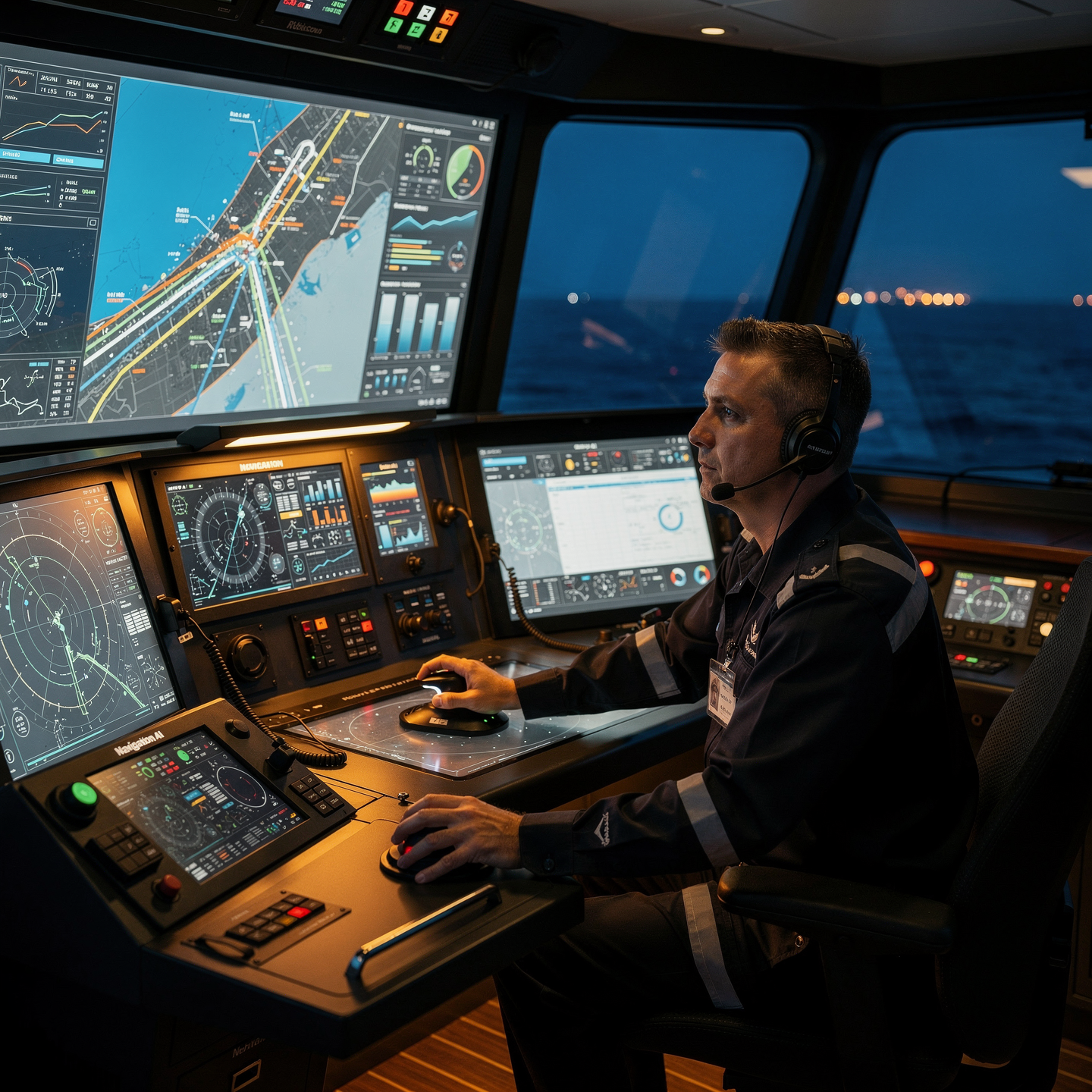
Master’s Degree in Artificial Intelligence applied to Naval Transport
Why this master’s programme?
The Master’s Degree in Artificial Intelligence Applied to Naval Transport
Offers an in-depth immersion in the application of the latest AI technologies to optimize and revolutionize the maritime industry. You will learn to develop and implement intelligent solutions for fleet management, route optimization, predictive maintenance, and onboard safety, boosting efficiency and reducing costs. This program provides you with the skills necessary to lead the digital transformation of the maritime sector, addressing real-world challenges with machine learning algorithms, computer vision, and big data analytics.
Key Advantages
- Practical Approach: Development of real-world projects using data from the maritime sector.
- Industry Experts: Faculty with experience in AI and maritime transport.
- Cutting-Edge Tools: Access to industry-leading AI software and platforms.
- Professional Networking: Connection with companies and experts in the maritime and technological fields.
- Adaptability: Flexible format to combine studies with your career professional.
- Modality: Online
- Level: Masters
- Hours: 1600 H
- Start date:
Availability: 1 in stock
Who is it aimed at?
- Naval and marine engineers looking to lead the digital transformation of the sector with AI.
- Merchant Marine officers and captains interested in optimizing navigation and safety with intelligent systems.
- Logistics and port management professionals who want to revolutionize operational efficiency with predictive analytics and automation.
- Software developers and data scientists who aspire to apply their expertise in a high-impact sector such as maritime transport.
- Researchers and academics looking to delve deeper into the latest trends in AI applied to maritime transport and marine robotics.
Flexibility and applicability
Designed for Active professionals: flexible online methodology, practical projects with real data and networking with industry experts.
Objectives and skills

Optimize fleet management:
Implement Fleet Management System software to monitor vehicle location, fuel consumption, and maintenance, optimizing routes and reducing operating costs.

Develop autonomous navigation systems:
Integrate advanced environmental perception (LiDAR, cameras, radar) with route planning algorithms that are robust to uncertainty and optimized for energy efficiency.

Implement predictive models for preventive maintenance of vessels:
“Analyze sensor data and maintenance logs to predict failures, optimize scheduling, and reduce operating costs.”

Improving energy efficiency in maritime transport:
Optimize routes and speeds using real-time weather and ocean data, minimizing resistance and fuel consumption.

Predict and mitigate operational risks in real time:
Implement predictive analytics based on historical data and simulations to identify vulnerabilities, optimize procedures, and activate automatic contingency plans in response to detected critical deviations.

Design and implement intelligent cargo management systems:
Optimize routes considering sea state, currents and weather conditions, minimizing fuel consumption and environmental impact.
Study plan – Modules
- Fundamentals of optimization in maritime transport: problem definition, key variables, and multidimensional objectives
- Advanced mathematical models for route planning: linear, nonlinear, integer, and stochastic programming
- Integration of artificial intelligence algorithms: supervised, unsupervised, and reinforcement learning applied to naval logistics
- Predictive analysis of demand and capacity: using time series, recurrent neural networks (RNNs), and ARIMA models to anticipate variations in maritime traffic
- Genetic algorithms and evolutionary optimization: design and application for optimal route selection and allocation of naval resources
- Deep neural networks applied to pattern detection in navigation data and real-time maritime conditions
- Simulation and modeling of operational scenarios under uncertainty: Monte Carlo techniques and agent-based simulation for risk assessment
- Optimization of energy consumption and emission reduction through
- Adaptive algorithms in logistics planning
- Big Data and advanced analytics applied to maritime logistics: integration and processing of heterogeneous data from sensors, AIS, weather, and port traffic
- Development of AI-based Decision Support Systems (DSS) for the continuous improvement of fleet and route management
- Implementation of clustering and segmentation techniques for optimizing loads, waiting times, and vessel allocation
- Risk management and mitigation through predictive analytics: accidents, adverse weather conditions, and port congestion
- Integration and communication protocols between intelligent systems onboard and ashore: interoperability and international standards
- Real-world case studies: application of artificial intelligence in large maritime operators and its impact on logistics efficiency and cost reduction
- Advanced visualization and dashboarding tools for real-time monitoring and tactical decision-making strategic
- International regulations and standards related to automation and the use of AI in maritime transport
- Future perspectives on AI applied to maritime optimization: full automation, autonomous fleets, and next-generation prescriptive systems
- Fundamentals of Intelligent Systems: Artificial Intelligence, Machine Learning, and Deep Learning Applied to Naval Navigation
- Architecture of Autonomous Systems for Ships: Sensors, Actuators, Control Platforms, and Inter-System Communications
- Multisensor Fusion and Real-Time Processing: Integration of Data from Radar, LiDAR, AIS, Cameras, and Inertial Systems
- Modeling and Predictive Simulation of Maritime Behavior: Trajectory Prediction, Obstacle Detection, and Risk Assessment in Dynamic Environments
- Real-Time Decision-Making Algorithms: Optimal Route Planning, Collision Avoidance, and Adaptive Management in Adverse Weather Conditions
- Neural Networks and Deep Learning Techniques Applied to the Interpretation of Signals and Patterns for Safe Autonomous Navigation
- Control Systems and Autonomous Navigation: Advanced PID Controllers, Adaptive Control, and Fuzzy Inference for Precise Maneuvers
- Implementation of knowledge systems and COLREG rules integrated with artificial intelligence for automated regulatory compliance
- Secure communication networks and protocols for data transfer between autonomous platforms and remote control centers
- Continuous monitoring and supervision: early warning systems, predictive diagnostics, and preventive maintenance of autonomous systems
- Human-in-the-loop and human-machine collaboration: interfaces, assisted control, and shared decision-making in autonomous navigation
- Cybersecurity assessment specific to intelligent navigation systems: threats, vulnerabilities, and mitigation protocols
- Case studies and implementation studies: analysis of real-world autonomous navigation projects on commercial vessels and their operational outcomes
- Regulatory and normative aspects: international legislation applicable to the operation of autonomous vessels and compliance with IMO standards
- Environmental impact and operational efficiency: AI-driven optimization for emissions and energy consumption reduction in operations autonomous
- Fundamentals of mathematical optimization: linear, nonlinear, and integer programming applied to maritime logistics
- Stochastic models for predictive analysis: Markov chains, Poisson processes, and Monte Carlo simulation in shipping routes
- Advanced machine learning techniques: deep neural networks, reinforcement learning, and genetic algorithms for autonomous route prediction and optimization
- Real-time data integration: maritime IoT sensors, AIS, meteorology, and oceanography for predictive systems
- Multi-objective route planning algorithms: minimizing costs, times, emissions, and risks in autonomous transport
- Optimization under dynamic constraints: modeling and solving problems with variable limitations such as sea state, traffic, and regulations
- Simulation and validation of scenarios: using digital twins to test autonomous navigation strategies and integrated maritime logistics
Application of big data and data mining in naval fleet management and anticipation of logistical demands
AI-based decision support systems: dashboards, predictive alerts, and automated recommendations for operators and managers
Applied cases and integrated projects: complete development of an optimization and predictive analytics system for autonomous fleets on commercial routes
- Fundamentals of AI architectures in naval systems: neural models, deep learning, and convolutional networks applied to maritime transport
- Advanced multisensory perception: integration and processing of signals from radar, sonar, optical cameras, and LIDAR for object recognition and classification in complex marine environments
- Sensor fusion techniques: probabilistic fusion algorithms, Kalman filter, particle filters, and multisensory decision-making methods to increase reliability and robustness in autonomous navigation systems
- Autonomous control of intelligent vessels: design and implementation of adaptive controllers based on reinforcement learning and real-time course planning for safe and efficient operations
- Development and application of maritime digital twins: dynamic vessel modeling, real-time simulations, predictive monitoring, and optimization of operations using AI techniques
- Cybersecurity strategies in naval AI systems: vulnerability analysis, detection of
- AI-based intrusions, resilience to cyberattacks, and secure protocols for autonomous system communication
- Integration of AI and automation systems: distributed architectures, edge computing, and cloud systems for data and process management in smart ships
- International regulations and standards for the implementation of AI in maritime transport: regulatory compliance, validation, and certification of autonomous systems
- Case studies and real-world applications: analysis of innovation projects in digital twins, multisensory perception, and autonomous control in leading shipping companies
- Development of prototypes and advanced simulators: tools for testing and validating AI algorithms in simulated environments that replicate real maritime conditions
- Fundamentals of Deep Neural Networks: Multilayer Perceptrons, Activation Functions, Backpropagation, and Optimization
- Advanced Architectures for Maritime Systems: CNNs, RNNs, LSTMs, and Transformers Adapted to Naval Transport
- Design of Models for Autonomous Control Systems: Integration of Neural Networks in Model-Based Predictive Control (MPC) Applied to Smart Ships
- Supervised and Unsupervised Learning on Marine Data: Preprocessing of Sensory Signals, Anomaly Detection, and Clustering of Operational Behaviors
- Implementation of Networks for Predictive Management: Forecasting of Maritime Conditions, Predictive Maintenance of Machinery, and Energy Optimization
- Development and Integration of Intelligent Perception Systems: Sensor Fusion Using Deep Learning for Safe Navigation and Autonomous Operation in Dynamic Environments
- Training and Tuning Techniques for Hyperparameters: Regularization, Dropout, data augmentation techniques specific to maritime data
Platforms and tools for real-time implementation: TensorFlow, PyTorch, ONNX, and deployment on onboard hardware
Model evaluation and validation: performance metrics, testing in maritime simulators, and real-world test scenarios
Security and robustness considerations: mitigating adversary attacks, fault tolerance, and reliability in naval autonomous systems
Complete case study: design, training, and implementation of a deep neural network for autonomous propulsion control and predictive navigation on a smart vessel
- Fundamentals and architecture of autonomous control systems in ships: dynamic modeling, embedded systems, and maritime communication protocols
- Deep neural networks for maritime perception: design, training, and optimization of CNNs and RNNs applied to optical and radar sensors
- Advanced sensor fusion: integration of LIDAR, multibeam sonar, and hyperspectral camera data for navigation and obstacle detection in complex maritime environments
- Predictive analytics algorithms for predictive maintenance and operational optimization: use of statistical models and machine learning to anticipate failures in critical naval systems
- Implementation of ADAS (Advanced Driver Assistance Systems) adapted to smart ships for autonomous and semi-autonomous maneuvers with built-in safety protocols
- Maritime cybersecurity architecture and protocols: defense against cyberattacks, ensuring integrity in SCADA systems, and managing access to ship networks
- Detection and mitigation of cyber threats using machine learning techniques: real-time network traffic analysis and adaptive intrusion response
- International regulations and standards related to autonomy and cybersecurity in maritime transport: IMO, IEC 62676, and IEC 61162-460
- Integration of autonomous systems with cloud-based control platforms and edge computing for fleet operations and remote monitoring
- Case studies and simulations of autonomous navigation: implementation of neural networks for route optimization, response to adverse weather conditions, and collaborative maritime traffic management
- Fundamentals of Advanced Optimization for Naval Systems: Classical Techniques, Metaheuristics, and Evolutionary Algorithms Applied to the Operational Efficiency of Smart Ships
- Design and Implementation of Autonomous Ship Control: Systems Architecture, Integrated Sensors, and Smart Actuators for Precise and Safe Maneuvers
- Deep Neural Networks Applied to Predicting Maritime Conditions and System Performance: Supervised and Unsupervised Models, Training, Validation, and Deployment in Real-World Environments
- Predictive Maintenance Analysis Based on Onboard Sensor Data: Early Fault Detection, Prognostics, and Intervention Planning to Reduce Costs and Downtime
- Adaptive and Robust Control Algorithms for Autonomous Navigation: Response to Dynamic Disturbances and Adverse Environmental Conditions
- Integration of Maritime Cyber-Physical Systems: Secure Communication Between Sensors, Control Platforms, and Command Centers in Real Time
- Protocols and Standards
Cybersecurity in maritime transport: threat assessment, vulnerability management, and risk mitigation in smart ships
Application of machine learning techniques for the detection of and response to cyberattacks: early warning and self-defense systems in connected ship networks
Advanced simulation and digital twins for route and operational optimization in autonomous fleets: scenario modeling and impact analysis on performance and safety
International regulations and best practices for the adoption of artificial intelligence in the maritime sector: legal compliance, ethics, and technology governance
- Fundamentals of Distributed AI: distributed architectures, communication models, interoperability and security protocols in multi-agent systems applied to the naval sector
- Design and development of Digital Twins for vessels: dynamic modeling, calibration with real-time sensor data, and predictive simulation of structural and operational behavior
- Integration of heterogeneous data: fusion of information from IoT sensors, radars, SCADA systems, and AIS platforms for continuous feeding of predictive models
- Machine and reinforcement learning algorithms for route optimization, energy consumption, and intelligent resource allocation in autonomous fleets
- Definition and application of performance and resilience metrics in distributed maritime AI systems: key indicators for predictive maintenance and automated decision-making
- Advanced protocols for the Secure communication and synchronization between onboard AI nodes and land-based platforms: blockchain, cryptography, and digital identity management
Implementation of adaptive control systems based on digital twins for real-time fault management, early warnings, and operational risk mitigation
Case studies: practical application in autonomous fleet simulators, integration with port management systems, and reduction of environmental footprint through AI
Design of scalable and redundant architectures for distributed AI deployment in highly complex maritime environments and adverse conditions
Advanced results analysis and continuous optimization through feedback loops between digital twins and AI systems, ensuring constant improvement of operational efficiency and safety
- Advanced Foundations in the Design of Autonomous Navigation Systems for Smart Ships: Modular Architecture, Redundancy, and Fault Tolerance.
- Integrated Multisensory Perception: Fusion of LiDAR, Radar, Hyperspectral Camera, Sonar, and GNSS Data for Real-Time 3D Mapping.
- Modeling and Processing of Sensory Signals Using Deep Neural Networks: CNNs, RNNs, and Hybrid Architectures for Object Detection and Classification in Complex Maritime Environments.
- Practical Implementation of Digital Twins in Maritime Transport: Predictive Simulation, Real-Time Monitoring, and Operational Optimization Using Reinforcement Learning Techniques.
- Adaptive Autonomous Control Algorithms: Optimal Route Planning, Collision Avoidance, and Decision-Making Under Uncertainty Using Probabilistic Models and Deep Reinforcement Learning.
- Integration of Cyber-Physical Systems for Smart Ship Security: Secure Communication Protocols, Intrusion Detection, and Response Automatic defense against cyberattacks using artificial intelligence.
Cryptography applied to maritime communication networks: implementation of blockchain and advanced encryption techniques to guarantee the integrity and confidentiality of critical data.
International regulations and technical standards for autonomous navigation and naval cybersecurity: compliance with SOLAS, IMO, IEC 62998, and IMO recommendations on autonomous systems.
Development and integration of intelligent human-machine interfaces: augmented reality for remote monitoring and assisted control in navigation and maneuvering operations.
Case studies and practical projects: design and simulation of complete autonomous navigation and cyber resilience systems applied to next-generation naval and commercial platforms.
- Comprehensive architecture of autonomous systems on ships: sensors, actuators, control systems, and communication networks in the maritime environment
- Advanced models of autonomous navigation: algorithms for route planning, obstacle avoidance, and real-time decision-making under dynamic maritime conditions
- Digital twins applied to naval management: conceptualization, design, simulation, and validation to replicate the operational and structural behavior of autonomous fleets
- Integration of artificial intelligence for multidimensional optimization: deep learning, neural networks, and optimization algorithms applied to energy consumption, predictive maintenance, and operational efficiency
- Maritime communication platforms for autonomous fleets: protocols, latency, redundancy, and security in data transmission between vessels and control centers
- Cybersecurity in autonomous naval transport systems: risk assessment, targeted attacks (spoofing, malware, intrusion), and defense strategies using artificial intelligence
- Applied
- International regulations and technical standards for the safe operation of autonomous fleets: compliance with IMO, SOLAS, and cybersecurity recommendations
- Implementation of real-time monitoring systems: big data analysis, anomaly detection, and alert generation for tactical and strategic decision-making
- Architecture and management of the centralized control platform for autonomous fleets: hardware-software integration, redundancy, scalability, and interoperability protocols
- Development of advanced simulation scenarios using digital twins: evaluation of navigation strategies, emergency response, and resource optimization in autonomous maritime operations
- Design and execution of the final project: practical integration of autonomous navigation systems, cybersecurity protocols, and digital twins for complete optimization in the management of autonomous naval fleets
- Validation and verification methodologies: testing in simulated and real environments to ensure the reliability and operational safety of autonomous systems and digital twins digital
- Economic and environmental impact analysis: evaluating the benefits and challenges of adopting autonomous technologies and digital twins in maritime transport
- Technological change management and leadership in naval innovation: building multidisciplinary teams and developing protocols for the successful implementation of smart solutions in the industry
Career prospects
“`html
- Naval Route Optimization Algorithm Developer: improving efficiency, reducing fuel consumption, and minimizing environmental impact.
- Autonomous Navigation Systems Specialist for Ships: design, implementation, and testing of intelligent navigation and control systems.
- Real-Time Data Analyst for Maritime Traffic Management: congestion prediction, safety optimization, and improved port efficiency.
- Artificial Intelligence Consultant for the Naval Industry: advising on the adoption of AI solutions to optimize operations and improve decision-making.
- Researcher in the Development of New AI Algorithms for Naval Applications: exploring new machine learning techniques and their application to maritime problems.
- AI Software Engineer for Ship Control Systems: software development for task automation and improved onboard safety.
- Cybersecurity Specialist for Intelligent Navigation Systems: protecting autonomous navigation systems against cyberattacks and vulnerabilities.
- AI Innovation Project Manager for the Naval Sector: planning, execution, and monitoring of research and development projects for AI solutions for the naval industry.
“`
Entry requirements

Academic/professional profile:
Bachelor’s degree in Nautical Science/Maritime Transport, Naval/Marine Engineering or a related qualification; or proven professional experience on the bridge/in operations.

Language proficiency:
Functional Maritime English (SMCP) recommended for simulations and technical materials.

Documentation:
Updated CV, copy of qualification or seaman’s book, national ID/passport, motivation letter.

Technical requirements (for online):
Device with camera/microphone, stable internet connection, monitor ≥ 24” recommended for ECDIS/Radar-ARPA.
Admissions process and dates

Online
application
(form + documents).

Academic review and interview
Admissions decision

Admissions decision
(+ scholarship offer if applicable).

Place reservation
(deposit) and enrolment.

Induction
(access to the virtual campus, calendars, simulator guides).
Scholarships and financial support
- Master AI: Learn to apply the latest Artificial Intelligence techniques in the Maritime Transport sector.
- Optimization and Efficiency: Improve the safety, efficiency, and sustainability of maritime operations with intelligent solutions.
- Predictive Analytics: Anticipate failures, optimize routes, and manage resources with predictive models based on naval data.
- Real-World Case Studies: Work with real-world data and solve specific industry challenges, from fleet management to port automation.
- Expert Professionals: Learn from a team of AI and maritime transport experts with experience in cutting-edge projects.
Testimonials
During the Master’s in Artificial Intelligence applied to Naval Transport, I developed a route optimization algorithm for container ships that, when implemented in a real case study with a shipping company, managed to reduce transit times by 12% and fuel consumption by 8%, generating significant cost savings and a considerable reduction in the carbon footprint.
During my Master’s degree in Naval Technological Research and Innovation, I developed a route optimization system for autonomous vessels, reducing fuel consumption by 12% and improving arrival times by 7% in realistic simulations. This project was awarded for its innovation and applicability in the sector, and it allowed me to obtain a research position at a leading naval technology center.
I applied the knowledge from the master’s program to optimize the routes of a fleet of cargo planes, reducing fuel consumption by 12% and delivery times by 7%, generating annual savings of $2.5 million for the company.
I applied my AI Master’s knowledge to optimize the cargo routes of a container ship fleet, resulting in a 15% reduction in fuel costs and an 8% increase in transport efficiency in the first quarter.

Frequently asked questions
Naval Transport
Yes. The itinerary includes ECDIS/Radar-ARPA/BRM with harbor, ocean, fog, storm, and SAR scenarios.
Online with live sessions; hybrid option for simulator/practical placements through agreements.
Maritime or naval transport sector.
Recommended functional SMCP. We offer support materials for standard phraseology.
Yes, with a relevant degree or experience in maritime/port operations. The admissions interview will confirm suitability.
Optional (3–6 months) through Companies & Collaborations and the Alumni Network.
Simulator practice (rubrics), defeat plans, SOPs, checklists, micro-tests and applied TFM.
A degree from Navalis Magna University + operational portfolio (tracks, SOPs, reports and KPIs) useful for audits and employment.
- Comprehensive architecture of autonomous systems on ships: sensors, actuators, control systems, and communication networks in the maritime environment
- Advanced models of autonomous navigation: algorithms for route planning, obstacle avoidance, and real-time decision-making under dynamic maritime conditions
- Digital twins applied to naval management: conceptualization, design, simulation, and validation to replicate the operational and structural behavior of autonomous fleets
- Integration of artificial intelligence for multidimensional optimization: deep learning, neural networks, and optimization algorithms applied to energy consumption, predictive maintenance, and operational efficiency
- Maritime communication platforms for autonomous fleets: protocols, latency, redundancy, and security in data transmission between vessels and control centers
- Cybersecurity in autonomous naval transport systems: risk assessment, targeted attacks (spoofing, malware, intrusion), and defense strategies using artificial intelligence
- Applied
- International regulations and technical standards for the safe operation of autonomous fleets: compliance with IMO, SOLAS, and cybersecurity recommendations
- Implementation of real-time monitoring systems: big data analysis, anomaly detection, and alert generation for tactical and strategic decision-making
- Architecture and management of the centralized control platform for autonomous fleets: hardware-software integration, redundancy, scalability, and interoperability protocols
- Development of advanced simulation scenarios using digital twins: evaluation of navigation strategies, emergency response, and resource optimization in autonomous maritime operations
- Design and execution of the final project: practical integration of autonomous navigation systems, cybersecurity protocols, and digital twins for complete optimization in the management of autonomous naval fleets
- Validation and verification methodologies: testing in simulated and real environments to ensure the reliability and operational safety of autonomous systems and digital twins digital
- Economic and environmental impact analysis: evaluating the benefits and challenges of adopting autonomous technologies and digital twins in maritime transport
- Technological change management and leadership in naval innovation: building multidisciplinary teams and developing protocols for the successful implementation of smart solutions in the industry
Request information
Complete the Application Form.
Attach your CV/degree certificate (if you have it to hand).
Indicate your preferred cohort (January/May/September) and whether you would like the hybrid option with simulator sessions.
An academic advisor will contact you within 24–48 hours to guide you through the admission process, scholarships, and compatibility with your professional schedule.
Faculty
Eng. Tomás Riera
Full Professor
Eng. Tomás Riera
Full Professor
Eng. Sofía Marquina
Full Professor
Eng. Sofía Marquina
Full Professor
Eng. Javier Bañuls
Full Professor
Eng. Javier Bañuls
Full Professor
Dr. Nuria Llobregat
Full Professor
Dr. Nuria Llobregat
Full Professor
Dr. Pau Ferrer
Full Professor
Dr. Pau Ferrer
Full Professor
Cap. Javier Abaroa (MCA)
Full Professor
Cap. Javier Abaroa (MCA)
Full Professor

