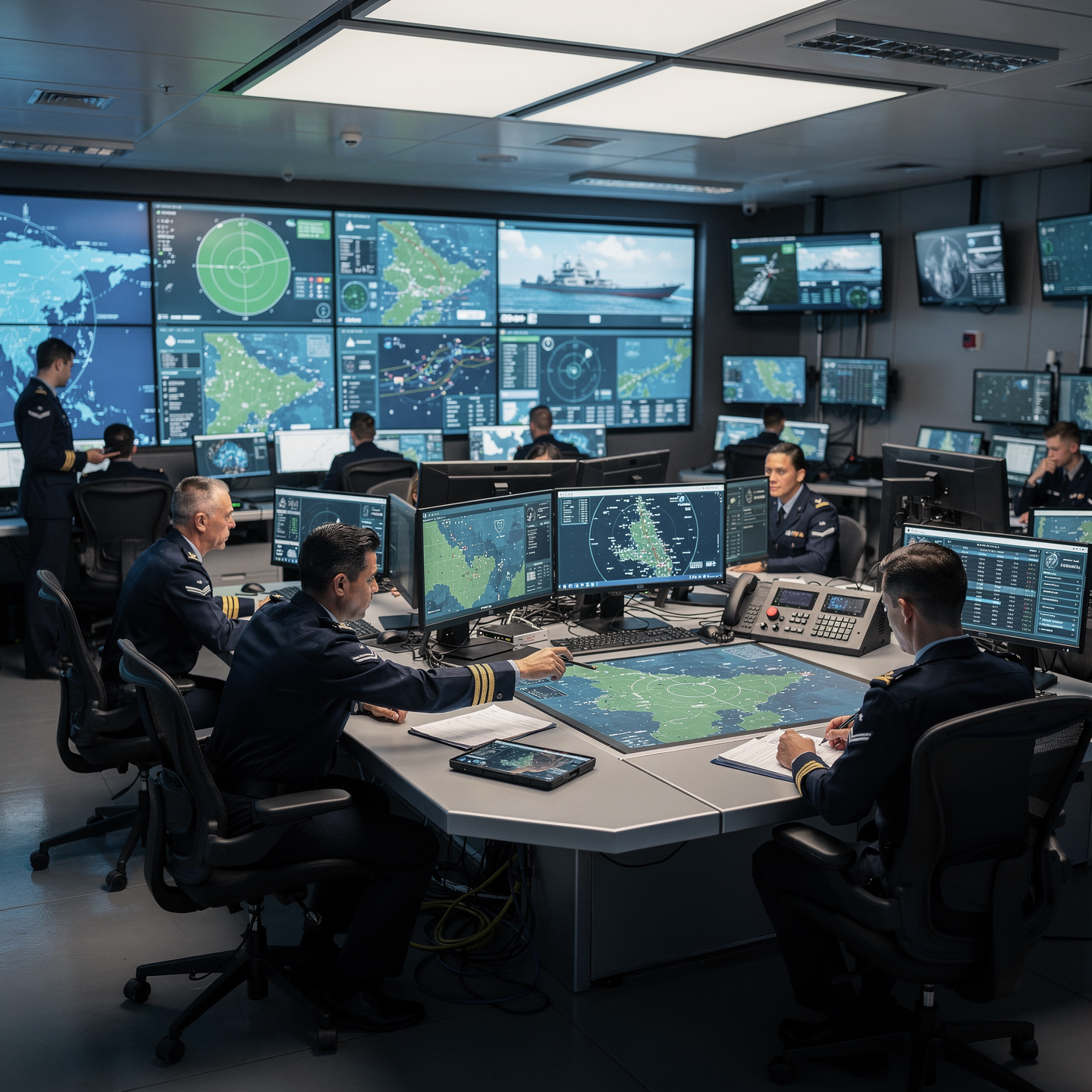
Master’s Degree in Naval Intelligence and Reconnaissance

Why this master’s programme?

The Master in Naval Intelligence and Reconnaissance

This program prepares you to lead in today’s complex maritime environment, where strategic intelligence is key to security and defense. You will learn to collect, analyze, and disseminate intelligence from diverse sources, mastering the latest technologies in sensors, platforms, and cybersecurity. This program will provide you with a deep understanding of naval operations, emerging threats, and counterintelligence strategies, enabling you to make informed and effective decisions in critical situations.

Differential Advantages

  • Practical Approach: simulation of real-world scenarios and tactical and strategic intelligence exercises.
  • Advanced Technologies: management of maritime surveillance systems, data analysis, and cyber intelligence.
  • Expert Teaching Team: professionals with experience in naval intelligence, maritime security, and defense.
  • Networking: opportunities to establish relationships with industry leaders and government agencies.
  • Skills Development: critical thinking, strategic analysis, effective communication, and decision-making.
Inteligencia

Master’s Degree in Naval Intelligence and Reconnaissance

Availability: 1 in stock

Who is it aimed at?

  • Navy and Merchant Marine officers interested in deepening their knowledge of maritime security, risk analysis, and the application of intelligence technologies.
  • Intelligence and security analysts seeking to specialize in the naval environment, data interpretation, and threat identification.
  • Naval systems engineers and developers who wish to understand operational needs and the applications of intelligence in platform design and management.
  • Defense and security professionals seeking to expand their knowledge of naval capabilities and vulnerabilities and network-centric warfare.
  • Graduates in engineering, political science, international relations, or related fields aspiring to a specialized career in naval intelligence and security Maritime.

Flexibility and specialization
 Designed for working professionals: flexible online format, updated content, and practical approach to real-world cases and simulations.

Inteligencia

Objectives and skills

Lead maritime intelligence operations:

“Analyze diverse information (meteorological, AIS, OSINT sources) to anticipate threats and optimize resources.”

Analyze and anticipate naval threats:

Integrate intelligence, weather, and own/allied resources to assess vulnerabilities and optimize deployments.

Manage naval intelligence resources:

Integrate information from multiple sources (SIGINT, IMINT, HUMINT, OSINT) to generate accurate and timely intelligence products.

Develop and implement effective countermeasures:

Execute evasive maneuvers with speed and decisiveness, prioritizing the safety of the crew and the integrity of the vessel.

Implement and optimize maritime surveillance systems:

Integrate data from multiple sources (radar, AIS, cameras, environmental sensors) to generate a clear and accurate operational picture of the maritime environment, adapting the presentation according to the user’s needs and the phase of the operation.

Interpreting and disseminating strategic naval intelligence:

“Analyze geopolitical trends and their potential impact on national maritime interests, communicating key findings to political and operational decision-makers.”

Study plan – Modules

  1. Fundamentals and evolution of maritime surveillance: concepts, technologies, and international regulatory frameworks
  2. Advanced naval reconnaissance operations: techniques for tracking, identifying, and classifying maritime targets
  3. Integration of ISR (Intelligence, Surveillance, and Reconnaissance) sensors: radar, sonar, satellites, UAVs, and electro-optical systems
  4. Multisensor data analysis and fusion: signal processing, correlation algorithms, and early warning systems
  5. Introduction to naval cybersecurity: threats, vulnerabilities, and attacker profiles in maritime environments
  6. Security of command and control (C2) systems: protection measures, intrusion detection, and incident response protocols
  7. Cryptography applied to naval communications: encryption, authentication, and key management to ensure confidentiality and integrity of information
  8. Scenario simulation and modeling Cyber-physical: Risk assessment and operational resilience testing on naval platforms

    National and international regulations on maritime cybersecurity: compliance, audits, and certification standards

    Design and implementation of cyber defense plans: security architecture, access policy, and ongoing staff training

    Real-world cases of cyberattacks in the naval sector: forensic analysis, lessons learned, and mitigation strategies

    Continuous monitoring and analysis of cyber intelligence: use of SIEM platforms, threat hunting techniques, and rapid response

    Development of operational capabilities for the protection of critical maritime infrastructure: sensor networks, secure communications, and technological redundancy

    Advanced implementation of the secure AIS protocol and maritime traffic control systems in hostile environments

    Interagency coordination and international cooperation in naval intelligence and cybersecurity operations

    Emerging innovations and future trends Maritime Surveillance and Cyber ​​Defense: Applied Artificial Intelligence, Machine Learning, and Blockchain

    Strategic Planning and Tactics for Joint Operations: Integration of Human, Technological, and Logistical Resources in Complex Scenarios

    Crisis Management and Decision-Making Under Pressure: Real-Time Simulations and Adaptive Leadership Techniques in the Naval Environment

    Ethical and Legal Aspects Related to Maritime Intelligence and Cyber ​​Defense: Privacy, Sovereignty, and Responsible Use of Technology

    Final Assessment Through a Practical Project: Design and Implementation of a Complete Surveillance and Cybersecurity Operation in a Simulated Scenario

  1. Signal Processing Fundamentals in Naval Scenarios: Fourier Theory, Wavelet Transforms, and Adaptive Filtering
  2. Detection and Classification of Acoustic Signatures: Identification Techniques and Spectral Analysis for Submarines and Submerged Threats
  3. Advanced Application of Doppler Processing for Target Tracking and Ambient Noise Reduction
  4. Remote Sensing and Electronic Reconnaissance: Principles of Naval SIGINT and ELINT in Hostile Environments
  5. Multispectral Analysis and Active and Passive Optical Sensors: Integration for Reconnaissance in Coastal and Offshore Operations
  6. Modeling and Simulation of Threat Scenarios: Use of Artificial Intelligence and Machine Learning Algorithms for Naval Behavior Patterns
  7. Data Fusion and Multisensor Correlation Methodologies on Integrated Naval Platforms
  8. Electronic Countermeasures (ECM) and electronic warfare techniques for deception and neutralization of enemy systems
  9. International regulations and protocols for the secure exchange of naval intelligence
  10. Case studies and analysis of historical operations: critical evaluation of tactics and strategies for reconnaissance and response to emerging threats
  1. Fundamentals of Advanced Maritime Surveillance: Integrated Electro-Optical Sensors, Synthetic Aperture Radar (SAR), and Automatic Identification Systems (AIS)
  2. Implementation of Multi-Source Systems for Real-Time Data Fusion and Maritime Operational Intelligence Generation
  3. Predictive Models and Artificial Intelligence Algorithms Applied to the Proactive Detection of Naval Threats and Illicit Activities
  4. Cyber ​​Defense Strategies in Naval Environments: Security Architecture for Combat Networks and Secure Management of Critical Shipboard Systems
  5. Cyber ​​Incident Response Protocol: Identification, Containment, Forensic Analysis, and Operational Recovery on Naval Platforms
  6. Integration of Unmanned Surveillance Technologies (UUVs, UAVs) for Extending Naval Defense and Reconnaissance Range
  7. Signals Intelligence (SIGINT) Analysis and Electronic Warfare: Advanced Techniques for Interference, Detection, and Countermeasures in Various Scenarios Maritime

    International regulations and standards applicable to naval cybersecurity and maritime surveillance operations

    Implementation of command and control (C2) systems for effective coordination in joint and multinational operations

    Case studies and operational simulations of hybrid warfare and cyberattacks in the maritime environment for strategic and tactical decision-making

  1. Fundamentals of Naval Intelligence: Key concepts, structure, and international doctrines applied to the maritime domain
  2. SIGINT and IMINT Intelligence Sources: Acquisition, processing, and exploitation of electromagnetic and image signals in naval operations
  3. Advanced Analysis of Electronic Signals: Techniques for interception, decryption, and classification of radar emissions, communications, and electronic warfare systems
  4. AIS (Automatic Identification System) Systems: Architecture, transmission protocols, vulnerabilities, and use in vessel identification and tracking
  5. Integration of Unmanned Platforms: Strategic and tactical employment of aerial, maritime, and underwater drones for reconnaissance and continuous surveillance
  6. Image Processing and Analysis (IMINT): Automatic recognition algorithms, anomaly detection, and real-time tactical intelligence generation
  7. Cyber ​​Defense in the Naval Domain: Security Architecture, Intrusion Detection, Applied Cryptography, and Incident Response in Command and Control Systems
  8. Applications of Artificial Intelligence and Machine Learning to Improve the Accuracy and Speed ​​of Data Analysis in Maritime Operations
  9. Maritime Reconnaissance and Protection Operations: Planning, Execution, and Monitoring of Combined Missions under Multidomain Scenarios with Hybrid Threats
  10. Integration of Multidisciplinary Intelligence for Decision-Making in Naval Command Centers: Interoperability, Information Flow, and Crisis Management
  11. Real-World Case Studies and Advanced Simulations for Familiarization with Complex Naval Intelligence Dynamics in Modern Operational Environments
  12. International Regulation and Ethics in the Use of SIGINT/IMINT Technologies: Legal Limitations, Human Rights, and Strategic Diplomacy
  13. Continuous Evaluation and Calibration of Surveillance Systems: Predictive Maintenance and Adaptation to New Threats
  14. Technological aspects

  15. Future projection of naval reconnaissance: trends, technological innovation, and capability development for sustainable maritime superiority
  1. Fundamentals of Naval Intelligence: Concepts, Structure, and the Intelligence Cycle Applied to Maritime Environments
  2. Interagency Integration: Coordination Among Naval Forces, Intelligence Agencies, and Strategic Allies for Joint Operations
  3. Analysis and Management of Large Volumes of Information: Data Mining Techniques, Artificial Intelligence, and Machine Learning in Naval Intelligence
  4. Maritime Intelligence Gathering and Surveillance Systems: SIGINT, MASINT, HUMINT, and SIGINT Applied to Threat Detection at Sea
  5. Planning and Execution of Joint Intelligence Operations in Multidimensional and Multisensory Naval Scenarios
  6. Tactical and Strategic Intelligence Management: Data Fusion, Prioritization, and Generation of Actionable Intelligence Products
  7. Information Security and Protection Protocols in Naval Environments: Cybersecurity, Cryptography, and Secure Source Management
  8. Naval Countermeasures and Electronic Warfare: Advanced Techniques for Neutralizing Electronic Threats and Improving Information Systems Performance
  9. Decision Support Operations: Support Algorithms, Simulations, and Real-Time Operational Visualization Tools
  10. Operational Case Studies: Detailed Analysis of Successful Joint Intelligence Missions and Applicable Lessons Learned
  1. Fundamentals of Naval Strategic Planning: Intelligence Analysis, Operational Environment Assessment, and Establishment of Reconnaissance Objectives
  2. Advanced Methodologies for Data Collection in the Open Sea: Electro-optical Sensors, Scanning Radar, Acoustic Systems, and Multi-INT Techniques
  3. Tactical Planning of Surveillance Operations: Interagency Coordination, Asset Synchronization, and Operational Risk Management
  4. Integration of Reconnaissance Platforms: Unmanned Aerial Vehicles (UUVs, UAVs), Fast Craft, and Critical Shipboard Sensors for Maritime Information Gathering
  5. Maritime Environmental Analysis for Operations: Detailed Study of Tides, Currents, Meteorological Conditions, and Their Impact on the Execution of Reconnaissance Missions
  6. Advanced Cartography and Applied Geospatial Systems: Interpretation of Satellite Imagery, Use of Digital Nautical Charts, and Real-Time GIS Applications
  7. Design and Application of Camouflage and Concealment Techniques in Environments Maritime reconnaissance for covert surveillance operations

    Simulation and wargaming models for validating and adjusting the reconnaissance operational plan

    Security and threat management protocols in reconnaissance operations: cybersecurity, electronic defense, and countermeasures against adversary detection

    Real-time monitoring and control of surveillance operations: use of command and control (C2) platforms, data link, and intelligence flow to naval operations centers

    Post-mission evaluation procedures: intelligence analysis, reporting of findings, preservation of evidence, and feedback for continuous improvement

    Legal and regulatory aspects: compliance with international conventions, respect for sovereign zones, and limitations in naval reconnaissance operations

    Leadership and decision-making training under pressure in high-uncertainty and high-threat maritime environments

    Case studies and lessons learned from historical and modern advanced naval reconnaissance campaigns

  1. Advanced Foundations of Maritime Surveillance: Electro-optical sensors, synthetic aperture coherent radar (SAR), and multispectral systems applied to detection and tracking in complex maritime environments
  2. Integration of Passive and Active Sensors: Multisensor fusion for improved naval reconnaissance accuracy and minimization of false positives in potential threats
  3. Emerging Technologies in Naval Reconnaissance: Autonomous maritime drones, unmanned underwater vehicles (UUVs), and automated coastal patrol systems with integrated artificial intelligence
  4. Naval Surveillance Systems Architecture: Design, implementation, and optimization of distributed sensor networks and centralized monitoring stations with interoperability and redundancy capabilities
  5. Advanced Analysis of Electromagnetic and Acoustic Signals: Digital signal processing (DSP) techniques, adaptive filtering, and detection of specific signatures for precise identification of objects and events

    Artificial intelligence algorithms applied to naval reconnaissance: supervised and unsupervised machine learning for automatic threat classification, recognition of maritime behavior patterns, and event prediction

    Naval cybersecurity protocols and methodologies: defense in depth, real-time monitoring, and countermeasures against electronic attacks targeting naval surveillance and control systems

    Information systems security and interoperability: implementation of international standards for the protection of critical data, advanced encryption, and access management in naval distributed networks

    Simulation and modeling in high-precision naval operations: virtual environments for training in threat detection, tracking, and response using real data and complex scenarios

    Operational applications and case studies: analysis of real incidents, rapid and adaptive response techniques in conflict scenarios, and maritime control sovereign

  1. Fundamentals of Artificial Intelligence (AI): Supervised, Unsupervised, and Reinforcement Learning Algorithms Applied in Maritime Environments
  2. Big Data in the Naval Sector: Capture, Storage, and Processing of Large Volumes of Data from Sensors, Satellites, and Open Sources
  3. Advanced Architectures for AI-Big Data Integration: Hybrid Models and Distributed Systems for Real-Time Analysis of Naval Information
  4. Automatic Recognition and Classification of Maritime Targets Using Convolutional Neural Networks (CNNs) and Anomaly Detection Models
  5. Implementation of Machine Learning for Predicting Navigation Patterns and Unusual Behaviors in Adversarial Fleets
  6. Multisensory Fusion: Integration of Radar, Sonar, Satellite Imagery, and AIS Data for Generating a Unified Tactical Picture
  7. Image Processing and Spatial Processing: Advanced Techniques for Segmentation, Feature Extraction, and Object Tracking in Maritime Scenarios
  8. complexities

  9. Predictive analysis for preventive maintenance of naval platforms using Big Data and AI models
  10. Deployment of automated surveillance systems using edge computing and real-time response capabilities in coastal and oceanic zones
  11. Data mining for strategic intelligence: extraction of actionable intelligence from heterogeneous and unstructured sources
  12. Cybersecurity in AI systems for naval operations: threat mitigation, robustness, and resilience of algorithms against attacks
  13. Evaluation and adaptation of AI models in dynamic maritime environments: continuous learning and knowledge transfer
  14. Case studies and advanced simulations of AI-Big Data integration in naval reconnaissance operations and asymmetric threat monitoring
  15. International regulations and standards applied to the exploitation of Big Data and Artificial Intelligence in the maritime-military field
  16. Future perspectives on automation and autonomy in Intelligent naval systems: technological trends and ethical challenges
  1. Advanced Architecture of Integrated Naval Surveillance Systems: Components, Multi-Spectral Sensors, Synthetic Aperture Radar (SAR), and Side-Scan Sonar
  2. Naval Communication Protocols and Standards: Tactical Data Links, Encrypted Communications, and IP-Based Tactical Networks for Real-Time Operations
  3. Cybersecurity Fundamentals on Naval Platforms: Threats, Vulnerabilities, and Defense Techniques Specific to SCADA Systems and Weapon Systems Control
  4. Signal Analysis and Fusion Methodologies: Digital Signal Processing (DSP), Multi-Sensor Detection Algorithms, and Machine Learning Applied to Naval Intelligence
  5. Electronic Intelligence Management (ELINT): Interoperability Between Systems, Spectral Analysis, and Advanced Interferometry Techniques for Threat Location and Classification
  6. C4ISR Systems Integration (Command, Control, Communications, Computers, Intelligence, Surveillance, and Reconnaissance for strategic and tactical decision-making

    Development and application of neural networks and deep learning in the automatic identification of acoustic and electromagnetic signatures in hostile marine environments

    Simulation and training for naval operations: advanced virtual platforms for practicing cyberattacks, electronic defense, and signals warfare

    Assessment and mitigation of risks associated with cyberattacks targeting critical naval infrastructure, including navigation and propulsion systems

    Procedures for multisensory integration and coordination in joint operations: interoperability between naval, air, and land forces in highly complex scenarios

    International standards, regulations, and ethics in naval intelligence and cybersecurity: compliance and application in legal and operational contexts

    Technological innovations Emerging technologies: quantum computing applied to naval cryptography, hyperspectral sensors, and autonomous maritime patrol systems

    Real-world case studies: a study of high-performance naval operations employing integrated surveillance and cyber defense systems, with lessons learned and best practices

    Advanced electronic countermeasures (ECM) techniques, offensive and defensive electronic warfare for the protection of strategic assets in complex naval environments

    Real-time intelligence management: processing, analysis, and distribution of information to support decision-making at the tactical, operational, and strategic levels

  1. Design and development of integrated system architectures for naval reconnaissance: specialized components, hardware, and software
  2. Advanced artificial intelligence algorithms: deep learning, convolutional neural networks, and reinforcement learning applied to target detection and classification
  3. Implementation of Big Data systems in maritime surveillance: real-time acquisition, processing, and storage of data from multiple sensors
  4. Multisensor fusion: integration of radars, sonars, electro-optical sensors, and infrared sensors to improve the accuracy and reliability of reconnaissance
  5. Development of predictive models based on artificial intelligence for anticipating threats and anomalies in complex maritime environments
  6. Intelligent maritime surveillance: automation of monitoring, early warnings, and behavioral analysis of naval and unmanned objects
  7. Study and application of big data analytics techniques for infrastructure protection
  8. Strategic areas: ports, offshore platforms, and sensitive coastal zones

    Decision support systems: design of interfaces and tools for the interpretation and optimal use of processed information in real time

    Cybersecurity and operational resilience protocols applied to naval reconnaissance systems and big data management

    Validation, testing, and performance evaluation of integrated reconnaissance systems in simulated and real-world operational scenarios, with analysis of key effectiveness and reliability metrics

Career prospects

“`html

  • Naval Intelligence Analyst: Collection, analysis, and dissemination of information relevant to maritime security.
  • Naval Reconnaissance Specialist: Identification and tracking of vessels and naval activities, using sensors and information systems.
  • Naval Operations Officer: Planning and execution of naval missions, including the coordination of units and resources.
  • Maritime Security Consultant: Risk assessment and development of strategies for the protection of maritime infrastructure and assets.
  • Naval Technology Researcher: Development and application of new technologies for naval intelligence and reconnaissance.
  • Naval Defense Project Manager: Leadership and coordination of projects related to the acquisition and deployment of naval systems.
  • Naval Data Analyst: Processing and analysis of large volumes of data to detect relevant patterns and trends.

    Maritime Security Policy Advisor: Preparation of reports and recommendations for the formulation of maritime security policies and regulations.

    “`

Entry requirements

Academic/professional profile:

Bachelor’s degree in Nautical Science/Maritime Transport, Naval/Marine Engineering or a related qualification; or proven professional experience on the bridge/in operations.

Language proficiency:

Functional Maritime English (SMCP) recommended for simulations and technical materials.

Documentation:

Updated CV, copy of qualification or seaman’s book, national ID/passport, motivation letter.

Technical requirements (for online):

Device with camera/microphone, stable internet connection, monitor ≥ 24” recommended for ECDIS/Radar-ARPA.

Admissions process and dates

Online
application

(form + documents).

Academic review and interview

Admissions decision

Admissions decision

(+ scholarship offer if applicable).

Place reservation

(deposit) and enrolment.

Induction

(access to the virtual campus, calendars, simulator guides).

Scholarships and financial support

  • Maritime Strategic Analysis: Master naval intelligence techniques and anticipate threats in the maritime environment.
  • Cutting-Edge Technologies: Delve into advanced sensors, reconnaissance systems, and naval cybersecurity.
  • Simulations and Practice: Participate in practical exercises and realistic simulations to apply your knowledge.
  • Expert Instructors: Learn from renowned industry professionals and maritime security experts.
  • Career Opportunities: Boost your career in leading organizations government, defense companies, and maritime security. Develop the key skills to lead in the naval domain of the future.

Testimonials

Frequently asked questions

Naval intelligence and reconnaissance.

Yes. The itinerary includes ECDIS/Radar-ARPA/BRM with harbor, ocean, fog, storm, and SAR scenarios.

Online with live sessions; hybrid option for simulator/practical placements through agreements.

Recommended functional SMCP. We offer support materials for standard phraseology.

Yes, with a relevant degree or experience in maritime/port operations. The admissions interview will confirm suitability.

Optional (3–6 months) through Companies & Collaborations and the Alumni Network.

Simulator practice (rubrics), defeat plans, SOPs, checklists, micro-tests and applied TFM.

A degree from Navalis Magna University + operational portfolio (tracks, SOPs, reports and KPIs) useful for audits and employment.

  1. Design and development of integrated system architectures for naval reconnaissance: specialized components, hardware, and software
  2. Advanced artificial intelligence algorithms: deep learning, convolutional neural networks, and reinforcement learning applied to target detection and classification
  3. Implementation of Big Data systems in maritime surveillance: real-time acquisition, processing, and storage of data from multiple sensors
  4. Multisensor fusion: integration of radars, sonars, electro-optical sensors, and infrared sensors to improve the accuracy and reliability of reconnaissance
  5. Development of predictive models based on artificial intelligence for anticipating threats and anomalies in complex maritime environments
  6. Intelligent maritime surveillance: automation of monitoring, early warnings, and behavioral analysis of naval and unmanned objects
  7. Study and application of big data analytics techniques for infrastructure protection
  8. Strategic areas: ports, offshore platforms, and sensitive coastal zones

    Decision support systems: design of interfaces and tools for the interpretation and optimal use of processed information in real time

    Cybersecurity and operational resilience protocols applied to naval reconnaissance systems and big data management

    Validation, testing, and performance evaluation of integrated reconnaissance systems in simulated and real-world operational scenarios, with analysis of key effectiveness and reliability metrics

Request information

  1. Complete the Application Form.

  2. Attach your CV/degree certificate (if you have it to hand).

  3. Indicate your preferred cohort (January/May/September) and whether you would like the hybrid option with simulator sessions.

    An academic advisor will contact you within 24–48 hours to guide you through the admission process, scholarships, and compatibility with your professional schedule.

Please enable JavaScript in your browser to complete this form.
Click or drag a file to this area to upload.

Faculty

0
    0
    Tu carrito
    Tu carrito esta vacíoRegresar a la tienda
    Scroll to Top


