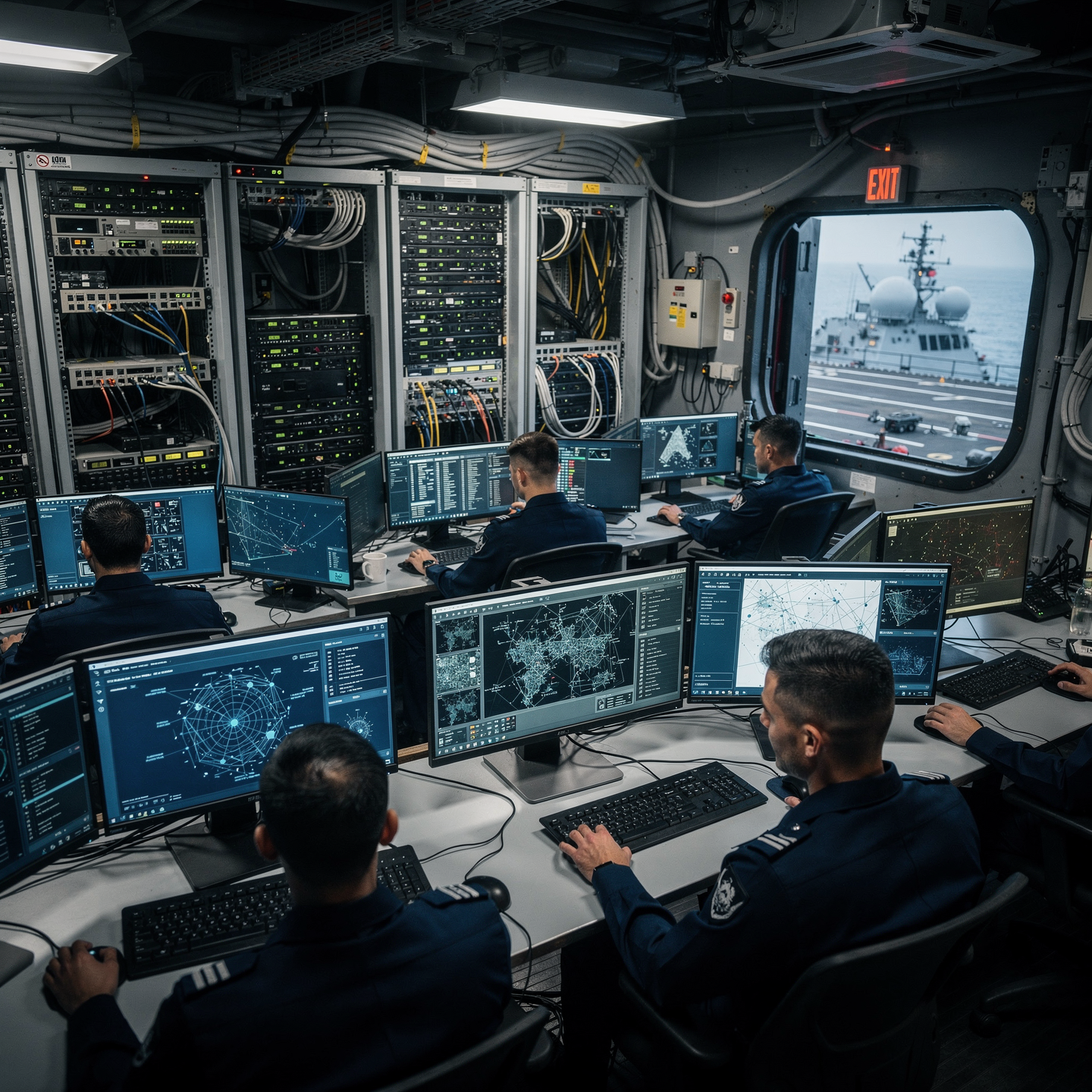
Master’s Degree in Naval Cybersecurity
Why this master’s programme?
The Master in Naval Cybersecurity
This program is designed to train the professionals who will protect the critical maritime infrastructure of the future. In response to the increasing cyber threats in the naval sector, this program offers comprehensive training in onboard systems security, maritime communications protection, and international regulations compliance. You will learn to defend against targeted attacks, implement robust security protocols, and manage cybersecurity incidents in complex maritime environments.
Differentiating Advantages
- Specialized Focus: Cybersecurity applied to the naval sector, autonomous vessels, and smart ports.
- Hands-on Labs: Simulation of attacks and defenses in real naval environments.
- Industry Experts: Instructors with experience in naval and maritime cybersecurity.
- Relevant Certifications: Preparation for leading cybersecurity certifications.
- Professional Networking: Access to a network of contacts in the naval and cybersecurity industry.
- Modality: Online
- Level: Masters
- Hours: 1600 H
- Start date: 25-04-2026
Availability: 1 in stock
Who is it aimed at?
- Naval officers, naval engineers, and maritime security personnel seeking to protect ships, ports, and critical infrastructure against cyberattacks.
- IT and cybersecurity professionals interested in specializing in the naval environment and the unique challenges of protecting maritime systems.
- Systems and network administrators at shipping companies who need to strengthen information security and comply with international regulations.
- Security consultants and auditors who want to expand their services to the maritime sector, offering risk assessments and response plans for cyber incidents.
- Graduates in computer engineering, telecommunications, or related fields seeking a high-value specialization in a constantly growing sector with high demand for professionals.
Flexibility and applicability
Designed for working professionals: online format with live classes, practical projects, and 24/7 access to digital resources.
Objectives and skills

Protecting critical maritime infrastructure:
“Implement cybersecurity measures and physical access control to key facilities, acting swiftly in the face of intrusions and threats.”

Managing cybersecurity incidents in naval environments:
Implement incident response plans, analyzing criticality and impact, prioritizing containment, eradication and recovery of critical systems, and ensuring the continuity of naval operations.

Develop and implement naval cyber defense strategies:
Implement real-time intrusion detection systems and incident response protocols tailored to the specific vulnerabilities of naval platforms and networks.

Leading cyberattack response teams at sea:
“Assess the criticality of the cyberattack and prioritize containment, preserving navigational safety, cargo integrity, and the protection of the marine environment.”

Assessing and mitigating cyber risks in naval systems:
Implement a comprehensive cybersecurity framework (NIST, ISO 27001) adapted to the naval architecture, prioritizing network segmentation, intrusion detection and incident response, validated through penetration testing and tabletop exercises.

Design and ensure secure naval communications:
Implement robust encryption and authentication protocols, ensuring the confidentiality and integrity of transmitted and stored information.
Study plan – Modules
- Naval Navigation Systems Architecture and Design: Fundamental Principles, Critical Components, and Redundant Configurations to Ensure Operational Resilience in Hostile Environments
- Advanced Maritime Communication Protocols: Detailed Analysis of VHF, HF, Satellite Links, and Digital Data Systems, with Emphasis on Encryption, Authentication, and Mitigation of Electronic Interference
- Assessment and Management of Cybersecurity Risks Specific to the Naval Domain: Identification of Internal and External Threats, Attack Vectors, and Vulnerability Analysis Methodologies Applied to Maritime SCADA Systems
- Implementation of Cryptographic Algorithms Resistant to Quantum Attacks for the Protection of Data in Transit and at Rest in Naval Communication Networks
- Development and Application of Intrusion Detection and Response Systems (IDS/IPS) Adapted to the Architecture of Naval Navigation and Communication Systems, Capable of Operating in Low-Bandwidth and High-Latency Conditions
- Systems Security GNSS: Advanced countermeasures against spoofing and jamming attacks, including the use of real-time authentication signals and integration with redundant inertial systems.
Integration and protection of ECDIS systems against cyber threats: firmware analysis, secure update management, and safeguards against malicious manipulation.
Simulation and modeling of cyberattack scenarios in hostile maritime environments for operational training and validation of real-time defense strategies.
International regulations and standards applicable to naval cybersecurity: compliance with IMO and NIST guidelines, and military standards that regulate the protection of critical maritime infrastructure.
Operational planning for cyber contingencies: development of rapid recovery protocols, digital forensics for incidents in navigation and communication systems, and establishment of electronic chains of custody in naval environments.
- Fundamentals of proactive defense in naval cyber-physical systems: architecture, attack vectors, and specific threat models for critical maritime infrastructure
- Vulnerability analysis of industrial control networks (ICS/SCADA) onboard and at shore stations, including Modbus, DNP3, and OPC UA protocols
- Implementation of intrusion detection and prevention systems (IDS/IPS) applied to maritime environments with latency and bandwidth limitations
- Application of advanced network segmentation and microsegmentation techniques to isolate critical subsystems onboard and ashore
- Development and deployment of honeypots and honeynets for attracting and analyzing malicious activity targeting naval platforms
- Incident management and response to cyberattacks: protocols, coordination between naval units and command centers, and establishment of incident response centers
(CSIRT) specializing in the maritime domain
Maritime cyber warfare simulation and exercises: creation of realistic attack scenarios, evaluation of operational resilience, and continuous improvement through targeted penetration testing
Cryptography applied to the protection of satellite communications, VHF links, and maritime signaling systems to ensure the integrity and confidentiality of operations
Continuous monitoring and digital forensics of critical maritime infrastructure: capture, preservation, and correlation of evidence to support post-incident investigations
International regulations and standards applicable to naval cybersecurity: compliance with IMO, NIST, and ISO/IEC 27001 guidelines, and their practical implementation in maritime operational environments
- Cybersecurity Fundamentals in Naval Systems: Threats, Vulnerabilities, and Attack Vectors Specific to the Maritime Domain
- Secure Architecture and Design of Navigation Systems: Integration of GNSS, Radar, INS, and ECDIS Systems with Advanced Security Protocols
- Cryptography Applied to Maritime Communications: Symmetric and Asymmetric Encryption, Key Management, and Digital Certification in Naval Networks
- Cyber Incident Detection and Response: Real-Time Monitoring Tools, Naval Forensics, and Containment Protocols in Hostile Environments
- Defense in Depth for Navigation Control Systems: Network Segmentation, Specialized Firewalls, and Sandboxing of Critical Applications
- Risk Management and Impact Assessment in Naval Operations: Advanced Methodologies for Identifying and Mitigating Cyber Risks in Strategic Maritime Missions
- International Standards and Regulations in Naval Cybersecurity: Compliance with IMO, NATO CNAD, and specific guidelines for the protection of critical infrastructure
- Implementation of Artificial Intelligence for Cyber Self-Defense: Predictive systems, anomalous behavior analysis, and automated responses in naval cyber defense
- Secure Maritime Communications Systems: Encryption of satellite links, jamming-resistant protocols, and protection against electromagnetic interference
- Advanced Simulation and Training Practices: Coordinated cyberattack exercises, joint response, and assessment of operational resilience in real and simulated scenarios
- Fundamentals and Challenges of Cyber Defense in Naval Environments: Specific Threats and Attack Vectors Targeting Critical Maritime Systems
- Secure Architectures for Naval Platforms: Network Design and Segmentation, Demilitarized Zones (DMZs), and Inspection Chambers for Isolating Navigation and Propulsion Systems
- Advanced Hardening Techniques in Naval Embedded Systems: Secure Configuration of Real-Time Operating Systems (RTOS), Access Control, and Secure Firmware Upgrades
- Implementation of Security Policies in Marine SCADA Systems: Risk Analysis, Privileged Access Control, and Management of Specific Industrial Equipment Vulnerabilities
- Advanced Detection Systems in Maritime Environments: Integration of IDS/IPS with Naval Telemetry, Unified Enterprise Behavioral Analysis (UEBA), and Contextual Correlation for Early Intrusion Identification
- Naval Digital Forensics Tools and Methodologies: Secure Evidence Collection,
- Preserving integrity and traceability in navigation and propulsion systems
- Operational response to cyber incidents on naval platforms: containment, eradication, and recovery protocols adapted to the limitations and criticality of the maritime environment
- Applied cryptography and robust authentication mechanisms in naval systems: implementation of public and private keys, digital certificates, and hardware security modules (HSMs)
- Security in naval communications: protection of satellite links, tactical networks, and critical transmission protocols to prevent interception and manipulation
- International regulations and standards for maritime cybersecurity: analysis of IMO Resolution MSC-FAL.1/Circ.3 and compliance on next-generation naval platforms
- Case studies and simulations of cyberattacks on navigation and propulsion systems: study of real attack vectors, vulnerability analysis, and development of effective mitigation plans
- Integration of artificial intelligence and Machine learning for continuous improvement in the detection and response to cyber threats in naval environments
Emerging trends in naval cyber defense: future threats, evolution of offensive and defensive technologies, and preparation for multi-domain scenarios
- Fundamentals of Secure Architectures: Design Principles, System Isolation, and Redundancy in Naval Environments
- Advanced Cyber Resilience Models: Detection, Response, and Recovery from Attacks on Naval Control Systems
- Protection of Embedded SCADA and DCS Systems: Network Segmentation, Access Control, and Real-Time Data Encryption
- Specific Naval Communication Protocols: Analysis and Securing of CAN Bus, MIL-STD-1553, and Critical Interconnection Systems
- Hardware and Firmware Hardening: Techniques for Mitigating Vulnerabilities in PLCs and Devices Integrated on Military Vessels
- Implementation of Zero Trust Policies on Maritime Platforms: Multi-Factor Authentication, Microsegmentation, and Continuous Monitoring
- Simulation and Analysis of Advanced Threats (APTs) Targeting Navigation and Weapon Systems: Proactive Identification and Mitigation
- Tools and frameworks for managing cyber incidents in sensitive maritime environments
- Integrating artificial intelligence and machine learning for behavioral and anomaly detection in naval control systems
- Recovery and business continuity strategies: failover protocols, real-time backups, and cyber resilience testing
- Cybersecurity in the supply chain: risk assessment and assurance of third-party components and software
- International regulations and standards applied to naval cybersecurity: compliance and certification
- Case studies and forensic analysis of cyber incidents on warships and strategic naval platforms
- Secure development of onboard software and upgrades of critical systems under offshore operating conditions
- Role of technical crews in cybersecurity management: training, procedures, and organizational culture
- Maritime Navigation and Communications Systems Models and Architectures: Critical Components and Cyber Threat Vectors
- Advanced Risk Analysis: Dynamic Vulnerability Assessment in Hostile Maritime Environments and Sophisticated Attack Scenarios
- Cryptographic Protection Protocols for NAVCOM Communications: Implementation of TLS, IPsec, and New Quantum Encryption Techniques in Satellite and RF Networks
- Intrusion Detection and Mitigation: Specialized IDS/IPS Systems for Maritime Signals and Digital Forensic Analysis of Naval Data Traffic
- Integration of Automatic and Manual Response Systems: Orchestration of AI and Machine Learning-Based Playbooks for Targeted Attacks
- Operational Resilience: Design and Management of Redundant and Secure Architectures to Ensure Continuity of Navigation and Communications in Electronic Warfare Scenarios
- Assessment and Control of Risks associated with electromagnetic interference (EMI) and denial-of-service (DoS) attacks on satellite and maritime radio frequency links
International regulations and standards: compliance with IMO, NATO, and local agency regulations on maritime cyber defense policies
Advanced simulation of cyberattacks and cyber defense exercises: practical implementation in naval simulation environments for training and protocol validation
Post-incident forensics: techniques for collecting, preserving, and analyzing digital evidence on compromised maritime navigation and control platforms
- Cybersecurity Fundamentals in Critical Maritime Infrastructure: Specific Threats, Attack Vectors, and Naval Context
- Threat and Vulnerability Models: Risk Analysis Applied to SCADA Systems, Control Centers, and Shipboard Platforms
- Advanced Proactive Defense Strategies: Early Detection, Artificial Intelligence for Behavioral Analysis, and Automated Response
- Implementation of Intrusion Detection and Prevention Systems (IDS/IPS) specialized in maritime and satellite networks
- Secure Architecture for Maritime Industrial Networks: Segmentation, Micro-segmentation, and the Use of Next-Generation Firewalls
- Operational Resilience and Business Continuity: Strategies for Incident Recovery and Ensuring Operations in Environments Hostile environments
Application of international standards and regulations (IEC 62443, NIST SP 800-82) in critical naval infrastructures
Naval digital forensics techniques: identification, preservation, and analysis of post-cyberattack evidence in maritime technology systems
Red teams and Blue teams in maritime environments: practical exercises to strengthen cyber defense and response capabilities against advanced attacks
Integration of blockchain and cryptography to ensure the integrity and security of critical logistics and communications information
Advanced incident management: communication protocols, interagency coordination, and international cooperation in naval cybersecurity
Implementation of specific SIEM platforms for continuous monitoring and situational analysis in infrastructures Maritime Security
Protection of electronic navigation systems and satellite communications against interference, spoofing, and denial-of-service attacks
Cybersecurity training and culture Technological innovations and future trends in naval cyber defense: artificial intelligence, machine learning, and automation in maritime security
- Fundamentals of Cryptography Applied to Naval Systems: symmetric and asymmetric algorithms, stream and block ciphers, hash functions, and digital authentication.
- Cryptographic Protocols for Satellite Communications: analysis of TLS/SSL, IPsec, and VPNs adapted to naval and satellite environments.
- Design and Architecture of Secure Networks in Naval Satellite Systems: segmentation, access control, and distributed cryptographic key management.
- Quantum Cryptography and its Impact on Naval Security: principles of quantum key distribution (QKD), quantum attacks, and post-quantum resistance.
- Implementation of Multi-Factor Authentication Mechanisms in Satellite Terminals for Naval Defense.
- Security in Military Satellite Links: interference mitigation, signal encryption, and analysis of specific threats such as denial-of-service and spoofing.
- Resilience and Continuity Protocols in Satellite Communications Networks: failover, cryptographic redundancy, and secure synchronization.
- International Standards and Regulations on Satellite Communications Security in Naval Operations, including applicable STANAGs and NIST guidelines.
- Tools and Platforms for Real-Time Cryptographic Management: encryption software, security hardware (HSM), and integrated monitoring systems.
- Real-World Case Studies and Practical Simulations: analysis of cyberattack incidents in naval satellite systems and breach response methodologies.
- Fundamentals of Naval Cybersecurity: Specific Threats to Critical Maritime Navigation and Communication Systems
- Advanced Encryption and Authentication Protocols in Maritime Networks: Implementation and Vulnerabilities
- Architecture of Critical Systems in Hostile Environments: Resilience, Redundancy, and Network Segmentation
- Proactive Intrusion Detection in SCADA Systems and Naval Platform Control
- Digital Forensic Methodologies Applied to Incidents in Maritime Navigation and Communication Equipment
- Analysis and Correlation of Logs and Events in Navigation Devices (ECDIS, AIS, Radar, VHF) for Attack Investigations
- Operational Response to Cyber-Physical Incidents: Protocols, Multidisciplinary Teams, and Interagency Coordination
- Advanced Attack Performance (APT) Simulation and Resilience Assessment of Maritime Navigation and Communication Systems
- Cybersecurity Crisis Management: Secure Communication, Business Continuity, and Recovery in Hostile Maritime Environments
- International Regulations and Applicable Standards for the Protection of Critical Naval Infrastructure (IMO, NIST, IEC 62443)
- Integration of Artificial Intelligence and Machine Learning for Predictive Detection and Automated Response in Naval Systems
- Combined Physical and Logical Security: Protections Against Unauthorized Access to Platforms and Maritime Control Centers
- Risk Assessment and Cybersecurity Audits Targeted for Critical Systems in the Maritime Logistics Chain
- Ongoing Cyber Defense Training and Education for Technical and Operational Teams in the Naval Sector
- Case Studies: Comprehensive Analysis of Real-World Cyberattacks in Maritime Environments and Lessons Learned to Improve Defense
- Conceptual Framework of Naval Cyber Defense: Contemporary Challenges and Evolution of Threats in Hostile Maritime Environments
- Design and Development of Integrated Resilience Architectures: Principles of Redundancy, Segmentation, and Access Control in Critical Naval Systems
- Advanced Threat Modeling (APT) Targeting Navigation and Communication Systems on Naval Platforms
- Implementation of Early Detection Mechanisms: Behavioral Analysis, Event Correlation, and Use of Artificial Intelligence in Naval Networks
- Automatic Response Protocols to Cyber Incidents: Activation of Countermeasures in Real Time and Guaranteed Operational Recovery
- Integration of C4ISR Systems with Cybersecurity Solutions: Ensuring the Chain of Command and Control Under Adverse Conditions and Electronic Warfare
- Assessment and Mitigation of Vulnerabilities in Naval GNSS, Radar, AIS, and Satellite Communications Systems
- Simulation and analysis of cyberattack scenarios: proactive defensive strategies to guarantee the continuity of maritime missions
- International regulations and technological standards applied to naval cyber defense: compliance and adaptation in multinational interoperability environments
- Development of contingency and disaster recovery plans specific to critical maritime and naval infrastructure
Career prospects
“`html
- Naval Cybersecurity Analyst: Protection of critical systems and naval networks against cyber threats.
- Maritime Cybersecurity Consultant: Risk assessment, design, and implementation of security solutions for the naval industry.
- Naval Systems Security Engineer: Development and implementation of security measures in the architecture of embarked systems.
- Naval Cybersecurity Incident Manager: Response to and recovery from cyber incidents in naval environments.
- Naval Cybersecurity Auditor: Evaluation of compliance with security regulations and standards on ships and naval bases.
- Maritime Cyber Threat Investigator: Analysis of malware and attack techniques targeting the naval industry.
- Naval Cyber Intelligence Specialist: Gathering and analyzing information on cyber threats to support strategic decision-making.
- Naval Cybersecurity Officer: Protecting the Navy’s digital assets and communications infrastructure.
“`
Entry requirements

Academic/professional profile:
Bachelor’s degree in Nautical Science/Maritime Transport, Naval/Marine Engineering or a related qualification; or proven professional experience on the bridge/in operations.

Language proficiency:
Functional Maritime English (SMCP) recommended for simulations and technical materials.

Documentation:
Updated CV, copy of qualification or seaman’s book, national ID/passport, motivation letter.

Technical requirements (for online):
Device with camera/microphone, stable internet connection, monitor ≥ 24” recommended for ECDIS/Radar-ARPA.
Admissions process and dates

Online
application
(form + documents).

Academic review and interview
Admissions decision

Admissions decision
(+ scholarship offer if applicable).

Place reservation
(deposit) and enrolment.

Induction
(access to the virtual campus, calendars, simulator guides).
Scholarships and financial support
- Proactive Defense: Learn to anticipate and neutralize cyber threats in naval environments.
- Critical Infrastructure Security: Protect the control and communications systems vital to maritime operations.
- Naval Digital Forensics: Master the techniques to investigate incidents and track attackers in naval cyberspace.
- Regulatory Compliance: Understand the international cybersecurity regulations and standards applicable to the naval environment.
- Cyberwarfare Simulations: Participate in practical exercises to strengthen your skills in crisis situations.
Testimonials
This master’s program provided me with the tools and knowledge necessary to lead the implementation of a new security system across a fleet of merchant ships. We reduced cybersecurity incidents by 60% in the first year, demonstrating the effectiveness of the strategies learned and solidifying my position as an expert in the sector.
I applied the knowledge from my master’s degree in naval cybersecurity to design an intrusion detection system that reduced false alerts on my unit’s network by 80%, optimizing the response to real threats.
I applied the knowledge I gained from my Master’s in Naval Cybersecurity to develop an intrusion detection system for a cargo ship’s control network. This system identified and neutralized a sophisticated cyberattack that aimed to manipulate navigation data, preventing a potential collision and protecting millions of dollars’ worth of cargo. My work was crucial in ensuring operational continuity and demonstrating the effectiveness of the cybersecurity strategies I learned during the Master’s program.
This master’s program provided me with the tools and knowledge necessary to lead the implementation of a new network security system for my organization, successfully mitigating a cyberattack that could have compromised classified information. Thanks to the training I received, I was able to identify the vulnerability and coordinate the response efficiently, minimizing the impact and protecting critical assets.

Frequently asked questions
Yes. The itinerary includes ECDIS/Radar-ARPA/BRM with harbor, ocean, fog, storm, and SAR scenarios.
Online with live sessions; hybrid option for simulator/practical placements through agreements.
Maritime or naval cybersecurity.
Recommended functional SMCP. We offer support materials for standard phraseology.
Yes, with a relevant degree or experience in maritime/port operations. The admissions interview will confirm suitability.
Optional (3–6 months) through Companies & Collaborations and the Alumni Network.
Simulator practice (rubrics), defeat plans, SOPs, checklists, micro-tests and applied TFM.
A degree from Navalis Magna University + operational portfolio (tracks, SOPs, reports and KPIs) useful for audits and employment.
- Conceptual Framework of Naval Cyber Defense: Contemporary Challenges and Evolution of Threats in Hostile Maritime Environments
- Design and Development of Integrated Resilience Architectures: Principles of Redundancy, Segmentation, and Access Control in Critical Naval Systems
- Advanced Threat Modeling (APT) Targeting Navigation and Communication Systems on Naval Platforms
- Implementation of Early Detection Mechanisms: Behavioral Analysis, Event Correlation, and Use of Artificial Intelligence in Naval Networks
- Automatic Response Protocols to Cyber Incidents: Activation of Countermeasures in Real Time and Guaranteed Operational Recovery
- Integration of C4ISR Systems with Cybersecurity Solutions: Ensuring the Chain of Command and Control Under Adverse Conditions and Electronic Warfare
- Assessment and Mitigation of Vulnerabilities in Naval GNSS, Radar, AIS, and Satellite Communications Systems
- Simulation and analysis of cyberattack scenarios: proactive defensive strategies to guarantee the continuity of maritime missions
- International regulations and technological standards applied to naval cyber defense: compliance and adaptation in multinational interoperability environments
- Development of contingency and disaster recovery plans specific to critical maritime and naval infrastructure
Request information
Complete the Application Form.
Attach your CV/degree certificate (if you have it to hand).
Indicate your preferred cohort (January/May/September) and whether you would like the hybrid option with simulator sessions.
An academic advisor will contact you within 24–48 hours to guide you through the admission process, scholarships, and compatibility with your professional schedule.
Faculty
Eng. Tomás Riera
Full Professor
Eng. Tomás Riera
Full Professor
Eng. Sofía Marquina
Full Professor
Eng. Sofía Marquina
Full Professor
Eng. Javier Bañuls
Full Professor
Eng. Javier Bañuls
Full Professor
Dr. Nuria Llobregat
Full Professor
Dr. Nuria Llobregat
Full Professor
Dr. Pau Ferrer
Full Professor
Dr. Pau Ferrer
Full Professor
Cap. Javier Abaroa (MCA)
Full Professor
Cap. Javier Abaroa (MCA)
Full Professor

