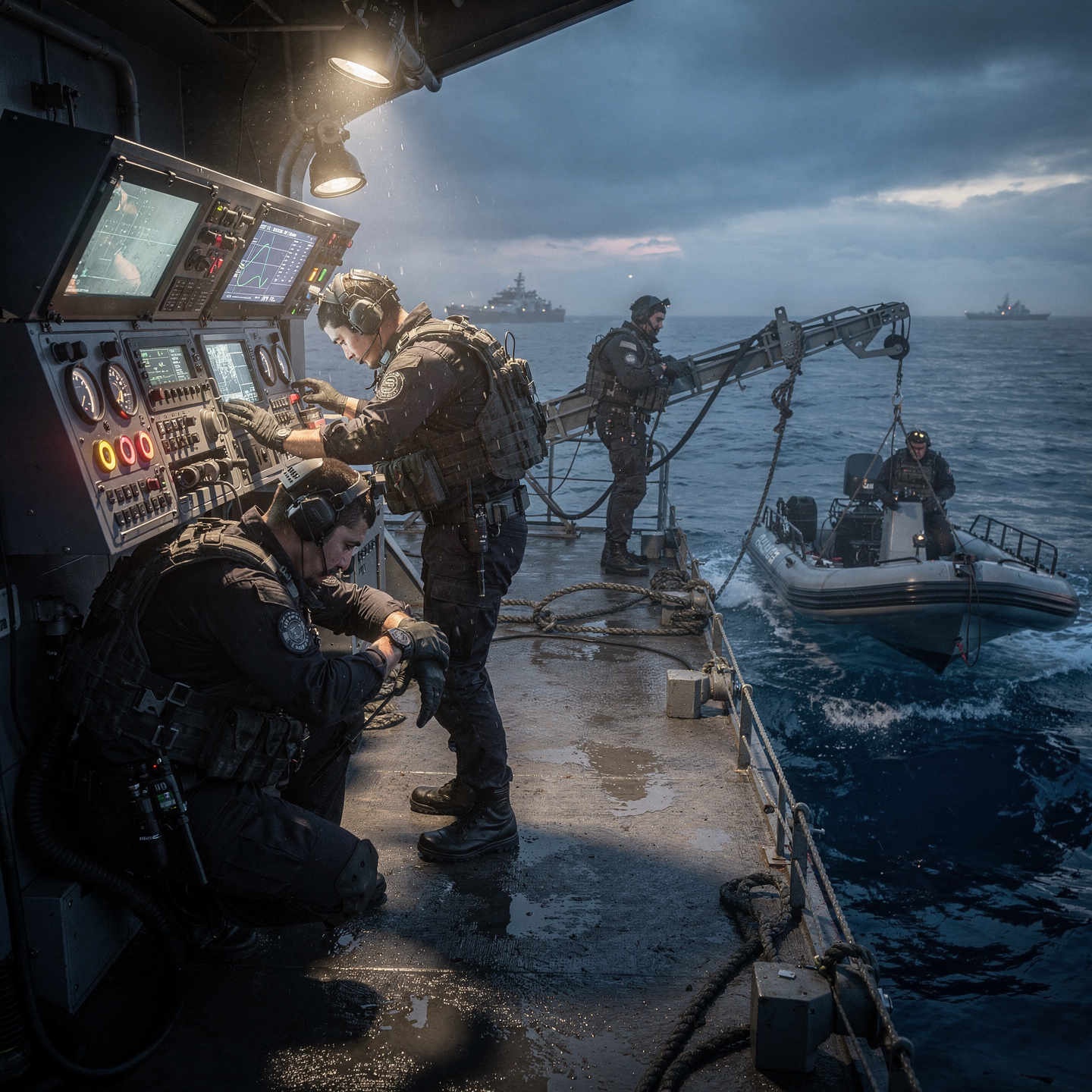
Master’s Degree in Maritime Special Operations
Why this master’s programme?
The Master in Maritime Special Operations
This is a cutting-edge program designed to train the leaders of the future in the complex and challenging maritime environment. This master’s degree offers a deep understanding of the tactics, strategies, and technologies employed in special operations at sea, from counterterrorism and piracy to search and rescue. You will learn from expert instructors with real-world experience, mastering crucial skills in planning, execution, and risk management. Prepare yourself to face the most demanding challenges and lead teams on critical missions with effectiveness and professionalism.
Differential Advantages
- Realistic Simulations: Training in virtual environments that replicate complex operational scenarios.
- State-of-the-art Equipment: Access to advanced technologies used by maritime special forces.
- International Collaboration: Opportunities to interact with experts and professionals from around the world.
- Emphasis on Ethics and Leadership: Development of decision-making skills in high-pressure situations.
- Practical Application: Projects and case studies that allow the application of acquired knowledge in real-world situations.
- Modality: Online
- Level: Masters
- Hours: 1600 H
- Start date: 25-04-2026
Availability: 1 in stock
Who is it aimed at?
- Navy, Special Forces, and Maritime Intervention Unit officers seeking to master advanced tactics, boarding operations, amphibious warfare, and high-threat scenarios.
- Maritime security personnel and protection companies requiring specialized training in vessel protection, counter-piracy response, and crisis management in hostile environments.
- Coast Guard and government agency members interested in strengthening their capabilities in maritime interdiction, counterterrorism, and rescue operations in extreme conditions.
- Maritime professionals (lawyers, insurance agents, consultants) seeking a comprehensive understanding of maritime special operations and their legal and operational implications.
- Graduates in Criminology, Security, or related fields For those seeking advanced specialization and a professional career in maritime special operations.
Flexibility and Practical Application
Designed for active professionals: online format with asynchronous content, real-world case studies, and operational scenario simulations for immediate application in the field.
Objectives and skills

Leading and managing teams in hostile maritime environments:
“Managing team fatigue and stress, optimizing decision-making under pressure, and maintaining morale in critical situations.”

Mastering combat and survival techniques in extreme maritime conditions:
“Navigating with precision using analog and digital instruments, interpreting adverse weather information to adapt the survival strategy.”

Apply safety and rescue protocols in complex maritime operations:
“Direct and execute SAR rescue maneuvers, assessing risks, stabilizing the victim and coordinating evacuation with air/sea resources.”

Use advanced communication and navigation systems in covert operations:
“Integrating secure communications (encrypted, stealth protocols) and precise satellite navigation (DGPS, INS) to maintain discretion and positional accuracy in hostile environments.”

Conduct intelligence and reconnaissance assessments in maritime areas of interest:
“Identify unusual vessels and activities by analyzing traffic patterns, AIS data, and intelligence sources, and report to the appropriate authorities in a timely manner.”

Develop advanced skills in handling tactical vessels and specialized weaponry:
“Operate weapons systems with precision and safety, integrating situational intelligence and assessing threats in real time.”
Study plan – Modules
- Fundamental principles of tactical driving in hostile maritime environments: situational analysis, use of terrain, and weather conditions
- Advanced strategic decision-making models for special operations: application of competitive intelligence and electronic warfare
- Integrated mission planning: interagency coordination and synchronization of surface, subsurface, and air units
- Operational risk analysis and management: identification of threats, vulnerabilities, and mitigation in complex maritime scenarios
- Secure and encrypted tactical communications: protocols, interoperability, and counterintelligence in maritime environments
- Application of C4ISR systems in special operations: real-time information gathering, processing, and distribution
- Evasive maneuvers and stealth navigation techniques: minimizing acoustic and radar signatures for infiltration and exfiltration
- Use of unmanned submersible vehicles and drones in reconnaissance and
- Maritime tactical support
- Coordination and execution of amphibious assaults: integration of land, naval, and air forces with an emphasis on precision and speed
- Post-operational evaluation and feedback: analysis of results, review of standards, and continuous optimization of tactical and strategic procedures
- Fundamentals of covert insertion and extraction: operational principles and tactical limitations in maritime environments
- Analysis of the hostile environment: maritime threat assessment, detection of adversary sensors and coastal surveillance systems
- Advanced operations planning: integration of signals intelligence (SIGINT), human intelligence (HUMINT), and real-time reconnaissance
- Specialized littoral navigation and approach techniques under conditions of minimal visibility and acoustic control
- Selection and use of covert platforms: amphibious vehicles, low thermal signature inflatable boats, autonomous underwater vehicles (AUVs), and lightweight submersibles
- Critical insertion procedures: immersion and exfiltration techniques in contaminated waters and in the presence of chemical or biological threats
- Optimizing the signature profile and reducing risks: use of passive and active electronic countermeasures during execution
- Training in night maneuvers and advanced use of NVG (Night Vision Goggles) and FLIR (Forward Looking Infrared) systems
- Secure and encrypted communications protocol for inter-team coordination and liaison with central command in electronic interference environments
- Development of contingency and rapid extraction plans: evasive tactics and use of secondary exfiltration points in complex environments
- Role of the operator in real-time signals intelligence for dynamic mission adaptation to changes in the tactical environment
- Integration of air and naval support: coordination with attack helicopters, UAVs, and interceptor fleets for special operations support
- Post-operational evaluation and data analysis for continuous improvement: information gathering, lessons learned, and updating of insertion/extraction protocols
- Comprehensive analysis of the operational environment: identification of maritime threats and risk assessment in hostile areas
- Advanced insertion and extraction planning: critical phases, resource allocation, and time synchronization
- Tactical navigation techniques in restricted and high-conflict waters: use of tactical GPS, inertial navigation, and dynamic mapping
- Maritime infiltration operations: cover approach techniques, use of underwater vehicles, and environmental impact
- Exfiltration in complex scenarios: alternative routes, evading detection, and SIGINT/Radar signature reduction tactics
- Advanced use and handling of fast and semi-rigid craft: operational characteristics and maintenance in extreme conditions
- Joint and multi-domain coordination: interoperability between surface, submarine, and air units during insertion and extraction
- Secure and real-time communication: tactical cryptography, protocols Data link and contingency plans for electronic interference.
Countermeasures and self-defense: evasive maneuvers, use of decoys, and electronic countermeasures during the maneuver.
Debriefing and post-operational analysis: data collection, performance evaluation, and lessons learned for future optimization.
- Command and Control Fundamentals in Maritime Special Operations: Structure, Levels, and Types of C2 (Command and Control) Applied to Dynamic and Hostile Environments
- Advanced Operational Planning: Integrated Mission Methodology Combining Tactical, Logistical, and Strategic Aspects Based on Maritime and Geopolitical Variables
- Naval Intelligence in Support of Special Operations: Collection, Analysis, and Dissemination of ISR (Intelligence, Surveillance, and Reconnaissance) from HUMINT, SIGINT, IMINT, and OSINT Sources
- Information Management and Command Systems: Use of C4ISR (Command, Control, Communications, Computers, Intelligence, Surveillance, and Reconnaissance) Networks for Real-Time Force Synchronization
- Assessment of Asymmetric and Symmetric Maritime Threats: Detection, Risk Analysis, and Mitigation Measures in Coastal and High Seas Scenarios
- Operational Logistics Support: Comprehensive management of resources, transportation, supply, and maintenance in extreme and limited-access conditions
- Interagency and Multinational Coordination Procedures: Interoperability with naval, air, and land units in coalitions and joint operations
- Contingency Planning: Development of backup plans in the event of technological failures, adverse weather conditions, and enemy activity
- Employment of Advanced Platforms and Technologies: Maritime drones, satellite communication systems, and electronic warfare equipment for electromagnetic dominance
- Post-Operational Analysis and Lessons Learned: Use of ISR data and effectiveness assessments for continuous optimization of the operational cycle
- Fundamentals of Inertial Navigation Systems (INS) applied to hostile maritime environments: gyroscopic sensors, accelerometers, calibration, and drift correction
- Advanced integration of GNSS and multi-frequency positioning solutions: GPS, GLONASS, Galileo, BeiDou, and differential correction techniques for high accuracy in tactical operations
- Architecture and configuration of ECDIS and electronic navigation systems for special operations: handling ENC/S-57 and S-63 charts, dynamic planning, and safe route management in conflict zones
- Implementation and optimization of maritime radars and ARPA (Automatic Radar Plotting Aid) in asymmetric warfare scenarios: signal interpretation, threat identification, and collision avoidance under adverse conditions
- Advanced AIS detection technologies and VTS surveillance systems: limitation analysis, spoofing, jamming techniques, and Reporting protocols for operational safety
Development and management of integrated onboard electronic defense systems (ECDIS-cybersecurity-anti-jamming): protection against cyberattacks, electronic interference, and operational resilience in a tactical maritime context
Automation and course control using autopilots integrated with advanced navigation systems: operating modes, parameterized settings, rapid reconfiguration, and failover
Protocols and procedures for navigation in extreme visibility and adverse weather conditions: radar piloting techniques, echo sounder navigation, and combined use of sensors to ensure mission success
Evaluation and handling of critical failures in navigation and communication systems: implementation of emergency procedures, technical redundancies, and manual protocols to ensure operational continuity
International regulations applicable to maritime navigation and electronic defense systems: compliance with STCW, SOLAS, ISPS, and military standards for maritime special operations
- Comprehensive Insertion Phases: Detailed Tactical Planning, Selection of Access Points, Maritime and Air Infiltration
- Advanced Extraction Techniques: Methods of Rapid and Safe Recovery Under Enemy Fire, Use of Dynamic Knots, and Extraction Techniques by Boat and Helicopter
- Command Operations in Hostile Environments: Leadership Under Stress, Real-Time Communication, Decision-Making in Adverse Conditions, and Management of Multidisciplinary Tactical Teams
- Use of Silent Insertion Equipment: Underwater Vehicles, Mini-Submarines, RHIB Inflatable Boats, and Electronic Tactical Camouflage Systems
- Tactical Navigation and Reconnaissance: Advanced Use of Inertial Navigation, Encrypted GPS, Topographic Maps, and Electronic Reconnaissance in High-Threat Areas
- Security and Containment Procedures During Insertion and Extraction to Minimize Threats Ballistics and detection by enemy sensors
Implementation of encrypted communication protocols and coded signals to ensure the integrity of information in the field
Camouflage and concealment strategies in maritime and coastal environments for clandestine and high-precision operations
Integration of air and naval support systems for fire cover, rapid evacuation, and logistical support in hostile areas
Analysis and adaptation to extreme maritime environmental conditions: currents, swells, visibility, and critical meteorological factors for mission execution
Drills and practical exercises of insertion and extraction under simulated fire, with individual and team evaluation to improve operational times and accuracy
Implementation of damage control techniques and immediate tactical medical care in Naval combat scenarios
Assessment of asymmetric risks and threats and development of specific countermeasures for maritime special operations
Interagency coordination and joint operations: interoperability between naval, air, and land units in joint insertions and extractions
Advanced use of drones and unmanned vehicles for reconnaissance, surveillance, and support in the insertion and extraction of special units
Development and execution of contingency plans for technical failures, ambushes, or adverse weather conditions during operations at sea
Application of electronic warfare principles for the interference and disorientation of enemy systems during tactical movements
Methodologies to ensure tactical maritime supremacy: neutralization of threats Naval operations and the establishment of operational exclusion zones
Psychological management and resilience of operators on prolonged, high-pressure missions in unstable environments
Documentation and presentation of detailed operational reports for continuous improvement and post-mission analysis in naval tactical environments
- Analysis and selection of insertion methods: from HALO/HAHO air insertion to boarding from fast craft
- Advanced extraction procedures under adverse conditions: rapid and safe recovery techniques in hostile maritime environments
- Specialized equipment for naval operations: types of underwater vehicles, inertial navigation systems, and camouflage and stealth technologies
- Command and control tactics in maritime special operations: dynamic hierarchical structures and real-time tactical decision-making
- Integrated operational planning: assessment of geographic, meteorological, and intelligence risks to ensure tactical superiority
- Use of stealth technology in insertion and extraction: reduced radar, acoustic, and visual signature profiles to avoid enemy detection
- Training in navigation in restricted waters and high-risk environments: advanced piloting skills, maritime GIS, and reconnaissance Hydrographic Analysis
Survival and Escape Strategies in Open Sea: Protocols for Multiple Contingency Scenarios During Extraction in Enemy Territories
Secure and Encrypted Communication in Clandestine Operations: Satellite, Radio Frequency, and Alternative Communication Methods in Jam Scenarios
Integration and Joint Coordination with Other Special Operations Units and Naval Forces: Interoperability and Synergies in Combined Operations
Study of International Maritime Law Applicable to Special Operations: Sovereignty, Exclusive Economic Zones, and Innocent Passage
Advanced Insertion and Extraction Drills and Exercises: Use of Virtual Environments and Real-World Scenarios to Optimize Performance and Reactivity
Command Psychology Under High Pressure: Stress Management, Team Motivation, and Leadership in Situations of Extreme Uncertainty
Assessment and Maintenance of Physical and Mental Fitness for Prolonged Operations: Specialized Physical Conditioning and Operational Endurance Programs
- Intelligence and counterintelligence methodologies applied to insertion and extraction operations in hostile environments
- Security procedures and operational leak prevention: handling sensitive information and confidentiality protocols
- Advanced camouflage, concealment, and silent movement techniques in natural and urban maritime environments
- Night vision and use of thermal imaging systems for reconnaissance and tactical deployment in night missions
- Management and neutralization of asymmetric threats during insertion and extraction phases: sea mines, enemy spotlights, and improvised explosive devices
- Logistics and supply in remote areas: techniques for securing critical resources during prolonged operations without immediate support
- Intelligence Analysis and Pre-Military Reconnaissance: Collection and evaluation of information from HUMINT, SIGINT, and IMINT sources to identify threats and specific environmental characteristics of hostile maritime zones.
- Advanced Underwater Infiltration Tactics: Silent approach techniques using live and autonomous support vehicles, use of propulsion systems, manipulation of ocean currents, and structuring of covert entry and extraction points.
- Integrated Mission Planning: Development of synchronized operational schedules that include insertion, objective, extraction, and contingency phases. Use of specialized software for simulating scenarios and responses to dynamic situations.
Selection and preparation of personnel: psychophysical evaluation and training in hypobaric resistance, apnea techniques, and stress management in high-pressure, low-visibility environments.
Equipment and technology applied to underwater combat: integration of inertial navigation systems, encrypted acoustic communication, specific compact weaponry, portable fire extinguishers, and underwater signaling devices.
Combined and multi-domain operations: coordination with surface, air, and logistical support units to ensure tactical superiority and protection in environments with a risk of enemy detection.
Underwater countermeasures and evasion: techniques for evading sonar sensors, jamming enemy communications, and minimizing the acoustic signature of equipment and operational personnel.
Emergency management and advanced recovery: procedures for handling Decompression sickness, rescue in areas of high turbulence, and establishment of emergency medical posts in marine environments.
International Law and Applicable Regulations: Detailed study of maritime treaties, legitimate use of force in territorial waters, exclusive economic zones, and international waters, as well as human rights aspects in special operations.
Post-Mission Evaluation and Intelligence Analysis: Collection of operational data, preparation of detailed reports, lessons learned, and continuous updating of action plans to optimize future missions in hostile maritime and underwater environments.
- Fundamentals of Tactical Conduct: Principles of Command, Control, and Communication under Adverse Maritime Conditions
- Operational Planning Strategies in Complex Maritime Environments: Intelligence Analysis, Threat Assessment, and Dynamic Planning
- Advanced Command Models in Naval Operations: Hierarchical Structure, Delegation of Responsibilities, and Real-Time Decision Making
- Interunit Coordination and Synchronization of Special Forces: Interoperability Protocols and Tactical Liaison Systems
- Application of Command and Control (C2) Technologies at Sea: Integration of Information Systems, Secure Communications, and Data Management on Mission
- Approach and Penetration Maneuvers in Hostile Environments: Stealth, Evasion, and Threat Suppression Tactics in Maritime Operations
- Planning and Execution of Extraction and Exfiltration Operations: Escape Techniques, Safe Routes, and Tactical Contingencies
- Managing the operational environment: the influence of meteorological, maritime, and geographical factors on tactical decision-making
- Commanding multinational teams in naval scenarios: cultural and operational coordination to optimize joint performance
- Post-operational analysis and feedback: critical review of missions, identification of failures, and lessons learned for future operations
- Strategic analysis of hostile maritime environments: identification of threats, vulnerabilities, and operational opportunities
- Comprehensive design of maritime special operations: multidisciplinary integration of human, technological, and logistical resources
- Advanced mission planning: reconnaissance, infiltration, direct action, exfiltration, and contingency phases
- Optimization of tactical maritime routes: use of inertial and satellite navigation systems with an emphasis on discretion and minimal detection
- Maritime entries and ambushes: boarding techniques, perimeter security, and threat suppression in coastal areas
- Coordination of naval and air units in joint operations: secure communication, interoperability, and attack synchronization
- Advanced management of operational resources: fuel management, specialized weaponry, and logistical support in remote environments
- Employment of unmanned systems (UUVs and USVs) for real-time intelligence, surveillance, and reconnaissance
Scenario simulation and modeling for pre-assessment and dynamic adaptation in critical operations
Legal and ethical procedures in operations in international waters and disputed areas
Risk assessment and mitigation measures in operations under extreme environmental conditions: weather, currents, and visibility
Implementation of electronic countermeasures and maritime cyber defense for the protection and stealth of special forces
Development of post-operational reports: performance analysis, lessons learned, and recommendations for future optimization
Practical workshop on technological integration for real-time command and control during maritime special operations
Final Master’s project: detailed design of an integrated maritime special operation, with tactical justification, planning, and results evaluation
Career prospects
“`html
- Maritime Special Operations Diver: Execution of rescue, boarding, reconnaissance, and combat missions in maritime environments.
- Maritime Special Operations Team Leader: Planning and leading teams on complex missions.
- Maritime Special Operations Instructor: Training and instruction of new operators in specialized tactics and techniques.
- Maritime Security Specialist: Protection of critical infrastructure, ships, and oil platforms against threats.
- Maritime Special Operations Consultant: Advising companies and governments on maritime security and defense strategies.
- Maritime Intelligence Analyst: Gathering and analyzing information for threat prevention and strategic decision-making.
- Underwater Systems Operator: Operation of ROVs and other equipment for underwater inspection, repair, and rescue.
- Maritime Liaison Officer: Coordination with other agencies and forces in joint operations and maritime interdiction missions.
“`
Entry requirements

Academic/professional profile:
Bachelor’s degree in Nautical Science/Maritime Transport, Naval/Marine Engineering or a related qualification; or proven professional experience on the bridge/in operations.

Language proficiency:
Functional Maritime English (SMCP) recommended for simulations and technical materials.

Documentation:
Updated CV, copy of qualification or seaman’s book, national ID/passport, motivation letter.

Technical requirements (for online):
Device with camera/microphone, stable internet connection, monitor ≥ 24” recommended for ECDIS/Radar-ARPA.
Admissions process and dates

Online
application
(form + documents).

Academic review and interview
Admissions decision

Admissions decision
(+ scholarship offer if applicable).

Place reservation
(deposit) and enrolment.

Induction
(access to the virtual campus, calendars, simulator guides).
Scholarships and financial support
- Acquire elite skills: Master the most advanced techniques and tactics in maritime special operations.
- Specialized training: Immerse yourself in realistic scenarios and high-fidelity simulations, preparing you for any challenge.
- Renowned experts: Learn from instructors with extensive experience in maritime special operations units.
- Prestigious certification: Earn an internationally recognized qualification that will boost your career in security and defense.
- Professional networking: Connect with peers and industry leaders, opening doors to new job opportunities.
Testimonials
“The Master’s in Maritime Special Operations provided me with the skills and knowledge necessary to successfully lead complex operations in challenging maritime environments. The expert instruction and hands-on training allowed me to hone my tactical, planning, and decision-making abilities under pressure, which proved fundamental to my recent promotion to Team Leader. This program has been crucial to my professional development and has prepared me to face future challenges in my career.”
My training in the Master of Naval Security and Defense provided me with a deep understanding of the global maritime landscape, enabling me to successfully lead the development and implementation of a new port security strategy that reduced incidents by 30% in the first year.
“I successfully completed the demanding Master’s program in Maritime Special Operations, mastering advanced diving, combat, and navigation techniques, as well as the planning and execution of complex missions in challenging maritime environments. The rigorous training provided me with the skills and confidence necessary to lead teams in high-pressure situations, and I feel prepared to face any challenge that may come my way in my Special Operations career.”
“The rigorous demands of the Master’s in Maritime Special Operations prepared me exceptionally well to lead teams in high-pressure environments. The tactical, diving, and combat skills I acquired during the program were fundamental to the success of our latest hostage rescue mission in hostile waters. Without the specific training provided by this master’s program, the outcome would have been very different.”

Frequently asked questions
Maritime environment.
Yes. The itinerary includes ECDIS/Radar-ARPA/BRM with harbor, ocean, fog, storm, and SAR scenarios.
Online with live sessions; hybrid option for simulator/practical placements through agreements.
Military operations.
Recommended functional SMCP. We offer support materials for standard phraseology.
Yes, with a relevant degree or experience in maritime/port operations. The admissions interview will confirm suitability.
Optional (3–6 months) through Companies & Collaborations and the Alumni Network.
Simulator practice (rubrics), defeat plans, SOPs, checklists, micro-tests and applied TFM.
A degree from Navalis Magna University + operational portfolio (tracks, SOPs, reports and KPIs) useful for audits and employment.
- Strategic analysis of hostile maritime environments: identification of threats, vulnerabilities, and operational opportunities
- Comprehensive design of maritime special operations: multidisciplinary integration of human, technological, and logistical resources
- Advanced mission planning: reconnaissance, infiltration, direct action, exfiltration, and contingency phases
- Optimization of tactical maritime routes: use of inertial and satellite navigation systems with an emphasis on discretion and minimal detection
- Maritime entries and ambushes: boarding techniques, perimeter security, and threat suppression in coastal areas
- Coordination of naval and air units in joint operations: secure communication, interoperability, and attack synchronization
- Advanced management of operational resources: fuel management, specialized weaponry, and logistical support in remote environments
- Employment of unmanned systems (UUVs and USVs) for real-time intelligence, surveillance, and reconnaissance
Scenario simulation and modeling for pre-assessment and dynamic adaptation in critical operations
Legal and ethical procedures in operations in international waters and disputed areas
Risk assessment and mitigation measures in operations under extreme environmental conditions: weather, currents, and visibility
Implementation of electronic countermeasures and maritime cyber defense for the protection and stealth of special forces
Development of post-operational reports: performance analysis, lessons learned, and recommendations for future optimization
Practical workshop on technological integration for real-time command and control during maritime special operations
Final Master’s project: detailed design of an integrated maritime special operation, with tactical justification, planning, and results evaluation
Request information
Complete the Application Form.
Attach your CV/degree certificate (if you have it to hand).
Indicate your preferred cohort (January/May/September) and whether you would like the hybrid option with simulator sessions.
An academic advisor will contact you within 24–48 hours to guide you through the admission process, scholarships, and compatibility with your professional schedule.
Faculty
Eng. Tomás Riera
Full Professor
Eng. Tomás Riera
Full Professor
Eng. Sofía Marquina
Full Professor
Eng. Sofía Marquina
Full Professor
Eng. Javier Bañuls
Full Professor
Eng. Javier Bañuls
Full Professor
Dr. Nuria Llobregat
Full Professor
Dr. Nuria Llobregat
Full Professor
Dr. Pau Ferrer
Full Professor
Dr. Pau Ferrer
Full Professor
Cap. Javier Abaroa (MCA)
Full Professor
Cap. Javier Abaroa (MCA)
Full Professor

