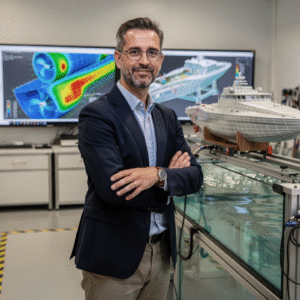
Diploma in Propulsion and Energy Optimization

Why this certificate program?

The Diploma in Propulsion and Energy Optimization

This program provides you with the tools to lead the transition to a more sustainable maritime future. Learn to evaluate and optimize existing propulsion systems, implement innovative technologies, and reduce the environmental impact of shipping operations. This program covers everything from thermodynamics applied to marine engines to the integration of alternative fuels and energy efficiency strategies, preparing you for the challenges and opportunities of the industry.

Differential Advantages

  • Life Cycle Assessment (LCA): Evaluate the environmental impact of different technologies and fuels.
  • Simulation and Modeling: Optimize the performance of propulsion systems using cutting-edge tools.
  • Regulations and Standards: Master international standards on emissions and energy efficiency.
  • Real-World Case Studies: Learn from successful examples of energy optimization in the maritime industry.
  • Networking: Connect with industry experts and professionals to boost your career.
Propulsión

Diploma in Propulsion and Energy Optimization

Availability: 1 in stock

Who is it aimed at?

  • Mechanical and Naval Engineers seeking to specialize in advanced propulsion systems and efficient energy management.
  • Maritime industry professionals interested in reducing operating costs by optimizing fuel consumption and implementing green technologies.
  • Ship maintenance and operations managers who want to improve the reliability and performance of main and auxiliary engines.
  • Consultants and technicians aspiring to offer specialized services in energy auditing and the design of innovative propulsion solutions.
  • Students and recent graduates seeking a boost in their professional career with theoretical and practical knowledge in marine propulsion and Sustainability.

Flexibility for your development
Ā Adaptable to your schedule: 100% online, access to multimedia materials and personalized tutoring.

Propulsión

Objectives and competencies

Evaluate and improve the efficiency of propulsion systems:

“Analyze engine performance, optimize fuel consumption and reduce polluting emissions by implementing predictive and corrective maintenance.”

Design and implement energy optimization strategies:

“Analyze consumption, implement improvements in equipment and facilities, and monitor results with key energy performance indicators.”

Managing propulsion and sustainable energy projects:

Optimize the use of renewable energies (solar, wind, waves) by integrating them into the ship’s electrical grid and energy storage systems.

Analyze and solve problems in propulsion systems:

“Identify root causes through systematic analysis, implement effective solutions, and document to prevent recurrence.”

Integrate advanced technologies in propulsion and energy:

Optimize energy efficiency through advanced management of hybrid systems and predictive consumption analysis.

Develop simulation models for energy systems:

“Implement optimization algorithms and sensitivity analysis to evaluate the performance and efficiency of simulated energy systems.”

Curriculum - Modules

  1. Comprehensive Maritime Incident Management: protocols, roles, and chain of command for coordinated response
  2. Operational Planning and Execution: briefing, routes, weather windows, and go/no-go criteria
  3. Rapid Risk Assessment: criticality matrix, scene control, and decision-making under pressure
  4. Operational Communication: VHF/GMDSS, standardized reports, and inter-agency liaison
  5. Tactical Mobility and Safe Boarding: RHIB maneuvers, approach, mooring, and recovery
  6. Equipment and Technologies: PPE, signaling, satellite tracking, and field data logging
  7. Immediate Care of the Affected: primary assessment, hypothermia, trauma, and stabilization for evacuation
  8. Adverse Environmental Conditions: swell, Visibility, flows, and operational mitigation

    Simulation and training: critical scenarios, use of VR/AR, and exercises with performance metrics

    Documentation and continuous improvement: lessons learned, indicators (MTTA/MTTR), and SOP updates

  1. Introduction to Modeling and Simulation: Concepts, advantages, and applications in propulsion.
  2. Fundamentals of Thermodynamics and Fluids: Review of basic principles and laws.
  3. Modeling Propulsion System Components: Pumps, turbines, compressors, heat exchangers.
  4. Simulation of Thermodynamic Cycles: Rankine, Brayton, Diesel, and Otto.
  5. Combustion and Fuel Properties: Modeling combustion processes in engines.
  6. Modeling Fuel Injection: Injection and atomization systems.
  7. Heat Transfer in Propulsion Systems: Modeling heat transfer phenomena.
  8. Gas Dynamics and Compressible Flow: Modeling high-speed flows.
  9. Software Simulation for Propulsion Systems: Introduction and use of tools such as MATLAB/Simulink and GT-SUITE.

    Model Validation and Verification: Techniques to ensure the accuracy and reliability of models.

  1. Introduction to Thermodynamics: basic concepts, systems, properties, and processes.
  2. First Law of Thermodynamics: internal energy, enthalpy, work, and heat.
  3. Second Law of Thermodynamics: entropy, irreversibility, and thermodynamic cycles.
  4. Ideal and real gases: equations of state, compressibility, and correction factors.
  5. Fuels and Combustion: types of fuels, stoichiometry, theoretical air, and excess air.
  6. Combustion Gas Analysis: measurement, interpretation, and emissions control.
  7. Heat Transfer: conduction, convection, and radiation; heat exchangers.
  8. Power Cycles: Carnot, Rankine, Otto, Diesel, and Brayton; Efficiency and optimization.
  9. Industrial Combustion Systems: boilers, furnaces, gas turbines, and internal combustion engines.
  10. Energy Efficiency and Optimization of Combustion Systems: strategies, technologies, and best practices.

  1. Introduction to Life Cycle Assessment (LCA): concepts, objectives, and applications.
  2. LCA Methodology: scope definition, inventory analysis, impact assessment, and interpretation.
  3. Carbon Footprint: calculation, standards (ISO 14067), and reduction strategies.
  4. LCA applied to energy systems: fossil fuels vs. Alternatives.
  5. Alternative fuels: biomass, biogas, biofuels, hydrogen, synthetic fuels.
  6. Biomass production: sustainability, yields, waste, and byproducts.
  7. Water electrolysis: technologies, efficiency, renewable energy sources.
  8. Carbon capture and storage (CCS): technologies, feasibility, environmental impacts.
  9. Emission benchmarking: Well-to-wheel and tank-to-wheel analysis.
  10. Legislation and policies for promoting alternative fuels and reducing emissions.

  1. Basic Concepts of Thermodynamics: systems, properties, states, processes
  2. First Law of Thermodynamics: internal energy, work, heat, and enthalpy
  3. Second Law of Thermodynamics: entropy, irreversibility, and thermodynamic cycles
  4. Pure Substances and Thermodynamic Diagrams: steam tables, P-V, T-S, and h-s diagrams
  5. Ideal and Real Gases: equations of state, compressibility, and gas mixtures
  6. Carnot Cycle: analysis and theoretical efficiency
  7. Rankine Cycle: components, efficiency, and improvements (reheating, regeneration)
  8. Gas Power Cycles: Otto, Diesel, Brayton, and their variations
  9. Refrigeration: cycles of Vapor compression and absorption refrigeration
  10. Applications of Thermodynamics: power plants, internal combustion engines, refrigeration systems

  1. System Architecture and Components: Structural design, materials, and subsystems (mechanical, electrical, electronic, and fluid) with selection and assembly criteria for marine environments
  2. Fundamentals and Principles of Operation: Physical and engineering foundations (thermodynamics, fluid mechanics, electricity, control, and materials) that explain performance and operating limits
  3. Safety and Environmental (SHE): Risk analysis, PPE, LOTO, hazardous atmospheres, spill and waste management, and emergency response plans
  4. Applicable Regulations and Standards: IMO/ISO/IEC requirements and local regulations;
  5. Conformance criteria, certification, and best practices for operation and maintenance
  6. Inspection, testing, and diagnostics: Visual/dimensional inspection, functional testing, data analysis, and predictive techniques (vibration, thermography, fluid analysis) to identify root causes
  7. Preventive and predictive maintenance: Hourly/cycle/seasonal plans, lubrication, adjustments, calibrations, consumable replacement, post-service verification, and operational reliability
  8. Instrumentation, tools, and metrology: Measuring and testing equipment, diagnostic software, calibration and traceability; selection criteria, safe use, and storage
  9. Onboard integration and interfaces: Mechanical, electrical, fluid, and data compatibility; Sealing and watertightness, EMC/EMI, corrosion protection, and interoperability testing.

    Quality, acceptance testing, and commissioning: process and materials control, FAT/SAT, bench and sea trials, go/no-go criteria, and evidence documentation.

    Technical documentation and integrated practice: logs, checklists, reports, and a complete case study (safety → diagnosis → intervention → verification → report) applicable to any system.

  1. Introduction to Life Cycle Assessment (LCA): Objectives and scope.
  2. Regulatory Framework and Standards: ISO 14040, ISO 14044.
  3. Defining Scope and Objectives: Functional unit, system boundaries.
  4. Data Collection and Life Cycle Inventory (LCI): Data sources, data quality.
  5. Life Cycle Impact Assessment (LCIA): Impact categories, characterization methods.
  6. Interpreting Results: Sensitivity, contribution, and dominance analysis.
  7. Ecodesign: Principles and strategies, integration into product design.
  8. Ecodesign Tools: Checklists, impact matrices environmental.
  9. Case Studies: Applications of LCA and Ecodesign in different sectors.
  10. Communication of Results: LCA reports, environmental product declarations.

Career opportunities

  • Energy Project Engineer: Design and optimization of propulsion and energy generation systems.
  • Energy Consultant: Energy audits, efficiency analysis, and improvement proposals for industries and buildings.
  • Energy Efficiency Manager: Implementation of measures to reduce energy consumption and costs in organizations.
  • Researcher and Developer: Innovation in propulsion technologies and renewable energy sources.
  • Energy Maintenance Manager: Supervision and optimization of energy equipment and systems.
  • Renewable Energy Technician: Installation, operation, and maintenance of solar, wind, and other energy systems.
  • Energy Auditor: Evaluation of compliance with energy efficiency regulations and standards.
  • Sales Representative Technical: Sale of equipment and services related to propulsion and energy optimization.

    “`

Admission requirements

Academic/professional profile:

Degree/Bachelor's degree in Nautical Science/Maritime Transport, Naval/Marine Engineering, or a related field; or proven professional experience in bridge/operations.

Language proficiency:

Recommended functional maritime English (SMCP) for simulations and technical materials.

Documentation:

Updated resume, copy of degree or seaman's book, ID card/passport, letter of motivation.

Technical requirements (for online):

Equipment with camera/microphone, stable connection, ≄ 24ā€ monitor recommended for ECDIS/Radar-ARPA.

Admission process and dates

1. Online
application

(form + documents).

2. Academic review and interview

(profile/objectives/schedule compatibility).

3. Admission decision

(+ scholarship proposal if applicable).

4. Reservation of place

(deposit) and registration.

5. Induction

(access to campus, calendars, simulator guides).

Scholarships and grants

  • Master Marine Propulsion: Delve into propulsion systems, from diesel engines to sustainable alternatives.
  • Energy Optimization: Learn strategies to reduce fuel consumption and improve operational efficiency.
  • Performance Analysis: Acquire skills to evaluate and optimize the performance of propulsion systems.
  • Emerging Technologies: Explore the latest innovations in propulsion and onboard energy management.
  • Case Studies: Apply your acquired knowledge to real-world scenarios and challenges in the maritime sector.
Boost your career in the maritime sector with this cutting-edge diploma.

Testimonials

Frequently asked questions

Both propulsion and energy efficiency are intrinsically linked in the diploma program, seeking to optimize the former through the latter.

Yes. The itinerary includes ECDIS/Radar-ARPA/BRM with harbor, ocean, fog, storm, and SAR scenarios.

Online with live sessions; hybrid option for simulator/practical placements through agreements.

Recommended functional SMCP. We offer support materials for standard phraseology.

Yes, with a relevant degree or experience in maritime/port operations. The admissions interview will confirm suitability.

Optional (3–6 months) through Companies & Collaborations and the Alumni Network.

Simulator practice (rubrics), defeat plans, SOPs, checklists, micro-tests and applied TFM.

A degree from Navalis Magna University + operational portfolio (tracks, SOPs, reports and KPIs) useful for audits and employment.

  1. Introduction to Turbomachinery: Types, Applications, and Fundamental Principles
  2. Gas Thermodynamics: Properties, Equations of State, and Processes
  3. Applied Fluid Mechanics: Boundary Layers, Losses, and Compressibility Effects
  4. Heat Transfer in Turbomachinery: Conduction, Convection, and Radiation
  5. Combustion: Stoichiometry, Flame Types, and Incomplete Combustion
  6. Thermodynamic Power Cycles: Rankine, Brayton, and Combined Cycles
  7. Turbine and Compressor Blades: Design, Aerodynamics, and Materials
  8. Combustion Chambers: Design, Flame Stability, and Emissions
  9. Heat Exchangers: Types, Design, and Optimization
  10. Performance Analysis and efficiency of turbomachinery systems

Request information

  1. Complete the Application Form.

  2. Attach your CV/degree certificate (if you have it to hand).

  3. Indicate your preferred cohort (January/May/September) and whether you would like the hybrid option with simulator sessions.

    An academic advisor will contact you within 24–48 hours to guide you through the admission process, scholarships, and compatibility with your professional schedule.

Please enable JavaScript in your browser to complete this form.
Click or drag a file to this area to upload.

Faculty

0
    0
    Tu carrito
    Tu carrito esta vacĆ­oRegresar a la tienda
    Scroll to Top