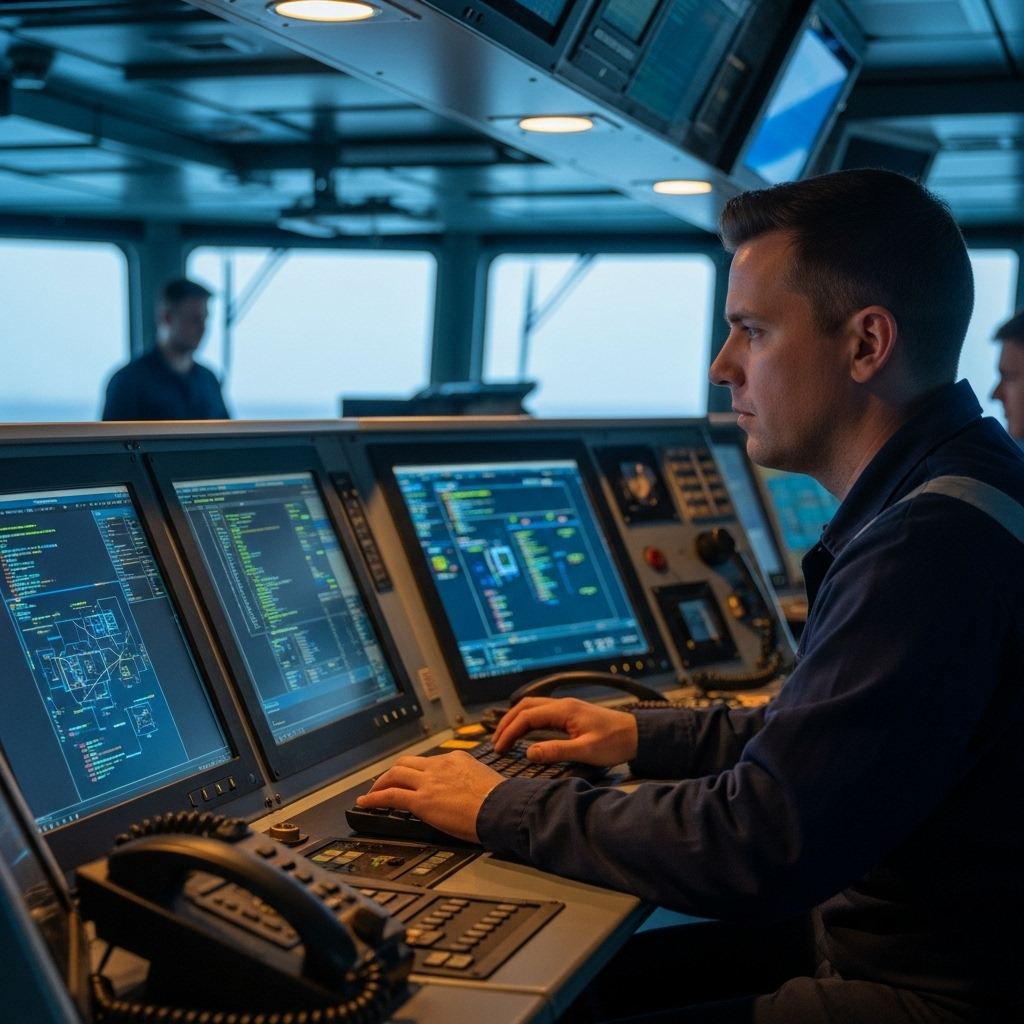
Naval Controller Programming Course

Why this course?

The Naval Controller Programming Course

This course provides you with the essential skills to design and implement advanced control systems in the maritime industry. Learn to master specialized programming languages, interact with marine sensors and actuators, and optimize the performance of onboard automation systems. This intensive program will equip you with the practical knowledge to solve the challenges of autonomous navigation, efficient energy management, and advanced maritime safety.

Differential Advantages

  • Realistic Simulation Environment: Experiment with real-time navigation and control scenarios.
  • Hands-on Projects: Develop customized solutions for real-world industry problems.
  • Expert Instructors: Learn from professionals with extensive experience in the development of naval control systems.
  • Networking: Connect with other professionals and expand your career opportunities.
  • Professional Certification: Gain recognition for your skills and knowledge in programming naval controllers.
Programación

Naval Controller Programming Course

Availability: 1 in stock

Who is it aimed at?

  • Naval engineers and technicians seeking to specialize in the development and implementation of control systems for vessels.
  • Students of electronic, mechatronic, or naval engineering wishing to acquire practical knowledge in controller programming for maritime applications.
  • Industrial automation professionals seeking to expand their experience to the naval sector, learning the specifics of maritime control systems.
  • Ship design and construction companies wishing to train their staff in the latest controller programming technologies to optimize the performance of their vessels.
  • Researchers and developers interested in innovation in naval control systems and the application of new technologies in automation vessels.

Flexibility and applicability
Ā Adapted to your pace: self-guided modules with practical exercises, consultation forums, and projects applicable to real-world challenges in the shipbuilding industry.

Programación

Objectives and competencies

Develop robust control systems:

“Implement predictive and adaptive control strategies, minimizing the impact of external disturbances and ensuring system stability in the face of uncertainties.”

Optimize onboard energy management:

“Analyze consumption, optimize routes, and coordinate with the machinery team to minimize environmental impact and operating costs.”

Implement autonomous navigation algorithms:

Integrate data from multiple sensors (GPS, IMU, LiDAR, cameras) to create a robust model of the environment and optimize real-time decision making.

Ensuring the cybersecurity of naval systems:

Implement a cyber risk management model specific to naval systems, including the identification, protection, detection, response and recovery from incidents, with special attention to network segmentation and the application of security patches.

Facilitating the integration of sensors and actuators:

“Configure, calibrate, and diagnose sensors and actuators, interpreting technical manuals and applying communication protocols (e.g., Modbus, Ethernet/IP).”

Monitor and maintain optimal system performance.

“Monitor critical resources (CPU, memory, disk) and services, optimizing configuration and proactively resolving incidents.”

Curriculum - Modules

  1. Comprehensive Maritime Incident Management: protocols, roles, and chain of command for coordinated response
  2. Operational Planning and Execution: briefing, routes, weather windows, and go/no-go criteria
  3. Rapid Risk Assessment: criticality matrix, scene control, and decision-making under pressure
  4. Operational Communication: VHF/GMDSS, standardized reports, and inter-agency liaison
  5. Tactical Mobility and Safe Boarding: RHIB maneuvers, approach, mooring, and recovery
  6. Equipment and Technologies: PPE, signaling, satellite tracking, and field data logging
  7. Immediate Care of the Affected: primary assessment, hypothermia, trauma, and stabilization for evacuation
  8. Adverse Environmental Conditions: swell, Visibility, flows, and operational mitigation

    Simulation and training: critical scenarios, use of VR/AR, and exercises with performance metrics

    Documentation and continuous improvement: lessons learned, indicators (MTTA/MTTR), and SOP updates

  1. Fundamentals of Analog Electronics: Passive and active components, basic circuits.
  2. Naval Sensors: Types, operating principles, calibration, and maintenance.
  3. Naval Actuators: Valves, motors, pumps, control and regulation systems.
  4. Automatic Control Systems: Open and closed loop, PID control, stability, and tuning.
  5. Programmable Logic Controllers (PLCs): Programming, configuration, and applications in naval systems.
  6. Industrial Communication Networks: Communication protocols (Modbus, Profibus), network architectures.
  7. Naval Automation Systems: Monitoring and control of propulsion, power generation, and charging systems.
  8. Power Control Systems: Power distribution, electrical protection, UPS, and generators.
  9. emergency.

  10. Predictive Maintenance: Vibration analysis techniques, thermography, and oil analysis.
  11. Regulations and Safety: Electrical safety and automation standards in the naval environment.

  1. Introduction to Embedded Systems: Definition, characteristics, and applications in robotics and autonomous navigation.
  2. Microcontroller Architecture: Types, selection, peripherals, and resource management.
  3. Sensors for Autonomous Navigation: IMU, GPS, LiDAR, cameras, encoders. Operating principles and calibration.
  4. Sensor Data Acquisition and Processing: Filtering, sensor fusion, and state estimation.
  5. Actuators: Motors, servomotors, steering and propulsion systems.
  6. Power control and management.

    Real-time operating systems (RTOS): Scheduling, task management, inter-process communication.

    Wireless communication: Communication protocols (WiFi, Bluetooth, LoRa, CAN bus) and security.

    Localization and mapping: SLAM (Simultaneous Localization and Mapping) algorithms, visual odometry, and LiDAR.

    Route planning: Search algorithms (A*, Dijkstra), obstacle avoidance, and path optimization.

    Autonomous control: Control architectures (PID, MPC), adaptive control, and AI-based control systems.

  1. Introduction to Naval Systems: Types, Functions, and Components
  2. Sensors and Transducers: Types, Characteristics, Calibration, and Maintenance
  3. Actuators: Valves, Motors, Pumps, Cylinders; Principles of operation and control

    Control systems: Open-loop and closed-loop, PID, fuzzy logic

    Communication networks: Protocols (CANbus, Modbus), Industrial Ethernet, fiber optics

    Power generation and distribution systems: Power plants, UPS, batteries

    Propulsion systems: Main engine control, variable-pitch propellers, thrusters

    Steering systems: Autopilot, rudder control, stabilizers

    Auxiliary systems: Bilge pump control, ballast, air conditioning, refrigeration

    Diagnosis and maintenance of automated systems: Fault identification and resolution

  1. Introduction to Autonomous Systems: History, Levels of Autonomy, and Applications
  2. Sensors for Autonomous Navigation: Cameras, LiDAR, Radar, IMU, GPS/GNSS
  3. Sensory Data Processing: Filtering, Sensor Fusion, Environmental Perception
  4. Simultaneous Localization and Mapping (SLAM): Algorithms, Visual Odometry, Optimization
  5. Route Planning: Search Algorithms (A*, Dijkstra), Sample-Based Routing (RRT) Planning
  6. Motion Control: PID Control, Predictive Control, Adaptive Control
  7. Software Architectures for Autonomous Systems: ROS, Embedded Frameworks
  8. Safety and Redundancy: Tolerance to Failures, backup systems, cybersecurity.
  9. Simulation and testing: simulation environments, algorithm validation, real-world testing.
  10. Legal and ethical aspects of autonomy: responsibility, privacy, social impact.

  1. System Architecture and Components: Structural design, materials, and subsystems (mechanical, electrical, electronic, and fluid) with selection and assembly criteria for marine environments
  2. Fundamentals and Principles of Operation: Physical and engineering foundations (thermodynamics, fluid mechanics, electricity, control, and materials) that explain performance and operating limits
  3. Safety and Environmental (SHE): Risk analysis, PPE, LOTO, hazardous atmospheres, spill and waste management, and emergency response plans
  4. Applicable Regulations and Standards: IMO/ISO/IEC requirements and local regulations;
  5. Conformance criteria, certification, and best practices for operation and maintenance
  6. Inspection, testing, and diagnostics: Visual/dimensional inspection, functional testing, data analysis, and predictive techniques (vibration, thermography, fluid analysis) to identify root causes
  7. Preventive and predictive maintenance: Hourly/cycle/seasonal plans, lubrication, adjustments, calibrations, consumable replacement, post-service verification, and operational reliability
  8. Instrumentation, tools, and metrology: Measuring and testing equipment, diagnostic software, calibration and traceability; selection criteria, safe use, and storage
  9. Onboard integration and interfaces: Mechanical, electrical, fluid, and data compatibility; Sealing and watertightness, EMC/EMI, corrosion protection, and interoperability testing.

    Quality, acceptance testing, and commissioning: process and materials control, FAT/SAT, bench and sea trials, go/no-go criteria, and evidence documentation.

    Technical documentation and integrated practice: logs, checklists, reports, and a complete case study (safety → diagnosis → intervention → verification → report) applicable to any system.

Plan de estudio - Módulos

  1. Comprehensive Maritime Incident Management: protocols, roles, and chain of command for coordinated response
  2. Operational Planning and Execution: briefing, routes, weather windows, and go/no-go criteria
  3. Rapid Risk Assessment: criticality matrix, scene control, and decision-making under pressure
  4. Operational Communication: VHF/GMDSS, standardized reports, and inter-agency liaison
  5. Tactical Mobility and Safe Boarding: RHIB maneuvers, approach, mooring, and recovery
  6. Equipment and Technologies: PPE, signaling, satellite tracking, and field data logging
  7. Immediate Care of the Affected: primary assessment, hypothermia, trauma, and stabilization for evacuation
  8. Adverse Environmental Conditions: swell, Visibility, flows, and operational mitigation

    Simulation and training: critical scenarios, use of VR/AR, and exercises with performance metrics

    Documentation and continuous improvement: lessons learned, indicators (MTTA/MTTR), and SOP updates

  1. Fundamentals of Analog Electronics: Passive and active components, basic circuits.
  2. Naval Sensors: Types, operating principles, calibration, and maintenance.
  3. Naval Actuators: Valves, motors, pumps, control and regulation systems.
  4. Automatic Control Systems: Open and closed loop, PID control, stability, and tuning.
  5. Programmable Logic Controllers (PLCs): Programming, configuration, and applications in naval systems.
  6. Industrial Communication Networks: Communication protocols (Modbus, Profibus), network architectures.
  7. Naval Automation Systems: Monitoring and control of propulsion, power generation, and charging systems.
  8. Power Control Systems: Power distribution, electrical protection, UPS, and generators.
  9. emergency.

  10. Predictive Maintenance: Vibration analysis techniques, thermography, and oil analysis.
  11. Regulations and Safety: Electrical safety and automation standards in the naval environment.

  1. Introduction to Embedded Systems: Definition, characteristics, and applications in robotics and autonomous navigation.
  2. Microcontroller Architecture: Types, selection, peripherals, and resource management.
  3. Sensors for Autonomous Navigation: IMU, GPS, LiDAR, cameras, encoders. Operating principles and calibration.
  4. Sensor Data Acquisition and Processing: Filtering, sensor fusion, and state estimation.
  5. Actuators: Motors, servomotors, steering and propulsion systems.
  6. Power control and management.

    Real-time operating systems (RTOS): Scheduling, task management, inter-process communication.

    Wireless communication: Communication protocols (WiFi, Bluetooth, LoRa, CAN bus) and security.

    Localization and mapping: SLAM (Simultaneous Localization and Mapping) algorithms, visual odometry, and LiDAR.

    Route planning: Search algorithms (A*, Dijkstra), obstacle avoidance, and path optimization.

    Autonomous control: Control architectures (PID, MPC), adaptive control, and AI-based control systems.

  1. Introduction to Naval Systems: Types, Functions, and Components
  2. Sensors and Transducers: Types, Characteristics, Calibration, and Maintenance
  3. Actuators: Valves, Motors, Pumps, Cylinders; Principles of operation and control

    Control systems: Open-loop and closed-loop, PID, fuzzy logic

    Communication networks: Protocols (CANbus, Modbus), Industrial Ethernet, fiber optics

    Power generation and distribution systems: Power plants, UPS, batteries

    Propulsion systems: Main engine control, variable-pitch propellers, thrusters

    Steering systems: Autopilot, rudder control, stabilizers

    Auxiliary systems: Bilge pump control, ballast, air conditioning, refrigeration

    Diagnosis and maintenance of automated systems: Fault identification and resolution

  1. Introduction to Autonomous Systems: History, Levels of Autonomy, and Applications
  2. Sensors for Autonomous Navigation: Cameras, LiDAR, Radar, IMU, GPS/GNSS
  3. Sensory Data Processing: Filtering, Sensor Fusion, Environmental Perception
  4. Simultaneous Localization and Mapping (SLAM): Algorithms, Visual Odometry, Optimization
  5. Route Planning: Search Algorithms (A*, Dijkstra), Sample-Based Routing (RRT) Planning
  6. Motion Control: PID Control, Predictive Control, Adaptive Control
  7. Software Architectures for Autonomous Systems: ROS, Embedded Frameworks
  8. Safety and Redundancy: Tolerance to Failures, backup systems, cybersecurity.
  9. Simulation and testing: simulation environments, algorithm validation, real-world testing.
  10. Legal and ethical aspects of autonomy: responsibility, privacy, social impact.

  1. System Architecture and Components: Structural design, materials, and subsystems (mechanical, electrical, electronic, and fluid) with selection and assembly criteria for marine environments
  2. Fundamentals and Principles of Operation: Physical and engineering foundations (thermodynamics, fluid mechanics, electricity, control, and materials) that explain performance and operating limits
  3. Safety and Environmental (SHE): Risk analysis, PPE, LOTO, hazardous atmospheres, spill and waste management, and emergency response plans
  4. Applicable Regulations and Standards: IMO/ISO/IEC requirements and local regulations;
  5. Conformance criteria, certification, and best practices for operation and maintenance
  6. Inspection, testing, and diagnostics: Visual/dimensional inspection, functional testing, data analysis, and predictive techniques (vibration, thermography, fluid analysis) to identify root causes
  7. Preventive and predictive maintenance: Hourly/cycle/seasonal plans, lubrication, adjustments, calibrations, consumable replacement, post-service verification, and operational reliability
  8. Instrumentation, tools, and metrology: Measuring and testing equipment, diagnostic software, calibration and traceability; selection criteria, safe use, and storage
  9. Onboard integration and interfaces: Mechanical, electrical, fluid, and data compatibility; Sealing and watertightness, EMC/EMI, corrosion protection, and interoperability testing.

    Quality, acceptance testing, and commissioning: process and materials control, FAT/SAT, bench and sea trials, go/no-go criteria, and evidence documentation.

    Technical documentation and integrated practice: logs, checklists, reports, and a complete case study (safety → diagnosis → intervention → verification → report) applicable to any system.

  1. Introduction to Naval Electronic Systems: History, Evolution, and Applications
  2. Electronics Fundamentals: Components, Circuits, Signals, and Measurements
  3. Electrical Power Generation and Distribution Systems: Power Plants, UPS, Batteries
  4. Naval Communication Systems: VHF/HF/UHF Radio, Satellite, GMDSS
  5. Electronic Navigation Systems: GPS, ECDIS, Radar, AIS, Sonar
  6. Engineering Control Systems: Automation, Sensors, Actuators, PLCs
  7. Fire Detection and Suppression Systems: Sensors, Alarms, Sprinklers, Extinguishing Agents
  8. Flood Control Systems: Pumps, Valves, Level Sensors, Alarms
  9. Internal entertainment and communications systems: TV, audio, telephony, public address systems.
  10. Cybersecurity in naval electronic systems: threats, vulnerabilities, protection.

  1. Introduction to Naval Control Systems: Types, Functions, and Historical Evolution.
  2. **Fundamentals of Controller Architecture:** Hierarchy, Components, and Communication Buses.
  3. **Naval Sensors:** Types (position, speed, attitude, environmental), Operating Principles, and Interfaces.
  4. **Naval Actuators:** Types (motors, pumps, valves, rudders), Characteristics, and Control.
  5. **Control Logic:** Block Diagrams, Transfer Functions, and PID Control.
  6. Modeling Naval Systems: Equations of Motion, Ship Dynamics, and Simulation.
  7. **Navigation Systems:** GPS, INS, Compasses, Radar, and Navigation Aids.
  8. **Bridge Automation Systems:** Control of Heading, Speed, Position, and Auxiliary Functions.
  9. **Naval Communication Networks:** Standards (NMEA, Ethernet, CAN), protocols, and security.

    Future trends: Artificial intelligence, autonomous control, and cyber-physical systems.

  1. Introduction to Naval Control Systems: Types and Applications
  2. Fundamentals of Maritime Navigation: Coordinates, Bearings, Distances
  3. Global Positioning Systems (GNSS): GPS, GLONASS, Galileo, BeiDou
  4. Navigation Sensors: Gyroscopes, Accelerometers, Logs, Anemometers
  5. Automatic Control Systems: Autopilots, Stability Control Systems
  6. Radar and Automatic Identification Systems (AIS): Principles and Applications
  7. Naval Simulation: Types of Simulators, Mathematical Models, and Physics
  8. Development of Simulation Models: Environment, Vessels, and Systems
  9. Integration of Systems of Control, navigation, and simulation
  10. Applications of naval simulation: training, design, and analysis

  1. Introduction to Naval Control Systems: Types and Applications
  2. Fundamentals of Hydrodynamics: Forces and Moments on the Ship
  3. Steering Systems: Rudders, Maneuvering Propellers, Azimuth Thrusters
  4. Automatic Course Control: Autopilots, PID Algorithms
  5. Propulsion Systems: Diesel Engines, Gas Turbines, Electric Propulsion
  6. Propulsion Plant Control: Power Management, Efficiency, and Emissions
  7. Navigation Systems: GNSS, Gyrocompasses, Logs, Echosounders
  8. Systems Integration: Distributed Control Architectures, Communication Buses
  9. Maintenance and Diagnostics: Procedures, Common Faults, monitoring
  10. Future trends: Autonomous ships, alternative propulsion, digitalization

Career opportunities

  • Onboard Software Developer: Creation and maintenance of control systems for ships.
  • Test and Validation Engineer: Ensuring the quality and reliability of naval controllers.
  • Naval Cybersecurity Specialist: Protecting control systems against cyberattacks.
  • Technology Consultant for the Naval Industry: Advising on the implementation of new technologies.
  • Naval Systems Integrator: Configuration and integration of controllers with other onboard systems.
  • Researcher and Developer at Naval Technology Centers: Innovation in the field of naval automation.
  • Controller Support and Maintenance Technician: Troubleshooting and repairing systems.
  • Naval Controller Programming Trainer: Transfer of knowledge and skills to new professionals.

    “`

Admission requirements

Academic/professional profile:

Degree/Bachelor's degree in Nautical Science/Maritime Transport, Naval/Marine Engineering, or a related field; or proven professional experience in bridge/operations.

Language proficiency:

Recommended functional maritime English (SMCP) for simulations and technical materials.

5. Induction

Updated resume, copy of degree or seaman's book, ID card/passport, letter of motivation.

Technical requirements (for online):

Equipment with camera/microphone, stable connection, ≄ 24ā€ monitor recommended for ECDIS/Radar-ARPA.

Admission process and dates

1. Online
application

(form + documents).

2. Academic review and interview

(profile/objectives/schedule compatibility).

3. Admission decision

(+ scholarship proposal if applicable).

4. Reservation of place

(deposit) and registration.

5. Induction

(access to campus, calendars, simulator guides).

Scholarships and grants

  • Programming Fundamentals: Learn the basic principles for controlling naval systems efficiently and safely.
  • Key Programming Languages: Master languages ​​like Python and C++ applied to marine automation.
  • Simulation and Testing: Develop and evaluate your programs in simulated environments to ensure they function correctly.
  • Control of Engines and Auxiliary Systems: Program the control of propulsion, steering, and other essential vessel systems.
  • Integration of Sensors and Actuators: Learn to connect and program the interaction with sensors and actuators for autonomous navigation.
Boost your career in the naval industry with cutting-edge programming skills.

Testimonials

Frequently asked questions

A naval controller controls warships.

Yes. The itinerary includes ECDIS/Radar-ARPA/BRM with harbor, ocean, fog, storm, and SAR scenarios.

Online with live sessions; hybrid option for simulator/practical placements through agreements.

The primary operational domain: Naval controllers operate in the maritime environment, considering factors such as currents, tides, draft, and specific navigation rules, while other controllers focus on air or land environments with their own limitations and regulations.

Recommended functional SMCP. We offer support materials for standard phraseology.

Yes, with a relevant degree or experience in maritime/port operations. The admissions interview will confirm suitability.

Optional (3–6 months) through Companies & Collaborations and the Alumni Network.

Simulator practice (rubrics), defeat plans, SOPs, checklists, micro-tests and applied TFM.

A degree from Navalis Magna University + operational portfolio (tracks, SOPs, reports and KPIs) useful for audits and employment.

  1. Introduction to Naval Control Systems: Types and Applications
  2. Fundamentals of Hydrodynamics: Forces and Moments on the Ship
  3. Steering Systems: Rudders, Maneuvering Propellers, Azimuth Thrusters
  4. Automatic Course Control: Autopilots, PID Algorithms
  5. Propulsion Systems: Diesel Engines, Gas Turbines, Electric Propulsion
  6. Propulsion Plant Control: Power Management, Efficiency, and Emissions
  7. Navigation Systems: GNSS, Gyrocompasses, Logs, Echosounders
  8. Systems Integration: Distributed Control Architectures, Communication Buses
  9. Maintenance and Diagnostics: Procedures, Common Faults, monitoring
  10. Future trends: Autonomous ships, alternative propulsion, digitalization

Request information

  1. Complete the Application Form
  2. Attach your CV/Qualifications (if you have them to hand).
  3. Indicate your preferred cohort (January/May/September) and whether you want the hybrid option with simulator sessions.
An academic advisor will contact you within 24–48 hours to guide you through the admission process, scholarships, and compatibility with your professional schedule. Translated with DeepL.com (free version)
Please enable JavaScript in your browser to complete this form.
Click or drag a file to this area to upload.

Teachers

0
    0
    Tu carrito
    Tu carrito esta vacĆ­oRegresar a la tienda
    Scroll to Top


