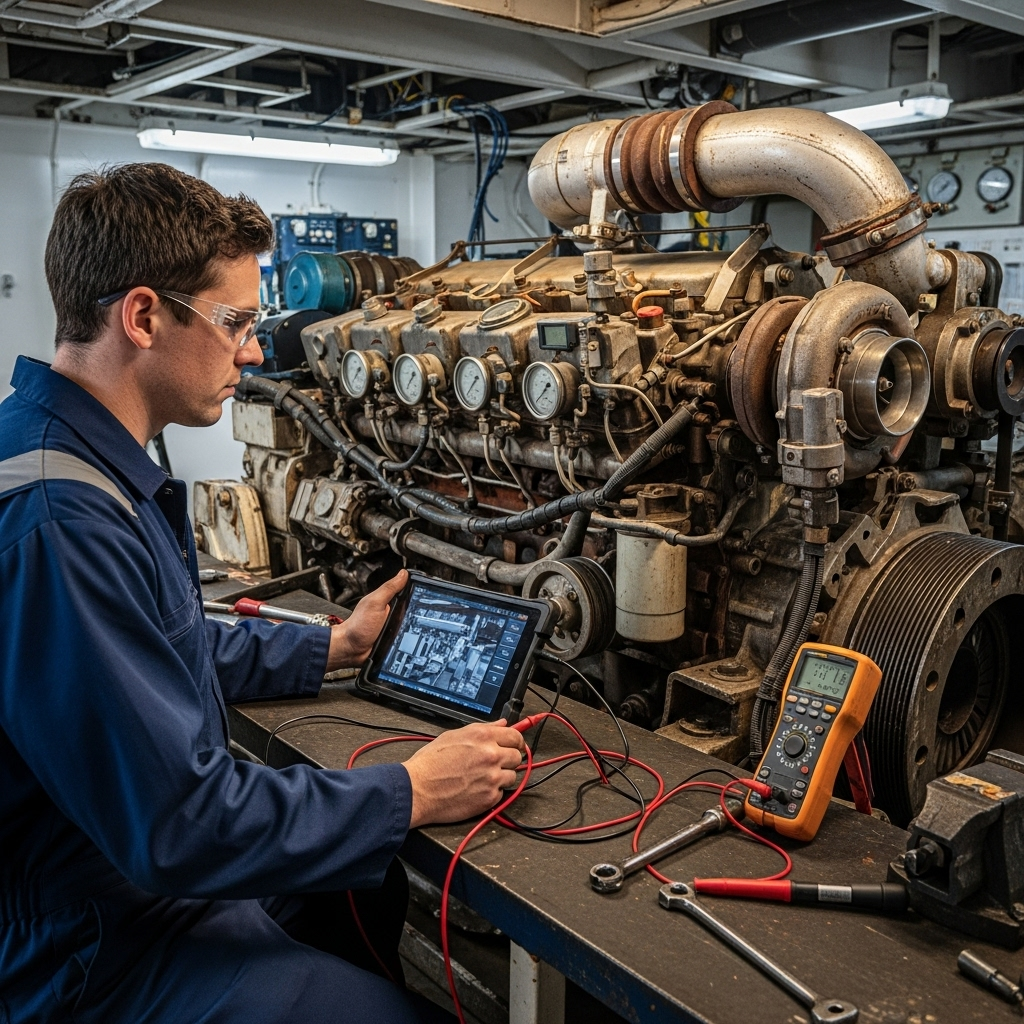
Marine Diesel Engine Diagnostics Course
Why this course?
The Marine Diesel Engine Diagnostics course
This course will provide you with the tools and specialized knowledge to detect and troubleshoot faults in these critical systems. Learn to interpret performance data, perform advanced diagnostic tests, and apply preventive maintenance techniques to optimize engine life and efficiency. This program combines fundamental theory with practical exercises based on real-world case studies.
Differential Advantages
- Predictive Diagnostics: Anticipate failures through vibration, oil, and thermographic analysis.
- Use of Cutting-Edge Tools: Learn to operate state-of-the-art diagnostic software and measuring equipment.
- Injection System Analysis: Master the calibration and repair of injectors and fuel pumps.
- Performance Optimization: Adjust key parameters to reduce fuel consumption and emissions.
- Effective Corrective Maintenance: Solve common problems such as leaks, overheating, and power loss.
- Modality: Online
- Level: Cursos
- Hours: 150 H
- Start date: 25-04-2026
Availability: 1 in stock
Who is it aimed at?
- Naval engineers and technicians seeking to deepen their knowledge of fault detection and troubleshooting in marine diesel engines.
- Chief engineers and engine officers wishing to optimize the performance and service life of onboard engines.
- Naval/maritime engineering students seeking to acquire practical skills in diagnosing marine diesel engines.
- Vessel maintenance personnel needing to reduce repair costs and downtime.
- Marine inspectors and surveyors interested in expanding their technical knowledge in the area of marine propulsion.
Flexibility and applicability
Adapted to the needs of active professionals: Downloadable material, practical exercises and real-world case studies.
Objectives and competencies

Identify and analyze common failures in marine diesel fuel systems:
“Diagnosing faulty injectors, deteriorated injection pumps, and blockages in filters/lines, using diagnostic tools and technical manuals.”

Interpreting diagrams and technical manuals for troubleshooting marine diesel engines:
Identify components, follow logical flows, and apply diagnostic procedures to interpret documentation and troubleshoot problems efficiently and safely.

Perform accurate diagnostic tests using specialized tools on marine diesel engines:
“Interpreting technical manuals, electrical diagrams, and manufacturer data to identify the root cause of anomalies.”

Apply preventive maintenance procedures to optimize performance and extend the service life of marine diesel engines:
“Following the manufacturer’s recommendations and best practices, recording operating data and analyzing trends to anticipate failures.”

Evaluate the condition and efficiency of cooling and lubrication systems in marine diesel engines:
“Inspect key components (pumps, chillers, filters) and analyze operating parameters (pressure, temperature, flow rate) to detect anomalies and optimize performance.”

Develop skills to accurately disassemble and assemble major components of marine diesel engines:
“Using specific technical tools and manuals, ensuring tolerances and tightening torques, and identifying wear or damage for proper repair or replacement.”
Curriculum - Modules
- Comprehensive Maritime Incident Management: protocols, roles, and chain of command for coordinated response
- Operational Planning and Execution: briefing, routes, weather windows, and go/no-go criteria
- Rapid Risk Assessment: criticality matrix, scene control, and decision-making under pressure
- Operational Communication: VHF/GMDSS, standardized reports, and inter-agency liaison
- Tactical Mobility and Safe Boarding: RHIB maneuvers, approach, mooring, and recovery
- Equipment and Technologies: PPE, signaling, satellite tracking, and field data logging
- Immediate Care of the Affected: primary assessment, hypothermia, trauma, and stabilization for evacuation
- Adverse Environmental Conditions: swell, Visibility, flows, and operational mitigation
Simulation and training: critical scenarios, use of VR/AR, and exercises with performance metrics
Documentation and continuous improvement: lessons learned, indicators (MTTA/MTTR), and SOP updates
- Introduction to Marine Diesel Systems: History, Evolution, and Applications
- Basic Thermodynamics: Diesel Cycles, Performance, and Efficiency
- Main Engine Components: Block, Crankshaft, Pistons, Connecting Rods, Cylinder Head
- Lubrication Systems: Types of Lubricants, Pumps, Filters, and Cooling Systems
- Cooling Systems: Types of Coolants, Pumps, Radiators, and Heat Exchangers
- Intake and Exhaust Systems: Turbochargers, Intercoolers, Air Filters, and Mufflers
- Fuel Systems: Injectors, Injection Pumps, Filters, and Tanks
- Electrical Systems: Batteries, Alternators, Starter Motors, and Wiring
- Instrumentation and Control: Sensors, actuators, control panels, and monitoring systems.
- Regulations and Safety: Environmental regulations, onboard safety, and emergency procedures.
‘
- Introduction to Marine Diesel Systems: Components and Basic Operation
- Marine Diesel Fuel: Types, Properties, Treatment, and Storage
- Lubrication Systems: Types of Oils, Analysis, and Maintenance
- Cooling Systems: Types of Coolants, Maintenance, and Troubleshooting
- Intake and Exhaust Systems: Components, Operation, and Gas Analysis
- Fuel Injection Systems: Types, Components, and Calibration
- Diagnosing Common Faults: Overheating, Loss of Power, Excessive Smoke
- Using Diagnostic Tools: Pressure Gauges, Thermometers, Gas Analyzers
- Data Analysis and Troubleshooting: Interpreting Readings and Accurate Diagnosis
- Preventive and corrective maintenance: procedures, scheduling, and documentation
‘
- Introduction to Marine Diesel Systems: Components and Basic Operation
- Marine Diesel Fuels: Types, Properties, Storage, and Treatment
- Injection Systems: Types, Components, Operation, and Maintenance
- Lubrication Systems: Types, Components, Operation, Oils, and Filters
- Cooling Systems: Types, Components, Operation, and Maintenance
- Intake and Exhaust Systems: Turbochargers, Intercoolers, and Catalytic Converters
- Electrical Systems: Batteries, Alternators, Starter Motors, and Wiring
- Control Systems: Sensors, Actuators, Electronic Control Units (ECUs)
- Troubleshooting: Tools, Techniques, and Procedures
- Troubleshooting Common Problems: Overheating, power loss, smoke, and noise.
‘
- Introduction to Marine Diesel Systems: Components and Basic Operation
- Marine Diesel Fuels: Types, Properties, Treatment, and Storage
- Injection Systems: Injection Pumps, Injectors, Common Rail
- Intake and Exhaust Systems: Turbochargers, Intercoolers, Air Filters, Mufflers
- Cooling Systems: Types of Cooling, Pumps, Heat Exchangers, Thermostats
- Lubrication Systems: Lubricating Oils, Pumps, Filters, Coolers
- Control and Monitoring Systems: Sensors, Actuators, Electronic Control Units (ECUs)
- Troubleshooting: Diagnostic Methods, Diagnostic Tools, Data Interpretation
- Preventive Maintenance: Inspections, Lubrication,
- Tuning, component replacement
- Performance optimization: Parameter tuning, emissions control, energy efficiency
‘
- System Architecture and Components: Structural design, materials, and subsystems (mechanical, electrical, electronic, and fluid) with selection and assembly criteria for marine environments
- Fundamentals and Principles of Operation: Physical and engineering foundations (thermodynamics, fluid mechanics, electricity, control, and materials) that explain performance and operating limits
- Safety and Environmental (SHE): Risk analysis, PPE, LOTO, hazardous atmospheres, spill and waste management, and emergency response plans
- Applicable Regulations and Standards: IMO/ISO/IEC requirements and local regulations;
- Conformance criteria, certification, and best practices for operation and maintenance
- Inspection, testing, and diagnostics: Visual/dimensional inspection, functional testing, data analysis, and predictive techniques (vibration, thermography, fluid analysis) to identify root causes
- Preventive and predictive maintenance: Hourly/cycle/seasonal plans, lubrication, adjustments, calibrations, consumable replacement, post-service verification, and operational reliability
- Instrumentation, tools, and metrology: Measuring and testing equipment, diagnostic software, calibration and traceability; selection criteria, safe use, and storage
- Onboard integration and interfaces: Mechanical, electrical, fluid, and data compatibility; Sealing and watertightness, EMC/EMI, corrosion protection, and interoperability testing.
Quality, acceptance testing, and commissioning: process and materials control, FAT/SAT, bench and sea trials, go/no-go criteria, and evidence documentation.
Technical documentation and integrated practice: logs, checklists, reports, and a complete case study (safety → diagnosis → intervention → verification → report) applicable to any system.
Plan de estudio - Módulos
- Comprehensive Maritime Incident Management: protocols, roles, and chain of command for coordinated response
- Operational Planning and Execution: briefing, routes, weather windows, and go/no-go criteria
- Rapid Risk Assessment: criticality matrix, scene control, and decision-making under pressure
- Operational Communication: VHF/GMDSS, standardized reports, and inter-agency liaison
- Tactical Mobility and Safe Boarding: RHIB maneuvers, approach, mooring, and recovery
- Equipment and Technologies: PPE, signaling, satellite tracking, and field data logging
- Immediate Care of the Affected: primary assessment, hypothermia, trauma, and stabilization for evacuation
- Adverse Environmental Conditions: swell, Visibility, flows, and operational mitigation
Simulation and training: critical scenarios, use of VR/AR, and exercises with performance metrics
Documentation and continuous improvement: lessons learned, indicators (MTTA/MTTR), and SOP updates
- Introduction to Marine Diesel Systems: History, Evolution, and Applications
- Basic Thermodynamics: Diesel Cycles, Performance, and Efficiency
- Main Engine Components: Block, Crankshaft, Pistons, Connecting Rods, Cylinder Head
- Lubrication Systems: Types of Lubricants, Pumps, Filters, and Cooling Systems
- Cooling Systems: Types of Coolants, Pumps, Radiators, and Heat Exchangers
- Intake and Exhaust Systems: Turbochargers, Intercoolers, Air Filters, and Mufflers
- Fuel Systems: Injectors, Injection Pumps, Filters, and Tanks
- Electrical Systems: Batteries, Alternators, Starter Motors, and Wiring
- Instrumentation and Control: Sensors, actuators, control panels, and monitoring systems.
- Regulations and Safety: Environmental regulations, onboard safety, and emergency procedures.
‘
- Introduction to Marine Diesel Systems: Components and Basic Operation
- Marine Diesel Fuel: Types, Properties, Treatment, and Storage
- Lubrication Systems: Types of Oils, Analysis, and Maintenance
- Cooling Systems: Types of Coolants, Maintenance, and Troubleshooting
- Intake and Exhaust Systems: Components, Operation, and Gas Analysis
- Fuel Injection Systems: Types, Components, and Calibration
- Diagnosing Common Faults: Overheating, Loss of Power, Excessive Smoke
- Using Diagnostic Tools: Pressure Gauges, Thermometers, Gas Analyzers
- Data Analysis and Troubleshooting: Interpreting Readings and Accurate Diagnosis
- Preventive and corrective maintenance: procedures, scheduling, and documentation
‘
- Introduction to Marine Diesel Systems: Components and Basic Operation
- Marine Diesel Fuels: Types, Properties, Storage, and Treatment
- Injection Systems: Types, Components, Operation, and Maintenance
- Lubrication Systems: Types, Components, Operation, Oils, and Filters
- Cooling Systems: Types, Components, Operation, and Maintenance
- Intake and Exhaust Systems: Turbochargers, Intercoolers, and Catalytic Converters
- Electrical Systems: Batteries, Alternators, Starter Motors, and Wiring
- Control Systems: Sensors, Actuators, Electronic Control Units (ECUs)
- Troubleshooting: Tools, Techniques, and Procedures
- Troubleshooting Common Problems: Overheating, power loss, smoke, and noise.
‘
- Introduction to Marine Diesel Systems: Components and Basic Operation
- Marine Diesel Fuels: Types, Properties, Treatment, and Storage
- Injection Systems: Injection Pumps, Injectors, Common Rail
- Intake and Exhaust Systems: Turbochargers, Intercoolers, Air Filters, Mufflers
- Cooling Systems: Types of Cooling, Pumps, Heat Exchangers, Thermostats
- Lubrication Systems: Lubricating Oils, Pumps, Filters, Coolers
- Control and Monitoring Systems: Sensors, Actuators, Electronic Control Units (ECUs)
- Troubleshooting: Diagnostic Methods, Diagnostic Tools, Data Interpretation
- Preventive Maintenance: Inspections, Lubrication,
- Tuning, component replacement
- Performance optimization: Parameter tuning, emissions control, energy efficiency
‘
- System Architecture and Components: Structural design, materials, and subsystems (mechanical, electrical, electronic, and fluid) with selection and assembly criteria for marine environments
- Fundamentals and Principles of Operation: Physical and engineering foundations (thermodynamics, fluid mechanics, electricity, control, and materials) that explain performance and operating limits
- Safety and Environmental (SHE): Risk analysis, PPE, LOTO, hazardous atmospheres, spill and waste management, and emergency response plans
- Applicable Regulations and Standards: IMO/ISO/IEC requirements and local regulations;
- Conformance criteria, certification, and best practices for operation and maintenance
- Inspection, testing, and diagnostics: Visual/dimensional inspection, functional testing, data analysis, and predictive techniques (vibration, thermography, fluid analysis) to identify root causes
- Preventive and predictive maintenance: Hourly/cycle/seasonal plans, lubrication, adjustments, calibrations, consumable replacement, post-service verification, and operational reliability
- Instrumentation, tools, and metrology: Measuring and testing equipment, diagnostic software, calibration and traceability; selection criteria, safe use, and storage
- Onboard integration and interfaces: Mechanical, electrical, fluid, and data compatibility; Sealing and watertightness, EMC/EMI, corrosion protection, and interoperability testing.
Quality, acceptance testing, and commissioning: process and materials control, FAT/SAT, bench and sea trials, go/no-go criteria, and evidence documentation.
Technical documentation and integrated practice: logs, checklists, reports, and a complete case study (safety → diagnosis → intervention → verification → report) applicable to any system.
- Introduction to Marine Diesel Fuel Systems: Components and General Operation.
- Marine Diesel Fuels: Types, Properties, Regulations (MARPOL Annex VI).
- Fuel Injection: Injection Pumps, Injectors (Mechanical and Electronic).
- Water Filtration and Separation Systems: Types of Filters, Maintenance.
- Fuel Regulation: Mechanical and Electronic Governors, Speed Control.
- Fuel Preheating Systems: Importance and Operation.
- Diagnosing Common Faults: Low Fuel Pressure, Excessive Smoke, Hard Starting.
- Using Diagnostic Tools: Pressure Gauges, Multimeters, Scanners.
- Preventive Maintenance: Scheduling, inspections, and component replacement.
- Safety: Safe procedures for handling fuels and diesel systems.
‘
- Introduction to Marine Diesel Systems: Components and Operation
- Diesel Fuel: Types, Quality, Storage, and Treatment
- Injection System: Injection Pumps, Injectors, Common Rail
- Lubrication System: Oil Types, Filters, Coolers, Pressure
- Cooling System: Freshwater, Saltwater, Heat Exchangers
- Intake and Exhaust System: Turbochargers, Intercoolers, Air Filters
- Electrical System: Alternators, Starter Motors, Batteries, Wiring
- Troubleshooting: Tools, Measurement Techniques, Data Interpretation
- Common Faults: Starting Failures, Loss of Power, Overheating, Smoke
- Preventive Maintenance: programs, inspections, component replacement
‘
- Introduction to Marine Diesel Systems: Components and Basic Operation
- Marine Diesel Fuels: Types, Properties, Storage, and Treatment
- Intake and Exhaust Systems: Optimizing Airflow and Gas Flow
- Fuel Injection Systems: Calibration, Adjustment, and Troubleshooting
- Lubrication Systems: Types of Oil, Filtration, Cooling, and Analysis
- Cooling Systems: Types of Coolants, Pumps, Heat Exchangers, and Thermostats
- Diagnostics with Measuring Tools: Pressure Gauges, Thermometers, and Gas Analyzers
- Vibration Analysis: Identifying Mechanical Faults and Imbalances
- Optimizing Engine Performance: Parameter Adjustments and tuning
- Preventive maintenance: scheduling, inspections, and component replacement
‘
- Introduction to Marine Diesel Systems: Evolution, Applications, and Regulations
- Basic Thermodynamics: Combustion Cycles, Efficiency, and Energy Balance
- Diesel Fuels: Properties, Types, Additives, and Pollution
- Injection Systems: Pumps, Injectors, Common Rail, and Electronics
- Supercharging: Turbochargers, Intercoolers, and Optimization
- Lubrication Systems: Oil Types, Filtration, and Cooling
- Cooling Systems: Fresh/Salt Water, Heat Exchangers, and Control
- Intake and Exhaust Systems: Filters, Manifolds, and Gas Aftertreatment
- Control and Monitoring Systems: Sensors, Actuators, and Alarms
- Environmental Regulations: IMO, Tier III and emissions reduction technologies
‘
Career opportunities
- Engineer/Chief Engineer on Vessels: Preventive and corrective maintenance of marine diesel engines.
- Service Technician in Shipyards and Naval Workshops: Diagnosis and repair of engines in land-based facilities.
- Marine Diesel Engine Technical Inspector: Evaluation of the condition and regulatory compliance of vessels.
- Technical Consultant: Advising on the selection, installation, and management of engines.
- Salesperson/Technical Representative: Distribution and support of engines and spare parts.
- Instructor/Trainer: Training in the diagnosis and maintenance of marine diesel engines.
- Marine Surveyor: Investigation of engine failures and breakdowns for insurance companies and shipowners.
- Design/Development Engineer: Improvement and adaptation of diesel engines for marine applications.
“`
Admission requirements

Academic/professional profile:
Degree/Bachelor's degree in Nautical Science/Maritime Transport, Naval/Marine Engineering, or a related field; or proven professional experience in bridge/operations.

Language proficiency:
Recommended functional maritime English (SMCP) for simulations and technical materials.

5. Induction
Updated resume, copy of degree or seaman's book, ID card/passport, letter of motivation.

Technical requirements (for online):
Equipment with camera/microphone, stable connection, ≥ 24” monitor recommended for ECDIS/Radar-ARPA.
Admission process and dates

1. Online
application
(form + documents).

2. Academic review and interview
(profile/objectives/schedule compatibility).

3. Admission decision
(+ scholarship proposal if applicable).

4. Reservation of place
(deposit) and registration.

5. Induction
(access to campus, calendars, simulator guides).
Scholarships and grants
- Diagnostic Fundamentals: Learn to identify common faults in marine diesel engines and interpret performance data.
- Tools and Techniques: Master the use of measuring equipment, diagnostic software, and standardized procedures.
- Systems Analysis: Delve into the operation of injection, cooling, lubrication, and exhaust for accurate diagnosis.
- Practical Cases: Apply your knowledge in real-world simulations and case studies to reinforce your learning.
- Maintenance Predictive: Implements strategies to prevent breakdowns and optimize engine life. Acquire the essential skills for efficient diagnostics and effective solutions in marine diesel engines.
Testimonials
During my training in marine diesel engine diagnostics, I identified and troubleshooted an intermittent power loss problem in the main engine of a cargo ship. By analyzing control system data, fuel pressure tests, and exhaust evaluations, I determined that the cause was a faulty injector. After its replacement, the engine regained its rated power, preventing costly delays and ensuring the vessel’s continued operation.
I applied the hydrodynamic principles learned in the course to optimize the design of a catamaran hull, achieving a 12% reduction in drag, validated through CFD simulations. This result translated into significant fuel savings and greater operational efficiency.
I successfully diagnosed and resolved an intermittent power loss issue in a MAN B&W main engine. After analyzing control system data, compression tests, and fuel system evaluation, I identified a faulty injector as the cause of the problem. The subsequent repair restored the engine’s rated power, preventing costly downtime and delays in vessel operations.
I successfully diagnosed and resolved an intermittent power loss problem in the main engine of a container ship. Through vibration analysis and fuel pressure testing, I identified a fault in injection pump number three, which had gone undetected during routine inspections. My intervention prevented costly operational delays and a potential unscheduled engine shutdown at sea.

Frequently asked questions
Heavy fuel oil.
Yes. The itinerary includes ECDIS/Radar-ARPA/BRM with harbor, ocean, fog, storm, and SAR scenarios.
Online with live sessions; hybrid option for simulator/practical placements through agreements.
Identify and troubleshoot problems in marine diesel engines to ensure their efficient, safe, and reliable operation.
Recommended functional SMCP. We offer support materials for standard phraseology.
Yes, with a relevant degree or experience in maritime/port operations. The admissions interview will confirm suitability.
Optional (3–6 months) through Companies & Collaborations and the Alumni Network.
Simulator practice (rubrics), defeat plans, SOPs, checklists, micro-tests and applied TFM.
A degree from Navalis Magna University + operational portfolio (tracks, SOPs, reports and KPIs) useful for audits and employment.
- Introduction to Marine Diesel Systems: Evolution, Applications, and Regulations
- Basic Thermodynamics: Combustion Cycles, Efficiency, and Energy Balance
- Diesel Fuels: Properties, Types, Additives, and Pollution
- Injection Systems: Pumps, Injectors, Common Rail, and Electronics
- Supercharging: Turbochargers, Intercoolers, and Optimization
- Lubrication Systems: Oil Types, Filtration, and Cooling
- Cooling Systems: Fresh/Salt Water, Heat Exchangers, and Control
- Intake and Exhaust Systems: Filters, Manifolds, and Gas Aftertreatment
- Control and Monitoring Systems: Sensors, Actuators, and Alarms
- Environmental Regulations: IMO, Tier III and emissions reduction technologies
‘
Request information
- Complete the Application Form
- Attach your CV/Qualifications (if you have them to hand).
- Indicate your preferred cohort (January/May/September) and whether you want the hybrid option with simulator sessions.
Teachers
Eng. Tomás Riera
Full Professor
Eng. Tomás Riera
Full Professor
Eng. Sofía Marquina
Full Professor
Eng. Sofía Marquina
Full Professor
Eng. Javier Bañuls
Full Professor
Eng. Javier Bañuls
Full Professor
Dr. Nuria Llobregat
Full Professor
Dr. Nuria Llobregat
Full Professor
Dr. Pau Ferrer
Full Professor
Dr. Pau Ferrer
Full Professor
Cap. Javier Abaroa (MCA)
Full Professor
Cap. Javier Abaroa (MCA)
Full Professor

