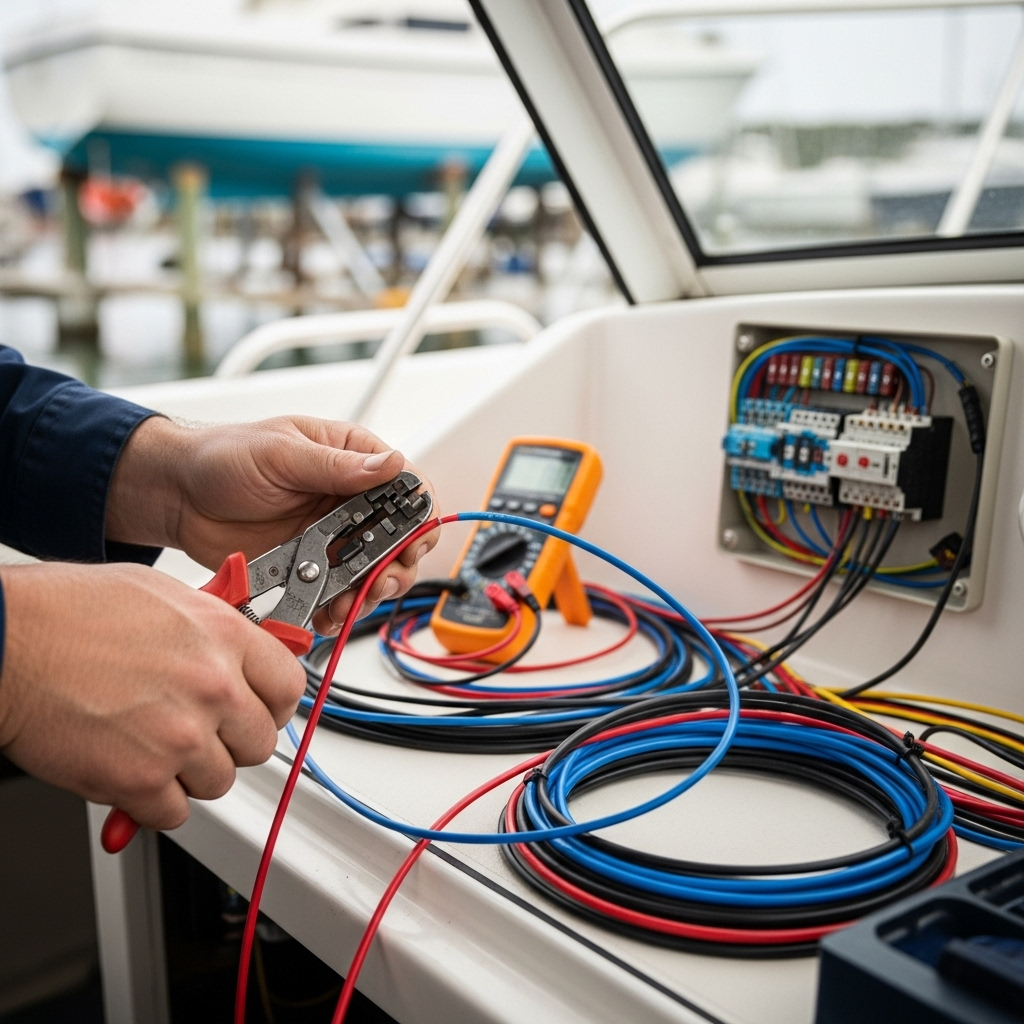
Basic Electricity Course for Boats
Why this course?
The Basic Electricity for Boats
This course provides you with the fundamental knowledge to understand and maintain your boat’s electrical system. Learn about circuits, wiring, batteries, and generators, ensuring the safety and efficiency of your onboard installation. This program is designed for both beginners and those looking to consolidate their skills.
Differential Advantages
- Key concepts explained clearly: from Ohm’s Law to surge protection.
- Practice with diagrams and schematics: learn to interpret plans and troubleshoot common problems.
- Electrical safety: understand the risks and how to prevent them to protect yourself and your vessel.
- Preventive maintenance: extend the life of your equipment and avoid costly breakdowns.
- Additional resources: access to videos, guides, and tools to continue learning at your own pace.
- Modality: Online
- Level: Cursos
- Hours: 150 H
- Start date: 24-07-2026
Availability: 1 in stock
Who is it aimed at?
- Owners of recreational and fishing boats who want to understand and maintain their vessel’s basic electrical systems.
- Shipyard and boatyard personnel looking to acquire fundamental knowledge for the installation and repair of electrical equipment.
- Nautical students and marine DIY enthusiasts who want to get started in marine electricity safely and effectively.
- Marine mechanics looking to expand their skills with basic knowledge of electricity applied to boats.
- Maintenance personnel in ports and marinas who need to diagnose and troubleshoot common electrical problems on vessels.
Learning Flexibility
Designed to adapt to your pace: 24/7 accessible online modules, practical exercises and personalized technical support.
Objectives and competencies

Diagnosing and repairing common electrical faults in boats:
Use measuring instruments, interpret electrical diagrams, and apply troubleshooting techniques to identify and correct short circuits, insulation faults, and wiring problems.

Interpret and apply current maritime electrical regulations:
To know and implement the regulations on board electrical safety, including those relating to emergency systems, batteries and prevention of electrical fires, ensuring compliance with national and international regulations.

Install and maintain basic electrical systems on boats:
“Following marine electrical safety regulations and manufacturer’s manuals.”

Selecting and sizing electrical components for boats:
Considering IEC 60092 standards, ensuring protection, safety and optimal energy performance.

Perform electrical measurements with appropriate instruments and analyze the results:
“With precision and safety, interpreting the data obtained to diagnose the condition of the circuit and detect anomalies.”

Understanding the fundamental principles of electricity and its application in boats:
Interpret electrical diagrams, diagnose basic faults and perform preventive maintenance tasks on the vessel’s electrical systems.
Curriculum - Modules
- Basic concepts: voltage, current, resistance, and power
- Ohm’s Law and calculating power consumption on boats
- Series, parallel, and mixed circuits (real-world examples on boats)
- Types of current: DC 12/24V vs. AC 110/230V on boats
- Basic electrical hazards and best practices for working on board
- Critical risks: electric shock, fire, and ground faults
- Protection with fuses, circuit breakers, and miniature circuit breakers
- Residual current devices (RCDs) and electrocution prevention in marine environments
- Grounding, bonding, and galvanic corrosion prevention
- Compliance principles and best practices (IEC 60092 / marine standards)
- Types of marine cable: cross-sections, insulation, and salinity resistance
- Calculating cable cross-section and DC voltage drop
- Terminals, connectors, proper crimping, and sealing
- Distribution panels and circuit organization
- Reading and interpreting basic electrical diagrams
- Battery Types (Lead-acid, AGM, GEL, Lithium-ion) and Onboard Uses
- Battery Banks: Configuration, Safety, and Ventilation
- Alternators, Regulators, and Shore Chargers
- Installing Switches, Relays, and Battery Isolators
- Basic Diagnostics: Discharged Battery, Charging Failure, and Parasitic Draw
- Marine Generators: Types, Capacities, and Safety
- Inverters and Converters (DC-AC / DC-DC)
- Smart Chargers and Onboard Energy Management
- Introduction to Solar Power on Vessels (Components and Connection)
- Best Practices for Safe Integration of Auxiliary Systems
- Using a multimeter: voltage, continuity, resistance, and amperage
- Identifying short circuits and insulation faults
- Detecting loose connections and corrosion in connections
- Troubleshooting common faults: lights, pumps, refrigerator, starting
- Systematic troubleshooting procedure with checklist
Plan de estudio - Módulos
- Basic concepts: voltage, current, resistance, and power
- Ohm’s Law and calculating power consumption on boats
- Series, parallel, and mixed circuits (real-world examples on boats)
- Types of current: DC 12/24V vs. AC 110/230V on boats
- Basic electrical hazards and best practices for working on board
- Critical risks: electric shock, fire, and ground faults
- Protection with fuses, circuit breakers, and miniature circuit breakers
- Residual current devices (RCDs) and electrocution prevention in marine environments
- Grounding, bonding, and galvanic corrosion prevention
- Compliance principles and best practices (IEC 60092 / marine standards)
- Types of marine cable: cross-sections, insulation, and salinity resistance
- Calculating cable cross-section and DC voltage drop
- Terminals, connectors, proper crimping, and sealing
- Distribution panels and circuit organization
- Reading and interpreting basic electrical diagrams
- Battery Types (Lead-acid, AGM, GEL, Lithium-ion) and Onboard Uses
- Battery Banks: Configuration, Safety, and Ventilation
- Alternators, Regulators, and Shore Chargers
- Installing Switches, Relays, and Battery Isolators
- Basic Diagnostics: Discharged Battery, Charging Failure, and Parasitic Draw
- Marine Generators: Types, Capacities, and Safety
- Inverters and Converters (DC-AC / DC-DC)
- Smart Chargers and Onboard Energy Management
- Introduction to Solar Power on Vessels (Components and Connection)
- Best Practices for Safe Integration of Auxiliary Systems
- Using a multimeter: voltage, continuity, resistance, and amperage
- Identifying short circuits and insulation faults
- Detecting loose connections and corrosion in connections
- Troubleshooting common faults: lights, pumps, refrigerator, starting
- Systematic troubleshooting procedure with checklist
- Seasonal electrical maintenance routines (pre- and post-navigation)
- Cleaning, protection, and sealing against moisture and salt
- Consumption management: load optimization and distribution
- System documentation: labeling, drawings, and change log
- Final inspection checklist + annual maintenance plan
- Introduction to electricity: basic concepts, quantities, and units.
- Electrical circuits: series, parallel, and mixed circuits; Kirchhoff’s laws.
- Electrical components: resistors, capacitors, inductors, diodes.
- Onboard electrical distribution systems: types of current (AC/DC), voltages.
- Generators and batteries: operation, maintenance, and safety.
- Overcurrent protection: fuses and circuit breakers, selection and sizing.
- Grounding: importance, TT, TN, and IT systems, testing and maintenance.
- Electrical safety: electrical hazards, prevention and protection measures.
- Regulations and standards: IEC, ABYC, compliance and best practices.
- First aid in case of electrical accident: CPR, burn treatment.
‘
- Introduction to electricity: basic concepts, voltage, current, resistance, and power.
- Electrical circuits: series, parallel, and mixed circuits. Ohm’s Law and Kirchhoff’s Laws.
- Standards and regulations: ABYC, ISO, and other standards applicable to marine electricity.
Electrical Components: resistors, capacitors, inductors, diodes, transistors.
Marine Wiring Systems: types of wires, gauges, color codes, and standards.
Circuit Protection: fuses, circuit breakers, and surge protectors.
Marine Batteries: types (lead-acid, AGM, gel, lithium), charging, discharging, maintenance, and safety.
Generators and Alternators: operating principles, maintenance, and basic troubleshooting.
Grounding Systems: importance of grounding, types of systems, and continuity testing.
Electrical Safety on Vessels: electrical hazards, safety measures, and protective equipment.
Personnel.
‘
- Introduction to Marine Electricity: Basic principles, current, voltage, resistance.
- Marine Batteries: Types, selection, installation, charging, maintenance, and safety.
- Marine Wiring: Cable types, sizing, color codes, connections, and protection.
- Electrical Panels and Distribution: Design, components, switches, fuses, protection devices, and grounding.
- Lighting Systems: Navigation lights, interior and exterior lighting, energy efficiency.
- Marine Electronic Equipment: Installation, connection, and compatibility of GPS, VHF radio, depth sounder, radar, and autopilot.
- Generators and Auxiliary Power Systems: Types, installation, maintenance, and safety.
- Freshwater Systems and sanitation: Pumps, switches, piping, and associated wiring.
Electrical safety on board: Protection against overcurrent, short circuits, earth leakage, and electrocution hazards.
Marine industry regulations and standards: ABYC, ISO, and local regulations.
‘
Career opportunities
- Marine Electrician: Installation, maintenance, and repair of electrical systems on recreational, commercial, and military vessels.
- Marine Electronics Technician: Diagnosing and troubleshooting navigation, communication, and entertainment equipment on board.
- Renewable Energy Installer on Vessels: Designing and implementing solar, wind, and other alternative energy systems on ships.
- Marine Automation Technician: Programming and maintaining automated control systems for engines, lights, and other equipment on board.
- Technical Advisor for Marine Electrical Equipment Sales: Providing technical support and advice to clients on the selection and use of electrical equipment for vessels.
- Electrical Installation Inspector on Ships: Conducting inspections to ensure compliance with electrical safety standards on ships. vessels.
- Marine Electric Motor Repairer: Maintenance and repair of electric motors used in propulsion, pumps, and other onboard equipment.
- Marine Electrical Safety Systems Technician: Installation and maintenance of protection systems against overloads, short circuits, and other electrical hazards on vessels.
“`
Admission requirements

Academic/professional profile:
Degree/Bachelor's degree in Nautical Science/Maritime Transport, Naval/Marine Engineering, or a related field; or proven professional experience in bridge/operations.

Language proficiency:
Recommended functional maritime English (SMCP) for simulations and technical materials.

5. Induction
Updated resume, copy of degree or seaman's book, ID card/passport, letter of motivation.

Technical requirements (for online):
Equipment with camera/microphone, stable connection, ≥ 24” monitor recommended for ECDIS/Radar-ARPA.
Admission process and dates

1. Online
application
(form + documents).

2. Academic review and interview
(profile/objectives/schedule compatibility).

3. Admission decision
(+ scholarship proposal if applicable).

4. Reservation of place
(deposit) and registration.

5. Induction
(access to campus, calendars, simulator guides).
Scholarships and grants
- Electrical Fundamentals: Learn the basic principles of electricity applied to boats.
- Onboard Systems: Master the operation and maintenance of essential electrical systems.
- Electrical Safety: Identify and mitigate risks to ensure safe navigation.
- Troubleshooting: Acquire skills to troubleshoot common electrical problems.
- Hands-on Practice: Apply your knowledge in practical exercises with boat equipment and components.
Testimonials
During my Basic Marine Electricity training, I was able to diagnose and troubleshoot a complex charging problem in a sailboat’s 12V system. Applying my knowledge of circuits, batteries, and wiring, I identified a faulty fuse in the distribution panel, replaced it, and restored power to essential navigation systems, demonstrating my competence in the vessel’s electrical systems.
During my Naval Engineering and Technology course, I exceeded my expectations by designing a hybrid propulsion system for vessels, demonstrating its viability through simulations and precise calculations. This project allowed me to apply the knowledge I had acquired and positioned me as a leader among my classmates.
I was able to diagnose and solve a complex electrical problem in my sailboat’s starting system by applying my knowledge of series and parallel circuits, voltage and current measurement, and multimeter operation. Thanks to the course, I avoided a costly repair and was able to set sail without incident.
I applied the knowledge I gained from the Basic Marine Electricity course to diagnose and troubleshoot an intermittent lighting problem on my sailboat. I identified a corroded connection on the distribution panel, cleaned and protected it, permanently resolving the issue and improving safety on board.

Frequently asked questions
Yes. The itinerary includes ECDIS/Radar-ARPA/BRM with harbor, ocean, fog, storm, and SAR scenarios.
Online with live sessions; hybrid option for simulator/practical placements through agreements.
In AC, the voltage polarity changes periodically, while in DC, the polarity remains constant.
Recommended functional SMCP. We offer support materials for standard phraseology.
Yes, with a relevant degree or experience in maritime/port operations. The admissions interview will confirm suitability.
Optional (3–6 months) through Companies & Collaborations and the Alumni Network.
Simulator practice (rubrics), defeat plans, SOPs, checklists, micro-tests and applied TFM.
A degree from Navalis Magna University + operational portfolio (tracks, SOPs, reports and KPIs) useful for audits and employment.
- Introduction to Marine Electricity: Basic principles, current, voltage, resistance.
- Marine Batteries: Types, selection, installation, charging, maintenance, and safety.
- Marine Wiring: Cable types, sizing, color codes, connections, and protection.
- Electrical Panels and Distribution: Design, components, switches, fuses, protection devices, and grounding.
- Lighting Systems: Navigation lights, interior and exterior lighting, energy efficiency.
- Marine Electronic Equipment: Installation, connection, and compatibility of GPS, VHF radio, depth sounder, radar, and autopilot.
- Generators and Auxiliary Power Systems: Types, installation, maintenance, and safety.
- Freshwater Systems and sanitation: Pumps, switches, piping, and associated wiring.
Electrical safety on board: Protection against overcurrent, short circuits, earth leakage, and electrocution hazards.
Marine industry regulations and standards: ABYC, ISO, and local regulations.
‘
Request information
- Complete the Application Form
- Attach your CV/Qualifications (if you have them to hand).
- Indicate your preferred cohort (January/May/September) and whether you want the hybrid option with simulator sessions.
Teachers
Eng. Tomás Riera
Full Professor
Eng. Tomás Riera
Full Professor
Eng. Sofía Marquina
Full Professor
Eng. Sofía Marquina
Full Professor
Eng. Javier Bañuls
Full Professor
Eng. Javier Bañuls
Full Professor
Dr. Nuria Llobregat
Full Professor
Dr. Nuria Llobregat
Full Professor
Dr. Pau Ferrer
Full Professor
Dr. Pau Ferrer
Full Professor
Cap. Javier Abaroa (MCA)
Full Professor
Cap. Javier Abaroa (MCA)
Full Professor

