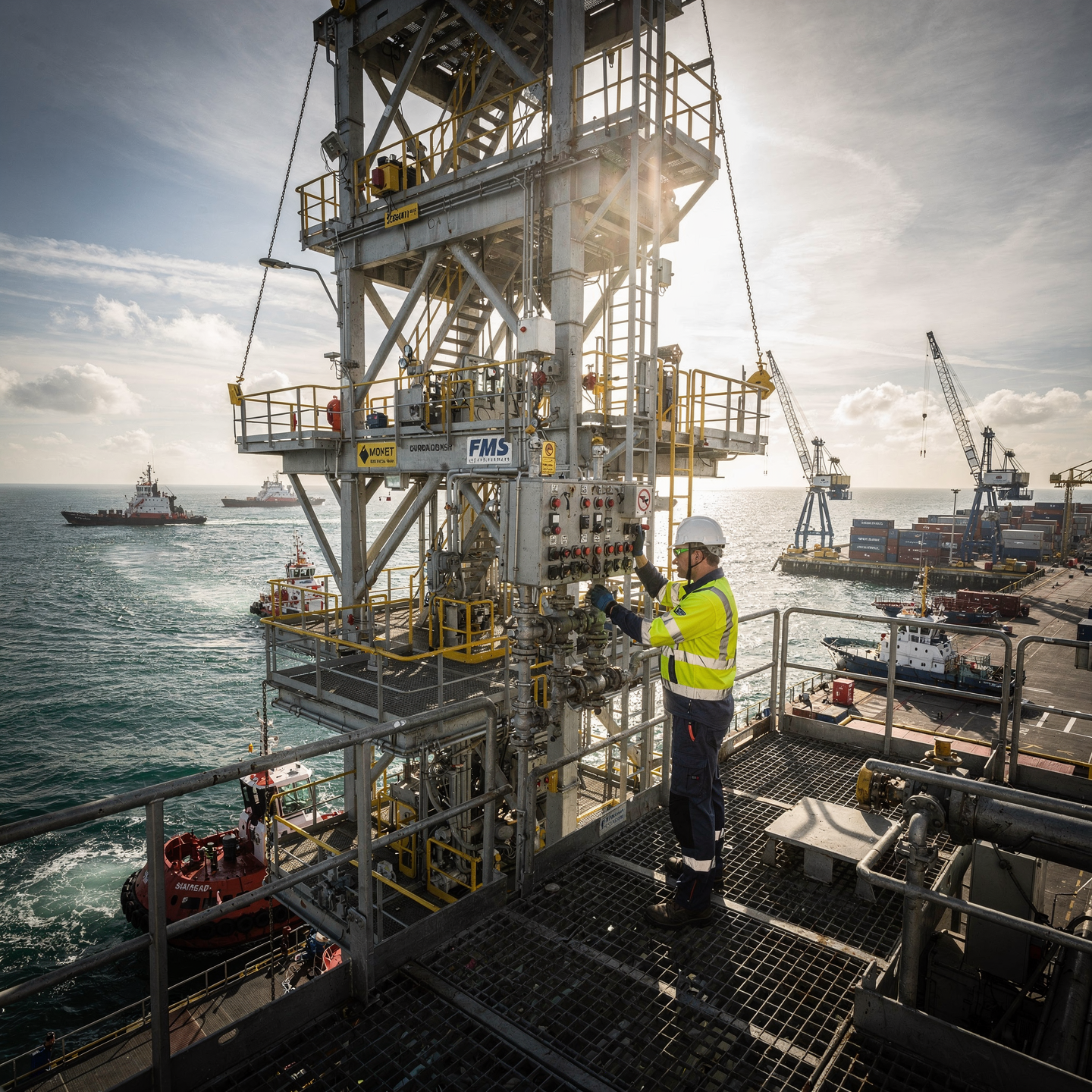
Master’s Degree in Port Engineering and Offshore Structures
Why this master’s programme?
The Master’s Degree in Port and Offshore Structures Engineering
This program provides you with comprehensive and specialized training in the design, construction, and maintenance of maritime infrastructure. Master the latest technologies and methodologies to meet the challenges of coastal and ocean engineering, from offshore wind turbine foundations to optimizing port operations. This program prepares you to lead innovative and sustainable projects in a constantly growing sector.
Differentiating Advantages
- Advanced Simulation: Numerical modeling with leading software for the analysis of offshore structures subjected to extreme environmental loads.
- Resilient Design: Strategies for adapting to climate change and protecting port infrastructure against extreme events.
- Innovative Materials: Application of composite materials and sustainable construction techniques for cost optimization and environmental impact reduction.
- Comprehensive Project Management: Development of leadership and management skills for the planning, execution, and control of complex projects in marine environments.
- Professional Networking: Direct contact with industry experts and internship opportunities at leading companies. international.
- Modality: Online
- Level: Masters
- Hours: 1600 H
- Start date:
Availability: 1 in stock
Who is it aimed at?
- Civil engineers, road engineers, and port engineers seeking to specialize in the design, construction, and maintenance of maritime and coastal infrastructure.
- Architects and urban planners interested in the planning and sustainable development of port and coastal areas.
- Maritime and energy sector professionals requiring advanced technical knowledge of offshore structures and marine renewable energy.
- Project and infrastructure managers in construction companies, engineering consultancies, and public administrations who wish to lead complex projects in the port and offshore sectors.
- Graduates in engineering and related sciences aspiring to a high-level professional career in a strategic and constantly evolving sector Evolution.
Flexibility and specialization
Adapted to the needs of the labor market: specialized modules, real-world case studies, and focus on the latest design and simulation technologies.
Objectives and skills

Designing and building resilient port infrastructure:
“To assess vulnerability to extreme weather events and propose adaptation solutions based on risk analysis and predictive modeling.”

Manage and optimize the operation of maritime terminals:
Plan and execute the stowage of ships safely and efficiently, considering cargo type, stability and applicable regulations.

Assessing and mitigating risks in maritime and coastal projects:
“Identify hazards (meteorology, bathymetry, traffic) and implement pre-established contingency plans.”

Lead marine engineering projects with sustainability criteria:
“Select shipbuilding materials and technologies that minimize environmental impact and optimize the vessel’s energy efficiency.”

Analyze and model the behavior of offshore structures subjected to extreme environmental loads:
“Implement static and dynamic nonlinear analysis to predict structural response to giant waves and seismic events.”

Develop and implement innovative solutions for offshore wind energy:
“Optimize the design of offshore wind farms to maximize energy production and minimize environmental impact, integrating state-of-the-art technologies and advanced predictive models.”
Study plan – Modules
- Fundamentals of offshore structural design: environmental loads, safety criteria, and international standards (API, ISO, DNV-GL)
- Advanced analysis of hydrodynamic and aerodynamic loads: waves, extreme winds, storm currents, and their impact on structures
- Numerical modeling and computational simulation: adaptive finite elements and CFD methods for optimization in complex marine environments
- Innovative materials and technologies for offshore structures: high-strength steels, anti-corrosion coatings, and advanced composites
- Seismic design and structural strength: dynamic analysis techniques, response spectra, and seismic isolation applied to offshore platforms
- Integration of real-time structural monitoring systems: strain sensors, accelerometers, and data acquisition systems for predictive maintenance
- Topological optimization and parametric design: structural weight reduction while maintaining integrity and durability in challenging environments hostile environments
- Fatigue and fracture mitigation strategies: cumulative damage assessment, non-destructive inspection techniques, and in-service repair
- Resilient and adaptive design: methodologies for addressing changing scenarios related to climate change and unusual extreme events
- Real-world case studies and benchmarking: analysis of successful offshore projects, lessons learned, and best practices in port and offshore engineering
- Failure scenario simulation and structural risk analysis: probabilistic and deterministic methods to ensure operational safety
- Comprehensive planning and management of offshore engineering projects: multidisciplinary coordination, critical deadlines, and strict quality control
- Fundamentals of structural mechanics applied to offshore structures: concepts of stiffness, strength, and stability in marine environments
- Theory of vibrations and nonlinear dynamics: modal analysis, natural frequencies, eigenmodes, and structural response to dynamic loads
- Characterization of the severe marine environment: extreme waves, wind, ocean currents, and their interaction with structures
- Advanced numerical modeling: finite elements, finite differences, and spectral methods for dynamic structural simulation
- Simulation of hydrodynamic and aeroelastic loads: integration of air and water forces in structural behavior
- Fatigue and service life analysis based on cyclic loads and extreme events in offshore structures
- Implementation of specialized software: use of tools such as ANSYS, Abaqus, and OrcaFlex for multimodal modeling and simulation
- Validation of computational models with data Experimental and parameter calibration techniques
Structural optimization for strength and cost under safety and dynamic performance criteria
Case studies and field studies on oil platforms, offshore wind farms, and ports under severe weather conditions
- Fundamentals of offshore structural design: international standards, design criteria, and safety factors applied to marine structures
- Dynamic analysis of offshore structures: modeling of hydrodynamic loads, wave effects, currents, and wind in extreme environments
- Advanced numerical simulation methodologies: finite elements, nonlinear dynamics, and fatigue analysis under cyclic loads
- Multimodal structural optimization: efficient design under dynamic loads, material and cost reduction without compromising integrity
- Integrated computational modeling: state-of-the-art software tools for real-time structural behavior simulation
- Structural resilience and adaptability: techniques to improve response to extreme events such as severe storms, submarine earthquakes, and collisions
- Soil-structure interaction analysis of platforms and piles: evaluation of stability and displacements in marine soils
- Risk assessment and mitigation: failure mode identification, probabilistic analysis, and predictive maintenance strategies
- Integration of smart sensors and structural monitoring systems for early detection of damage and deformations
- Case studies and real-world projects: design and analysis of iconic offshore structures, special ports, and oil platforms in harsh environments
complexes
- Fundamentals of structural inspection in port and offshore infrastructure: international regulations, API, DNV, and LRFD standards applied
- Advanced non-destructive testing (NDT) methodologies: ultrasound, radiography, infrared thermography, and eddy currents for fatigue and corrosion detection
- Structural integrity analysis: damage assessment, remaining life calculation, and failure criteria under dynamic marine and seismic loads
- Automated inspection techniques using drones and underwater robots (ROVs/AUVs): data acquisition, processing, and anomaly reporting in harsh environments
- Prediction and management of corrosion degradation in marine environments: influencing factors, atmospheric corrosion models, and Underwater
Implementation of predictive maintenance systems: integration of IoT sensors, SCADA, and big data analytics to anticipate structural failures
Computational modeling and FEM (finite element) simulation for structural assessment and rehabilitation
Inspection procedures during construction and throughout the lifecycle: quality control, on-site verification, and technical documentation
Planning of maintenance programs and periodic reviews: technical and economic criteria to maximize availability and operational safety
Practical case studies: analysis of structural failures in offshore platforms and port structures, lessons learned, and regulatory improvements
- Introduction to Port and Offshore Engineering: Concepts, Historical Evolution, and Current Trends
- Fundamentals of Marine Soil Mechanics: Geotechnical Characterization, Stratigraphic Profiles, and Advanced In-Situ Sampling Techniques
- Advanced Structural Analysis of Port Infrastructure: Applications of Finite Elements, Nonlinear Dynamics, and Seismic Considerations
- Design and Dimensioning of Offshore Piles and Foundations: Static and Dynamic Methods, Calculation of Bearing Capacity and Corrosion Resistance
- Hydro-Mechanical Modeling of Waves and Currents: CFD Systems, Fluid-Structure Interaction, and Effects on Submerged and Partially Submerged Structures
- Integrated Engineering of Offshore Systems: Fixed and Floating Platforms, Umbilical Cables, and Dynamic Anchoring Systems
- Evaluation and Mitigation of Environmental and Climate Risks: Probabilistic Analysis of Extreme Tides and Storms
and changes in sea level
International regulations and technical standards applicable to port and offshore infrastructure: API, ISO, OCIMF, and PIANC recommendations
Technological innovations in construction and maintenance: robotics, real-time structural monitoring using smart sensors and drones
Comprehensive management of port and offshore projects: advanced planning, quality control, maritime logistics, and cost and time optimization techniques
Cost-structural protection systems: breakwaters, seawalls, and seabed stabilization techniques using geosynthetics and bioengineering
Simulation and operational impact assessment: maritime traffic, port maneuvers, and congestion and safety management systems
Real-world case studies and critical analysis of landmark projects worldwide: lessons learned and practical applications
Specialized software and advanced digital tools applied to port and offshore engineering: Modeling, design, and comprehensive infrastructure management
Sustainable development in offshore and port engineering: environmental criteria, circular economy, and corporate social responsibility in infrastructure projects
- Fundamentals of Solid Mechanics and Dynamic Behavior Applied to Offshore Structures
- Advanced Nonlinear Analysis: Numerical Methods, Finite Elements, Constitutive Models, and Large Deformation Simulation
- Modeling and Simulation of Extreme Environmental Loads: Severe Waves, Cyclonic Winds, Intense Currents, and Seismic Events
- Structural Resilience Assessment Methodologies: Ductility Criteria, Energy Absorption Capacity, and Damage Tolerance
- Topological and Parametric Optimization for Structural Efficiency and Cost Reduction in Complex Offshore Designs
- Integration of Advanced Materials: Composites, High-Strength Steels, and Coating Technologies for Corrosion and Fatigue Protection
- Computational Fluid Dynamics (CFD) Applied to Fluid-Structure Interactions and Their Influence on Stability and Vibrations
- Performance-based design and specific international standards for offshore structures (API, DNV, ISO)
- Probabilistic reliability analysis and risk assessment for preventing catastrophic failures under extreme conditions
- Implementation of real-time structural monitoring systems: sensors, data acquisition, predictive analytics, and predictive maintenance
- Case studies of structural failures in ports and offshore platforms: diagnosis, causes, and lessons learned
- Advanced software tools: structural simulation applications, integrated modeling, and multi-objective optimization
- Sustainable and resilient design strategies in the face of climate change and extreme weather events
- Life cycle management of structures and evaluation of their residual capacity to ensure safety and functionality
- Future trends in offshore engineering: artificial intelligence, digital technologies twins, automation, and smart materials
- Fundamentals of offshore structural design: strength, durability, and fatigue criteria in extreme marine environments
- Advanced materials for offshore structures: selection, behavior under corrosion, erosion, and dynamic loads
- Dynamic analysis of structures: vibration theory, numerical methods, and modeling of behavior under waves, wind, and earthquakes
- Computational simulation and modeling: advanced use of FEM/CFD software for stress and strain evaluation in complex offshore structures
- Resilient design: strategies to increase redundancy, damage tolerance, and post-event recovery capacity
- Integration of intelligent structural monitoring (SHM) systems: sensors, real-time data acquisition, and predictive maintenance protocols
- Advanced inspection and maintenance methodologies: non-destructive techniques, safe access, and condition-based planning
- Applicable international standards: API, ISO, DNV-GL, and its correct application in the design and certification of offshore structures
Environmental impact and sustainability: design to minimize the ecological footprint and strategies for marine environment recovery
Real-world case studies: critical analysis of successful and failed offshore projects, lessons applied to contemporary engineering
- Fundamentals and evolution of automation in ports and offshore structures: history, trends, and future challenges
- Integration of cyber-physical systems: modeling, simulation, and real-time control for port operations and offshore platforms
- Advanced sensing technologies: IoT, smart sensors, and M2M communication for environmental and structural monitoring
- SCADA and DCS systems: architecture, communication protocols, and distributed monitoring and control strategies
- Application of Big Data and predictive analytics for port logistics optimization and predictive infrastructure maintenance
- Autonomous robotics and unmanned vehicles: drones, ROVs, and AGVs for inspection, security, and operations in complex offshore environments
- Implementation of artificial intelligence and machine learning for adaptive management and automated real-time decision-making
- Automation of cranes and cargo handling systems: design, motion control, and safety systems to increase efficiency and reduce risks
- Integration of digital platforms and logistics information systems (TOS, ERP) for the comprehensive and sustainable management of smart ports
- Sustainability and energy efficiency: clean technologies, consumption optimization, and emissions reduction in port and offshore operations
- Regulations, international standards, and cybersecurity protocols applied to the automation and remote operation of critical infrastructure
- Case studies and advanced simulations: strategic project design, risk assessment, and continuous improvement using digital twins
- Development of contingency plans and operational resilience using intelligent systems and robust automation in the face of adverse conditions
- Training and change management: skills required for technical personnel in the face of the technological revolution in ports and offshore structures
- Future perspectives: Integrating 5G networks, cloud computing, and blockchain for advanced traceability and security in port management
- Fundamentals of computational modeling in offshore engineering: principles, techniques, and advanced tools
- Theory and application of numerical methods for structural simulation under dynamic marine loads
- Integration of hydrodynamic and structural models: coupled analysis for offshore platforms and ports
- Simulation of extreme events: severe swells, hurricane-force wind loads, and atmospheric cyclones
- Structural resilience: concepts and criteria for design under extreme conditions and progressive deterioration
- Implementation of real-time structural monitoring systems and their contribution to failure prevention
- Topological and parametric optimization in the design of offshore structures: techniques based on genetic algorithms and machine learning
- Risk management and probabilistic analysis applied to port infrastructure and platforms maritime
International regulations and technical standards applicable to the resilient and optimized design of offshore structures
Advanced case studies: practical application of computational modeling to maximize durability and safety in complex maritime works
- Fundamentals of offshore structural design: analysis of hydrodynamic loads, wind, waves, and extreme currents
- Advanced methodologies for numerical modeling and CFD simulation applied to marine structures
- Innovative materials and technologies for the sustainable construction of ports and offshore platforms
- Integration of risk mitigation systems: anti-corrosion solutions, structural monitoring, and predictive maintenance
- Design optimization using resilient engineering techniques to adapt to changing environmental conditions
- Environmental and social impact assessment of offshore projects under international regulations and sustainability criteria
- Application of international technical standards and codes in the design and construction of port and offshore infrastructure
- Comprehensive management of offshore projects: planning, quality control, logistics, and environmental compliance
- Development of renewable energy systems integrated into marine infrastructure to promote efficiency energy
- Final project development: detailed design, structural analysis, technical report, and innovation proposals for sustainable and resilient offshore systems
Career prospects
“`html
- Offshore Structural Design Engineer: Calculation and design of platforms, foundations, and marine structures.
- Offshore Project Engineer: Comprehensive management of construction and maintenance projects for marine infrastructure.
- Marine Renewable Energy Specialist: Development and optimization of offshore wind farms and other ocean energy sources.
- Maritime and Port Engineering Consultant: Technical advice on the design, construction, and operation of ports and coastal facilities.
- Ocean Engineering Researcher: Development of new technologies and models for the simulation and analysis of the behavior of structures at sea.
- Offshore Maintenance Engineer: Planning and execution of preventive and corrective maintenance programs on platforms and marine structures.
- Safety and Offshore Risk: Risk assessment and development of safety plans for offshore operations.
Coastal Engineer: Design and management of coastal protection works and beach regeneration.
Numerical Modeling and Wave and Current Simulation Technician: Application of specialized software for the analysis of ocean behavior.
Port Infrastructure Manager: Planning, development, and maintenance of port and maritime terminal infrastructure.
“`
Entry requirements

Academic/professional profile:
Bachelor’s degree in Nautical Science/Maritime Transport, Naval/Marine Engineering or a related qualification; or proven professional experience on the bridge/in operations.

Language proficiency:
Functional Maritime English (SMCP) recommended for simulations and technical materials.

Documentation:
Updated CV, copy of qualification or seaman’s book, national ID/passport, motivation letter.

Technical requirements (for online):
Device with camera/microphone, stable internet connection, monitor ≥ 24” recommended for ECDIS/Radar-ARPA.
Admissions process and dates

Online
application
(form + documents).

Academic review and interview
Admissions decision

Admissions decision
(+ scholarship offer if applicable).

Place reservation
(deposit) and enrolment.

Induction
(access to the virtual campus, calendars, simulator guides).
Scholarships and financial support
- Advanced Design and Calculation: Master modeling and simulation tools for port and offshore structures.
- International Standards: Delve into the key standards and regulations for the safety and sustainability of maritime infrastructure.
- Marine Renewable Energies: Specialize in the design and construction of platforms for wind and wave energy generation.
- Offshore Project Management: Acquire the necessary skills for the planning, execution, and control of projects in demanding marine environments.
- Practical Simulations: Apply your knowledge to real-world cases and collaborative projects with companies in the sector.
Testimonials
During my Master’s degree in Port and Offshore Structures Engineering, I exceeded my expectations by designing an innovative floating platform for offshore wind energy generation. My design optimized stability and resistance to extreme sea conditions, receiving praise from the evaluation panel for its technical feasibility and potential impact on the renewable energy industry. This experience solidified my knowledge of hydrodynamics, structural analysis, and offshore design, preparing me to make a significant contribution to the sector.
During my Master’s degree in Naval Construction & Design, I led the development of an innovative propulsion system for recreational boats, achieving a 15% reduction in fuel consumption, validated through CFD simulations. This project was awarded for its efficiency and sustainability, and allowed me to obtain a position as chief engineer at a leading company in the sector.
During my Master’s degree in Port and Offshore Structures Engineering, I developed an innovative numerical model to predict fatigue in floating wind energy structures, which was validated with experimental data and subsequently published in a high-impact scientific journal. This work allowed me to obtain a doctoral scholarship to continue researching in this field.
I applied the knowledge I gained during my Master’s program to optimize the design of an offshore platform, reducing construction costs by 15% and increasing its resistance to extreme environmental conditions. This achievement was crucial in ensuring the project’s viability and established me as an expert in the field.

Frequently asked questions
Both areas, ports and offshore structures, are studied in depth, although the specific approach may vary depending on each university’s program.
Yes. The itinerary includes ECDIS/Radar-ARPA/BRM with harbor, ocean, fog, storm, and SAR scenarios.
Online with live sessions; hybrid option for simulator/practical placements through agreements.
In both cases, both in coastal structures and in structures located in the open sea (offshore).
Recommended functional SMCP. We offer support materials for standard phraseology.
Yes, with a relevant degree or experience in maritime/port operations. The admissions interview will confirm suitability.
Optional (3–6 months) through Companies & Collaborations and the Alumni Network.
Simulator practice (rubrics), defeat plans, SOPs, checklists, micro-tests and applied TFM.
A degree from Navalis Magna University + operational portfolio (tracks, SOPs, reports and KPIs) useful for audits and employment.
- Fundamentals of offshore structural design: analysis of hydrodynamic loads, wind, waves, and extreme currents
- Advanced methodologies for numerical modeling and CFD simulation applied to marine structures
- Innovative materials and technologies for the sustainable construction of ports and offshore platforms
- Integration of risk mitigation systems: anti-corrosion solutions, structural monitoring, and predictive maintenance
- Design optimization using resilient engineering techniques to adapt to changing environmental conditions
- Environmental and social impact assessment of offshore projects under international regulations and sustainability criteria
- Application of international technical standards and codes in the design and construction of port and offshore infrastructure
- Comprehensive management of offshore projects: planning, quality control, logistics, and environmental compliance
- Development of renewable energy systems integrated into marine infrastructure to promote efficiency energy
- Final project development: detailed design, structural analysis, technical report, and innovation proposals for sustainable and resilient offshore systems
Request information
Complete the Application Form.
Attach your CV/degree certificate (if you have it to hand).
Indicate your preferred cohort (January/May/September) and whether you would like the hybrid option with simulator sessions.
An academic advisor will contact you within 24–48 hours to guide you through the admission process, scholarships, and compatibility with your professional schedule.
Faculty
Eng. Tomás Riera
Full Professor
Eng. Tomás Riera
Full Professor
Eng. Sofía Marquina
Full Professor
Eng. Sofía Marquina
Full Professor
Eng. Javier Bañuls
Full Professor
Eng. Javier Bañuls
Full Professor
Dr. Nuria Llobregat
Full Professor
Dr. Nuria Llobregat
Full Professor
Dr. Pau Ferrer
Full Professor
Dr. Pau Ferrer
Full Professor
Cap. Javier Abaroa (MCA)
Full Professor
Cap. Javier Abaroa (MCA)
Full Professor

