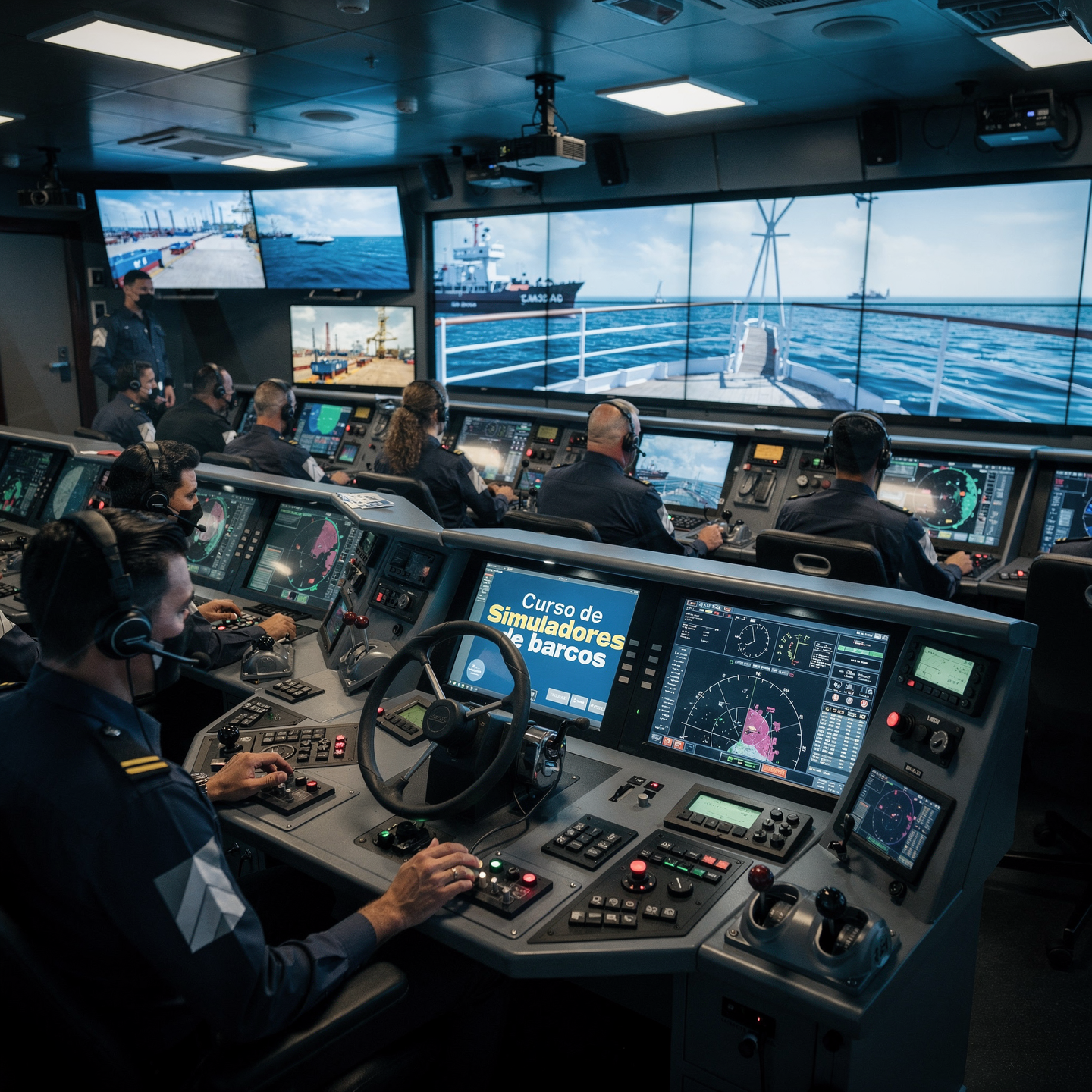
Boat Simulators Course
Why this course?
Master the art of navigation with our Ship Simulators course.
Learn to control vessels in diverse scenarios, from adverse weather conditions to complex port maneuvers, all in a safe and realistic virtual environment. This course will prepare you to face the challenges of the sea with confidence and precision.
Key Benefits:
- Risk-Free Hands-on Experience: Practice complex maneuvers and emergency situations without the real-life consequences.
- Advanced Skills Development: Improve your reaction time, decision-making, and coordination while navigating.
- Personalized Training: Adapt scenarios and challenges to your experience level and specific needs.
- Certification Preparation: Gain a solid foundation to advance your maritime career and obtain relevant certifications.
- Learning Flexibility: Access the simulator from anywhere and learn at your own pace.
- Modality: Online
- Level: Cursos
- Hours: 150 H
- Start date: 24-10-2026
Availability: 1 in stock
Who is it aimed at?
- Naval engineering and marine architecture students looking to apply theory in a practical setting and develop design and simulation skills.
- Naval engineers and architects wanting to explore new ship configurations, optimize performance, and validate designs before construction.
- Shipyard operators and shipping companies interested in evaluating the impact of modifications to existing ships and optimizing operational efficiency.
- Researchers and academics seeking a tool to model and simulate ship behavior under various environmental and operational conditions.
- Naval design and simulation enthusiasts wanting to experiment with creating and testing different types of ships in a realistic environment virtual.
Learning Flexibility
Adapted to professionals and students: access to online simulations, practical exercises with personalized feedback, and a user community to share experiences.
Objectives and competencies

Mastering navigation techniques in diverse climatic and geographical conditions:
“Interpret and apply meteorological and oceanographic information to optimize the route and anticipate risks.”

Efficiently manage resources and crew in emergency situations:
“Establish clear priorities, communicate effectively, and delegate tasks under pressure, optimizing the response and minimizing risks.”

Operate ship propulsion systems and machinery safely and efficiently:
Optimize system performance, minimizing fuel consumption and emissions, through the application of standardized procedures and continuous analysis of operating parameters.

Develop effective communication skills for team decision-making:
“To promote active listening and the clear expression of ideas, facilitating constructive debate and convergence towards consensus solutions.”

Apply maritime safety and risk prevention procedures in navigation:
“Perform inspections and maintenance of safety equipment (life jackets, rafts, EPIRBs) ensuring their operability.”

Interpret and apply international and local maritime regulations:
“Manage compliance with SOLAS and MARPOL, adapting procedures to local legislation and reporting incidents to the maritime authority.”
Curriculum - Modules
- Comprehensive Maritime Incident Management: protocols, roles, and chain of command for coordinated response
- Operational Planning and Execution: briefing, routes, weather windows, and go/no-go criteria
- Rapid Risk Assessment: criticality matrix, scene control, and decision-making under pressure
- Operational Communication: VHF/GMDSS, standardized reports, and inter-agency liaison
- Tactical Mobility and Safe Boarding: RHIB maneuvers, approach, mooring, and recovery
- Equipment and Technologies: PPE, signaling, satellite tracking, and field data logging
- Immediate Care of the Affected: primary assessment, hypothermia, trauma, and stabilization for evacuation
- Adverse Environmental Conditions: swell, Visibility, flows, and operational mitigation
Simulation and training: critical scenarios, use of VR/AR, and exercises with performance metrics
Documentation and continuous improvement: lessons learned, indicators (MTTA/MTTR), and SOP updates
- Introduction to Nautical Simulators: types, functionalities, validation
- Ship Modeling: hydrodynamic characteristics, steering, behavior under different conditions
- Simulated Maritime Environment: creation and modification of scenarios, meteorological and oceanographic conditions
- Basic Maneuvers: starting, stopping, turns, buoyancy
- Docking and Undocking Maneuvers: different dock configurations, use of tugboats, spring-rigged boats
- Maneuvers in Channels and Restricted Waters: bank effects, interaction with other vessels
- Maneuvers in Strong Winds and Currents: control strategies, use of navigational aids
- Maneuvers of Emergency: man overboard, engine failure, emergency steering
Ship-to-Ship Transfer (STS) Operations: planning, execution, safety
Maneuver Evaluation and Analysis: debriefing, error identification, continuous improvement
‘
- Naval Hydrodynamics: Forces and moments, static and dynamic stability.
- Behavior at Sea: Ship movements, roll, pitch, yaw, resistance.
- Ship Steering: Rudder, propellers, propeller effects, rudder/engine coordination.
- Maneuvers in Restricted Waters: Channels, ports, rivers, shore effects, and shallow water.
- Bedding and Unberthing Maneuvers: Use of tugs, mooring lines, and spring lines.
- Maneuvers in Wind and Current: Force compensation, drift angles.
- Anchoring and Lifting Maneuvers: Advanced techniques, situations of Emergency.
Towing Maneuvers: Preparation, execution, safety.
Search and Rescue (SAR) Maneuvers: Search patterns, coordination.
Emergency Maneuvers: Man overboard, rudder failure, loss of propulsion.
‘
- Fundamentals of Naval Dynamics: Forces, stability, and ship control.
- Maneuvering in Adverse Conditions: Wind, current, waves, and shallow water.
- Tugboats: Types, connection systems, communications, and coordinated maneuvers.
- Approach and Docking/Undocking: Advanced techniques, use of propellers and thrusters.
- Man Overboard Maneuvers: Rapid and safe recovery, different techniques.
- Onboard Emergencies: Fires, flooding, steering failures, and collisions.
- Emergency Simulation: Use of simulators for training and evaluation.
- Management of Crisis: Communication, decision-making, and coordination in emergency situations.
Post-Incident Analysis: Investigation of causes, lessons learned, and continuous improvement.
Legislation and Regulations: Relevant international conventions and maritime regulations.
‘
- Introduction to Naval Dynamics: Forces, Moments, and Stability
- Types of Naval Simulators: Full Bridge, Engine Room, Cargo Control
- Mathematical Modeling of Ships: Hydrodynamics, Propulsion, and Steering
- Environmental Effects: Wind, Waves, Currents, and Shallow Water
- Ship-to-Ship Interaction: Tugs, Supply Transfer, and Bunkering
- Approach and Docking Maneuvers: Piers, Buoys, Locks, and Platforms
- Maneuvers in Extreme Conditions: Storms, Ice, and Fog
- Damage Control: Flooding, Fire, and Loss of Steering
- Emergency Maneuvers: Man Overboard, Abandon Ship, and Collisions
- Risk Analysis and Decision-Making of decisions in critical situations
‘
- System Architecture and Components: Structural design, materials, and subsystems (mechanical, electrical, electronic, and fluid) with selection and assembly criteria for marine environments
- Fundamentals and Principles of Operation: Physical and engineering foundations (thermodynamics, fluid mechanics, electricity, control, and materials) that explain performance and operating limits
- Safety and Environmental (SHE): Risk analysis, PPE, LOTO, hazardous atmospheres, spill and waste management, and emergency response plans
- Applicable Regulations and Standards: IMO/ISO/IEC requirements and local regulations;
- Conformance criteria, certification, and best practices for operation and maintenance
- Inspection, testing, and diagnostics: Visual/dimensional inspection, functional testing, data analysis, and predictive techniques (vibration, thermography, fluid analysis) to identify root causes
- Preventive and predictive maintenance: Hourly/cycle/seasonal plans, lubrication, adjustments, calibrations, consumable replacement, post-service verification, and operational reliability
- Instrumentation, tools, and metrology: Measuring and testing equipment, diagnostic software, calibration and traceability; selection criteria, safe use, and storage
- Onboard integration and interfaces: Mechanical, electrical, fluid, and data compatibility; Sealing and watertightness, EMC/EMI, corrosion protection, and interoperability testing.
Quality, acceptance testing, and commissioning: process and materials control, FAT/SAT, bench and sea trials, go/no-go criteria, and evidence documentation.
Technical documentation and integrated practice: logs, checklists, reports, and a complete case study (safety → diagnosis → intervention → verification → report) applicable to any system.
Plan de estudio - Módulos
- Comprehensive Maritime Incident Management: protocols, roles, and chain of command for coordinated response
- Operational Planning and Execution: briefing, routes, weather windows, and go/no-go criteria
- Rapid Risk Assessment: criticality matrix, scene control, and decision-making under pressure
- Operational Communication: VHF/GMDSS, standardized reports, and inter-agency liaison
- Tactical Mobility and Safe Boarding: RHIB maneuvers, approach, mooring, and recovery
- Equipment and Technologies: PPE, signaling, satellite tracking, and field data logging
- Immediate Care of the Affected: primary assessment, hypothermia, trauma, and stabilization for evacuation
- Adverse Environmental Conditions: swell, Visibility, flows, and operational mitigation
Simulation and training: critical scenarios, use of VR/AR, and exercises with performance metrics
Documentation and continuous improvement: lessons learned, indicators (MTTA/MTTR), and SOP updates
- Introduction to Nautical Simulators: types, functionalities, validation
- Ship Modeling: hydrodynamic characteristics, steering, behavior under different conditions
- Simulated Maritime Environment: creation and modification of scenarios, meteorological and oceanographic conditions
- Basic Maneuvers: starting, stopping, turns, buoyancy
- Docking and Undocking Maneuvers: different dock configurations, use of tugboats, spring-rigged boats
- Maneuvers in Channels and Restricted Waters: bank effects, interaction with other vessels
- Maneuvers in Strong Winds and Currents: control strategies, use of navigational aids
- Maneuvers of Emergency: man overboard, engine failure, emergency steering
Ship-to-Ship Transfer (STS) Operations: planning, execution, safety
Maneuver Evaluation and Analysis: debriefing, error identification, continuous improvement
‘
- Naval Hydrodynamics: Forces and moments, static and dynamic stability.
- Behavior at Sea: Ship movements, roll, pitch, yaw, resistance.
- Ship Steering: Rudder, propellers, propeller effects, rudder/engine coordination.
- Maneuvers in Restricted Waters: Channels, ports, rivers, shore effects, and shallow water.
- Bedding and Unberthing Maneuvers: Use of tugs, mooring lines, and spring lines.
- Maneuvers in Wind and Current: Force compensation, drift angles.
- Anchoring and Lifting Maneuvers: Advanced techniques, situations of Emergency.
Towing Maneuvers: Preparation, execution, safety.
Search and Rescue (SAR) Maneuvers: Search patterns, coordination.
Emergency Maneuvers: Man overboard, rudder failure, loss of propulsion.
‘
- Fundamentals of Naval Dynamics: Forces, stability, and ship control.
- Maneuvering in Adverse Conditions: Wind, current, waves, and shallow water.
- Tugboats: Types, connection systems, communications, and coordinated maneuvers.
- Approach and Docking/Undocking: Advanced techniques, use of propellers and thrusters.
- Man Overboard Maneuvers: Rapid and safe recovery, different techniques.
- Onboard Emergencies: Fires, flooding, steering failures, and collisions.
- Emergency Simulation: Use of simulators for training and evaluation.
- Management of Crisis: Communication, decision-making, and coordination in emergency situations.
Post-Incident Analysis: Investigation of causes, lessons learned, and continuous improvement.
Legislation and Regulations: Relevant international conventions and maritime regulations.
‘
- Introduction to Naval Dynamics: Forces, Moments, and Stability
- Types of Naval Simulators: Full Bridge, Engine Room, Cargo Control
- Mathematical Modeling of Ships: Hydrodynamics, Propulsion, and Steering
- Environmental Effects: Wind, Waves, Currents, and Shallow Water
- Ship-to-Ship Interaction: Tugs, Supply Transfer, and Bunkering
- Approach and Docking Maneuvers: Piers, Buoys, Locks, and Platforms
- Maneuvers in Extreme Conditions: Storms, Ice, and Fog
- Damage Control: Flooding, Fire, and Loss of Steering
- Emergency Maneuvers: Man Overboard, Abandon Ship, and Collisions
- Risk Analysis and Decision-Making of decisions in critical situations
‘
- System Architecture and Components: Structural design, materials, and subsystems (mechanical, electrical, electronic, and fluid) with selection and assembly criteria for marine environments
- Fundamentals and Principles of Operation: Physical and engineering foundations (thermodynamics, fluid mechanics, electricity, control, and materials) that explain performance and operating limits
- Safety and Environmental (SHE): Risk analysis, PPE, LOTO, hazardous atmospheres, spill and waste management, and emergency response plans
- Applicable Regulations and Standards: IMO/ISO/IEC requirements and local regulations;
- Conformance criteria, certification, and best practices for operation and maintenance
- Inspection, testing, and diagnostics: Visual/dimensional inspection, functional testing, data analysis, and predictive techniques (vibration, thermography, fluid analysis) to identify root causes
- Preventive and predictive maintenance: Hourly/cycle/seasonal plans, lubrication, adjustments, calibrations, consumable replacement, post-service verification, and operational reliability
- Instrumentation, tools, and metrology: Measuring and testing equipment, diagnostic software, calibration and traceability; selection criteria, safe use, and storage
- Onboard integration and interfaces: Mechanical, electrical, fluid, and data compatibility; Sealing and watertightness, EMC/EMI, corrosion protection, and interoperability testing.
Quality, acceptance testing, and commissioning: process and materials control, FAT/SAT, bench and sea trials, go/no-go criteria, and evidence documentation.
Technical documentation and integrated practice: logs, checklists, reports, and a complete case study (safety → diagnosis → intervention → verification → report) applicable to any system.
- Introduction to simulation: types of simulators, fidelity, and objectives
- Familiarizing yourself with the simulator environment: controls, interfaces, and visualization
- Preparing for the simulation: briefing, objectives, roles, and communication
- Maneuvering in port: berthing, unberthing, turning, and simulated anchoring
- Maneuvering in restricted waters: canals, rivers, estuaries, and locks
- Maneuvering with tugboats: types, configuration, and coordination
- Adverse weather conditions: wind, waves, current, and reduced visibility
- Equipment breakdowns and failures: steering, propulsion, electricity, and communications
- Onboard emergencies: fire, flooding, collision, grounding, and man aboard water
- Debriefing and post-simulation analysis: lessons learned and continuous improvement
‘
- Principles of Energy Optimization in Ships: Key Factors and Strategies
- Propulsion Systems: Efficiency Analysis, Maintenance, and Upgrades
- Ballast Management: Optimization to Reduce Drag
- Hulus and Propellers: Cleaning, Coatings, and Design for Efficiency
- Optimized Routes: Meteorology, Currents, and Sea State Forecasting
- Use of Alternative Fuels: LNG, Methanol, Hydrogen, and Biofuels
- Renewable Energy on Board: Solar, Wind, and System Integration
- Heat Recovery Systems: Exhaust Gas Utilization
- Monitoring and Control: Tracking Energy Consumption and Performance
- Regulations and standards on energy efficiency (EEDI, SEEMP, IMO)
‘
- Definition of Advanced Maneuvering: Scope and Objectives
- Ship Dynamics: Forces, moments, directional stability, and special effects (squat, bank, etc.)
- Ship-Tug Interaction: Types of tugs, mooring, and coordination
- Maneuvers in Adverse Conditions: Strong winds, currents, waves, ice
- Approach and Docking: Detailed planning, speed, and angles of attack
- Undocking and Departure: Strategies, use of tugs, and environmental considerations
- Emergency Maneuvers: Man overboard (MOB), engine failure, and steering
- Management of the Communication: VTS, pilot, crew, and external entities
Simulation of Complex Maneuvers: Use of simulators for training and evaluation
Post-Maneuver Analysis: Lessons learned and continuous improvement
‘
- Risk assessment in complex maneuvers: identification and mitigation
- Governing at low speeds: propeller, rudder, and wind effects
- Tugs: types, mooring, communications, and combined maneuvers
- Maneuvers in adverse conditions: strong wind, current, and swell
- Approach and docking/undocking in different configurations
- Emergency anchoring: techniques and considerations
- Governing failure management: alternative procedures
- Beaching: assessment, immediate actions, and refloating
- Man overboard: different recovery techniques
- Personnel and supply transfer maneuvers in the sea
‘
Career opportunities
- Bridge Officer on Merchant and Passenger Ships: Safe navigation, maneuvering in port and restricted waters, emergency management.
- Tugboat and Port Support Vessel Operator: Towing maneuvers, dynamic positioning, vessel assistance.
- VTS Personnel: Monitoring and management of maritime traffic, navigational assistance, incident response.
- Instructor at Maritime Training Centers: Design and delivery of simulation courses, competency assessment, development of training programs.
- Consultant for Shipping and Maritime Services Companies: Risk analysis, operational optimization, maritime accident investigation.
- Technical Personnel at Simulator Manufacturers: Development and maintenance of simulators, technical support, training for users.
- Researcher at academic institutions and maritime research centers: Development of simulation models, data analysis, maritime safety studies.
- Forensic expert in the maritime field: Reconstruction of maritime accidents, analysis of causes, preparation of expert reports.
“`
Admission requirements

Academic/professional profile:
Degree/Bachelor's degree in Nautical Science/Maritime Transport, Naval/Marine Engineering, or a related field; or proven professional experience in bridge/operations.

Language proficiency:
Recommended functional maritime English (SMCP) for simulations and technical materials.

5. Induction
Updated resume, copy of degree or seaman's book, ID card/passport, letter of motivation.

Technical requirements (for online):
Equipment with camera/microphone, stable connection, ≥ 24” monitor recommended for ECDIS/Radar-ARPA.
Admission process and dates

1. Online
application
(form + documents).

2. Academic review and interview
(profile/objectives/schedule compatibility).

3. Admission decision
(+ scholarship proposal if applicable).

4. Reservation of place
(deposit) and registration.

5. Induction
(access to campus, calendars, simulator guides).
Scholarships and grants
- Master Navigation: Learn to maneuver in diverse maritime scenarios with our state-of-the-art simulators.
- Realistic Training: Experience adverse weather conditions, equipment failures, and heavy traffic to improve your decision-making.
- Professional Certification: Earn industry-recognized credits and meet international maritime safety standards.
- Expert Instructors: Learn from captains and officers with extensive experience in navigation and simulations.
- Skills Development: Hone your emergency response capabilities and optimize fuel consumption.
Testimonials
I quickly mastered handling container ships in adverse weather conditions thanks to the realism of the simulator, which allowed me to obtain my certification with excellent marks and secure a position as first officer in a major shipping company.
I mastered the programming of navigation and autonomous control systems, applying advanced algorithms to optimize routes and maneuvers, which allowed me to lead the development of an autopilot system for recreational boats, significantly reducing fuel consumption and improving navigation accuracy.
I mastered the loading and unloading operations of a tanker in the simulator, achieving a record time and zero spills, exceeding the instructor’s expectations.
I mastered docking and undocking maneuvers in adverse weather conditions on the simulator, which allowed me to obtain my harbor master’s license with greater confidence and skill.

Frequently asked questions
To provide a safe and controlled training platform for sailors.
Yes. The itinerary includes ECDIS/Radar-ARPA/BRM with harbor, ocean, fog, storm, and SAR scenarios.
Online with live sessions; hybrid option for simulator/practical placements through agreements.
To train and evaluate the navigation and handling skills of a boat in a safe and controlled environment.
Recommended functional SMCP. We offer support materials for standard phraseology.
Yes, with a relevant degree or experience in maritime/port operations. The admissions interview will confirm suitability.
Optional (3–6 months) through Companies & Collaborations and the Alumni Network.
Simulator practice (rubrics), defeat plans, SOPs, checklists, micro-tests and applied TFM.
A degree from Navalis Magna University + operational portfolio (tracks, SOPs, reports and KPIs) useful for audits and employment.
- Risk assessment in complex maneuvers: identification and mitigation
- Governing at low speeds: propeller, rudder, and wind effects
- Tugs: types, mooring, communications, and combined maneuvers
- Maneuvers in adverse conditions: strong wind, current, and swell
- Approach and docking/undocking in different configurations
- Emergency anchoring: techniques and considerations
- Governing failure management: alternative procedures
- Beaching: assessment, immediate actions, and refloating
- Man overboard: different recovery techniques
- Personnel and supply transfer maneuvers in the sea
‘
Request information
- Complete the Application Form
- Attach your CV/Qualifications (if you have them to hand).
- Indicate your preferred cohort (January/May/September) and whether you want the hybrid option with simulator sessions.
Teachers
Eng. Tomás Riera
Full Professor
Eng. Tomás Riera
Full Professor
Eng. Sofía Marquina
Full Professor
Eng. Sofía Marquina
Full Professor
Eng. Javier Bañuls
Full Professor
Eng. Javier Bañuls
Full Professor
Dr. Nuria Llobregat
Full Professor
Dr. Nuria Llobregat
Full Professor
Dr. Pau Ferrer
Full Professor
Dr. Pau Ferrer
Full Professor
Cap. Javier Abaroa (MCA)
Full Professor
Cap. Javier Abaroa (MCA)
Full Professor

