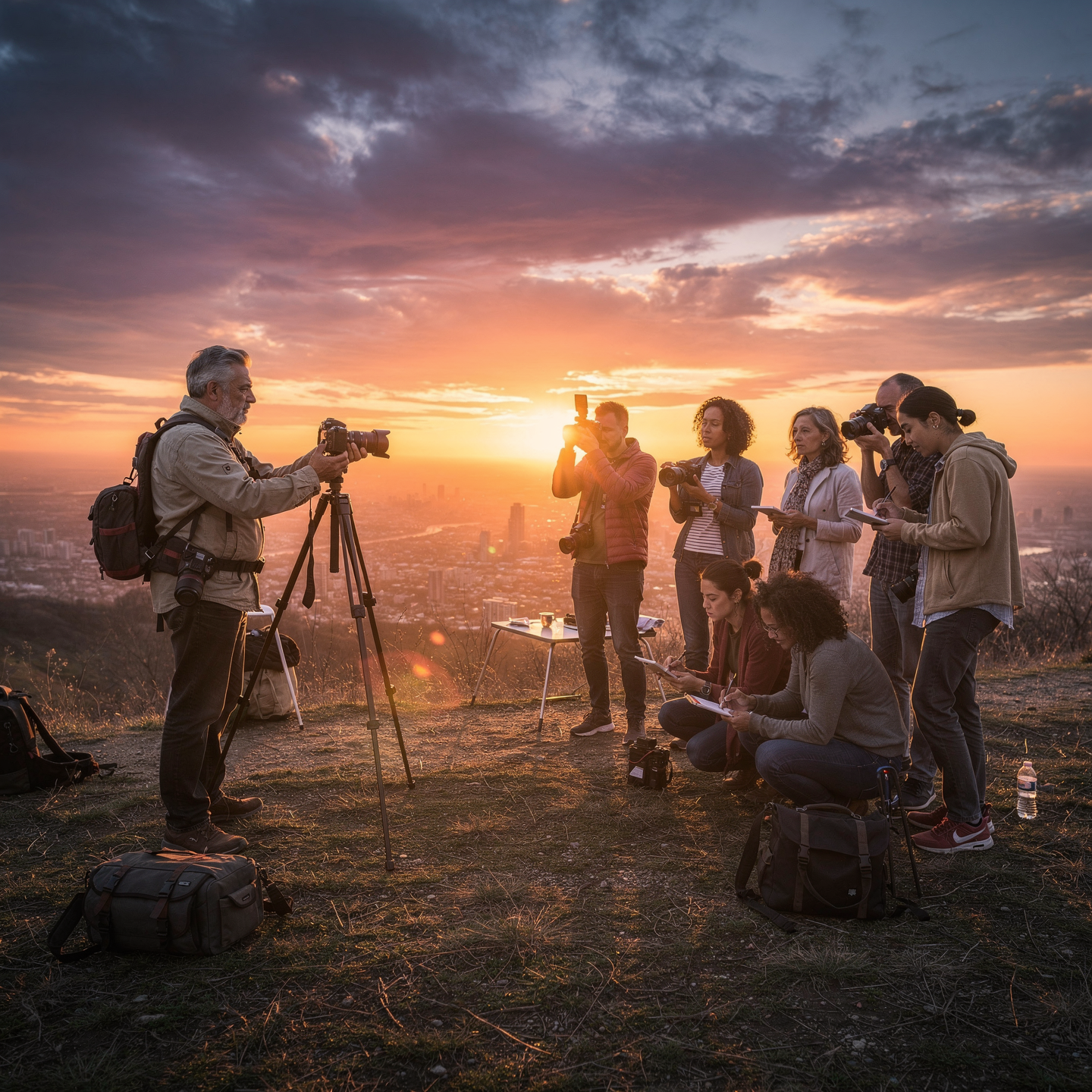
Timelapse and sunset photography course

Why this course?

Capture the magic of sunset with our Timelapse and Sunset Photography course.

Learn to master the essential techniques for creating stunning timelapse sequences and still photographs that convey the ephemeral beauty of this natural phenomenon. From planning and setting up your equipment to final editing, this course will guide you step by step so you can bring your creative vision to life and achieve professional results.

Differentiating Advantages

  • Advanced Exposure Techniques: Master the dynamic range of sunsets to achieve balanced images.
  • Strategic Planning: Learn to predict and choose the best locations and times for your sessions.
  • Professional Editing: Discover efficient workflows for processing and assembling your time-lapses and photographs.
  • Essential Equipment: Learn about the essential tools and accessories for capturing high-quality images.
  • Creative Inspiration: Explore different styles and approaches to develop your own voice as a sunset photographer.
Timelapse

Timelapse and sunset photography course

Availability: 1 in stock

Who is it aimed at?

  • Photography enthusiasts who want to take their skills to the next level and capture the magic of sunsets professionally.
  • Travelers and adventurers looking to document their experiences with stunning images and create unforgettable memories.
  • Social media content creators who want to stand out with high-quality photos and time-lapse videos, attracting a wider audience.
  • Visual artists and graphic designers looking for new techniques and tools to enrich their creative projects.
  • Nature and landscape lovers who want to express their passion through photography and share the beauty of the world around them.

Creative Flexibility

Adapted for all levels: from beginners to advanced users, with a practical approach and personalized exercises and access to a community of passionate photographers.

Timelapse

Objectives and competencies

Capture timelapse sequences and stunning sunset photographs:

“Mastering long exposure, interval, and composition to evoke emotions and tell unique visual stories of the transition from day to night.”

Mastering exposure and composition techniques to optimize visual quality in changing light conditions.

Adjust aperture, ISO, and shutter speed to capture sharp, well-exposed images in high-contrast or low-light situations.

Edit and post-process images and timelapses of sunsets to achieve a professional and attractive finish.

“Correct exposure, color and sharpness, eliminate imperfections and create unique atmospheres to highlight the beauty of each sunset.”

Select and use the appropriate photographic equipment to capture high-quality time-lapses and sunset photographs:

“Considering the lighting conditions, the environment and the desired effect, to achieve sharp, well-exposed images with the appropriate composition.”

Understanding and applying the principles of landscape photography and color theory to enhance the beauty of sunsets:

Master composition, exposure, and post-processing to capture and enhance the golden light, silhouettes, and unique chromatic contrasts of sunset.

Develop creativity and personal style in capturing and editing timelapses and sunset photographs:

“Experimenting with long exposure, bracketing, and HDR techniques, merging them with non-destructive post-processing workflows to achieve unique and expressive results.”

Curriculum - Modules

  1. Comprehensive Maritime Incident Management: protocols, roles, and chain of command for coordinated response
  2. Operational Planning and Execution: briefing, routes, weather windows, and go/no-go criteria
  3. Rapid Risk Assessment: criticality matrix, scene control, and decision-making under pressure
  4. Operational Communication: VHF/GMDSS, standardized reports, and inter-agency liaison
  5. Tactical Mobility and Safe Boarding: RHIB maneuvers, approach, mooring, and recovery
  6. Equipment and Technologies: PPE, signaling, satellite tracking, and field data logging
  7. Immediate Care of the Affected: primary assessment, hypothermia, trauma, and stabilization for evacuation
  8. Adverse Environmental Conditions: swell, Visibility, flows, and operational mitigation

    Simulation and training: critical scenarios, use of VR/AR, and exercises with performance metrics

    Documentation and continuous improvement: lessons learned, indicators (MTTA/MTTR), and SOP updates

  1. Introduction to Timelapse: Basic concepts, necessary equipment, and planning.
  2. Photography Equipment for Timelapse: Cameras, lenses, intervalometers, tripods, and accessories.
  3. Camera Settings for Timelapse: Shooting modes, white balance, focus, and metering.
  4. Timelapse Shooting Techniques: Interval, exposure, motion control, and special effects.
  5. Timelapse Editing: Software, stabilization, deflickering, grading, and exporting.
  6. Twilight Photography: Blue hour, golden hour, equipment, and settings.
  7. Composition in Twilight Photography: Rules, lines, points of interest, and visual storytelling.
  8. Advanced Techniques in Twilight Photography: HDR, light painting, long exposure, and photography Night photography.
  9. Planning timelapse and twilight photography projects: Location, weather, timing, and safety.
  10. Ethics in landscape photography and environmental preservation.

  1. Introduction to Timelapse: Basic concepts, history, and applications in astronomy and solar photography.
  2. The Sun as a photographic subject: Characteristics, solar phenomena (spots, prominences, flares), and observation risks.
  3. Photographic equipment for Solar Timelapse: Cameras, lenses, solar filters (types and uses), mounts, and tripods.
  4. Control and capture software: Programs for intervalometers, remote focus, and exposure management.
  5. Planning a Solar Timelapse session: Selecting location, time, duration, framing, and composition.
  6. Capture techniques: Camera settings (ISO, aperture, shutter speed), focus, white balance, and use of filters.
  7. Interval and duration: Calculating the appropriate interval for different phenomena solar panels and desired duration of the final video.
  8. RAW Image Processing: Development, color correction, noise reduction, and stabilization.
  9. Timelapse Editing and Assembly: Video editing software, sequence creation, speed adjustments, and effects.
  10. Post-production: Adding music, titles, credits, and final export for different platforms (web, social media).

  1. Introduction to Twilight Timelapse: Basic concepts and applications.
  2. Essential Equipment: Cameras, lenses, intervalometers, tripods, and batteries.
  3. Camera Settings: Shooting modes, white balance, ISO, and aperture.
  4. Exposure Techniques: Light metering, histograms, and the use of ND filters.
  5. Session Planning: Location, composition, weather conditions, and lunar phase.
  6. Editing Software: Adobe Lightroom, LRTimelapse, and other programs.
  7. Image Processing: Color correction, flicker removal, and exposure adjustment.
  8. Timelapse Editing: Creating smooth videos and stabilizing shots.
  9. Ethical and legal considerations: Permissions, safety, and respect for the environment.
  10. Presentation and distribution: Video formats, platforms, and copyright.

  1. Introduction to Timelapse: Basic Concepts and Creative Applications
  2. Essential Equipment: Cameras, Lenses, Tripods, Intervalometers, and Accessories
  3. Camera Settings: Manual Mode, White Balance, ISO, and Aperture
  4. Shooting Planning: Location, Golden Hour, Weather, and Composition
  5. Shooting Techniques: Intervals, Long Exposure, and HDR
  6. Image Processing: Software, Workflow, and Color Correction
  7. Video Editing: Assembly, Stabilization, Music, and Exporting
  8. Dynamic Sunsets: Clouds, Water, and Moving Elements
  9. Special Effects: Motion Control, Dolly Zoom, and Tilt-Shift
  10. Sharing your work: Platforms, social media, and portfolio

  1. System Architecture and Components: Structural design, materials, and subsystems (mechanical, electrical, electronic, and fluid) with selection and assembly criteria for marine environments
  2. Fundamentals and Principles of Operation: Physical and engineering foundations (thermodynamics, fluid mechanics, electricity, control, and materials) that explain performance and operating limits
  3. Safety and Environmental (SHE): Risk analysis, PPE, LOTO, hazardous atmospheres, spill and waste management, and emergency response plans
  4. Applicable Regulations and Standards: IMO/ISO/IEC requirements and local regulations;
  5. Conformance criteria, certification, and best practices for operation and maintenance
  6. Inspection, testing, and diagnostics: Visual/dimensional inspection, functional testing, data analysis, and predictive techniques (vibration, thermography, fluid analysis) to identify root causes
  7. Preventive and predictive maintenance: Hourly/cycle/seasonal plans, lubrication, adjustments, calibrations, consumable replacement, post-service verification, and operational reliability
  8. Instrumentation, tools, and metrology: Measuring and testing equipment, diagnostic software, calibration and traceability; selection criteria, safe use, and storage
  9. Onboard integration and interfaces: Mechanical, electrical, fluid, and data compatibility; Sealing and watertightness, EMC/EMI, corrosion protection, and interoperability testing.

    Quality, acceptance testing, and commissioning: process and materials control, FAT/SAT, bench and sea trials, go/no-go criteria, and evidence documentation.

    Technical documentation and integrated practice: logs, checklists, reports, and a complete case study (safety → diagnosis → intervention → verification → report) applicable to any system.

Plan de estudio - Módulos

  1. Comprehensive Maritime Incident Management: protocols, roles, and chain of command for coordinated response
  2. Operational Planning and Execution: briefing, routes, weather windows, and go/no-go criteria
  3. Rapid Risk Assessment: criticality matrix, scene control, and decision-making under pressure
  4. Operational Communication: VHF/GMDSS, standardized reports, and inter-agency liaison
  5. Tactical Mobility and Safe Boarding: RHIB maneuvers, approach, mooring, and recovery
  6. Equipment and Technologies: PPE, signaling, satellite tracking, and field data logging
  7. Immediate Care of the Affected: primary assessment, hypothermia, trauma, and stabilization for evacuation
  8. Adverse Environmental Conditions: swell, Visibility, flows, and operational mitigation

    Simulation and training: critical scenarios, use of VR/AR, and exercises with performance metrics

    Documentation and continuous improvement: lessons learned, indicators (MTTA/MTTR), and SOP updates

  1. Introduction to Timelapse: Basic concepts, necessary equipment, and planning.
  2. Photography Equipment for Timelapse: Cameras, lenses, intervalometers, tripods, and accessories.
  3. Camera Settings for Timelapse: Shooting modes, white balance, focus, and metering.
  4. Timelapse Shooting Techniques: Interval, exposure, motion control, and special effects.
  5. Timelapse Editing: Software, stabilization, deflickering, grading, and exporting.
  6. Twilight Photography: Blue hour, golden hour, equipment, and settings.
  7. Composition in Twilight Photography: Rules, lines, points of interest, and visual storytelling.
  8. Advanced Techniques in Twilight Photography: HDR, light painting, long exposure, and photography Night photography.
  9. Planning timelapse and twilight photography projects: Location, weather, timing, and safety.
  10. Ethics in landscape photography and environmental preservation.

  1. Introduction to Timelapse: Basic concepts, history, and applications in astronomy and solar photography.
  2. The Sun as a photographic subject: Characteristics, solar phenomena (spots, prominences, flares), and observation risks.
  3. Photographic equipment for Solar Timelapse: Cameras, lenses, solar filters (types and uses), mounts, and tripods.
  4. Control and capture software: Programs for intervalometers, remote focus, and exposure management.
  5. Planning a Solar Timelapse session: Selecting location, time, duration, framing, and composition.
  6. Capture techniques: Camera settings (ISO, aperture, shutter speed), focus, white balance, and use of filters.
  7. Interval and duration: Calculating the appropriate interval for different phenomena solar panels and desired duration of the final video.
  8. RAW Image Processing: Development, color correction, noise reduction, and stabilization.
  9. Timelapse Editing and Assembly: Video editing software, sequence creation, speed adjustments, and effects.
  10. Post-production: Adding music, titles, credits, and final export for different platforms (web, social media).

  1. Introduction to Twilight Timelapse: Basic concepts and applications.
  2. Essential Equipment: Cameras, lenses, intervalometers, tripods, and batteries.
  3. Camera Settings: Shooting modes, white balance, ISO, and aperture.
  4. Exposure Techniques: Light metering, histograms, and the use of ND filters.
  5. Session Planning: Location, composition, weather conditions, and lunar phase.
  6. Editing Software: Adobe Lightroom, LRTimelapse, and other programs.
  7. Image Processing: Color correction, flicker removal, and exposure adjustment.
  8. Timelapse Editing: Creating smooth videos and stabilizing shots.
  9. Ethical and legal considerations: Permissions, safety, and respect for the environment.
  10. Presentation and distribution: Video formats, platforms, and copyright.

  1. Introduction to Timelapse: Basic Concepts and Creative Applications
  2. Essential Equipment: Cameras, Lenses, Tripods, Intervalometers, and Accessories
  3. Camera Settings: Manual Mode, White Balance, ISO, and Aperture
  4. Shooting Planning: Location, Golden Hour, Weather, and Composition
  5. Shooting Techniques: Intervals, Long Exposure, and HDR
  6. Image Processing: Software, Workflow, and Color Correction
  7. Video Editing: Assembly, Stabilization, Music, and Exporting
  8. Dynamic Sunsets: Clouds, Water, and Moving Elements
  9. Special Effects: Motion Control, Dolly Zoom, and Tilt-Shift
  10. Sharing your work: Platforms, social media, and portfolio

  1. System Architecture and Components: Structural design, materials, and subsystems (mechanical, electrical, electronic, and fluid) with selection and assembly criteria for marine environments
  2. Fundamentals and Principles of Operation: Physical and engineering foundations (thermodynamics, fluid mechanics, electricity, control, and materials) that explain performance and operating limits
  3. Safety and Environmental (SHE): Risk analysis, PPE, LOTO, hazardous atmospheres, spill and waste management, and emergency response plans
  4. Applicable Regulations and Standards: IMO/ISO/IEC requirements and local regulations;
  5. Conformance criteria, certification, and best practices for operation and maintenance
  6. Inspection, testing, and diagnostics: Visual/dimensional inspection, functional testing, data analysis, and predictive techniques (vibration, thermography, fluid analysis) to identify root causes
  7. Preventive and predictive maintenance: Hourly/cycle/seasonal plans, lubrication, adjustments, calibrations, consumable replacement, post-service verification, and operational reliability
  8. Instrumentation, tools, and metrology: Measuring and testing equipment, diagnostic software, calibration and traceability; selection criteria, safe use, and storage
  9. Onboard integration and interfaces: Mechanical, electrical, fluid, and data compatibility; Sealing and watertightness, EMC/EMI, corrosion protection, and interoperability testing.

    Quality, acceptance testing, and commissioning: process and materials control, FAT/SAT, bench and sea trials, go/no-go criteria, and evidence documentation.

    Technical documentation and integrated practice: logs, checklists, reports, and a complete case study (safety → diagnosis → intervention → verification → report) applicable to any system.

  1. Introduction to Timelapse: Basic concepts, history, and applications in astronomy.
  2. The Sun as a photographic subject: Characteristics, behavior, and observable phenomena.
  3. Essential equipment: Cameras, lenses, intervalometers, tripods, and solar filters.
  4. Sun safety: Precautions and protective equipment for eyes and equipment.
  5. Planning the session: Location, time, weather, and solar phases to capture.
  6. Camera settings: Manual mode, aperture, ISO, shutter speed, and white balance.
  7. Intervalometry: Calculating the optimal interval, session duration, and number of photos.
  8. Focusing techniques: Manual focus, focusing at infinity, and checking the Sharpness.
  9. RAW Capture: Advantages of the RAW format for editing and post-production.
  10. File Storage and Organization: Naming, classifying, and backing up images.

  1. Introduction to Timelapse: Basic Concepts and Creative Applications.
  2. Essential Equipment: Cameras, Lenses, Tripods, Intervalometers, and Accessories.
  3. Camera Settings: Shooting Modes, White Balance, ISO, and Light Metering.
  4. Exposure Fundamentals: Aperture, Shutter Speed, and Depth of Field for Timelapse.
  5. Planning Your Sunset Shoot: Location, Composition, and Weather Forecast.
  6. Intervalometer Techniques: Calculating the Ideal Interval for Different Motion Effects.
  7. RAW vs. JPEG: Advantages and disadvantages for post-production editing.

    Flicker control: Techniques for minimizing flicker in time-lapses.

    Basic editing in time-lapse software: Removing imperfections and color correction.

    Exporting and presentation: Formats, resolutions, and platforms for sharing your time-lapse.

  1. Introduction to Timelapse: Basic concepts and creative applications.
  2. Essential Equipment: Cameras, lenses, intervalometers, and sturdy tripods.
  3. Camera Settings: Shooting modes, white balance, and color profiles.
  4. Interval and Duration: Calculating the optimal interval to capture the movement of the sun and clouds.
  5. Exposure and Aperture: Controlling light for dramatic and dynamic sunsets.
  6. Focus and Depth of Field: Techniques for maintaining sharpness throughout the scene.
  7. Composition in Timelapse: Rules of composition and visual storytelling.
  8. Location and Planning: Finding suitable locations and planning ahead Meteorological.
  9. RAW Capture: Advantages and workflow for post-production.
  10. Advanced Techniques: Camera movement (sliders), hyperlapse, and basic astrotimelapse.

  1. Timelapse Fundamentals: History, evolution, and creative applications.
  2. Understanding Twilight Light: Twilight phases, characteristics, and photographic challenges.
  3. Essential Equipment: Cameras, lenses, intervalometers, tripods, and accessories.
  4. Camera Settings: Exposure, aperture, ISO, white balance, and shooting modes.
  5. Planning and Location Scouting: Location scouting, weather forecasting, and timing calculations.
  6. Composition Techniques: Rules of composition, use of natural elements, and perspective.
  7. Shooting in RAW: Advantages of the RAW format for editing and color correction.
  8. Processing and Editing: Editing software, exposure correction, and color removal Flickering and stabilization.
  9. Editing and Exporting: Creating video sequences, export formats, and optimization for different platforms.
  10. Ethical and Legal Considerations: Permissions, copyright, and respect for the environment.

Career opportunities

  • Landscape and Nature Photographer: Specializing in capturing the beauty of sunsets and their evolution over time.
  • Timelapse Creator for Audiovisual Projects: Creating timelapse sequences for documentaries, advertising, film, and television.
  • Content Creator for Social Media and Online Platforms: Generating engaging visual content for brands, travel agencies, and personal profiles.
  • Tour Guide specializing in Sunset Photography: Organizing tours and workshops to teach others how to capture this natural phenomenon.
  • Video Editor and Timelapse Post-Production Specialist: Professional processing and editing of timelapse sequences for optimal results.
  • Sales of Photographic Artwork and Timelapses: Marketing images and videos through galleries, stock photo agencies, and online platforms.
  • Collaboration with marketing and advertising agencies: Creation of impactful visual content for advertising and promotional campaigns.
  • Scientific and environmental documentation: Recording changes in the landscape and natural phenomena related to sunsets for scientific studies.

“`

Admission requirements

Academic/professional profile:

Degree/Bachelor's degree in Nautical Science/Maritime Transport, Naval/Marine Engineering, or a related field; or proven professional experience in bridge/operations.

Language proficiency:

Recommended functional maritime English (SMCP) for simulations and technical materials.

5. Induction

Updated resume, copy of degree or seaman's book, ID card/passport, letter of motivation.

Technical requirements (for online):

Equipment with camera/microphone, stable connection, ≥ 24” monitor recommended for ECDIS/Radar-ARPA.

Admission process and dates

1. Online
application

(form + documents).

2. Academic review and interview

(profile/objectives/schedule compatibility).

3. Admission decision

(+ scholarship proposal if applicable).

4. Reservation of place

(deposit) and registration.

5. Induction

(access to campus, calendars, simulator guides).

Scholarships and grants

  • Master Timelapse: Learn to capture the magic of time with advanced timelapse techniques.
  • Spectacular Sunset Photography: Discover the secrets to achieving stunning sunset images.
  • Equipment and Optimal Settings: Learn about essential equipment and the ideal camera settings for professional results.
  • Professional Editing: Process your photos and videos with specialized software to create visual works of art.
  • Creativity and Composition: Develop your artistic vision and learn to compose images that tell stories.
Transform every sunset into an opportunity to create breathtaking visual content!

Testimonials

Frequently asked questions

The transition from warm, bright light to cooler, darker tones as the sun descends below the horizon.

Yes. The itinerary includes ECDIS/Radar-ARPA/BRM with harbor, ocean, fog, storm, and SAR scenarios.

Online with live sessions; hybrid option for simulator/practical placements through agreements.

To capture the beauty and changes in light over time.

Recommended functional SMCP. We offer support materials for standard phraseology.

Yes, with a relevant degree or experience in maritime/port operations. The admissions interview will confirm suitability.

Optional (3–6 months) through Companies & Collaborations and the Alumni Network.

Simulator practice (rubrics), defeat plans, SOPs, checklists, micro-tests and applied TFM.

A degree from Navalis Magna University + operational portfolio (tracks, SOPs, reports and KPIs) useful for audits and employment.

  1. Timelapse Fundamentals: History, evolution, and creative applications.
  2. Understanding Twilight Light: Twilight phases, characteristics, and photographic challenges.
  3. Essential Equipment: Cameras, lenses, intervalometers, tripods, and accessories.
  4. Camera Settings: Exposure, aperture, ISO, white balance, and shooting modes.
  5. Planning and Location Scouting: Location scouting, weather forecasting, and timing calculations.
  6. Composition Techniques: Rules of composition, use of natural elements, and perspective.
  7. Shooting in RAW: Advantages of the RAW format for editing and color correction.
  8. Processing and Editing: Editing software, exposure correction, and color removal Flickering and stabilization.
  9. Editing and Exporting: Creating video sequences, export formats, and optimization for different platforms.
  10. Ethical and Legal Considerations: Permissions, copyright, and respect for the environment.

Request information

  1. Complete the Application Form
  2. Attach your CV/Qualifications (if you have them to hand).
  3. Indicate your preferred cohort (January/May/September) and whether you want the hybrid option with simulator sessions.
An academic advisor will contact you within 24–48 hours to guide you through the admission process, scholarships, and compatibility with your professional schedule. Translated with DeepL.com (free version)
Please enable JavaScript in your browser to complete this form.
Click or drag a file to this area to upload.

Teachers

0
    0
    Tu carrito
    Tu carrito esta vacíoRegresar a la tienda
    Scroll to Top


