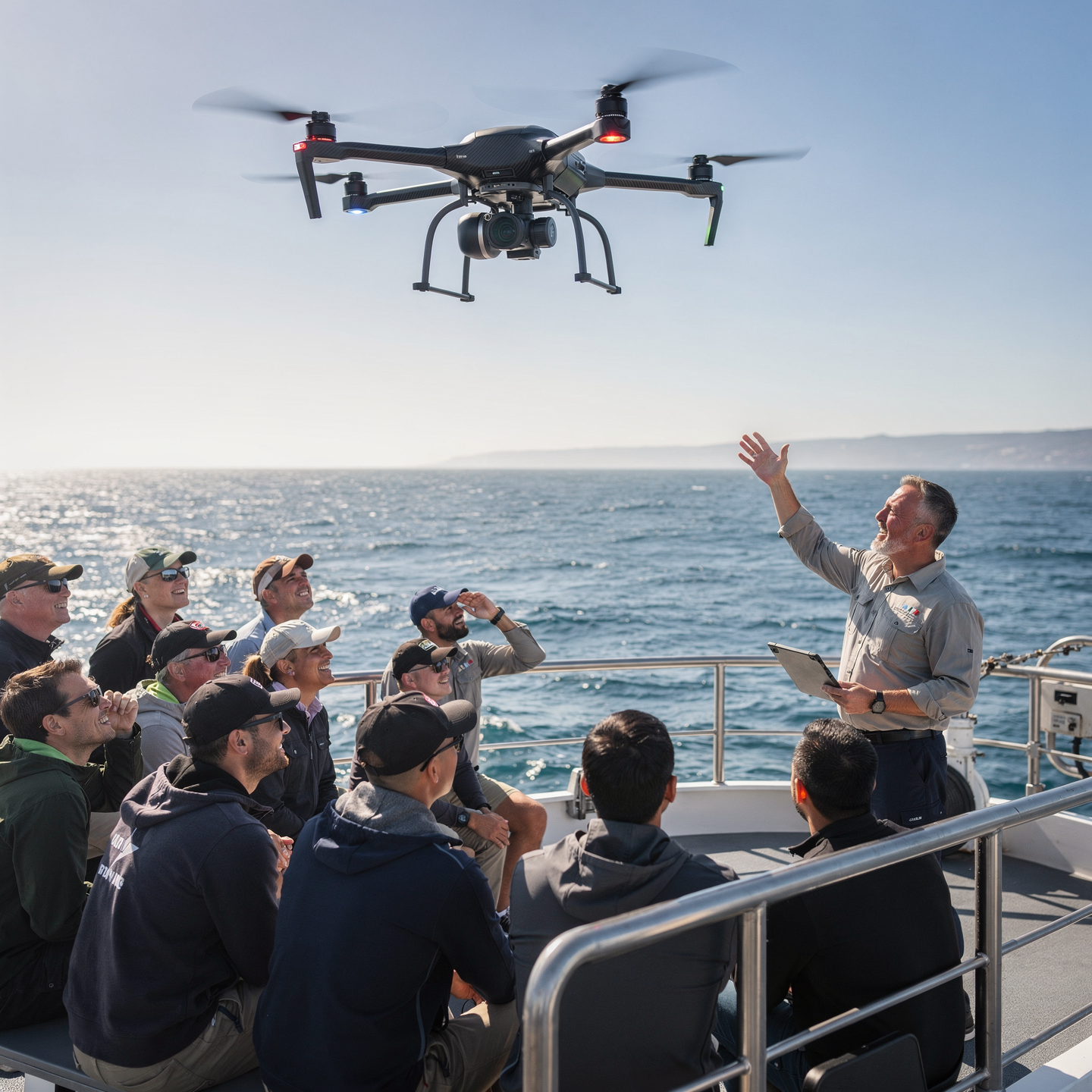
Course on the use of drones in maritime environments

Why this course?

The Use of Drones in Maritime Environments

course prepares you to operate drones safely and efficiently in the maritime sector. Learn to inspect ships and coastal infrastructure, conduct search and rescue operations, and obtain valuable data for environmental management. This program covers current regulations, drone maintenance, flight planning, and image processing.

Differential Advantages

  • Real-world case studies: hull inspection, spill detection, marine wildlife monitoring.
  • Advanced flight simulations: adverse weather conditions, restricted airspace, emergencies.
  • Specialized software: orthomosaic processing, 3D modeling, geospatial data analysis.
  • Professional certification: meets the requirements for legally operating drones in maritime environments.
  • Networking: Connect with experts and professionals in the maritime and aviation sectors.

Course on the use of drones in maritime environments

Availability: 1 in stock

Who is it aimed at?

  • Maritime professionals (captains, engineers, inspectors) interested in infrastructure inspection, surveillance, and search and rescue operations.
  • Logistics and maritime transport companies seeking to optimize fleet management, cargo monitoring, and port security.
  • Drone technicians and pilots wishing to specialize in marine environments, learning about specific regulations, weather conditions, and advanced flight techniques.
  • Port authorities and coast guards needing to strengthen security, maritime traffic control, and emergency response.
  • Students and recent graduates in engineering, nautical studies, or environmental sciences seeking to expand their knowledge with a Innovative and booming technology.

Flexibility and applicability
 Tailored to your needs: 24/7 accessible online content, real-world case studies, and personalized advice from industry experts.

Objectives and competencies

Inspect coastal infrastructure:

“Identify structural deterioration, assess risks, and propose prioritized corrective measures.”

Assess the status of marine wildlife:

“Analyze population census data, assess threats (pollution, fishing), and propose conservation measures based on scientific evidence.”

Conduct search and rescue operations:

“Assess the situation, plan the search, coordinate resources (air, sea, land) and apply rescue techniques appropriate to the environment and the victims.”

Monitoring marine pollution:

“Visually identify spills, assess their extent and notify the competent authorities (Maritime Rescue/Port Authority) following established protocols.”

Support maritime security and surveillance:

“Detect and report suspicious/illegal activities, coordinating with authorities and respecting the protocols for action.”

Optimizing efficiency in logistics and maritime transport:

Implement route optimization and cargo management strategies, using tracking technologies and data analysis to reduce costs and transit times, coordinating efficiently with port and customs authorities.

Curriculum - Modules

  1. Comprehensive Maritime Incident Management: protocols, roles, and chain of command for coordinated response
  2. Operational Planning and Execution: briefing, routes, weather windows, and go/no-go criteria
  3. Rapid Risk Assessment: criticality matrix, scene control, and decision-making under pressure
  4. Operational Communication: VHF/GMDSS, standardized reports, and inter-agency liaison
  5. Tactical Mobility and Safe Boarding: RHIB maneuvers, approach, mooring, and recovery
  6. Equipment and Technologies: PPE, signaling, satellite tracking, and field data logging
  7. Immediate Care of the Affected: primary assessment, hypothermia, trauma, and stabilization for evacuation
  8. Adverse Environmental Conditions: swell, Visibility, flows, and operational mitigation

    Simulation and training: critical scenarios, use of VR/AR, and exercises with performance metrics

    Documentation and continuous improvement: lessons learned, indicators (MTTA/MTTR), and SOP updates

  1. Introduction to drones in the maritime environment: Types, capabilities, and limitations.
  2. Applicable aeronautical legislation: National and international regulations, AESA, ICAO, etc.
  3. Operational safety: Risk analysis, emergency procedures, and incident mitigation.
  4. Flight planning in maritime areas: Marine meteorology, currents, tides, and obstacles.
  5. Communications: Marine radio frequencies, onboard communication systems, and communication with coastal stations.
  6. Preventive and corrective maintenance of drones in saline environments.
  7. Data protection: Privacy, confidentiality, and security of collected information.
  8. Applications of drones in the inspection of ships and infrastructure Maritime.
  9. Search and Rescue (SAR): Protocols, coordination, and use of equipped drones.
  10. Professional ethics and legal responsibility of drone operators in the maritime sector.

  1. Introduction to Drone Operations in the Maritime Environment
  2. Regulations and Standards: AESA, EASA, and relevant maritime legislation
  3. Types of Drones: Platforms, sensors, and specific capabilities for the maritime sector
  4. Mission Planning: Risk assessment, meteorology, and operating areas
  5. Communications: Radio frequencies, protocols, and communications security
  6. Surveillance Operations: Vessel identification, route tracking, and detection of suspicious activities
  7. Security Operations: Support for security forces, border control, and counter-piracy
  8. Maritime Rescue Operations: Search and rescue, damage assessment, and support for vessels in distress Danger
  9. Maintenance and Operations: Aircraft care, troubleshooting, and failure prevention.
  10. Professional Ethics and Legal Responsibility in Drone Operations

  1. Introduction to drone operations in the maritime environment: opportunities and challenges.
  2. Maritime legislation applicable to drones: national and international regulations.
  3. Operational safety: risk analysis, contingency plans, and emergency procedures.
  4. Types of drones used in the maritime environment: characteristics, advantages, and disadvantages.
  5. Sensors and payloads for maritime applications: cameras, radars, environmental sensors.
  6. Drone communication and control in maritime environments: radio links, satellites, and tracking systems.
  7. Flight planning in coastal and oceanic areas: considerations regarding wind, tides, and obstacles.
  8. Takeoff and landing operations on ships and offshore platforms: procedures and equipment.
  9. Drone maintenance and overhaul in the marine environment: corrosion prevention and component care.
  10. Ethics and privacy in maritime drone operations: respect for legislation and third-party rights.

  1. Introduction to Drone Operations in the Maritime Environment
  2. Operational Safety: Risk assessment, mitigation, and emergency plans specific to the maritime environment
  3. Maritime Meteorology: Interpretation of forecasts, winds, waves, currents, and their impact on drone operations
  4. International Maritime Law: SOLAS Convention, MARPOL, and other regulations relevant to drone operations
  5. National Law: Specific regulations on the use of drones in maritime and coastal areas
  6. Maritime Airspace: Restricted areas, NOTAMs, and communications with maritime authorities
  7. Specific Technical Considerations: Corrosion resistance, impermeability, and adaptation to adverse weather conditions
  8. Emergency Procedures: Engine failures, signal loss, water landings, and drone recovery at sea
  9. Best Practices: Pre-flight checklists, preventive maintenance, and operations logs
  10. Ethics and Professional Responsibility: Privacy protection, information security, and regulatory compliance

  1. System Architecture and Components: Structural design, materials, and subsystems (mechanical, electrical, electronic, and fluid) with selection and assembly criteria for marine environments
  2. Fundamentals and Principles of Operation: Physical and engineering foundations (thermodynamics, fluid mechanics, electricity, control, and materials) that explain performance and operating limits
  3. Safety and Environmental (SHE): Risk analysis, PPE, LOTO, hazardous atmospheres, spill and waste management, and emergency response plans
  4. Applicable Regulations and Standards: IMO/ISO/IEC requirements and local regulations;
  5. Conformance criteria, certification, and best practices for operation and maintenance
  6. Inspection, testing, and diagnostics: Visual/dimensional inspection, functional testing, data analysis, and predictive techniques (vibration, thermography, fluid analysis) to identify root causes
  7. Preventive and predictive maintenance: Hourly/cycle/seasonal plans, lubrication, adjustments, calibrations, consumable replacement, post-service verification, and operational reliability
  8. Instrumentation, tools, and metrology: Measuring and testing equipment, diagnostic software, calibration and traceability; selection criteria, safe use, and storage
  9. Onboard integration and interfaces: Mechanical, electrical, fluid, and data compatibility; Sealing and watertightness, EMC/EMI, corrosion protection, and interoperability testing.

    Quality, acceptance testing, and commissioning: process and materials control, FAT/SAT, bench and sea trials, go/no-go criteria, and evidence documentation.

    Technical documentation and integrated practice: logs, checklists, reports, and a complete case study (safety → diagnosis → intervention → verification → report) applicable to any system.

Plan de estudio - Módulos

  1. Comprehensive Maritime Incident Management: protocols, roles, and chain of command for coordinated response
  2. Operational Planning and Execution: briefing, routes, weather windows, and go/no-go criteria
  3. Rapid Risk Assessment: criticality matrix, scene control, and decision-making under pressure
  4. Operational Communication: VHF/GMDSS, standardized reports, and inter-agency liaison
  5. Tactical Mobility and Safe Boarding: RHIB maneuvers, approach, mooring, and recovery
  6. Equipment and Technologies: PPE, signaling, satellite tracking, and field data logging
  7. Immediate Care of the Affected: primary assessment, hypothermia, trauma, and stabilization for evacuation
  8. Adverse Environmental Conditions: swell, Visibility, flows, and operational mitigation

    Simulation and training: critical scenarios, use of VR/AR, and exercises with performance metrics

    Documentation and continuous improvement: lessons learned, indicators (MTTA/MTTR), and SOP updates

  1. Introduction to drones in the maritime environment: Types, capabilities, and limitations.
  2. Applicable aeronautical legislation: National and international regulations, AESA, ICAO, etc.
  3. Operational safety: Risk analysis, emergency procedures, and incident mitigation.
  4. Flight planning in maritime areas: Marine meteorology, currents, tides, and obstacles.
  5. Communications: Marine radio frequencies, onboard communication systems, and communication with coastal stations.
  6. Preventive and corrective maintenance of drones in saline environments.
  7. Data protection: Privacy, confidentiality, and security of collected information.
  8. Applications of drones in the inspection of ships and infrastructure Maritime.
  9. Search and Rescue (SAR): Protocols, coordination, and use of equipped drones.
  10. Professional ethics and legal responsibility of drone operators in the maritime sector.

  1. Introduction to Drone Operations in the Maritime Environment
  2. Regulations and Standards: AESA, EASA, and relevant maritime legislation
  3. Types of Drones: Platforms, sensors, and specific capabilities for the maritime sector
  4. Mission Planning: Risk assessment, meteorology, and operating areas
  5. Communications: Radio frequencies, protocols, and communications security
  6. Surveillance Operations: Vessel identification, route tracking, and detection of suspicious activities
  7. Security Operations: Support for security forces, border control, and counter-piracy
  8. Maritime Rescue Operations: Search and rescue, damage assessment, and support for vessels in distress Danger
  9. Maintenance and Operations: Aircraft care, troubleshooting, and failure prevention.
  10. Professional Ethics and Legal Responsibility in Drone Operations

  1. Introduction to drone operations in the maritime environment: opportunities and challenges.
  2. Maritime legislation applicable to drones: national and international regulations.
  3. Operational safety: risk analysis, contingency plans, and emergency procedures.
  4. Types of drones used in the maritime environment: characteristics, advantages, and disadvantages.
  5. Sensors and payloads for maritime applications: cameras, radars, environmental sensors.
  6. Drone communication and control in maritime environments: radio links, satellites, and tracking systems.
  7. Flight planning in coastal and oceanic areas: considerations regarding wind, tides, and obstacles.
  8. Takeoff and landing operations on ships and offshore platforms: procedures and equipment.
  9. Drone maintenance and overhaul in the marine environment: corrosion prevention and component care.
  10. Ethics and privacy in maritime drone operations: respect for legislation and third-party rights.

  1. Introduction to Drone Operations in the Maritime Environment
  2. Operational Safety: Risk assessment, mitigation, and emergency plans specific to the maritime environment
  3. Maritime Meteorology: Interpretation of forecasts, winds, waves, currents, and their impact on drone operations
  4. International Maritime Law: SOLAS Convention, MARPOL, and other regulations relevant to drone operations
  5. National Law: Specific regulations on the use of drones in maritime and coastal areas
  6. Maritime Airspace: Restricted areas, NOTAMs, and communications with maritime authorities
  7. Specific Technical Considerations: Corrosion resistance, impermeability, and adaptation to adverse weather conditions
  8. Emergency Procedures: Engine failures, signal loss, water landings, and drone recovery at sea
  9. Best Practices: Pre-flight checklists, preventive maintenance, and operations logs
  10. Ethics and Professional Responsibility: Privacy protection, information security, and regulatory compliance

  1. System Architecture and Components: Structural design, materials, and subsystems (mechanical, electrical, electronic, and fluid) with selection and assembly criteria for marine environments
  2. Fundamentals and Principles of Operation: Physical and engineering foundations (thermodynamics, fluid mechanics, electricity, control, and materials) that explain performance and operating limits
  3. Safety and Environmental (SHE): Risk analysis, PPE, LOTO, hazardous atmospheres, spill and waste management, and emergency response plans
  4. Applicable Regulations and Standards: IMO/ISO/IEC requirements and local regulations;
  5. Conformance criteria, certification, and best practices for operation and maintenance
  6. Inspection, testing, and diagnostics: Visual/dimensional inspection, functional testing, data analysis, and predictive techniques (vibration, thermography, fluid analysis) to identify root causes
  7. Preventive and predictive maintenance: Hourly/cycle/seasonal plans, lubrication, adjustments, calibrations, consumable replacement, post-service verification, and operational reliability
  8. Instrumentation, tools, and metrology: Measuring and testing equipment, diagnostic software, calibration and traceability; selection criteria, safe use, and storage
  9. Onboard integration and interfaces: Mechanical, electrical, fluid, and data compatibility; Sealing and watertightness, EMC/EMI, corrosion protection, and interoperability testing.

    Quality, acceptance testing, and commissioning: process and materials control, FAT/SAT, bench and sea trials, go/no-go criteria, and evidence documentation.

    Technical documentation and integrated practice: logs, checklists, reports, and a complete case study (safety → diagnosis → intervention → verification → report) applicable to any system.

  1. Regulations and legislation applicable to drones: AESA, EASA, local regulations.
  2. Operational safety: risk analysis, emergency procedures, maintenance.
  3. Basic meteorology for drones: wind, temperature, humidity, clouds, adverse phenomena.
  4. Interpretation of meteorological reports: METAR, TAF, wind maps.
  5. Emergencies and contingency plans: engine failures, loss of contact, emergency landings.
  6. Basic first aid: PAS protocol, injury assessment, CPR.
  7. Emergency communication: emergency frequencies, contact with rescue services.
  8. Crisis management: damage assessment, crowd control, coordination with Authorities.
  9. Incident and accident investigation: data collection, root cause analysis, report writing.
  10. Civil liability and insurance: coverage, limits, claims.

  1. Introduction to Maritime Drone Operations: Current Landscape and Future
  2. Regulations and Standards: National and International Legislation Applicable to Drones in the Maritime Sector
  3. Operational Safety: Risk Assessment, Contingency Plans, and Emergency Procedures
  4. Meteorological and Environmental Considerations in Maritime Drone Operations
  5. Types of Drones and Sensors Used in Maritime Applications
  6. Preventive and Corrective Maintenance of Drones in Maritime Environments
  7. Communications and Data Link in Maritime Drone Operations
  8. Flight Planning: Specific Considerations for Maritime Environments
  9. Drone Applications in the Maritime Sector: Inspection, Search and rescue, surveillance, etc.
  10. Ethics and privacy in the use of drones in the maritime environment

  1. Introduction to drone operations in the coastal environment: regulations and best practices.
  2. Air safety: risk management, hazard analysis, and contingency plans.
  3. Preventive maintenance: inspection, cleaning, and basic drone repair.
  4. Communications: radio frequencies, communication protocols, and encryption.
  5. Sensors and payloads: EO/IR cameras, LiDAR, detection and rescue systems.
  6. Mission planning: flight management software, georeferencing, and mapping.
  7. SAR operations: search and rescue with drones, detection and salvage techniques.
  8. Coastal surveillance: vessel identification, spill detection, and monitoring border.
  9. Data Management: storage, processing, and analysis of collected information.
  10. Ethics and Responsibility in the Use of Drones: privacy, security, and the environment.

  1. Introduction to drone operations in the maritime environment: Legislation, regulations, and best practices.
  2. Air safety: Specific risks of the maritime environment, mitigation, and emergency procedures.
  3. Types of drones: Characteristics, capabilities, and limitations for different maritime missions (surveillance, search and rescue, etc.).
  4. Sensors and payloads: EO/IR cameras, radars, communication equipment, and their application in safety and search and rescue.
  5. Flight planning: Meteorological considerations, restricted flight zones, communications, and airspace management.
  6. Maritime surveillance operations: Vessel identification, detection of illegal activities, and support for port security.
  7. Search and rescue operations: Search and rescue of people at sea, damage assessment, and Support for emergency operations.
  8. Communications: Communication protocols between the drone pilot, maritime authorities, and rescue teams.
  9. Maintenance and Inspections: Preventive and corrective maintenance procedures to ensure drone operability.
  10. Data Analysis and Reporting: Processing the information collected by the drone and preparing reports for decision-making.

Career opportunities

  • Marine Infrastructure Inspector: Inspection of bridges, docks, offshore platforms, and other structures.
  • Coastal Surveillance and Border Control: Monitoring of illegal activities, search and rescue, fisheries control.
  • Marine Mapping and Surveying: Creation of detailed maps of the seabed, detection of changes and hazards.
  • Marine Scientific Research: Collection of oceanographic data, study of marine life, pollution analysis.
  • Marine Agriculture (Aquaculture): Monitoring of marine farms, monitoring of crop health, optimization of production.
  • Marine Renewable Energy: Inspection and maintenance of offshore wind farms, monitoring of wave energy plants.
  • Search and Rescue Emergencies: Rapid damage assessment of vessels, search for missing persons, spill control.

    Logistics and maritime transport: Route optimization, cargo control, container inspection.

    Port security: Surveillance of port facilities, threat detection, maritime traffic management.

    Maritime tourism and recreation: Creation of immersive experiences, destination promotion, monitoring of tourist activities.

    “`

Admission requirements

Academic/professional profile:

Degree/Bachelor's degree in Nautical Science/Maritime Transport, Naval/Marine Engineering, or a related field; or proven professional experience in bridge/operations.

Language proficiency:

Recommended functional maritime English (SMCP) for simulations and technical materials.

5. Induction

Updated resume, copy of degree or seaman's book, ID card/passport, letter of motivation.

Technical requirements (for online):

Equipment with camera/microphone, stable connection, ≥ 24” monitor recommended for ECDIS/Radar-ARPA.

Admission process and dates

1. Online
application

(form + documents).

2. Academic review and interview

(profile/objectives/schedule compatibility).

3. Admission decision

(+ scholarship proposal if applicable).

4. Reservation of place

(deposit) and registration.

5. Induction

(access to campus, calendars, simulator guides).

Scholarships and grants

  • Maritime Aerial Domain: Learn to operate drones safely and efficiently in the demanding marine environment.
  • Regulations and Legislation: Understand the specific regulations for drone use in coastal areas and on the high seas.
  • Practical Applications: Discover how drones optimize infrastructure inspection, maritime surveillance, and search and rescue.
  • Maintenance and Safety: Master preventive maintenance techniques and safety protocols for successful operations.
  • Specialized Equipment: Familiarize yourself with sensors and payloads Tools adapted to the maritime environment to obtain accurate data. Boost your career in the maritime sector with this innovative training and adapt to new technologies.

Testimonials

Frequently asked questions

Inspection of offshore oil and gas platforms

Yes. The itinerary includes ECDIS/Radar-ARPA/BRM with harbor, ocean, fog, storm, and SAR scenarios.

Online with live sessions; hybrid option for simulator/practical placements through agreements.

Search and rescue operations in challenging or remote maritime environments.

Recommended functional SMCP. We offer support materials for standard phraseology.

Yes, with a relevant degree or experience in maritime/port operations. The admissions interview will confirm suitability.

Optional (3–6 months) through Companies & Collaborations and the Alumni Network.

Simulator practice (rubrics), defeat plans, SOPs, checklists, micro-tests and applied TFM.

A degree from Navalis Magna University + operational portfolio (tracks, SOPs, reports and KPIs) useful for audits and employment.

  1. Introduction to drone operations in the maritime environment: Legislation, regulations, and best practices.
  2. Air safety: Specific risks of the maritime environment, mitigation, and emergency procedures.
  3. Types of drones: Characteristics, capabilities, and limitations for different maritime missions (surveillance, search and rescue, etc.).
  4. Sensors and payloads: EO/IR cameras, radars, communication equipment, and their application in safety and search and rescue.
  5. Flight planning: Meteorological considerations, restricted flight zones, communications, and airspace management.
  6. Maritime surveillance operations: Vessel identification, detection of illegal activities, and support for port security.
  7. Search and rescue operations: Search and rescue of people at sea, damage assessment, and Support for emergency operations.
  8. Communications: Communication protocols between the drone pilot, maritime authorities, and rescue teams.
  9. Maintenance and Inspections: Preventive and corrective maintenance procedures to ensure drone operability.
  10. Data Analysis and Reporting: Processing the information collected by the drone and preparing reports for decision-making.

Request information

  1. Complete the Application Form
  2. Attach your CV/Qualifications (if you have them to hand).
  3. Indicate your preferred cohort (January/May/September) and whether you want the hybrid option with simulator sessions.
An academic advisor will contact you within 24–48 hours to guide you through the admission process, scholarships, and compatibility with your professional schedule. Translated with DeepL.com (free version)
Please enable JavaScript in your browser to complete this form.
Click or drag a file to this area to upload.

Teachers

0
    0
    Tu carrito
    Tu carrito esta vacíoRegresar a la tienda
    Scroll to Top


