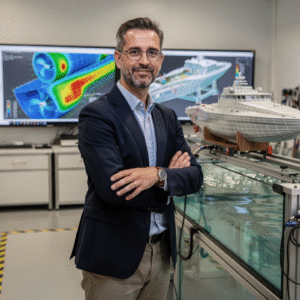
Diploma in Yacht and Sports Boat Maneuvering

Why this certificate program?

The Diploma in Yacht and Recreational Boat Maneuvering

This program prepares you to master the art of recreational boating, from theoretical fundamentals to advanced piloting techniques. Learn to maneuver safely and precisely in diverse conditions, optimizing your vessel’s performance. This intensive program provides you with the knowledge and skills to sail with confidence and fully enjoy the nautical experience.

Differential Advantages

  • Expert Harbor Maneuvers: Dock and undock safely in different configurations and wind conditions.
  • Advanced Coastal Navigation: Plan passages, interpret nautical charts, and use electronic navigation aids.
  • Onboard Emergency Management: Act effectively in critical situations such as breakdowns, man overboard, or adverse weather conditions.
  • Sailing Performance Optimization: Adjust sails, understand wind dynamics, and improve your sailing speed and efficiency.
  • Intensive Practice on Real Vessels: Apply theoretical knowledge in practical situations under the supervision of experienced instructors.
Maniobra

Diploma in Yacht and Sports Boat Maneuvering

Availability: 1 in stock

Who is it aimed at?

  • Yacht skippers, captains of recreational craft, and experienced sailors looking to perfect their maneuvering skills in diverse conditions and scenarios.
  • Sailing instructors and industry professionals who wish to deepen their technical and pedagogical knowledge in the handling of yachts and recreational craft.
  • Yacht and recreational craft owners interested in maximizing the safety and efficiency of their vessels.
  • Candidates for recreational boating licenses who require comprehensive and practical training to pass the exams and obtain their certifications.
  • Sailing enthusiasts and watersports lovers looking to expand their knowledge and enjoy a sailing experience Safer and more enjoyable.

Flexibility for your schedule
 Designed for professionals and amateurs: 24/7 accessible online content, practical exercises adaptable to your availability, and personalized guidance from experts in the field.

Maniobra

Objectives and competencies

Mastering navigation and anchoring techniques:

“Execute safe maneuvers considering currents, wind and depth, using appropriate anchoring systems and complying with environmental regulations.”

Managing safety and emergencies on board:

Implement security procedures (ISPS/PBIP), coordinate emergency drills (fires, abandonment) and ensure effective communication with port authorities.

Maintaining and repairing the basic systems of a vessel:

“Diagnosing and resolving common faults in plumbing systems, basic electricity and auxiliary engines, ensuring the safe and efficient operation of the vessel.”

Interpreting maritime regulations and their practical application:

“Identify and apply the SOLAS, MARPOL and STCW regulations relevant to onboard operations, demonstrating an understanding of responsibilities in safety, pollution prevention and crew management.”

Develop advanced skills in handling sailing and motor yachts:

“Perform complex docking and undocking maneuvers in different weather and port conditions.”

Optimize fuel efficiency and resource management:

Plan the route considering weather conditions, currents and tides to minimize transit time and consumption, continuously monitoring the vessel’s performance and adjusting the plan as needed.

Curriculum - Modules

  1. Comprehensive Maritime Incident Management: protocols, roles, and chain of command for coordinated response
  2. Operational Planning and Execution: briefing, routes, weather windows, and go/no-go criteria
  3. Rapid Risk Assessment: criticality matrix, scene control, and decision-making under pressure
  4. Operational Communication: VHF/GMDSS, standardized reports, and inter-agency liaison
  5. Tactical Mobility and Safe Boarding: RHIB maneuvers, approach, mooring, and recovery
  6. Equipment and Technologies: PPE, signaling, satellite tracking, and field data logging
  7. Immediate Care of the Affected: primary assessment, hypothermia, trauma, and stabilization for evacuation
  8. Adverse Environmental Conditions: swell, Visibility, flows, and operational mitigation

    Simulation and training: critical scenarios, use of VR/AR, and exercises with performance metrics

    Documentation and continuous improvement: lessons learned, indicators (MTTA/MTTR), and SOP updates

  1. Introduction to Maritime Safety: Regulations and Best Practices
  2. Lifesaving Equipment: Life jackets, life rafts, EPIRBs, immersion suits
  3. Fire Prevention and Fighting: Classes of fire, fire extinguishers, fixed systems
  4. First Aid on board: Wound treatment, CPR, hypothermia
  5. Survival at Sea: Rescue techniques, distress signals
  6. Basic Meteorology: Atmospheric pressure, temperature, wind, and humidity
  7. Interpreting Weather Maps and Storm Warnings
  8. Maritime Communications: VHF, MF/HF, DSC, NAVTEX, Inmarsat
  9. Procedures for Emergency: distress call, MAYDAY, PAN PAN

    Safety in navigation operations: cargo stowage, deck safety

  1. Introduction to coastal navigation: definitions and basic concepts.
  2. Nautical charts: types, scales, projections, and datum.
  3. Navigation instruments: magnetic and gyroscopic compasses, log, sounding line.
  4. Nautical publications: sailing directions, notices to mariners, lists of lighthouses.
  5. Aids to navigation: buoys, beacons, lighthouses, leading lines.
  6. Correcting the compass needle: declination and deviation.
  7. Calculating bearing: true, compass, and magnetic.
  8. Obtaining position: simultaneous bearings, distances, and leading lines.
  9. Planning the Coastal crossing: Route selection and waypoints.

    Execution and monitoring of the crossing: Adjustments and corrections.

  1. Introduction to the Atmosphere: Composition, Structure, and Scales
  2. Atmospheric Pressure: Gradient, Isobars, Centers of Action, and Geostrophic Winds
  3. Temperature: Gradients, Inversions, Advection, and Coastal Effects
  4. Humidity and Atmospheric Stability: Clouds, Precipitation, and Fog
  5. Air Masses and Fronts: Characteristics, Formation, and Evolution
  6. Weather Systems: Lows, Highs, Troughs, and Ridges
  7. Local Winds: Sea and Land Breezes, Katabatic Winds, and Foehn Winds
  8. Waves and Swells: Formation, Propagation, Significant Height, and Period
  9. Sea Ice: Types, Formation, Drift, and Hazards to Navigation
  10. Sources of meteorological information: observations, models and warnings

  1. Introduction to Maritime Safety: Conventions, Organizations, and Regulations
  2. Basic Meteorology: Atmosphere, Pressure, Temperature, Wind, Humidity
  3. Meteorological Instruments: Barometer, Thermometer, Anemometer, Hygrometer
  4. Interpreting Weather Maps: Isobars, Fronts, Low-Pressure Systems, High-Pressure Systems
  5. Weather Forecasting: Information Sources, Interpreting Bulletins, Storm Warnings
  6. Waves and Swells: Formation, Height, Period, Effects on Navigation
  7. Sea Ice: Formation, Types, Navigation in Icy Conditions
  8. Maritime Communication Systems: VHF, MF/HF, Satellite (INMARSAT, Iridium)
  9. GMDSS: Components, distress procedures, digital selective calling (DSC)
  10. Communications security: Protocols, privacy, and best practices

  1. System Architecture and Components: Structural design, materials, and subsystems (mechanical, electrical, electronic, and fluid) with selection and assembly criteria for marine environments
  2. Fundamentals and Principles of Operation: Physical and engineering foundations (thermodynamics, fluid mechanics, electricity, control, and materials) that explain performance and operating limits
  3. Safety and Environmental (SHE): Risk analysis, PPE, LOTO, hazardous atmospheres, spill and waste management, and emergency response plans
  4. Applicable Regulations and Standards: IMO/ISO/IEC requirements and local regulations;
  5. Conformance criteria, certification, and best practices for operation and maintenance
  6. Inspection, testing, and diagnostics: Visual/dimensional inspection, functional testing, data analysis, and predictive techniques (vibration, thermography, fluid analysis) to identify root causes
  7. Preventive and predictive maintenance: Hourly/cycle/seasonal plans, lubrication, adjustments, calibrations, consumable replacement, post-service verification, and operational reliability
  8. Instrumentation, tools, and metrology: Measuring and testing equipment, diagnostic software, calibration and traceability; selection criteria, safe use, and storage
  9. Onboard integration and interfaces: Mechanical, electrical, fluid, and data compatibility; Sealing and watertightness, EMC/EMI, corrosion protection, and interoperability testing.

    Quality, acceptance testing, and commissioning: process and materials control, FAT/SAT, bench and sea trials, go/no-go criteria, and evidence documentation.

    Technical documentation and integrated practice: logs, checklists, reports, and a complete case study (safety → diagnosis → intervention → verification → report) applicable to any system.

  1. Introduction to Coastal Navigation: Definitions, Fundamentals, and Safety
  2. Nautical Charts and Publications: Types, Corrections, and Practical Use
  3. Navigation Instruments: Compass, Binoculars, GPS, and VHF Radio
  4. International Regulations for Preventing Collisions at Sea (COLREGs): Lights, Shapes, and Signals
  5. Aids to Navigation: Buoys, Lighthouses, Beacons, and Leading Marks
  6. Planning Coastal Voyages: Route, Tides, and Currents
  7. Basic Meteorology: Winds, Clouds, Atmospheric Pressure, and Warnings
  8. Maritime Safety: Safety Equipment, Man Overboard, and Distress Calls
  9. Communications
  10. Maritime: VHF radio, DSC, emergency calls

    Basic first aid: Actions to take in case of accident or medical emergency

Career opportunities

  • Yacht Skipper / Sports Craft Skipper: Responsible for the navigation, safety, and maintenance of the vessel.
  • Sailing Instructor: In nautical schools, teaching theoretical and practical courses on handling yachts and sports craft.
  • Nautical Charter: Boat rental, both with and without a skipper, managing the rental and maintenance.
  • Water Sports and Recreation Companies: Offering excursions, boat trips, and other water-related activities.
  • Marinas and Yacht Clubs: Performing mooring duties, assisting boats, and maintaining facilities.
  • Boat Sales and Repairs: Advising clients on boat purchases and performing repair and maintenance tasks.
  • Organization of nautical events: Participating in the organization and management of regattas, competitions, and other sailing-related events.
  • Boat maintenance and repair work: Cleaning, painting, engine repair, and other specialized work.

“`

Admission requirements

Academic/professional profile:

Degree/Bachelor's degree in Nautical Science/Maritime Transport, Naval/Marine Engineering, or a related field; or proven professional experience in bridge/operations.

Language proficiency:

Recommended functional maritime English (SMCP) for simulations and technical materials.

Documentation:

Updated resume, copy of degree or seaman's book, ID card/passport, letter of motivation.

Technical requirements (for online):

Equipment with camera/microphone, stable connection, ≥ 24” monitor recommended for ECDIS/Radar-ARPA.

Admission process and dates

1. Online
application

(form + documents).

2. Academic review and interview

(profile/objectives/schedule compatibility).

3. Admission decision

(+ scholarship proposal if applicable).

4. Reservation of place

(deposit) and registration.

5. Induction

(access to campus, calendars, simulator guides).

Scholarships and grants

  • Master Navigation: Learn advanced yacht maneuvering and control techniques in diverse conditions.
  • Safety and Efficiency: Delve into safety protocols, resource optimization, and preventative maintenance.
  • Real-World Case Studies: Tackle simulations and case studies to hone your decision-making skills.
  • Professional Certification: Earn a recognized diploma that will boost your career in the recreational boating industry.
  • Expert Instructors: Learn from professionals with extensive experience in navigation and maritime education.
Prepare to lead with confidence and safety in the world of recreational boating.

Testimonials

Frequently asked questions

Yes. The itinerary includes ECDIS/Radar-ARPA/BRM with harbor, ocean, fog, storm, and SAR scenarios.

Online with live sessions; hybrid option for simulator/practical placements through agreements.

Yes, this diploma covers the operation of both sailing and motor vessels.

Recommended functional SMCP. We offer support materials for standard phraseology.

Yes, with a relevant degree or experience in maritime/port operations. The admissions interview will confirm suitability.

Optional (3–6 months) through Companies & Collaborations and the Alumni Network.

Simulator practice (rubrics), defeat plans, SOPs, checklists, micro-tests and applied TFM.

A degree from Navalis Magna University + operational portfolio (tracks, SOPs, reports and KPIs) useful for audits and employment.

  1. Introduction to coastal navigation: definitions, scope, and safety.
  2. Navigation instruments: compass, log, sounding lead, sextant, binoculars.
  3. Nautical publications: sailing directions, notices to mariners, lists of lighthouses.
  4. Aids to navigation: lighthouses, beacons, buoys, leading marks.
  5. Basic meteorology: atmospheric pressure, temperature, wind, humidity.
  6. Weather forecasting: sources of information, interpretation of weather reports.
  7. Sea conditions: waves, swell, currents, influence on navigation.
  8. Maritime safety: rescue equipment, emergency communications.
  9. Basic Maritime Legislation: International Conventions, National Regulations.
  10. Basic First Aid on Board: Treatment of Common Injuries, CPR.

Request information

  1. Complete the Application Form.

  2. Attach your CV/degree certificate (if you have it to hand).

  3. Indicate your preferred cohort (January/May/September) and whether you would like the hybrid option with simulator sessions.

    An academic advisor will contact you within 24–48 hours to guide you through the admission process, scholarships, and compatibility with your professional schedule.

Please enable JavaScript in your browser to complete this form.
Click or drag a file to this area to upload.

Faculty

0
    0
    Tu carrito
    Tu carrito esta vacíoRegresar a la tienda
    Scroll to Top