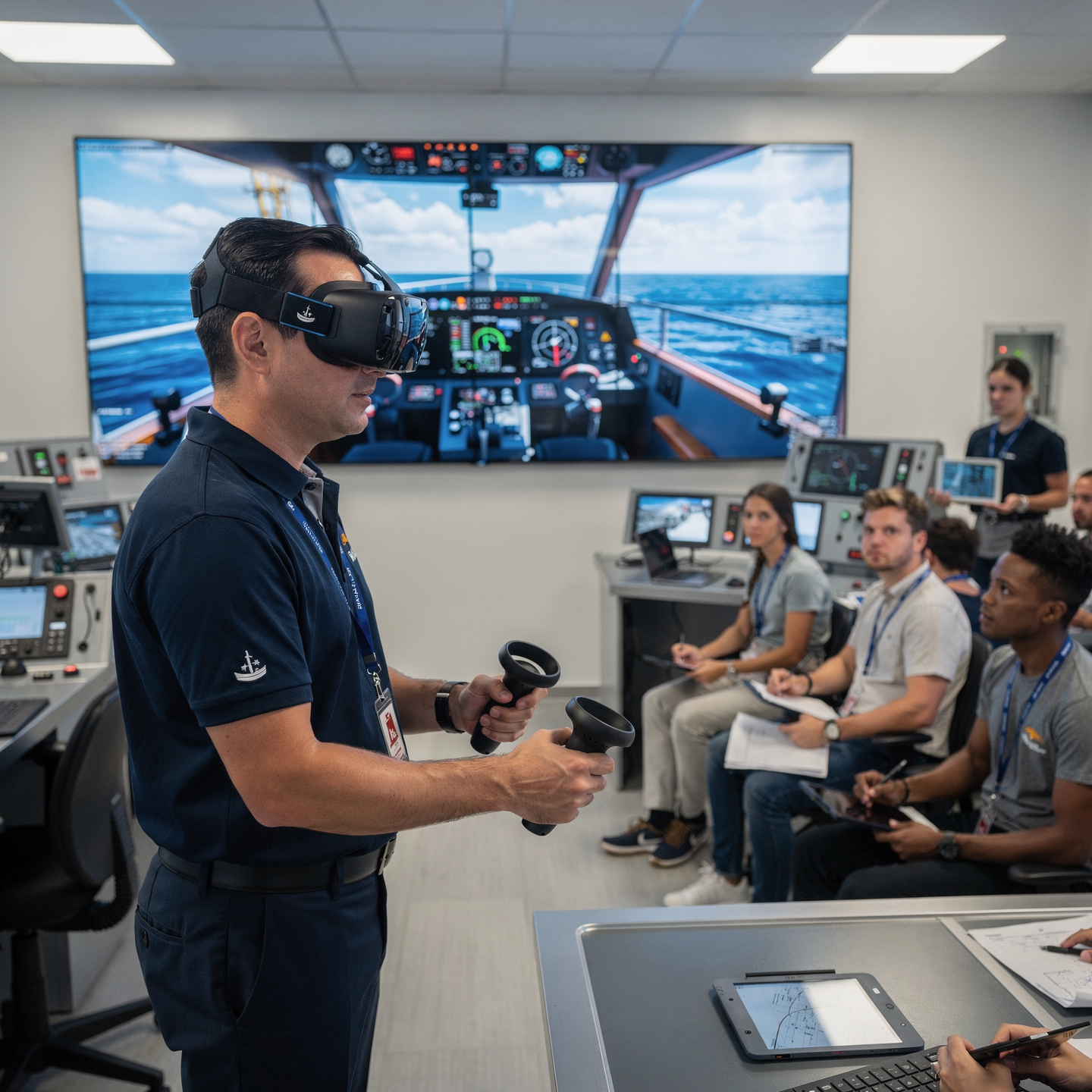
Master’s Degree in Maritime Simulation and Virtual Training
Why this masterās programme?
The Master in Maritime Simulation and Virtual Training
Offers a complete immersion in the cutting-edge technologies that are transforming the maritime industry. Master the design, development, and application of state-of-the-art simulators for the training and certification of maritime professionals. This program will equip you to create realistic virtual environments, optimize operational efficiency, and improve maritime safety. Learn to lead simulation projects, analyze performance data, and design innovative training programs.
Differential Advantages
- State-of-the-art Software and Hardware: Access to the most advanced simulation tools on the market.
- Real-world Case Studies: Development of projects based on current operational challenges.
- Expert Instructors: Leading professionals in the maritime simulation industry.
- Professional Networking: Connection with companies and organizations in the maritime sector.
- Professional Certification: Recognition of your skills and knowledge in maritime simulation.
- Modality: Online
- Level: Masters
- Hours: 1600 H
- Start date: 25-04-2026
Availability: 1 in stock
Who is it aimed at?
- Naval and Marine Engineers seeking to master the latest simulation and modeling tools for vessel design and optimization.
- Merchant Marine Officers wishing to hone their skills in complex maneuvers and emergency management through realistic virtual environments.
- Maritime Instructors and Trainers interested in integrating state-of-the-art simulation into their training programs and improving learning efficiency.
- Offshore and Energy Sector Professionals requiring specialized training in critical maritime operations and platform safety.
- Software Developers and 3D Modelers aspiring to work on the creation of next-generation maritime simulators and virtual reality solutions for the industry.
Flexibility and specialization:
Online program with real-time virtual practical sessions, customized simulation projects, and expert instructors in maritime technology and training.
Objectives and skills

Develop accurate simulation models:
Integrate data from various sources (AIS, radar, weather conditions) to calibrate and validate the model, optimizing realism in different operational and geographical scenarios.

Evaluate and optimize the performance of maritime systems:
Analyze operation and maintenance data to identify areas for improvement in energy efficiency and reduce emissions.

Managing maritime crises and emergencies:
“Assess risks, prioritize actions, and communicate effectively with authorities, crew, and those affected.”

Design and validate maritime virtual training programs:
Integrate human factors (CRM) into realistic scenarios and evaluate individual/group performance.

Implement Virtual and Augmented Reality technologies:
Develop interactive prototypes, evaluate their usability, and optimize immersion for various educational applications.

Leading innovation projects in maritime simulation:
Define realistic goals and success metrics for each project, managing resources and deadlines flexibly in the face of unforeseen events and changes in the environment.
Study plan ā Modules
- Fundamental principles of maritime simulation: definition, objectives, and benefits in advanced training
- Mathematical and dynamic modeling of ships: integration of hydrodynamics, stability, and response under varying conditions
- Design of immersive 3D visualization systems: virtual and augmented reality technologies applied to maritime environments
- Modular simulator architecture: specialized hardware, high-fidelity sensors, and middleware platforms for integration
- Implementation of artificial intelligence algorithms for simulating complex scenarios and decision-making under stress
- Human-machine interface (HMI) in maritime simulators: ergonomics, usability, and realism to maximize knowledge transfer
- Simulation of propulsion and advanced maneuvering systems: control of propellers, rudders, and auxiliary systems with realistic feedback
- Integration and synchronization of real-time data: use of industrial networks and specific communication protocols between subsystems
- Validation and verification of simulators: international standards (STCW, IMO), calibration, and continuous performance evaluation
- Methodologies for creating training scenarios: risk analysis, emergency simulation, and tactical response evaluation
- Fundamentals of maritime simulation: types of simulators, fidelity levels, and training applications
- Design and development of virtual scenarios for maritime emergencies: incorporation of meteorological variables, sea conditions, and maritime traffic
- Modeling and simulation of critical incidents: fires, floods, collisions, and structural failures in ships
- Integration of augmented reality (AR) and virtual reality (VR) systems for an immersive and multisensory training experience
- Optimization of safety protocols using simulators: analysis of procedures, response times, and decision-making under pressure
- Advanced evaluation and feedback methodologies in simulation sessions: quantitative and qualitative metrics to measure performance and effectiveness
- Implementation of artificial intelligence and adaptive algorithms to personalize training according to risk and competence profiles
- Comprehensive management of maritime emergencies: team coordination, effective communication, and Standardized protocols in virtual environments
International standards applicable to emergency management and safety protocols: SOLAS, ISM, ISPS and their impact on simulation-based training
Case studies and integrative exercises: simulation of complex incidents with multidisciplinary interaction and real-time decision-making
- Fundamentals of maritime simulation: definition, historical evolution, and current applications
- Mathematical and physical modeling in simulators: computational fluid dynamics (CFD), hull-water interaction, and environmental effects
- Simulation system architecture: specialized hardware, virtual reality (VR), augmented reality (AR), and mixed reality (MR) platforms
- Real-time simulation: synchronization, latency, sensor accuracy, and dynamic response in complex maritime scenarios
- Integration of real sensors and systems: radar, ECDIS, AIS, GNSS, engine control systems, and virtual power plants
- Advanced human-machine interface (HMI): ergonomic design, haptic feedback, and immersive visualization for effective training
- Gamified training strategies in maritime operations: motivation, competency-based assessment, and analysis of Performance
Development of complex scenarios: navigation in adverse weather conditions, emergency response, and crisis management in virtual environments
Validation and certification of maritime simulators according to international standards (STCW, IMO Model Courses)
Data analysis and feedback: use of artificial intelligence for performance evaluation, error detection, and continuous improvement in training programs
Implementation of collaborative simulators for multi-user operations and coordination on bridges and in control centers
Legal and ethical aspects of using simulation for maritime training: privacy, liability, and competency standards
Future of maritime simulation: trends in digital twins, machine learning, and automation of training processes
Change management and technology adoption in maritime training institutions: instructor training and resource optimization - Practical cases and real-world applications: case study analysis in simulation for accident prevention and operational optimization
- Fundamentals of scenario engineering: definition, scope, and critical factors in advanced maritime simulation
- Critical case design methodologies: risk analysis, selection of dynamic variables, and construction of realistic hypothetical scenarios
- Modeling and parameterization of environmental conditions: wind, waves, visibility, currents, and their impact on decision-making in simulators
- Implementation of programmed events and technical failures: strategies for simulating emergencies and anomalous behavior of onboard systems
- Advanced management of large volumes of data: capture, storage, processing, and analysis of real-time telemetry for formative assessment
- Integration of simulation systems with certified databases and national and international protocols
- Definition and application of regulatory validation standards: compliance with IMO, STCW, and SOLAS in the design and execution of virtual training scenarios
- Protocols for skills certification: design of objective assessment tests based on evidence gathered during simulations
- Accreditation and auditing of maritime simulation centers: technical requirements, equipment, and documentation for quality assurance
- Document management and reporting: preparation of technical reports, performance analysis, and continuous improvement plans in virtual training centers
- Optimizing the training experience through structured feedback and technology for tracking individualized progress
- International case studies: comparative analysis of standards and procedures for scenario engineering in world-leading centers
- Innovation and emerging trends in maritime simulation: augmented reality, artificial intelligence, and adaptive systems for critical scenarios
- Fundamentals of Virtual Reality (VR) and Augmented Reality (AR) applied to the maritime environment: specialized technologies, hardware, and software
- Design and integration of immersive environments for maritime simulation: creation of realistic scenarios, 3D modeling, and fluid dynamics
- Human-Machine Interfaces and User Experience (UX) in maritime simulators: optimization for effective training and reduction of the learning curve
- Implementation of haptic systems and sensory feedback to improve perception and reaction in virtual environments
- Advanced simulation of critical weather and operational conditions using VR/AR to improve decision-making in emergency situations
- Integration of real-time data and performance analysis during training sessions: telemetry, biometrics, and objective evaluation
- Application of adaptive learning methodologies and AI-based dynamic scenarios to personalize and maximize the effectiveness of virtual maritime training
- Management and synchronization of multi-user teams on collaborative VR/AR platforms for teamwork training and bridge coordination
- Risk assessment and simulation of response to maritime incidents using mixed VR and AR environments to improve protocols and reaction times
- Deployment of VR/AR systems integrated with full mission bridge simulators and other technological devices for holistic and homogeneous training
- International regulations, standards, and certifications for the use and validation of virtual simulation technologies in the maritime sector
- Development of practical case studies and training scenarios based on real operations and analysis of lessons learned using VR/AR technology
- Methodologies for measuring the impact and return on investment (ROI) of maritime training programs based on immersive virtual simulation
- Emerging innovations and advanced research in immersive technologies applied to navigation, piloting, and maritime maneuvers
- Fundamentals and evolution of maritime simulation: history, types, and current applications in professional training
- Models and algorithms for physical and environmental representation: fluid dynamics, wave behavior, hull-water interaction, and integrated meteorology
- Immersive technologies: virtual reality (VR), augmented reality (AR), and mixed reality (MR) for creating hyper-realistic maritime environments
- Design and development of advanced simulation scenarios: integration of operational variables, emergencies, and extreme conditions for comprehensive training
- Bridge and engine simulators: architecture, human-machine interfaces (HMIs), accuracy, and calibration to replicate the real bridge experience
- Feedback systems and automated evaluation: performance metrics, behavior analysis, and real-time progress reporting
- Implementation and management of collaborative virtual training platforms: teamwork, communication, and remote coordination for maritime operations
- International regulations and standards applied to maritime simulation (STCW, IMO, IALA): compliance, accreditation, and validation of training programs
- Innovation in artificial intelligence and machine learning to optimize the adaptability and personalization of training according to profiles and objectives
- Future perspectives and disruptive trends in maritime simulation: digital twins, big data, blockchain for traceability and security in training
complex
- Fundamentals of Technological Innovation in Maritime Simulation Systems: Historical Evolution and Emerging Trends
- Advanced Simulator Architecture: Modular Integration, Immersive Platforms, and High-Fidelity 3D Visualization Systems
- Modeling and Validation of Complex Maritime Scenarios: Fluid Physics, Vessel Dynamics, and Real-Time Environmental Conditions
- User-Centered Design Methodologies for Training Simulators: Ergonomics, Immersive Experience, and Adaptation to Professional Profiles
- Implementation of Artificial Intelligence and Machine Learning for Dynamic Training Optimization and Automated Performance Evaluation
- Advanced Simulator Validation and Certification Protocols: Technical Criteria, Performance Testing, and International Regulatory Compliance
- Application of Augmented and Virtual Reality Systems for Tactical Training in Maritime Operations: Multisensory Integration and Haptic Feedback
- Comprehensive Management Strategies in Maritime Operations Using Simulators: Decision-making under pressure and multidisciplinary coordination
Resource optimization through predictive simulations and big data analysis for maritime incident and emergency scenarios
Advanced human-machine interfaces: Touch panels, gesture control, and virtual assistants for improved interaction and operational efficiency
Real-time performance monitoring and analysis systems: Key metrics, automatic reporting, and personalized feedback for continuous improvement
Development and integration of collaborative virtual environments for simultaneous crew and multi-user team training
International regulations and standards applied to maritime simulators: IMO, STCW, and specific certifications for bridge and engine room simulators
Cybersecurity management on maritime simulation platforms: Risk assessment, protection protocols, and incident response
Case studies and practical analyses of successful implementation in the naval industry Impact, return on investment, and technological sustainability
- Fundamentals of Human Behavior in Maritime Environments: Psychological Principles Applied to Navigation and Onboard Operations
- Advanced Decision-Making Models Under Stress and Adverse Conditions in Virtual Training Simulators
- Critical Human Factors in Maritime Safety: Analysis of Human Error, Fatigue, Distractions, and Their Impact on Real and Simulated Operations
- Crew-Machine Interaction on Virtual Platforms: Cognitive Ergonomics, Human-System Interfaces, and Optimization of Situational Control
- Group Dynamics and Effective Communication in Bridge Teams Using Immersive Simulation Environments to Improve Collaborative Work and Coordination
- Evaluation and Monitoring of Individual and Collective Performance Using Advanced Metrics in Maritime Simulators for Continuous Improvement and Reduction of Operational Risks
- Design and Application of High-Fidelity Training Scenarios Including Environmental, Human, and Technical Factors to Maximize Learning Transfer
- Implementation of Techniques of Feedback and debriefing based on behavioral and neurocognitive analysis to enhance experiential learning in virtual maritime training.
Integration of virtual and augmented reality technologies for simulating critical situations and emergencies, focused on stress management and operational resilience.
Ethical and regulatory principles related to simulation and virtual training, focused on the safety, well-being, and professional development of maritime personnel.
- Fundamentals of Advanced Maritime Simulation: physical principles, hydrodynamic modeling, and ship kinematics in virtual environments
- Maritime Simulator Systems Architecture: integrated hardware, software, human-machine interfaces, and communication protocols for real-time operations
- Design of Complex Training Scenarios: development of critical operational situations, environmental emergencies, and maneuvers under extreme conditions
- Multisensor Integration: simulation of radar, AIS, ECDIS, sonar, and other navigation systems with operational fidelity and dynamic response
- Human Behavior and Decision Models in Simulators: incorporation of human factors, stress management, and adaptive responses for effective training
- Validation and Verification of Maritime Simulators: functional testing, physical and mathematical-statistical calibration to ensure accuracy and operational reliability
- International regulations and certification standards: compliance with IMO, STCW, IALA, and recommendations from regulatory bodies in simulation and training
- Development of advanced user interfaces: ergonomic design, augmented and virtual reality, and optimization of the immersive experience for instructors and trainees
- Performance evaluation and data analysis in virtual training: metrics, automated reports, real-time and post-session feedback
- Implementation of dynamic scenario acquisition and management systems: techniques for real-time updates, adaptation to changing conditions, and creation of modular databases
- Theoretical and methodological foundations of simulation applied to maritime operations: types, fidelity levels, and modeling paradigms
- Design and development of integrated models for maritime crisis management: identification of critical variables, scenarios, and decision logic
- Advanced methodologies for representing maritime emergencies: simulation of fires, oil spills, collisions, and groundings
- Implementation of virtual training systems based on bridge, engine room, and unified command simulators
- Integration of artificial intelligence and machine learning for the real-time prediction and evaluation of complex incidents
- Protocols and frameworks for decision-making under pressure: analysis of human factors, stress, and communication in critical situations
- Development of immersive user interfaces and ergonomics in virtual maritime environments: augmented reality, virtual reality, and multisensory systems
- Validation, verification, and calibration of simulation models: metrics, stress tests, and comparison with operational empirical data
- Methodologies for evaluating performance and competence in virtual training: key indicators, feedback, and adaptive feedback
- Writing and presenting the final paper: scientific structuring, technical justification, quantitative analysis, and operational recommendations
Career prospects
“`html
- Maritime Simulator Developer: Creation of realistic virtual environments and training tools.
- Maritime Simulation Center Instructor: Training officers and captains in the use of simulators.
- Maritime Safety Consultant: Risk analysis and design of virtual training solutions.
- Virtual/Augmented Reality Specialist for the Maritime Sector: Development of innovative applications for training and operations.
- Researcher in New Maritime Simulation Technologies: Improvement of the fidelity and effectiveness of simulators.
- Merchant Marine Officer with Simulation Specialization: Application of simulation techniques to improve decision-making and emergency management.
- Maritime Simulation Center Support Technician: Maintenance and configuration of equipment and software.
- Maritime Training Scenario Designer: Creating realistic and challenging exercises for maritime personnel training.
“`
Entry requirements

Academic/professional profile:
Bachelorās degree in Nautical Science/Maritime Transport, Naval/Marine Engineering or a related qualification; or proven professional experience on the bridge/in operations.

Language proficiency:
Functional Maritime English (SMCP) recommended for simulations and technical materials.

Documentation:
Updated CV, copy of qualification or seamanās book, national ID/passport, motivation letter.

Technical requirements (for online):
Device with camera/microphone, stable internet connection, monitor ā„ 24ā recommended for ECDIS/Radar-ARPA.
Admissions process and dates

Online
application
(form + documents).

Academic review and interview
Admissions decision

Admissions decision
(+ scholarship offer if applicable).

Place reservation
(deposit) and enrolment.

Induction
(access to the virtual campus, calendars, simulator guides).
Scholarships and financial support
- Develop skills: Master the most advanced maritime simulation tools on the market.
- Cutting-edge training: Learn to design and execute realistic and effective virtual training scenarios.
- Apply in the industry: Prepare to lead simulation projects in ports, shipping lines, and training centers.
- Professional certification: Earn a recognized qualification that will boost your career in the maritime sector.
- Strategic networking: Connect with leading experts and professionals in maritime simulation and training.
Testimonials
This master’s degree provided me with the tools and knowledge necessary to develop a state-of-the-art navigation simulator for container ships. I successfully implemented AI algorithms to simulate adverse weather conditions and realistic traffic patterns, resulting in a highly effective training tool that is now used at a leading international maritime academy, significantly reducing training costs and improving operational safety.
During the Master’s in Nautical Education & Training, I developed a low-cost coastal navigation simulation system that is now used at the academy where I did my internship, improving students’ understanding and reducing the hours of practical training at sea needed to achieve the required competence.
“This master’s degree provided me with the tools and knowledge necessary to develop a state-of-the-art river navigation simulator. I applied the principles I learned about 3D modeling, fluid dynamics, and virtual reality to create an immersive and realistic environment, which is now used for barge captain training, significantly reducing training costs and improving safety in river operations.”
I applied the knowledge from the Master’s in Maritime Simulation and Virtual Training to develop an emergency maneuver simulator on oil platforms, which reduced incidents by 30% during the first year of implementation, exceeding the company’s expectations and establishing a new safety standard.

Frequently asked questions
Yes. The itinerary includes ECDIS/Radar-ARPA/BRM with harbor, ocean, fog, storm, and SAR scenarios.
Online with live sessions; hybrid option for simulator/practical placements through agreements.
It focuses on simulating maritime environments for training, not on actual navigation.
Recommended functional SMCP. We offer support materials for standard phraseology.
Yes, with a relevant degree or experience in maritime/port operations. The admissions interview will confirm suitability.
Optional (3ā6 months) through Companies & Collaborations and the Alumni Network.
Simulator practice (rubrics), defeat plans, SOPs, checklists, micro-tests and applied TFM.
A degree from Navalis Magna University + operational portfolio (tracks, SOPs, reports and KPIs) useful for audits and employment.
- Theoretical and methodological foundations of simulation applied to maritime operations: types, fidelity levels, and modeling paradigms
- Design and development of integrated models for maritime crisis management: identification of critical variables, scenarios, and decision logic
- Advanced methodologies for representing maritime emergencies: simulation of fires, oil spills, collisions, and groundings
- Implementation of virtual training systems based on bridge, engine room, and unified command simulators
- Integration of artificial intelligence and machine learning for the real-time prediction and evaluation of complex incidents
- Protocols and frameworks for decision-making under pressure: analysis of human factors, stress, and communication in critical situations
- Development of immersive user interfaces and ergonomics in virtual maritime environments: augmented reality, virtual reality, and multisensory systems
- Validation, verification, and calibration of simulation models: metrics, stress tests, and comparison with operational empirical data
- Methodologies for evaluating performance and competence in virtual training: key indicators, feedback, and adaptive feedback
- Writing and presenting the final paper: scientific structuring, technical justification, quantitative analysis, and operational recommendations
Request information
Complete the Application Form.
Attach your CV/degree certificate (if you have it to hand).
Indicate your preferred cohort (January/May/September) and whether you would like the hybrid option with simulator sessions.
An academic advisor will contact you within 24ā48 hours to guide you through the admission process, scholarships, and compatibility with your professional schedule.
Faculty
Eng. TomƔs Riera
Full Professor
Eng. TomƔs Riera
Full Professor
Eng. SofĆa Marquina
Full Professor
Eng. SofĆa Marquina
Full Professor
Eng. Javier BaƱuls
Full Professor
Eng. Javier BaƱuls
Full Professor
Dr. Nuria Llobregat
Full Professor
Dr. Nuria Llobregat
Full Professor
Dr. Pau Ferrer
Full Professor
Dr. Pau Ferrer
Full Professor
Cap. Javier Abaroa (MCA)
Full Professor
Cap. Javier Abaroa (MCA)
Full Professor

