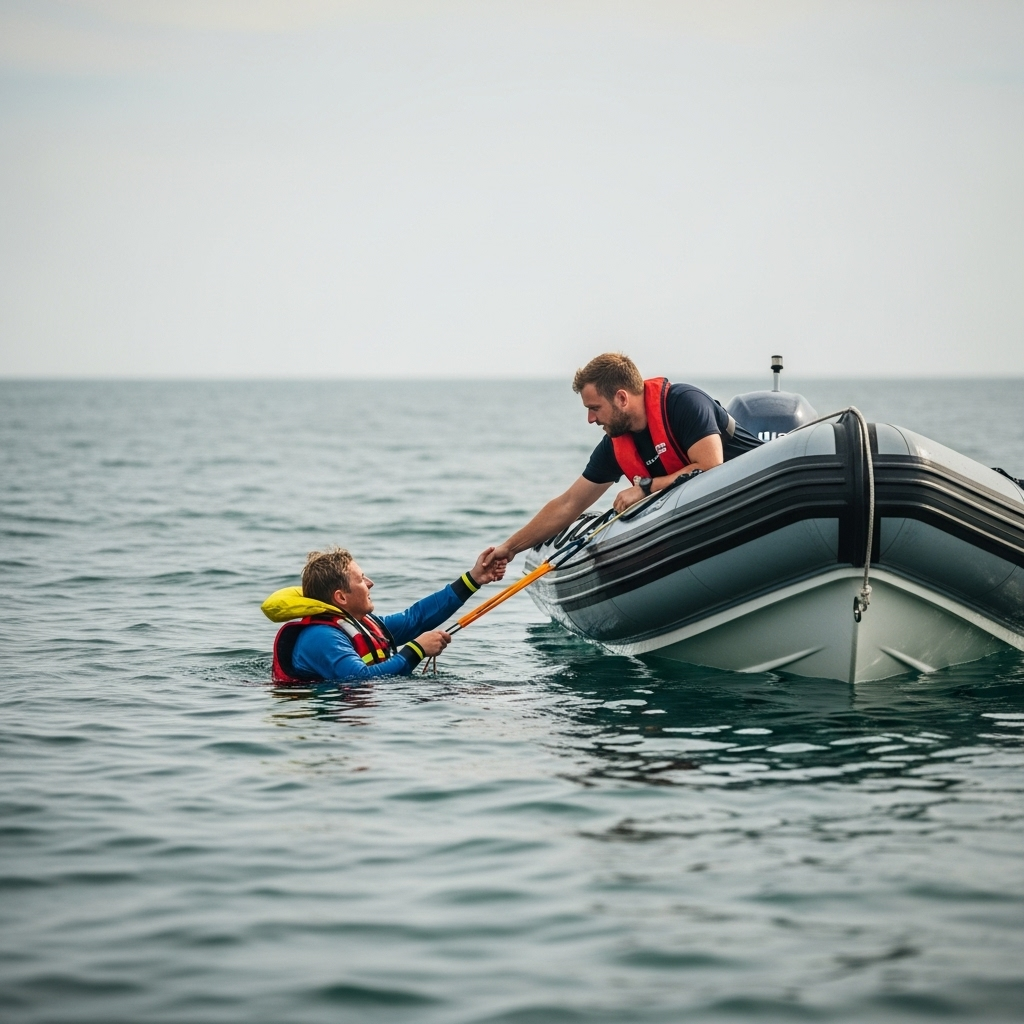
Small Boat Rescue Techniques Course
Why this course?
The Small Vessel Rescue Techniques Course
This course provides you with the essential skills to act safely and effectively in emergency situations. Learn to master water rescue techniques, first aid specific to the maritime environment, and the correct use of lifesaving equipment. This practical course will prepare you to respond to any eventuality, protecting lives and minimizing risks.
Small Vessel Rescue Techniques
Key Benefits
- Rescue Techniques: Master towing, refloating, and extracting people from the water.
- First Aid: Learn to treat hypothermia, drowning, and other common injuries at sea.
- Safety Equipment: Become familiar with life jackets, rafts, flares, and communication systems.
- Emergency Planning: Develop strategies to prevent accidents and coordinate effective responses.
- Realistic Drills: Participate in hands-on exercises to test your skills in simulated scenarios.
- Modality: Online
- Level: Cursos
- Hours: 150 H
- Start date: 26-07-2026
Availability: 1 in stock
Who is it aimed at?
- Recreational and sports boat skippers who wish to acquire crucial skills to respond to emergencies at sea.
- Crew members of small vessels seeking formal training in rescue techniques and first aid in maritime environments.
- Nautical activity monitors and instructors who need to update their knowledge and safety protocols to ensure the safety of their students.
- Maritime emergency and rescue service personnel who wish to complement their training with specific techniques for small vessels.
- Sailing and water sports enthusiasts who prioritize safety and self-protection in their recreational activities at sea.
Flexibility of Learning:
Adapted for professionals and amateurs: accessible online content, guided practical exercises and downloadable resources for permanent reference.
Objectives and competencies

Carry out rescue and assistance operations for people in danger in small boats:
“Assess the risk situation (weather, location, condition of the vessel) and apply safe water rescue techniques.”

Assess risks and apply safety procedures in maritime emergency situations:
Act quickly and effectively in the event of fires, floods or abandonment of the ship, prioritizing the safety of the crew and passengers and communicating the emergency according to the on-board Emergency Plan.

Use emergency communication and signaling equipment effectively:
To know and apply standardized communication protocols (IMO), optimizing the clarity and accuracy of messages in critical situations.

Implement fire and water ingress response protocols for small vessels:
Quickly assess the situation, activate the alarm, communicate the emergency by radio (channel 16/VHF or DSC), try to extinguish the fire/plug the water leak with the available means (fire extinguishers, bilge pumps, etc.) and prepare for evacuation if necessary, prioritizing the safety of the crew and passengers.

Stabilize and safely tow disabled vessels:
“Use appropriate towing techniques according to the type of breakdown, size of the vessel and environmental conditions, prioritizing the safety of the crew and the integrity of the vessel.”

Master first aid and basic life support techniques in the maritime environment:
“Quickly assess the scene, prioritize care for multiple victims, and coordinate evacuation according to maritime protocols.”
Curriculum - Modules
- Comprehensive Maritime Incident Management: protocols, roles, and chain of command for coordinated response
- Operational Planning and Execution: briefing, routes, weather windows, and go/no-go criteria
- Rapid Risk Assessment: criticality matrix, scene control, and decision-making under pressure
- Operational Communication: VHF/GMDSS, standardized reports, and inter-agency liaison
- Tactical Mobility and Safe Boarding: RHIB maneuvers, approach, mooring, and recovery
- Equipment and Technologies: PPE, signaling, satellite tracking, and field data logging
- Immediate Care of the Affected: primary assessment, hypothermia, trauma, and stabilization for evacuation
- Adverse Environmental Conditions: swell, Visibility, flows, and operational mitigation
Simulation and training: critical scenarios, use of VR/AR, and exercises with performance metrics
Documentation and continuous improvement: lessons learned, indicators (MTTA/MTTR), and SOP updates
- Introduction to Survival at Sea: Specific Hazards and Risks.
- Personal Safety Equipment: Life jackets, survival suits, personal EPIRBs.
- Life Rafts: Types, equipment, launching, and boarding procedures.
- Water Survival Techniques: Survival positions, use of signaling equipment.
- Basic First Aid at Sea: Treatment of hypothermia, sunburn, dehydration, and common injuries.
- Emergency Communications: Use of VHF radio, distress calls (MAYDAY), satellite alert systems.
- Search and Rescue (SAR): Organization, procedures, and collaboration with rescue teams.
- Stress and Panic Management: Coping techniques, leadership in crisis situations.
- Post-disaster recovery: Damage assessment, incident reporting, psychological support.
- Applicable legislation and regulations: International conventions, national and local regulations.
‘
- Survival Theory: Factors, Psychology, Priorities
- Individual Survival Equipment: Vests, Suits, EPIRB, PLB
- Life Rafts: Deployment, Equipment, Rationing, Maintenance
- Distress Signals: Pyrotechnics, EPIRBs, Visual and Audible Signals
- Water Rescue Techniques: Approach, Towing, Hoisting
- First Aid in Emergency Situations: Hypothermia, Drowning, Injuries
- Emergency Communication: VHF, Distress Call, SAR Procedures
- Safety on Board: Fire Prevention, Water Ingress Prevention, Man Overboard
- Handling the Vessel in Adverse Conditions: Wind, Waves, Currents
- Survival prolonged: obtaining water and food, building shelters
‘
- Survival Equipment: life rafts, immersion suits, life jackets
- Sea Survival Techniques: flotation, HELP position, distress signals
- First Aid at Sea: hypothermia, dehydration, sunburn
- Emergency Communication: VHF, EPIRB, SART, personal emergency beacons
- Sea Search and Rescue (SAR): organization, resources, procedures
- Coastal Rescue: risk assessment, water entry techniques
- Handling Rescue Vessels: speedboats, jet skis, inflatable boats
- Victim Extraction: rescue techniques in different scenarios (beach, cliff, vessel)
- Support Advanced life support in the water: CPR, airway management
Legal and ethical aspects of maritime rescue
‘
- Introduction to Maritime Safety: Regulations, Statistics, and Risks
- Personal Protective Equipment: Life Jackets, Survival Suits, PPE
- Life Rafts: Types, Equipment, Launching, and Survival
- Rescue Craft: Types, Handling, Maintenance, and Procedures
- Emergency Communications: VHF Radio, DSC, EPIRB, SART
- Water Survival Techniques: Floating, Survival Swimming, Rescue
- Basic First Aid: CPR, Wound Treatment, Hypothermia, Burns
- Fire on Board: Prevention, Detection, Extinguishing, and Firefighting Equipment
- Rescue Maneuvers: Man Overboard, Towing, vessel assistance
- Basic meteorology: forecast interpretation, effects on navigation and safety
‘
- System Architecture and Components: Structural design, materials, and subsystems (mechanical, electrical, electronic, and fluid) with selection and assembly criteria for marine environments
- Fundamentals and Principles of Operation: Physical and engineering foundations (thermodynamics, fluid mechanics, electricity, control, and materials) that explain performance and operating limits
- Safety and Environmental (SHE): Risk analysis, PPE, LOTO, hazardous atmospheres, spill and waste management, and emergency response plans
- Applicable Regulations and Standards: IMO/ISO/IEC requirements and local regulations;
- Conformance criteria, certification, and best practices for operation and maintenance
- Inspection, testing, and diagnostics: Visual/dimensional inspection, functional testing, data analysis, and predictive techniques (vibration, thermography, fluid analysis) to identify root causes
- Preventive and predictive maintenance: Hourly/cycle/seasonal plans, lubrication, adjustments, calibrations, consumable replacement, post-service verification, and operational reliability
- Instrumentation, tools, and metrology: Measuring and testing equipment, diagnostic software, calibration and traceability; selection criteria, safe use, and storage
- Onboard integration and interfaces: Mechanical, electrical, fluid, and data compatibility; Sealing and watertightness, EMC/EMI, corrosion protection, and interoperability testing.
Quality, acceptance testing, and commissioning: process and materials control, FAT/SAT, bench and sea trials, go/no-go criteria, and evidence documentation.
Technical documentation and integrated practice: logs, checklists, reports, and a complete case study (safety → diagnosis → intervention → verification → report) applicable to any system.
Plan de estudio - Módulos
- Comprehensive Maritime Incident Management: protocols, roles, and chain of command for coordinated response
- Operational Planning and Execution: briefing, routes, weather windows, and go/no-go criteria
- Rapid Risk Assessment: criticality matrix, scene control, and decision-making under pressure
- Operational Communication: VHF/GMDSS, standardized reports, and inter-agency liaison
- Tactical Mobility and Safe Boarding: RHIB maneuvers, approach, mooring, and recovery
- Equipment and Technologies: PPE, signaling, satellite tracking, and field data logging
- Immediate Care of the Affected: primary assessment, hypothermia, trauma, and stabilization for evacuation
- Adverse Environmental Conditions: swell, Visibility, flows, and operational mitigation
Simulation and training: critical scenarios, use of VR/AR, and exercises with performance metrics
Documentation and continuous improvement: lessons learned, indicators (MTTA/MTTR), and SOP updates
- Introduction to Survival at Sea: Specific Hazards and Risks.
- Personal Safety Equipment: Life jackets, survival suits, personal EPIRBs.
- Life Rafts: Types, equipment, launching, and boarding procedures.
- Water Survival Techniques: Survival positions, use of signaling equipment.
- Basic First Aid at Sea: Treatment of hypothermia, sunburn, dehydration, and common injuries.
- Emergency Communications: Use of VHF radio, distress calls (MAYDAY), satellite alert systems.
- Search and Rescue (SAR): Organization, procedures, and collaboration with rescue teams.
- Stress and Panic Management: Coping techniques, leadership in crisis situations.
- Post-disaster recovery: Damage assessment, incident reporting, psychological support.
- Applicable legislation and regulations: International conventions, national and local regulations.
‘
- Survival Theory: Factors, Psychology, Priorities
- Individual Survival Equipment: Vests, Suits, EPIRB, PLB
- Life Rafts: Deployment, Equipment, Rationing, Maintenance
- Distress Signals: Pyrotechnics, EPIRBs, Visual and Audible Signals
- Water Rescue Techniques: Approach, Towing, Hoisting
- First Aid in Emergency Situations: Hypothermia, Drowning, Injuries
- Emergency Communication: VHF, Distress Call, SAR Procedures
- Safety on Board: Fire Prevention, Water Ingress Prevention, Man Overboard
- Handling the Vessel in Adverse Conditions: Wind, Waves, Currents
- Survival prolonged: obtaining water and food, building shelters
‘
- Survival Equipment: life rafts, immersion suits, life jackets
- Sea Survival Techniques: flotation, HELP position, distress signals
- First Aid at Sea: hypothermia, dehydration, sunburn
- Emergency Communication: VHF, EPIRB, SART, personal emergency beacons
- Sea Search and Rescue (SAR): organization, resources, procedures
- Coastal Rescue: risk assessment, water entry techniques
- Handling Rescue Vessels: speedboats, jet skis, inflatable boats
- Victim Extraction: rescue techniques in different scenarios (beach, cliff, vessel)
- Support Advanced life support in the water: CPR, airway management
Legal and ethical aspects of maritime rescue
‘
- Introduction to Maritime Safety: Regulations, Statistics, and Risks
- Personal Protective Equipment: Life Jackets, Survival Suits, PPE
- Life Rafts: Types, Equipment, Launching, and Survival
- Rescue Craft: Types, Handling, Maintenance, and Procedures
- Emergency Communications: VHF Radio, DSC, EPIRB, SART
- Water Survival Techniques: Floating, Survival Swimming, Rescue
- Basic First Aid: CPR, Wound Treatment, Hypothermia, Burns
- Fire on Board: Prevention, Detection, Extinguishing, and Firefighting Equipment
- Rescue Maneuvers: Man Overboard, Towing, vessel assistance
- Basic meteorology: forecast interpretation, effects on navigation and safety
‘
- System Architecture and Components: Structural design, materials, and subsystems (mechanical, electrical, electronic, and fluid) with selection and assembly criteria for marine environments
- Fundamentals and Principles of Operation: Physical and engineering foundations (thermodynamics, fluid mechanics, electricity, control, and materials) that explain performance and operating limits
- Safety and Environmental (SHE): Risk analysis, PPE, LOTO, hazardous atmospheres, spill and waste management, and emergency response plans
- Applicable Regulations and Standards: IMO/ISO/IEC requirements and local regulations;
- Conformance criteria, certification, and best practices for operation and maintenance
- Inspection, testing, and diagnostics: Visual/dimensional inspection, functional testing, data analysis, and predictive techniques (vibration, thermography, fluid analysis) to identify root causes
- Preventive and predictive maintenance: Hourly/cycle/seasonal plans, lubrication, adjustments, calibrations, consumable replacement, post-service verification, and operational reliability
- Instrumentation, tools, and metrology: Measuring and testing equipment, diagnostic software, calibration and traceability; selection criteria, safe use, and storage
- Onboard integration and interfaces: Mechanical, electrical, fluid, and data compatibility; Sealing and watertightness, EMC/EMI, corrosion protection, and interoperability testing.
Quality, acceptance testing, and commissioning: process and materials control, FAT/SAT, bench and sea trials, go/no-go criteria, and evidence documentation.
Technical documentation and integrated practice: logs, checklists, reports, and a complete case study (safety → diagnosis → intervention → verification → report) applicable to any system.
- Introduction to Survival at Sea: Principles and Priorities
- Individual Survival Equipment: Life Jackets, Immersion Suits, Personal Protective Equipment (PPE) and Life Rafts
- Lifeboats and Liferafts: Types, Equipment, Launching, and Procedures
- Water Survival Techniques: Survival Swimming, HELP Position, Staying Afloat
- Basic First Aid in Maritime Emergencies: CPR, Hemorrhage Control, Hypothermia Treatment
- Distress Signals: Pyrotechnics, Audible and Visual Signals, Emergency Beacons
- Seasonal Search and Rescue (SAR) Operations: Organization, Resources, and Procedures
- Rescue Helicopters: Hoisting and Communication.
- Survival in adverse weather conditions: cold, heat, wind, and waves.
- Psychological aspects of survival: maintaining morale and decision-making under stress.
‘
- Survival Equipment: life rafts, survival suits, EPIRB, SART
- Sea Survival Techniques: survival swimming, hypothermia, dehydration, sunburn
- Distress Signals: flares, smoke signals, signal mirror, EPIRBs
- First Aid in Emergency Situations: CPR, hemorrhage control, fracture treatment
- Rescue Techniques: hoisting, lowering, use of rescue equipment
- Emergency Communications: VHF radio, distress call, GMDSS procedures
- Fire Prevention on Board: types of fires, fire extinguishers, detection and suppression systems
- Personal Safety: personal protective equipment, Occupational hazards on board, accident prevention
Ship abandonment procedures: roles and responsibilities, drills
Legislation and regulations on survival, rescue and maritime safety: SOLAS Convention, ISM Code
‘
- Safety Equipment: life jackets, life rafts, immersion suits.
- Distress Signals: flares, rockets, smoke signals, EPIRB beacons, SART radar transponders.
- Emergency Procedures: man overboard, collision, grounding, fire, flooding.
- Water Survival Techniques: floating, fetal position, survival swimming.
- Basic First Aid: CPR, hemorrhage control, burn treatment, hypothermia and shock.
- Emergency Communications: VHF radio, MAYDAY distress call, communication procedures.
- Rescue Techniques: towing, transferring people, providing medical assistance to Onboard.
- Basic Meteorology: identification of weather hazards, interpretation of forecasts.
- Emergency Navigation: use of compass, simplified maps, determination of position.
- Legal and Ethical Aspects: obligations of the captain and crew in emergency situations.
‘
- Introduction to First Aid, Search and Rescue (SAR): Definitions, scope, and limitations.
- Legal and Ethical Framework: Legal responsibilities, informed consent, confidentiality.
- Scene Assessment and Safety: Hazard identification, risk control, personal protective equipment (PPE).
- Patient Assessment: ABCDE (airway, breathing, circulation, disability, exposure), vital signs assessment.
- Basic CPR: Chest compressions, mouth-to-mouth ventilation, use of an automated external defibrillator (AED).
- Wound and Bleeding Management: Types of wounds, bleeding control (direct pressure, tourniquet).
- Trauma: Fractures, sprains, Dislocations, immobilization, and transport.
- Burns: Types of burns, severity assessment, initial treatment.
- Land search and rescue: Search techniques, orientation, communication, victim extraction.
- Special considerations in SAR: Hypothermia, hyperthermia, drowning, crush injuries.
‘
Career opportunities
- Lifeguard at beaches and pools: surveillance, prevention, and rescue in aquatic environments.
- Recreational Craft Skipper: management of onboard safety and operation of recreational craft.
- Sea Rescue Vessel Crew Member: participation in rescue and assistance operations at sea.
- Lifesaving Techniques Instructor: training of new professionals in aquatic rescue techniques.
- Search and Rescue Coordination Center Operator: management of maritime emergencies and coordination of resources.
- Security Personnel at Nautical Events: surveillance and prevention of incidents at competitions and aquatic events.
- Volunteer in Maritime Rescue Organizations: collaboration in rescue and humanitarian aid operations.
- Occupational Risk Prevention Technician in the Maritime Sector: Risk assessment and control in aquatic activities and vessels.
“`
Admission requirements

Academic/professional profile:
Degree/Bachelor's degree in Nautical Science/Maritime Transport, Naval/Marine Engineering, or a related field; or proven professional experience in bridge/operations.

Language proficiency:
Recommended functional maritime English (SMCP) for simulations and technical materials.

5. Induction
Updated resume, copy of degree or seaman's book, ID card/passport, letter of motivation.

Technical requirements (for online):
Equipment with camera/microphone, stable connection, ≥ 24” monitor recommended for ECDIS/Radar-ARPA.
Admission process and dates

1. Online
application
(form + documents).

2. Academic review and interview
(profile/objectives/schedule compatibility).

3. Admission decision
(+ scholarship proposal if applicable).

4. Reservation of place
(deposit) and registration.

5. Induction
(access to campus, calendars, simulator guides).
Scholarships and grants
- Mastery of Techniques: Learn effective rescue techniques in emergency situations using boats and launches.
- Water Safety: Prevention and response protocols to minimize risks and maximize survival.
- Essential Equipment: Knowledge and use of life jackets, rafts, and other essential devices.
- Aquatic First Aid: Stabilization and initial care for drowning and hypothermia victims.
- Safe Navigation: Optimize your skills for responsible and conscious navigation in maritime and riverine environments.
Testimonials
“During a simulated rescue exercise in bad weather, I applied the rescue techniques I had learned, successfully rescuing two ‘victims’ from the water in adverse conditions quickly and safely, demonstrating mastery of boat handling and rescue techniques.”
During the Nautical and Marine Operations course, I applied my theoretical knowledge in practice, successfully navigating a 12-meter sailboat through a predefined circuit, including docking and undocking maneuvers, demonstrating competence in navigation, safety, and handling of the vessel.
“Thanks to my training in Small Boat Rescue Techniques, I was able to react calmly and efficiently when our sailboat capsized. I applied the rescue maneuvers I had learned, ensuring the safety of all crew members and preventing a tragedy. The practice in drills and the emphasis on stress management were key to my success in that critical situation.”
“During a sudden storm, the vessel we were sailing on with five other crew members began to flood rapidly. Thanks to my training in rescue techniques, I remained calm, directed the pumping protocol, distributed the life jackets correctly, and, by applying the emergency signals I had learned, we were rescued by the coast guard in less than 30 minutes without any casualties. My actions were vital to the survival of everyone on board.”

Frequently asked questions
Life jackets (sufficient quantity and in good condition).
Yes. The itinerary includes ECDIS/Radar-ARPA/BRM with harbor, ocean, fog, storm, and SAR scenarios.
Online with live sessions; hybrid option for simulator/practical placements through agreements.
Shout “Man overboard!” to alert the crew.
Recommended functional SMCP. We offer support materials for standard phraseology.
Yes, with a relevant degree or experience in maritime/port operations. The admissions interview will confirm suitability.
Optional (3–6 months) through Companies & Collaborations and the Alumni Network.
Simulator practice (rubrics), defeat plans, SOPs, checklists, micro-tests and applied TFM.
A degree from Navalis Magna University + operational portfolio (tracks, SOPs, reports and KPIs) useful for audits and employment.
- Introduction to First Aid, Search and Rescue (SAR): Definitions, scope, and limitations.
- Legal and Ethical Framework: Legal responsibilities, informed consent, confidentiality.
- Scene Assessment and Safety: Hazard identification, risk control, personal protective equipment (PPE).
- Patient Assessment: ABCDE (airway, breathing, circulation, disability, exposure), vital signs assessment.
- Basic CPR: Chest compressions, mouth-to-mouth ventilation, use of an automated external defibrillator (AED).
- Wound and Bleeding Management: Types of wounds, bleeding control (direct pressure, tourniquet).
- Trauma: Fractures, sprains, Dislocations, immobilization, and transport.
- Burns: Types of burns, severity assessment, initial treatment.
- Land search and rescue: Search techniques, orientation, communication, victim extraction.
- Special considerations in SAR: Hypothermia, hyperthermia, drowning, crush injuries.
‘
Request information
- Complete the Application Form
- Attach your CV/Qualifications (if you have them to hand).
- Indicate your preferred cohort (January/May/September) and whether you want the hybrid option with simulator sessions.
Teachers
Eng. Tomás Riera
Full Professor
Eng. Tomás Riera
Full Professor
Eng. Sofía Marquina
Full Professor
Eng. Sofía Marquina
Full Professor
Eng. Javier Bañuls
Full Professor
Eng. Javier Bañuls
Full Professor
Dr. Nuria Llobregat
Full Professor
Dr. Nuria Llobregat
Full Professor
Dr. Pau Ferrer
Full Professor
Dr. Pau Ferrer
Full Professor
Cap. Javier Abaroa (MCA)
Full Professor
Cap. Javier Abaroa (MCA)
Full Professor

