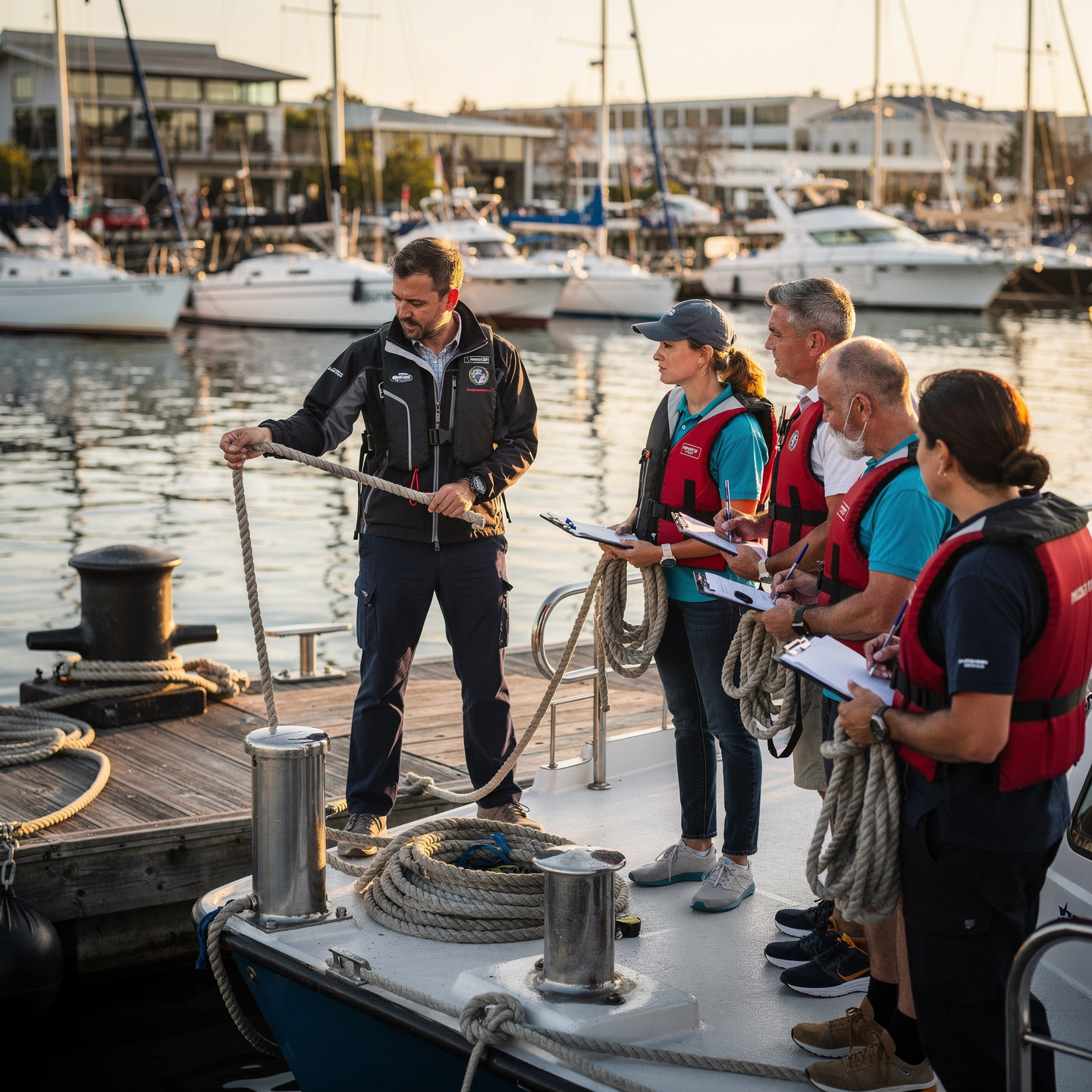
Anchoring and mooring techniques course
Why this course?
The Anchoring and Mooring Techniques Course
This course is designed to provide in-depth, practical knowledge of best practices for the safe and efficient handling of vessels in port and at anchor. You will learn to optimize operations, minimize risks, and ensure the safety of the vessel, crew, and the environment. This program covers the proper selection of equipment, maneuver planning, and emergency response.
Differential Advantages
- Equipment Analysis: Types of anchors, chains, mooring lines, and their applications according to the vessel and conditions.
- Maneuver Planning: Risk assessment, emergency procedures, and effective communication.
- Advanced Mooring Techniques: Use of springs, crossbeams, longlines, and cleats to optimize the vessel’s safety and stability.
- Regulations and Best Practices: Compliance with international regulations and industry standards.
- Practical Simulations: Exercises to apply acquired knowledge in real and challenging situations.
- Modality: Online
- Level: Cursos
- Hours: 150 H
- Start date: 24-07-2026
Availability: 1 in stock
Who is it aimed at?
- Sailors, officers, and captains seeking to refine their skills in anchoring and mooring operations, minimizing risks and optimizing time.
- Deck supervisors and safety officers who need to update their knowledge of regulations, equipment, and safety procedures in port and anchorage.
- Nautical students and professionals in training who wish to acquire a solid and practical foundation in the essential techniques for safe and efficient navigation.
- Port terminal and shipyard personnel involved in berthing and unberthing operations, seeking to improve coordination and communication during maneuvers.
- Maritime inspectors and auditors who need a in-depth understanding of evaluation criteria and best practices in anchoring and a tie-down to ensure regulatory compliance.
Learning Flexibility
Adapted to professionals with demanding schedules: 24/7 accessible online content, simulated practical exercises, and personalized tutoring to answer questions and delve deeper into specific topics.
Objectives and competencies

Mastering the selection and application of lashing techniques to secure cargo under various conditions:
“Select and execute lashing techniques (direct, loop, with tensioner) considering the weight, dimensions of the load, type of vehicle and environmental conditions (wind, humidity, temperature) to guarantee stability and safety during transport.”

Inspect and maintain the lashing equipment to ensure its optimal functioning and safety:
“Perform periodic inspections according to the preventive maintenance plan, identifying wear, corrosion and damage, replacing defective components and lubricating moving parts, documenting the actions and ensuring the availability of critical spare parts.”

Evaluate and mitigate the risks associated with handling and transporting anchored loads:
“Identify hazards, implement controls (procedures, equipment, communication) and monitor their effectiveness, considering human factors and environmental conditions.”

Apply current regulations regarding anchoring and lashing for safe and compliant transport:
“To know and apply the specific legislation on cargo stowage and securing, including force calculations and material selection, to prevent displacements and guarantee the integrity of the cargo and the vehicle.”

Design and implement optimized anchoring and lashing plans for load stability and safety:
“Select appropriate anchoring/mooring equipment and techniques, considering cargo type, environmental and port conditions, and current regulations.”

Optimize load distribution and the use of anchor points to maximize safety and efficiency:
“Select appropriate slings and anchor points, considering the weight, center of gravity of the load and lifting angles, following good safety practices.”
Curriculum - Modules
- Comprehensive Maritime Incident Management: protocols, roles, and chain of command for coordinated response
- Operational Planning and Execution: briefing, routes, weather windows, and go/no-go criteria
- Rapid Risk Assessment: criticality matrix, scene control, and decision-making under pressure
- Operational Communication: VHF/GMDSS, standardized reports, and inter-agency liaison
- Tactical Mobility and Safe Boarding: RHIB maneuvers, approach, mooring, and recovery
- Equipment and Technologies: PPE, signaling, satellite tracking, and field data logging
- Immediate Care of the Affected: primary assessment, hypothermia, trauma, and stabilization for evacuation
- Adverse Environmental Conditions: swell, Visibility, flows, and operational mitigation
Simulation and training: critical scenarios, use of VR/AR, and exercises with performance metrics
Documentation and continuous improvement: lessons learned, indicators (MTTA/MTTR), and SOP updates
- Introduction to Load Securing: Basic Principles and Regulations
- Types of Loads: Characteristics, Hazards, and Special Considerations
- Securing Equipment: Slings, Chains, Cables, Straps, and Accessories
- Calculating Securing Force: Factors to Consider and Calculation Methods
- Lashing Loads: Techniques and Procedures According to the Type of Transport (Land, Sea, Air)
- Load Stowage: Weight Distribution, Safety, and Stability
- Inspection and Maintenance of Securing Equipment: Rejection Criteria and Best Practices
- Applicable Legislation and Regulations: EN, ISO, IMO, ADR, IMDG
- Safety in Load Securing Loads: Occupational Risk Prevention and Best Practices
Practical Cases and Examples of Load Securing in Different Industries
‘
- Introduction to Stowage: Definition, importance, and objectives of safe stowage.
- Legislation and Regulations: International conventions, national and industry regulations.
- Load Units: Types, characteristics, dimensions, weights, and centers of gravity.
- Stowage Equipment: Types, maintenance, inspection, and correct use of slings, wire rope ties, chains, etc.
- Principles of Stability: Transverse and longitudinal stability, free surface effect.
- Stowage Planning: Preparation of stowage plans, weight and moment calculations.
- Securing Techniques: Lashing, bracing, padding, and other methods for securing cargo.
- Dangerous Goods (IMDG): Classification, handling, stowage, and segregation according to the IMDG Code.
- Inspection and Control: Verification of stowage, risk identification, and corrective actions.
- Stewage Safety: Safe procedures, use of PPE, accident prevention, and emergency response.
‘
- Introduction to Safe Cargo Stowage: Definitions, Objectives, and Responsibilities
- Cargo Properties: Center of Gravity, Dimensions, Weight, and Stability
- Cargo Transport Units (CTUs): Containers, Platforms, Vehicles, and Equipment
- Steering Materials: Lashing Straps, Slings, Securements, Wedges, and Timber
- Steering Techniques: Blocking, Bracing, Straight Lashing, and Loop Lashing
- Cargo Calculation: Weight Distribution, Acceleration Forces, and Stability
- Standards and Regulations: IMDG, CTU Code, SOLAS, and National Conventions
- Lifting and Handling Equipment: Cranes, Forklifts Lifting equipment and slings
Inspection and maintenance of stevedoring equipment
Safety in stevedoring: Prevention of occupational hazards and handling of hazardous loads
‘
- Introduction to anchoring: Purpose, types of anchors, system components.
- Essential nautical knots: Joining knots, stopper knots, running knots, and loops.
- Ropes and hawsers: Types of materials, construction, maintenance, and care.
- Anchoring and weighing anchor: Planning, execution, communication, and factors to consider.
- Safety on board: Personal protective equipment (PPE), common risks, and accident prevention.
- Legislation and regulations: Regulations on maritime safety, anchoring, and navigation.
- Modern anchoring systems: High-performance anchors, chains, stoppers, and windlasses.
- Techniques Rescue and salvage: Recovery of stuck anchors, towing, and emergency assistance.
Maintenance and overhaul: Equipment inspection, lubrication, cleaning, and basic repairs.
Onboard emergencies: Response procedures for fire, flooding, man overboard, and abandoning ship.
‘
- System Architecture and Components: Structural design, materials, and subsystems (mechanical, electrical, electronic, and fluid) with selection and assembly criteria for marine environments
- Fundamentals and Principles of Operation: Physical and engineering foundations (thermodynamics, fluid mechanics, electricity, control, and materials) that explain performance and operating limits
- Safety and Environmental (SHE): Risk analysis, PPE, LOTO, hazardous atmospheres, spill and waste management, and emergency response plans
- Applicable Regulations and Standards: IMO/ISO/IEC requirements and local regulations;
- Conformance criteria, certification, and best practices for operation and maintenance
- Inspection, testing, and diagnostics: Visual/dimensional inspection, functional testing, data analysis, and predictive techniques (vibration, thermography, fluid analysis) to identify root causes
- Preventive and predictive maintenance: Hourly/cycle/seasonal plans, lubrication, adjustments, calibrations, consumable replacement, post-service verification, and operational reliability
- Instrumentation, tools, and metrology: Measuring and testing equipment, diagnostic software, calibration and traceability; selection criteria, safe use, and storage
- Onboard integration and interfaces: Mechanical, electrical, fluid, and data compatibility; Sealing and watertightness, EMC/EMI, corrosion protection, and interoperability testing.
Quality, acceptance testing, and commissioning: process and materials control, FAT/SAT, bench and sea trials, go/no-go criteria, and evidence documentation.
Technical documentation and integrated practice: logs, checklists, reports, and a complete case study (safety → diagnosis → intervention → verification → report) applicable to any system.
Plan de estudio - Módulos
- Comprehensive Maritime Incident Management: protocols, roles, and chain of command for coordinated response
- Operational Planning and Execution: briefing, routes, weather windows, and go/no-go criteria
- Rapid Risk Assessment: criticality matrix, scene control, and decision-making under pressure
- Operational Communication: VHF/GMDSS, standardized reports, and inter-agency liaison
- Tactical Mobility and Safe Boarding: RHIB maneuvers, approach, mooring, and recovery
- Equipment and Technologies: PPE, signaling, satellite tracking, and field data logging
- Immediate Care of the Affected: primary assessment, hypothermia, trauma, and stabilization for evacuation
- Adverse Environmental Conditions: swell, Visibility, flows, and operational mitigation
Simulation and training: critical scenarios, use of VR/AR, and exercises with performance metrics
Documentation and continuous improvement: lessons learned, indicators (MTTA/MTTR), and SOP updates
- Introduction to Load Securing: Basic Principles and Regulations
- Types of Loads: Characteristics, Hazards, and Special Considerations
- Securing Equipment: Slings, Chains, Cables, Straps, and Accessories
- Calculating Securing Force: Factors to Consider and Calculation Methods
- Lashing Loads: Techniques and Procedures According to the Type of Transport (Land, Sea, Air)
- Load Stowage: Weight Distribution, Safety, and Stability
- Inspection and Maintenance of Securing Equipment: Rejection Criteria and Best Practices
- Applicable Legislation and Regulations: EN, ISO, IMO, ADR, IMDG
- Safety in Load Securing Loads: Occupational Risk Prevention and Best Practices
Practical Cases and Examples of Load Securing in Different Industries
‘
- Introduction to Stowage: Definition, importance, and objectives of safe stowage.
- Legislation and Regulations: International conventions, national and industry regulations.
- Load Units: Types, characteristics, dimensions, weights, and centers of gravity.
- Stowage Equipment: Types, maintenance, inspection, and correct use of slings, wire rope ties, chains, etc.
- Principles of Stability: Transverse and longitudinal stability, free surface effect.
- Stowage Planning: Preparation of stowage plans, weight and moment calculations.
- Securing Techniques: Lashing, bracing, padding, and other methods for securing cargo.
- Dangerous Goods (IMDG): Classification, handling, stowage, and segregation according to the IMDG Code.
- Inspection and Control: Verification of stowage, risk identification, and corrective actions.
- Stewage Safety: Safe procedures, use of PPE, accident prevention, and emergency response.
‘
- Introduction to Safe Cargo Stowage: Definitions, Objectives, and Responsibilities
- Cargo Properties: Center of Gravity, Dimensions, Weight, and Stability
- Cargo Transport Units (CTUs): Containers, Platforms, Vehicles, and Equipment
- Steering Materials: Lashing Straps, Slings, Securements, Wedges, and Timber
- Steering Techniques: Blocking, Bracing, Straight Lashing, and Loop Lashing
- Cargo Calculation: Weight Distribution, Acceleration Forces, and Stability
- Standards and Regulations: IMDG, CTU Code, SOLAS, and National Conventions
- Lifting and Handling Equipment: Cranes, Forklifts Lifting equipment and slings
Inspection and maintenance of stevedoring equipment
Safety in stevedoring: Prevention of occupational hazards and handling of hazardous loads
‘
- Introduction to anchoring: Purpose, types of anchors, system components.
- Essential nautical knots: Joining knots, stopper knots, running knots, and loops.
- Ropes and hawsers: Types of materials, construction, maintenance, and care.
- Anchoring and weighing anchor: Planning, execution, communication, and factors to consider.
- Safety on board: Personal protective equipment (PPE), common risks, and accident prevention.
- Legislation and regulations: Regulations on maritime safety, anchoring, and navigation.
- Modern anchoring systems: High-performance anchors, chains, stoppers, and windlasses.
- Techniques Rescue and salvage: Recovery of stuck anchors, towing, and emergency assistance.
Maintenance and overhaul: Equipment inspection, lubrication, cleaning, and basic repairs.
Onboard emergencies: Response procedures for fire, flooding, man overboard, and abandoning ship.
‘
- System Architecture and Components: Structural design, materials, and subsystems (mechanical, electrical, electronic, and fluid) with selection and assembly criteria for marine environments
- Fundamentals and Principles of Operation: Physical and engineering foundations (thermodynamics, fluid mechanics, electricity, control, and materials) that explain performance and operating limits
- Safety and Environmental (SHE): Risk analysis, PPE, LOTO, hazardous atmospheres, spill and waste management, and emergency response plans
- Applicable Regulations and Standards: IMO/ISO/IEC requirements and local regulations;
- Conformance criteria, certification, and best practices for operation and maintenance
- Inspection, testing, and diagnostics: Visual/dimensional inspection, functional testing, data analysis, and predictive techniques (vibration, thermography, fluid analysis) to identify root causes
- Preventive and predictive maintenance: Hourly/cycle/seasonal plans, lubrication, adjustments, calibrations, consumable replacement, post-service verification, and operational reliability
- Instrumentation, tools, and metrology: Measuring and testing equipment, diagnostic software, calibration and traceability; selection criteria, safe use, and storage
- Onboard integration and interfaces: Mechanical, electrical, fluid, and data compatibility; Sealing and watertightness, EMC/EMI, corrosion protection, and interoperability testing.
Quality, acceptance testing, and commissioning: process and materials control, FAT/SAT, bench and sea trials, go/no-go criteria, and evidence documentation.
Technical documentation and integrated practice: logs, checklists, reports, and a complete case study (safety → diagnosis → intervention → verification → report) applicable to any system.
- Introduction to stowage and lashing: Objectives, responsibilities, and legal framework
- Cargo properties: Types, packaging, centers of gravity, risks
- Stowage equipment: Slings, shackles, cables, wire ropes, turnbuckles
- Lashing techniques: Direct, cross, loop, chain, and strap lashing
- Force calculations: Friction, acceleration, dynamic forces, safety
- Stowage planning: Layout, sequence, load compatibility
- Stowage and lashing of general cargo: Packages, boxes, sacks, drums
- Stowage and lashing of specialized cargo Bulk cargo: Minerals, grains, liquids
Stealing and securing of containers: Types, standards, safety
Inspection and maintenance of lashing equipment: Rejection criteria and records
‘
- Introduction to Lashing: Definition, objectives, and types of cargo.
- Legal and regulatory framework: International (IMO, IMO), European (EN), and national regulations.
- Lashing equipment: Types, materials, strength, and certification.
- Force calculation: Static and dynamic forces, safety factors.
- Lashing planning: Risk assessment, equipment selection, and methods.
- Lashing of general cargo: Containers, pallets, packages, and machinery.
- Lashing of special cargo: Oversized, hazardous, and bulk cargo.
- Safety in lashing: Accident prevention, correct use of equipment, and Emergency procedures.
- Load optimization: Weight distribution, stability, and space utilization.
- Inspection and maintenance of lashing equipment: Service life, rejection criteria, and records.
‘
- Introduction to Cargo Safety: Accident Statistics and Costs
- Legislation and Regulations: National and International Regulations on Stowage and Lashing
- Cargo Transport Units (CTUs): Types, Characteristics, and Regulations
- Securing Materials: Chains, Slings, Straps, Cables, Turnbuckles, and Their Correct Use
- Force Calculation: Acceleration Factors, Angles, and Load Distribution
- Stowage Methods: Blocking, Lashing, Bracing, and Gap Filling
- Direct and Indirect Lashing: Application and Limitations of Each Method
- Considerations for Different Types of Cargo: General Cargo, Bulk Cargo, Oversized Cargo, Hazardous Cargo
- Inspection and maintenance of securing and lashing equipment
- Emergency procedures: response to lashing failures and cargo rollovers
‘
- External forces: wind, current, waves, and their effect on the vessel
- Types of ropes and hawsers: materials, strength, care, and maintenance
- Sailor’s knots: eye knot, clove hitch, bowline, square knot, half hitch, overhand knot
- Use of winches, capstans, and windlasses: safety and best practices
- Approaching the dock: headwind/sternwind/beamwind, current
- Using tugboats: coordination, hawsers, and communications
- Bedding alongside, bow-to, and slip-on: techniques and considerations
- Undocking maneuvers: wind, current, use of tow lines and spring
- Types of Anchors: grapnel, grapnel, Danforth, Bruce, CQR, Hall
- Calculating the length of anchor chain/cable: relationship with depth and conditions
- Anchor tacking techniques: safety, avoiding snags, recovering the anchor
- Swinging maneuvers: swing circle, avoiding collisions with other vessels
- Anchoring in adverse weather conditions: sea anchors, precautions
‘
Career opportunities
- Dockworker: Responsible for the proper securing and lashing of cargo on ships and other means of transport.
- Specialized Lashing Technician: Securing cargo in land, sea, and air transport, complying with safety regulations.
- Cargo Supervisor: Inspecting and supervising loading and unloading operations to ensure safety and compliance with procedures.
- Warehouse Worker: Securing merchandise within the warehouse to prevent damage during storage and handling.
- Loading and Unloading Assistant: Applying anchoring and lashing techniques to secure merchandise during loading and unloading in different environments.
- Transport Vehicle Driver: Using lashing techniques to securely fasten cargo on trucks, trains, and other vehicles Vehicles.
- Logistics Technician: Planning and management of transport and storage operations, including proper cargo securing.
- Safety Inspector: Verification of compliance with safety regulations in loading, unloading, and transport operations, including anchoring and lashing techniques.
“`
Admission requirements

Academic/professional profile:
Degree/Bachelor's degree in Nautical Science/Maritime Transport, Naval/Marine Engineering, or a related field; or proven professional experience in bridge/operations.

Language proficiency:
Recommended functional maritime English (SMCP) for simulations and technical materials.

5. Induction
Updated resume, copy of degree or seaman's book, ID card/passport, letter of motivation.

Technical requirements (for online):
Equipment with camera/microphone, stable connection, ≥ 24” monitor recommended for ECDIS/Radar-ARPA.
Admission process and dates

1. Online
application
(form + documents).

2. Academic review and interview
(profile/objectives/schedule compatibility).

3. Admission decision
(+ scholarship proposal if applicable).

4. Reservation of place
(deposit) and registration.

5. Induction
(access to campus, calendars, simulator guides).
Scholarships and grants
- Anchoring Fundamentals: Understand the theoretical and practical principles for safely securing vessels.
- Mooring Techniques: Master a variety of knots and methods for securing your vessel in different conditions.
- Equipment Selection: Learn to choose the right anchor, chain, and lines for each situation and vessel type.
- Safety and Best Practices: Minimize risks and ensure the safety of your vessel and others.
- Equipment Maintenance: Extend the lifespan of your anchoring and mooring equipment with cleaning and inspection techniques.
Testimonials
I implemented anchoring and mooring techniques on a shipbuilding project, and the results were exceptional. We reduced assembly time by 30%, and incidents related to securing the components were completely eliminated, exceeding the project’s safety and efficiency expectations.
During the Nautical and Marine Operations course, I exceeded my expectations by mastering coastal navigation, including the use of electronic nautical charts and efficient route planning. Furthermore, I acquired practical skills in vessel handling and the application of maritime regulations, which enabled me to obtain my recreational boat skipper’s license.
I implemented anchoring and tying techniques in a sales presentation and successfully closed five significant deals, exceeding my quarterly targets. The connection I established with the clients, using the techniques I learned, was key to building trust and securing their commitment.
I implemented anchoring and tying techniques in a sales presentation and successfully closed five deals, exceeding my target by 20%. The confidence and assurance I projected through these techniques were key to connecting with and persuading clients.

Frequently asked questions
An anchor fixes a rope to a point, while a lashing fixes a rope to an object.
Yes. The itinerary includes ECDIS/Radar-ARPA/BRM with harbor, ocean, fog, storm, and SAR scenarios.
Online with live sessions; hybrid option for simulator/practical placements through agreements.
An anchor secures a load to a fixed point, while a tie-down secures a load to an object or structure.
Recommended functional SMCP. We offer support materials for standard phraseology.
Yes, with a relevant degree or experience in maritime/port operations. The admissions interview will confirm suitability.
Optional (3–6 months) through Companies & Collaborations and the Alumni Network.
Simulator practice (rubrics), defeat plans, SOPs, checklists, micro-tests and applied TFM.
A degree from Navalis Magna University + operational portfolio (tracks, SOPs, reports and KPIs) useful for audits and employment.
- External forces: wind, current, waves, and their effect on the vessel
- Types of ropes and hawsers: materials, strength, care, and maintenance
- Sailor’s knots: eye knot, clove hitch, bowline, square knot, half hitch, overhand knot
- Use of winches, capstans, and windlasses: safety and best practices
- Approaching the dock: headwind/sternwind/beamwind, current
- Using tugboats: coordination, hawsers, and communications
- Bedding alongside, bow-to, and slip-on: techniques and considerations
- Undocking maneuvers: wind, current, use of tow lines and spring
- Types of Anchors: grapnel, grapnel, Danforth, Bruce, CQR, Hall
- Calculating the length of anchor chain/cable: relationship with depth and conditions
- Anchor tacking techniques: safety, avoiding snags, recovering the anchor
- Swinging maneuvers: swing circle, avoiding collisions with other vessels
- Anchoring in adverse weather conditions: sea anchors, precautions
‘
Request information
- Complete the Application Form
- Attach your CV/Qualifications (if you have them to hand).
- Indicate your preferred cohort (January/May/September) and whether you want the hybrid option with simulator sessions.
Teachers
Eng. Tomás Riera
Full Professor
Eng. Tomás Riera
Full Professor
Eng. Sofía Marquina
Full Professor
Eng. Sofía Marquina
Full Professor
Eng. Javier Bañuls
Full Professor
Eng. Javier Bañuls
Full Professor
Dr. Nuria Llobregat
Full Professor
Dr. Nuria Llobregat
Full Professor
Dr. Pau Ferrer
Full Professor
Dr. Pau Ferrer
Full Professor
Cap. Javier Abaroa (MCA)
Full Professor
Cap. Javier Abaroa (MCA)
Full Professor

