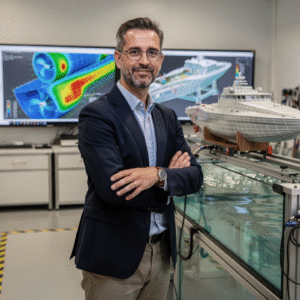
Diploma in Tide and Current Prediction

Why this certificate program?

The Diploma in Tidal and Current Prediction

This program provides you with the essential tools to understand and accurately predict the behavior of ocean tides and currents. Learn to interpret oceanographic data, apply advanced mathematical models, and use specialized software to optimize navigation, coastal management, and maritime operations. This program prepares you to make informed and confident decisions in a dynamic and challenging environment.

This program provides you with the essential tools to understand and accurately predict the behavior of ocean tides and currents.

Differential Advantages

  • Advanced Data Analysis: Master spectral and harmonic analysis techniques for tide prediction.
  • Numerical Modeling: Understand and apply hydrodynamic models to simulate current behavior.
  • Specialized Software: Use industry-leading software tools for data prediction and visualization.
  • Practical Applications: Develop real-world projects in navigation, ports, aquaculture, and marine renewable energy.
  • Professional Certification: Earn a recognized diploma that validates your knowledge and skills in tide and current prediction.
Predicción

Diploma in Tide and Current Prediction

Availability: 1 in stock

Who is it aimed at?

  • Oceanographers and meteorologists who seek to refine their predictive models and interpret tidal data more accurately.
  • Coastal and port engineers who need to optimize the design and management of maritime infrastructure sensitive to sea level variations.
  • Navigators, fishermen, and tour operators who want to understand tides and currents for safe and efficient navigation.
  • Marine science students and professionals who aspire to master tidal prediction tools and techniques.
  • Coastal emergency management officials who need to predict floods and extreme events in advance.

Flexibility for your Development

Designed for active professionals: online format with recorded classes, discussion forums, and downloadable material accessible 24/7.

Predicción

Objectives and competencies

Optimize maritime operations:

“Efficiently manage fuel consumption, optimizing routes and speed to reduce costs and emissions.”

Assess coastal and maritime risks:

“Identify natural hazards (storm surges, tsunamis, subsidence) and impacts of climate change (sea level rise, acidification) and their effect on coastal infrastructure and populations.”

Develop accurate predictive models:

“Use Machine Learning algorithms (regression, classification, clustering) and optimize them with relevant data, selecting the key variables and validating their performance with appropriate metrics.”

Interpreting complex oceanographic data:

“To discern patterns and anomalies, relating them to meteorological phenomena and ocean currents to optimize navigation and safety.”

Managing coastal resources sustainably:

“Implement coastal land use and zoning strategies, considering the conservation of sensitive ecosystems and the development of compatible economic activities.”

Designing resilient maritime infrastructures:

“Integrating innovative and sustainable engineering solutions, considering climate change and extreme events, to minimize environmental impact and maximize the lifespan of infrastructure.”

Curriculum - Modules

  1. Comprehensive Maritime Incident Management: protocols, roles, and chain of command for coordinated response
  2. Operational Planning and Execution: briefing, routes, weather windows, and go/no-go criteria
  3. Rapid Risk Assessment: criticality matrix, scene control, and decision-making under pressure
  4. Operational Communication: VHF/GMDSS, standardized reports, and inter-agency liaison
  5. Tactical Mobility and Safe Boarding: RHIB maneuvers, approach, mooring, and recovery
  6. Equipment and Technologies: PPE, signaling, satellite tracking, and field data logging
  7. Immediate Care of the Affected: primary assessment, hypothermia, trauma, and stabilization for evacuation
  8. Adverse Environmental Conditions: swell, Visibility, flows, and operational mitigation

    Simulation and training: critical scenarios, use of VR/AR, and exercises with performance metrics

    Documentation and continuous improvement: lessons learned, indicators (MTTA/MTTR), and SOP updates

  1. Introduction to Numerical Oceanographic Modeling: Types and Applications
  2. Fundamentals of Geophysical Fluid Dynamics: Navier-Stokes Equations, Coriolis Equations, Approximations
  3. Discretization and Numerical Methods: Finite Differences, Finite Volumes, Finite Elements
  4. Ocean Circulation Models: ROMS, NEMO, HYCOM
  5. Wave Models: SWAN, WAVEWATCH III
  6. Data Assimilation: Techniques and Applications in Oceanography
  7. Statistical Analysis of Oceanographic Data: Time Series, Spectral Analysis, EOF
  8. Oceanographic Data Visualization: Tools and Techniques
  9. Validation and Calibration Models: Metrics and Procedures

    Practical Applications: Prediction of tides, currents, and pollutant transport

  1. Introduction to Numerical Tidal Modeling: Fundamentals and Applications
  2. Descriptive Statistics for Tidal Data: Measures of Central Tendency and Dispersion
  3. Time Series: Decomposition, Trend Analysis, and Seasonality in Tidal Data
  4. Tidal Harmonics: Identification, Calculation, and Prediction of Tides
  5. Software for Tidal Modeling: Introduction to Programming Tools and Libraries
  6. Numerical Tidal Models: Types, Calibration, and Validation
  7. Analysis of Tidal Residuals: Identification of Error Sources and Model Improvement
  8. Uncertainty in Tidal Prediction: Risk Assessment and Management
  9. Applications Practical exercises: Navigation, coastal infrastructure, and environmental management.
  10. Visualization and communication of results: Effective reports and presentations.

  1. Introduction to Numerical Oceanographic Modeling: Fundamentals and Applications
  2. Fundamental Equations of Ocean Dynamics: Navier-Stokes, Continuity, Thermodynamics
  3. Numerical Discretization: Finite Differences, Finite Volumes, Finite Elements
  4. General Oceanic Circulation (GCM) Models: Components and Atmospheric Coupling
  5. Wave Modeling: Linear Theory, Spectral Models, Coastal Transformations
  6. Assimilation of Oceanographic Data: Techniques and Algorithms
  7. Analysis of Observational Data: Descriptive Statistics, Time Series, Spectral Analysis
  8. Visualization of Oceanographic Data: Software and Tools
  9. Calibration and Validation of Oceanographic Models
  10. Practical Applications of Modeling and Data analysis in coastal management and ocean forecasting

  1. Introduction to numerical oceanographic modeling: types of models and applications.
  2. Fundamentals of geophysical fluid dynamics: Navier-Stokes equations, Coriolis equations, hydrostatic approximation.
  3. Spatial and temporal discretization: finite difference methods, finite volume methods, and finite element methods.
  4. Numerical schemes: stability, consistency, and convergence.
  5. Modeling ocean circulation: barotropic and baroclinic models.
  6. Modeling waves and tides: shallow water equations, spectral models.
  7. Assimilation of oceanographic data: optimal interpolation methods, Kalman filtering.
  8. Analysis of oceanographic time series: Fourier techniques, wavelet analysis and spectral analysis.
  9. Visualization and analysis of results: software tools for processing and presenting oceanographic data.
  10. Case studies: application of numerical models to the analysis of specific oceanographic phenomena.

  1. System Architecture and Components: Structural design, materials, and subsystems (mechanical, electrical, electronic, and fluid) with selection and assembly criteria for marine environments
  2. Fundamentals and Principles of Operation: Physical and engineering foundations (thermodynamics, fluid mechanics, electricity, control, and materials) that explain performance and operating limits
  3. Safety and Environmental (SHE): Risk analysis, PPE, LOTO, hazardous atmospheres, spill and waste management, and emergency response plans
  4. Applicable Regulations and Standards: IMO/ISO/IEC requirements and local regulations;
  5. Conformance criteria, certification, and best practices for operation and maintenance
  6. Inspection, testing, and diagnostics: Visual/dimensional inspection, functional testing, data analysis, and predictive techniques (vibration, thermography, fluid analysis) to identify root causes
  7. Preventive and predictive maintenance: Hourly/cycle/seasonal plans, lubrication, adjustments, calibrations, consumable replacement, post-service verification, and operational reliability
  8. Instrumentation, tools, and metrology: Measuring and testing equipment, diagnostic software, calibration and traceability; selection criteria, safe use, and storage
  9. Onboard integration and interfaces: Mechanical, electrical, fluid, and data compatibility; Sealing and watertightness, EMC/EMI, corrosion protection, and interoperability testing.

    Quality, acceptance testing, and commissioning: process and materials control, FAT/SAT, bench and sea trials, go/no-go criteria, and evidence documentation.

    Technical documentation and integrated practice: logs, checklists, reports, and a complete case study (safety → diagnosis → intervention → verification → report) applicable to any system.

  1. Introduction to tides: basic concepts and definitions.
  2. Tidal theory: gravitational forces, astronomical components, spring and neap tides.
  3. Tidalic data collection: tide gauge stations, sensors, measurement techniques.
  4. Harmonic analysis: decomposition of the tidal signal, determination of harmonic constituents.
  5. Statistical tidal models: linear regression, time series, neural networks.
  6. Numerical tidal models: hydrodynamic equations, spatial and temporal discretization.
  7. Implementation of numerical models: simulation software and tools.
  8. Model calibration and validation: comparison with observed data, performance metrics.
  9. Applications of tidal modeling: water level prediction, navigation, coastal management.
  10. Case studies: examples of tidal modeling in different regions and applications.

Career opportunities

  • Oceanographic Data Analyst: Prediction and modeling of tides and currents for various applications.
  • Coastal and Port Project Consultant: Advising on the planning and design of maritime infrastructure.
  • Research Scientist: Development of predictive models and analysis of the impact of climate change on coastlines.
  • Marine Renewable Energy Technician: Optimization of the location and operation of wind farms and other energy sources.
  • Nautical Cartographer: Creation and updating of nautical charts with accurate tidal and current information.
  • Coastal Risk Manager: Assessment and mitigation of risks associated with flooding and coastal erosion.
  • Marine Meteorological Forecaster: Prediction of ocean conditions for navigation and maritime safety.

    Aquaculture Specialist: Optimization of environmental conditions for the cultivation of marine species.

    “`

Admission requirements

Academic/professional profile:

Degree/Bachelor's degree in Nautical Science/Maritime Transport, Naval/Marine Engineering, or a related field; or proven professional experience in bridge/operations.

Language proficiency:

Recommended functional maritime English (SMCP) for simulations and technical materials.

Documentation:

Updated resume, copy of degree or seaman's book, ID card/passport, letter of motivation.

Technical requirements (for online):

Equipment with camera/microphone, stable connection, ≥ 24” monitor recommended for ECDIS/Radar-ARPA.

Admission process and dates

1. Online
application

(form + documents).

2. Academic review and interview

(profile/objectives/schedule compatibility).

3. Admission decision

(+ scholarship proposal if applicable).

4. Reservation of place

(deposit) and registration.

5. Induction

(access to campus, calendars, simulator guides).

Scholarships and grants

  • Predictive Modeling: Master cutting-edge techniques to accurately predict tides and currents.
  • Oceanographic Data Analysis: Learn to interpret and use historical and real-time data for decision-making.
  • Specialized Software: Use professional simulation and visualization tools to analyze oceanographic phenomena.
  • Practical Applications: Develop real-world projects in navigation, coastal management, and marine renewable energy.
  • Professional Certification: Earn a diploma that validates your knowledge and opens doors in the maritime sector.
Boost your career with specialized knowledge in the prediction of tides and currents.

Testimonials

Frequently asked questions

Yes. The itinerary includes ECDIS/Radar-ARPA/BRM with harbor, ocean, fog, storm, and SAR scenarios.

Online with live sessions; hybrid option for simulator/practical placements through agreements.

Recommended functional SMCP. We offer support materials for standard phraseology.

Yes, with a relevant degree or experience in maritime/port operations. The admissions interview will confirm suitability.

Optional (3–6 months) through Companies & Collaborations and the Alumni Network.

Simulator practice (rubrics), defeat plans, SOPs, checklists, micro-tests and applied TFM.

A degree from Navalis Magna University + operational portfolio (tracks, SOPs, reports and KPIs) useful for audits and employment.

  1. Introduction to Numerical Modeling: Basic Concepts and Applications
  2. Finite Difference Methods: Discretization, Consistency, and Stability
  3. Finite Element Methods: Variational Formulation, Shape Functions, and Assembly
  4. Finite Volume Methods: Conservation, Numerical Schemes, and Applications
  5. Solving Linear Systems: Direct and Iterative Methods, Preconditioning
  6. Time Discretization: Explicit and Implicit Methods, Stability
  7. Error Analysis: Truncation, Rounding, and Convergence
  8. Model Validation and Verification: Comparison with Experimental and Analytical Data
  9. Software for Numerical Modeling: Introduction to tools such as MATLAB, Python (with libraries such as NumPy, SciPy) or COMSOL

    Case Studies: Applications in engineering, physics and other disciplines

Request information

  1. Complete the Application Form.

  2. Attach your CV/degree certificate (if you have it to hand).

  3. Indicate your preferred cohort (January/May/September) and whether you would like the hybrid option with simulator sessions.

    An academic advisor will contact you within 24–48 hours to guide you through the admission process, scholarships, and compatibility with your professional schedule.

Please enable JavaScript in your browser to complete this form.
Click or drag a file to this area to upload.

Faculty

0
    0
    Tu carrito
    Tu carrito esta vacíoRegresar a la tienda
    Scroll to Top