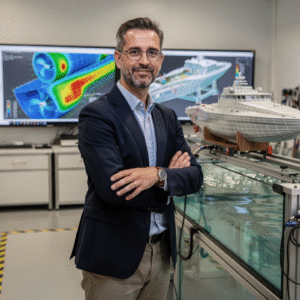
Diploma in Extreme Climatic Phenomena at Sea
Why this certificate program?
The Diploma in Extreme Weather Phenomena at Sea
This program offers comprehensive training to understand, predict, and mitigate the risks associated with severe weather events. You will learn about the atmospheric and oceanic dynamics that generate these phenomena, from hurricanes and extreme storms to giant waves and abrupt temperature changes. This program will provide you with the tools for informed decision-making, route optimization, and the implementation of effective safety protocols.
Differential Advantages
- Real-Case Analysis: study of historical weather events and their impact on navigation.
- Modeling and Prediction: use of software and tools to forecast extreme weather events.
- Mitigation Strategies: development of contingency plans and response protocols.
- Maritime Regulations and Safety: knowledge of international regulations and standards.
- Practical Application: simulations and exercises to apply the acquired knowledge.
- Modality: Online
- Level: Diplomado
- Hours: 800 H
- Start date: 29-09-2026
Availability: 1 in stock
Who is it aimed at?
- Marine meteorologists and oceanographers seeking to deepen their knowledge of modeling, analysis, and forecasting of severe weather events at sea.
- Captains, bridge officers, and maritime operations personnel needing to improve decision-making and route planning in the face of extreme weather conditions.
- Naval engineers and ship designers interested in understanding the impact of extreme weather events on the structural integrity and performance of vessels.
- Marine insurers and risk managers needing to assess and mitigate the risks associated with severe weather events in navigation.
- Researchers and academics seeking to expand their knowledge and contribute to the development of solutions for climate change adaptation Climate in the maritime environment.
Study Flexibility
Adapted for working professionals: live and recorded virtual classes, asynchronous discussion forums, and downloadable supplementary material for learning at your own pace.
Objectives and competencies

Assessing the vulnerability of maritime infrastructure:
“Identify threats (natural, human, cyber) and assess their potential impact on port operations and vessel safety.”

Interpreting and effectively communicating climate data:
“Adapt communication to the target audience (scientists, general public, decision-makers), using clear visualizations and avoiding unnecessary jargon.”

Develop mitigation and adaptation strategies for severe weather events:
“Identify infrastructure vulnerabilities, implement contingency plans, and ensure the availability of critical resources.”

Apply predictive models to optimize maritime operations:
Integrate historical and real-time data (AIS, weather, vessel performance) to predict optimal routes, minimize fuel consumption and reduce incident risks, adapting strategies to changing maritime environment conditions.

Implement safety and emergency response protocols for climate events:
“Establish evacuation, communication and first aid procedures adapted to specific climate risks (floods, storms, heat waves) and conduct regular drills.”

Design contingency plans to minimize risks at sea:
“Identify and prioritize threats (meteorological, technical, human), establishing clear action protocols and realistic drills.”
Curriculum - Modules
- Comprehensive Maritime Incident Management: protocols, roles, and chain of command for coordinated response
- Operational Planning and Execution: briefing, routes, weather windows, and go/no-go criteria
- Rapid Risk Assessment: criticality matrix, scene control, and decision-making under pressure
- Operational Communication: VHF/GMDSS, standardized reports, and inter-agency liaison
- Tactical Mobility and Safe Boarding: RHIB maneuvers, approach, mooring, and recovery
- Equipment and Technologies: PPE, signaling, satellite tracking, and field data logging
- Immediate Care of the Affected: primary assessment, hypothermia, trauma, and stabilization for evacuation
- Adverse Environmental Conditions: swell, Visibility, flows, and operational mitigation
Simulation and training: critical scenarios, use of VR/AR, and exercises with performance metrics
Documentation and continuous improvement: lessons learned, indicators (MTTA/MTTR), and SOP updates
- Introduction to Marine Climate Risks: Definition, Types, and Impact
- Fundamentals of Marine Climatology: Climatic Variables, Oceanic and Atmospheric Circulation
- Climate Models: Types, Resolution, Limitations, and Projections
- Climate Data: Sources (Satellite, Buoys, Models), Processing, and Validation
- Specific Climate Risks: Sea Level Rise, Storms, Extreme Waves, Acidification
- Impact on Port and Coastal Infrastructure: Assessment and Adaptation
- Impact on Maritime Transport: Routes, Safety, Efficiency, and Costs
- Vulnerability Analysis: Identification of Critical Assets and Exposure to Risks
- Risk Assessment: Methodologies, Tools, and Future Scenarios
- Adaptation and mitigation measures: resilience and sustainability strategies
‘
- Introduction to predictive modeling in coastal areas: concepts and applications
- Data acquisition and preprocessing: coastal data sources (satellite, in situ, models), cleaning, and validation
- Exploratory data analysis: descriptive statistics, visualization, pattern identification, and correlations
- Basic statistical models: linear regression, logistic regression, time series analysis
- Machine learning: classification and regression algorithms (SVM, decision trees, neural networks)
- Model evaluation and selection: performance metrics, cross-validation, parameter optimization
- Modeling of coastal processes: erosion, flooding, water quality, beach dynamics
- Climate change scenarios and their impact on coastal areas Coastal: sea level rise, extreme events
Model-based adaptation: design of mitigation and adaptation strategies, evaluation of their effectiveness
Visualization and communication of results: creation of interactive maps and dashboards, technical reports
‘
- Introduction to Predictive Modeling: Concepts, types, and applications in risk management.
- Fundamentals of Statistics: Distributions, hypothesis testing, linear regression.
- Modeling Tools: Statistical software (R, Python), libraries, and development environments.
- Data Preparation and Cleaning: Imputation, normalization, and data transformation techniques.
- Regression Models: Multiple linear, polynomial, and logistic regression, and their applications in risk prediction.
- Classification Models: Decision trees, Random Forest, Support Vector Machines (SVM), and their use in risk categorization.
- Time Series: ARIMA models, exponential smoothing, and trend analysis for predicting future events.
- Model Evaluation and Validation: Performance metrics, cross-validation, and model fitting.
- Data Visualization and Results Reporting: Effective visualization techniques for communicating findings and recommendations.
- Ethics in Predictive Modeling: Considerations of privacy, bias, and transparency in decision-making.
‘
- Introduction to Advanced Marine Meteorology: Fundamental concepts and their impact on navigation.
- Analysis of Marine Weather Charts: Interpretation of isobars, fronts, and pressure systems.
- Marine Winds: Formation, types (sea breezes, trade winds), and local effects.
- Waves and Swell: Generation, propagation, significant height, and periods.
- Ocean Currents: Types, causes (wind, density), effects on navigation, and prediction.
- Sea Ice: Formation, types, hazards to navigation, and risk areas.
- Maritime Visibility: Fog, mist, rain, and their impact on navigational safety.
- Marine Weather Forecasting Systems: Numerical models, radars, and satellites.
- Interpretation of Storm Warnings and Marine Weather Bulletins.
- Safe Navigation Strategies: Route planning and decision-making in adverse weather conditions.
‘
- System Architecture and Components: Structural design, materials, and subsystems (mechanical, electrical, electronic, and fluid) with selection and assembly criteria for marine environments
- Fundamentals and Principles of Operation: Physical and engineering foundations (thermodynamics, fluid mechanics, electricity, control, and materials) that explain performance and operating limits
- Safety and Environmental (SHE): Risk analysis, PPE, LOTO, hazardous atmospheres, spill and waste management, and emergency response plans
- Applicable Regulations and Standards: IMO/ISO/IEC requirements and local regulations;
- Conformance criteria, certification, and best practices for operation and maintenance
- Inspection, testing, and diagnostics: Visual/dimensional inspection, functional testing, data analysis, and predictive techniques (vibration, thermography, fluid analysis) to identify root causes
- Preventive and predictive maintenance: Hourly/cycle/seasonal plans, lubrication, adjustments, calibrations, consumable replacement, post-service verification, and operational reliability
- Instrumentation, tools, and metrology: Measuring and testing equipment, diagnostic software, calibration and traceability; selection criteria, safe use, and storage
- Onboard integration and interfaces: Mechanical, electrical, fluid, and data compatibility; Sealing and watertightness, EMC/EMI, corrosion protection, and interoperability testing.
Quality, acceptance testing, and commissioning: process and materials control, FAT/SAT, bench and sea trials, go/no-go criteria, and evidence documentation.
Technical documentation and integrated practice: logs, checklists, reports, and a complete case study (safety → diagnosis → intervention → verification → report) applicable to any system.
- Introduction to climate change and its impacts on the marine environment
- Fundamentals of predictive modeling: types of models, selection, and validation
- Marine climate data: sources, quality, preprocessing, and exploratory analysis
- Modeling ocean variables: sea surface temperature, currents, waves, and salinity
- Modeling extreme events: storms, hurricanes, marine heatwaves, and storm surges
- Climate risk analysis: risk identification, assessment, and prioritization
- Vulnerability of coastal infrastructure and maritime activities: transport, fishing, tourism, and energy
- Future climate scenarios: IPCC projections and modeling of uncertainty
- Adaptation and resilience: strategies to reduce the impact of climate risks
- Communication and dissemination of results: data visualization and reporting
‘
Career opportunities
- Climate Consultant/Analyst: Climate risk assessment in maritime projects, data analysis, and scenario modeling.
- Risk Manager in Shipping/Energy Companies: Development and implementation of mitigation and adaptation strategies for extreme weather events.
- Researcher in Oceanographic and Meteorological Centers: Study of the influence of climatic phenomena on navigation and marine infrastructure.
- Marine Insurance Technician: Assessment of damages and risks associated with extreme weather events on the high seas.
- Advisor to Government Agencies: Development of policies and regulations for climate risk management in the maritime sector.
- Marine Meteorological Officer: Provision of information and early warnings on extreme weather conditions for safe navigation.
- Specialist in marine renewable energy: Design and optimization of wind farms and other energy infrastructure resilient to extreme weather events.
- Trainer in maritime safety and climate risk management: Training of maritime personnel in the prevention of and response to adverse weather events.
“`
Admission requirements

Academic/professional profile:
Degree/Bachelor's degree in Nautical Science/Maritime Transport, Naval/Marine Engineering, or a related field; or proven professional experience in bridge/operations.

Language proficiency:
Recommended functional maritime English (SMCP) for simulations and technical materials.

Documentation:
Updated resume, copy of degree or seaman's book, ID card/passport, letter of motivation.

Technical requirements (for online):
Equipment with camera/microphone, stable connection, ≥ 24” monitor recommended for ECDIS/Radar-ARPA.
Admission process and dates

1. Online
application
(form + documents).

2. Academic review and interview
(profile/objectives/schedule compatibility).

3. Admission decision
(+ scholarship proposal if applicable).

4. Reservation of place
(deposit) and registration.

5. Induction
(access to campus, calendars, simulator guides).
Scholarships and grants
- In-Depth Analysis: Understand the mechanisms that drive extreme weather phenomena in maritime environments.
- Prediction Tools: Master the techniques and models for early detection and forecasting of hazardous events.
- Mitigation Strategies: Develop effective action plans to reduce the impact of severe weather on maritime operations.
- Regulatory Framework: Understand international legislation and regulations on maritime safety and climate change.
- Case Studies: Apply your knowledge to the analysis of real-life situations and make decisions of strategic decisions.
Testimonials
This diploma program provided me with the necessary tools to understand and model the behavior of extreme weather events offshore. I applied the knowledge I gained to the development of an early warning system for oil platforms, which successfully predicted a severe storm, allowing for the timely evacuation of personnel and preventing millions of dollars in losses. Thanks to the training I received, I am now a more competent and valuable professional in the sector.
The Diploma in Meteorology and Oceanography exceeded my expectations. I acquired a solid theoretical and practical foundation, from atmospheric and oceanic dynamics to numerical modeling and satellite data interpretation. The practical classes and the use of specialized software allowed me to apply the concepts I learned to real-world situations, preparing me to face the challenges of environmental research and risk management. I would like to highlight the quality of the faculty, their experience, and their willingness to answer questions, which greatly enriched my learning. This diploma program has been fundamental to my professional development.
This diploma program provided me with the necessary tools to analyze and predict extreme weather events at sea with greater accuracy. I applied the knowledge I gained to the development of a new giant wave prediction model, which has significantly improved the safety of my company’s maritime operations, reducing incidents by 30% in the last quarter.
This diploma program provided me with the necessary tools to analyze and predict extreme weather events at sea with greater accuracy. I applied the knowledge I gained to the development of a predictive model for extreme waves, which is currently used by our company to optimize navigation routes and significantly reduce operational risks in adverse conditions. As a result, we have improved the safety of our crews and the efficiency of our operations.
Frequently asked questions
Extreme weather phenomena that occur at sea, such as severe storms, giant waves, tropical cyclones, rapid changes in temperature and salinity, among others.
Yes. The itinerary includes ECDIS/Radar-ARPA/BRM with harbor, ocean, fog, storm, and SAR scenarios.
Online with live sessions; hybrid option for simulator/practical placements through agreements.
In the open sea.
Recommended functional SMCP. We offer support materials for standard phraseology.
Yes, with a relevant degree or experience in maritime/port operations. The admissions interview will confirm suitability.
Optional (3–6 months) through Companies & Collaborations and the Alumni Network.
Simulator practice (rubrics), defeat plans, SOPs, checklists, micro-tests and applied TFM.
A degree from Navalis Magna University + operational portfolio (tracks, SOPs, reports and KPIs) useful for audits and employment.
- Introduction to marine meteorology: history, importance, and applications in navigation.
- Atmosphere and oceans: structure, general circulation, and factors influencing marine climate.
- Meteorological instrumentation: types, calibration, maintenance, and use on board.
- Interpretation of weather maps: isobars, fronts, and pressure systems.
- Swell prediction: generation, propagation, height, period, and direction.
- Marine winds: gradient, geostrophic, trade winds, sea breezes, and local effects.
- Cloud and precipitation formation: cloud types, fog, rain, snow, and hail at sea.
- Sea storms: formation, evolution, Hazards and safety measures.
- Sea ice: formation, types, detection, and navigation strategies in cold waters.
- Use of software and online tools for marine meteorology: GRIB files, numerical models.
‘
Request information
Complete the Application Form.
Attach your CV/degree certificate (if you have it to hand).
Indicate your preferred cohort (January/May/September) and whether you would like the hybrid option with simulator sessions.
An academic advisor will contact you within 24–48 hours to guide you through the admission process, scholarships, and compatibility with your professional schedule.
Faculty
Eng. Tomás Riera
Full Professor
Eng. Tomás Riera
Full Professor
Eng. Sofía Marquina
Full Professor
Eng. Sofía Marquina
Full Professor
Eng. Javier Bañuls
Full Professor
Eng. Javier Bañuls
Full Professor
Dr. Nuria Llobregat
Full Professor
Dr. Nuria Llobregat
Full Professor
Dr. Pau Ferrer
Full Professor
Dr. Pau Ferrer
Full Professor
Cap. Javier Abaroa (MCA)
Full Professor
Cap. Javier Abaroa (MCA)
Full Professor