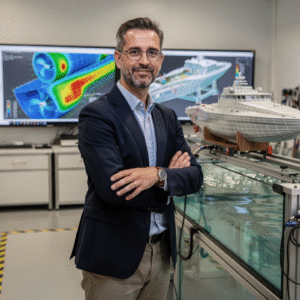
Diploma in Naval Surveillance Drones
Why this certificate program?
The Diploma in Naval Surveillance Drones
This program prepares you to master the latest technologies and strategies for using drones for maritime security. Learn to plan surveillance missions, interpret sensor data, and respond effectively to threats. This program provides you with the essential skills to operate drones in complex naval environments, optimizing safety and efficiency.
the Diploma in Naval Surveillance Drones
Key Benefits
- Operation and Maintenance: Gain practical knowledge in the handling and care of naval drones.
- Data Analysis: Learn to interpret sensor data for early risk detection.
- Legislation and Regulations: Understand the legal framework for the use of drones in maritime spaces.
- Surveillance Strategies: Develop skills for planning effective and safe missions.
- Practical Simulations: Participate in simulations to apply your knowledge in realistic scenarios.
- Modality: Online
- Level: Diplomado
- Hours: 800 H
- Start date: 19-06-2026
Availability: 1 in stock
Who is it aimed at?
- Naval officers and maritime security personnel seeking to integrate drones into their surveillance and reconnaissance operations.
- Naval systems engineers and technicians interested in the maintenance and operation of shipboard drones.
- Port and coastal security experts wishing to improve efficiency in threat detection and traffic control.
- Maritime and logistics service companies seeking to optimize the inspection of vessels, infrastructure, and areas of interest.
- Maritime law and insurance professionals requiring up-to-date knowledge of drone regulations and use in the naval sector.
Flexibility and Applicability
Designed for working professionals: online format with live classes, relevant case studies, and 24/7 access to the virtual platform.
Objectives and competencies

Operate and maintain naval drone systems:
“Perform the deployment and recovery of the drone in adverse weather conditions, interpreting sensor data and applying emergency procedures.”

Interpreting surveillance data for strategic decision-making:
Identify patterns and trends in surveillance data to anticipate risks and opportunities, optimizing resource allocation and improving operational efficiency.

Implement security and cybersecurity protocols in naval drone operations:
“Encrypt drone-station communications and authenticate devices, preventing interception and unauthorized control, by updating keys periodically.”

Integrating drones into maritime surveillance operations:
“Maximize coverage and efficiency by planning autonomous flights, prioritizing high-risk areas and optimizing battery autonomy, while respecting current legislation and safety protocols.”

Adapting drone technology to the specific needs of naval surveillance:
“Integrate advanced sensors (EO/IR, radar) for detection and tracking, optimizing their performance in adverse maritime conditions and making them compatible with existing naval command and control systems.”

Manage the information collected to optimize the response to maritime threats:
“Filter and prioritize data from multiple sources (sensors, reports, intelligence) for an accurate assessment of the threat and its potential impact.”
Curriculum - Modules
- Comprehensive Maritime Incident Management: protocols, roles, and chain of command for coordinated response
- Operational Planning and Execution: briefing, routes, weather windows, and go/no-go criteria
- Rapid Risk Assessment: criticality matrix, scene control, and decision-making under pressure
- Operational Communication: VHF/GMDSS, standardized reports, and inter-agency liaison
- Tactical Mobility and Safe Boarding: RHIB maneuvers, approach, mooring, and recovery
- Equipment and Technologies: PPE, signaling, satellite tracking, and field data logging
- Immediate Care of the Affected: primary assessment, hypothermia, trauma, and stabilization for evacuation
- Adverse Environmental Conditions: swell, Visibility, flows, and operational mitigation
Simulation and training: critical scenarios, use of VR/AR, and exercises with performance metrics
Documentation and continuous improvement: lessons learned, indicators (MTTA/MTTR), and SOP updates
- Introduction to Maritime Drone ISR Operations: Concepts, Applications, and Benefits
- Regulations and Standards: Aeronautical and maritime legislation applicable to drones
- Sensors and Payloads: Types of sensors (EO/IR, radar, acoustic), integration, and calibration
- ISR Mission Planning: Objectives, areas of interest, routes, and contingencies
- Operations in Maritime Environments: Specific challenges (wind, salt corrosion, interference)
- Communications and Data Links: Communication systems, bandwidth, and security
- ISR Data Analysis: Processing, interpretation, and dissemination of information
- Maintenance and Field Operations: Pre-flight checks, preventive maintenance, and troubleshooting.
- Safety in Operations: Risk assessment, emergency procedures, and threat mitigation.
- Ethics and Privacy in ISR: Ethical considerations, data protection, and regulatory compliance.
‘
- Introduction to Marine Sensors: Classification, Principles, and Applications
- Global Positioning Systems (GNSS): GPS, GLONASS, Galileo, BeiDou
- Motion Sensors: IMUs, Accelerometers, Gyroscopes, and Compasses
- Environmental Sensors: Meteorological, Oceanographic, and Water Quality Sensors
- Remote Sensing Systems: Radar, Sonar, Lidar, and Hyperspectral Cameras
- Communication and Data Transmission: Protocols, Networks, and Security
- Autonomous Marine Platforms: AUVs, USVs, and Underwater Gliders
- Autonomous Mission Planning: Objectives, Constraints, and Optimization
- Navigation and Autonomous Control: Algorithms, Perception, and Decision-Making
- Maritime Operations: Safety, Risk Management, and Regulations
‘
- Introduction to Naval ISR Operations with Drones: Purpose and Scope
- Types of Naval Drones: Classification, Characteristics, and Capabilities
- ISR Sensors: EO/IR, Radar, Acoustic, and their Integration into Drones
- Secure Communications: Data Links, Antennas, and Cybersecurity
- ISR Mission Planning: Objectives, Routes, Altitudes, and Timings
- Legislation and Regulations: National and International Regulations
- Ethical and Legal Considerations: Privacy, Use of Force, and Accountability
- Integration with Naval Platforms: Launch, Recovery, and Maintenance
- ISR Data Processing and Analysis: Software, Techniques, and Dissemination
- Case Studies: Successful Naval ISR Operations and Lessons Learned
‘
- Introduction to Modern Maritime Operations: Challenges and Opportunities
- Marine Sensors: Types, Operation, and Calibration
- Acquisition of Oceanographic and Meteorological Data: Buoys, Satellites, and Coastal Stations
- Fundamentals of Marine Data Analysis: Descriptive and Inferential Statistics
- Marine Remote Sensing: Applications in Oceanography and Coastal Management
- Signal Processing for Underwater Acoustic Sensors: Sonar and Hydrophones
- Big Data in the Maritime Sector: Storage and Processing Challenges
- Modeling and Simulation of Oceanographic Processes: Currents, Waves, and Tides
- Maritime Data Visualization: Tools and Techniques for Decision Making
Artificial Intelligence Applied to Autonomous Navigation: Perception, Planning, and Control
‘
- System Architecture and Components: Structural design, materials, and subsystems (mechanical, electrical, electronic, and fluid) with selection and assembly criteria for marine environments
- Fundamentals and Principles of Operation: Physical and engineering foundations (thermodynamics, fluid mechanics, electricity, control, and materials) that explain performance and operating limits
- Safety and Environmental (SHE): Risk analysis, PPE, LOTO, hazardous atmospheres, spill and waste management, and emergency response plans
- Applicable Regulations and Standards: IMO/ISO/IEC requirements and local regulations;
- Conformance criteria, certification, and best practices for operation and maintenance
- Inspection, testing, and diagnostics: Visual/dimensional inspection, functional testing, data analysis, and predictive techniques (vibration, thermography, fluid analysis) to identify root causes
- Preventive and predictive maintenance: Hourly/cycle/seasonal plans, lubrication, adjustments, calibrations, consumable replacement, post-service verification, and operational reliability
- Instrumentation, tools, and metrology: Measuring and testing equipment, diagnostic software, calibration and traceability; selection criteria, safe use, and storage
- Onboard integration and interfaces: Mechanical, electrical, fluid, and data compatibility; Sealing and watertightness, EMC/EMI, corrosion protection, and interoperability testing.
Quality, acceptance testing, and commissioning: process and materials control, FAT/SAT, bench and sea trials, go/no-go criteria, and evidence documentation.
Technical documentation and integrated practice: logs, checklists, reports, and a complete case study (safety → diagnosis → intervention → verification → report) applicable to any system.
- Introduction to Maritime SAR Operations with Drones: Scope and Objectives
- Legislation and Regulations: Airspace, Privacy, and Maritime Security
- Specific Drones for SAR: Sensors, Autonomy, and Payload Capacity
- SAR Mission Planning: Analysis of the Maritime Environment and Meteorological Factors
- Communication and Coordination: Protocols with Maritime Rescue and Other Actors
- Aerial Search Techniques: Search Patterns, Optimal Altitude and Speed
- Image and Data Interpretation: Identification of People, Vessels, and Hazards
- Night Operations: Use of Cameras Thermal and Lighting Systems
Drone Deployment and Recovery: Safe Procedures in Maritime Environments
Drills and Case Studies: Evaluating Effectiveness and Continuous Improvement
‘
Career opportunities
- Drone Operator on Patrol Boats and Surveillance Vessels: Conducting coastal surveillance missions, fisheries control, spill detection, and supporting search and rescue operations.
- Drone Data and Image Analyst: Processing and analyzing collected information for threat detection, identification of illicit activities, and damage assessment.
- Naval Drone Maintenance and Repair Technician: Ensuring the proper functioning of drones, performing preventive and corrective maintenance, and troubleshooting technical issues.
- Maritime Security Consultant with Drones: Advising companies and organizations on the implementation of drone surveillance systems for the protection of critical infrastructure and risk prevention.
- Naval Drone Flight and Operations Instructor: Training new operators and technicians in the safe and Efficient drone operator for maritime applications.
- Naval Drone Software and Hardware Developer: Design and development of new technologies and applications for drones, including control systems, sensors, and communications.
- Naval Drone Technology Researcher: Participation in research and development projects to improve drone capabilities in the maritime and naval sectors.
- Maritime Surveillance Drone Project Manager: Planning, coordination, and supervision of surveillance projects using drones, ensuring compliance with objectives and budgets.
“`
Admission requirements

Academic/professional profile:
Degree/Bachelor's degree in Nautical Science/Maritime Transport, Naval/Marine Engineering, or a related field; or proven professional experience in bridge/operations.

Language proficiency:
Recommended functional maritime English (SMCP) for simulations and technical materials.

Documentation:
Updated resume, copy of degree or seaman's book, ID card/passport, letter of motivation.

Technical requirements (for online):
Equipment with camera/microphone, stable connection, ≥ 24” monitor recommended for ECDIS/Radar-ARPA.
Admission process and dates

1. Online
application
(form + documents).

2. Academic review and interview
(profile/objectives/schedule compatibility).

3. Admission decision
(+ scholarship proposal if applicable).

4. Reservation of place
(deposit) and registration.

5. Induction
(access to campus, calendars, simulator guides).
Scholarships and grants
- Advanced Navigation and Piloting: Master autonomous flight and remote control techniques for drones designed for maritime surveillance.
- Sensors and Surveillance Systems: Learn to interpret data from multispectral cameras, radars, and other key sensors for detection and tracking.
- Data Analysis and Maritime Intelligence: Transform collected information into actionable intelligence for the safety and security of naval resources.
- Maritime Aviation Regulations and Standards: Understand the legal framework and best practices for safe and efficient drone operations in maritime environments.
- Naval Drone Maintenance and Repair: Acquire practical skills for diagnosing and troubleshooting common problems in specialized drones.
Testimonials
The Diploma in Naval Surveillance Drones exceeded my expectations. I acquired solid theoretical and practical knowledge, from regulations and flight planning to advanced image analysis software. The experience with simulators and real drones allowed me to develop crucial skills for maritime surveillance, such as vessel detection and target tracking. Thanks to this training, I secured a position as a drone operator at a major port security company.
The Diploma in Maritime Security & Defense provided me with the necessary tools and knowledge to lead the development and implementation of a new security protocol in my company, reducing incidents by 30% in the first quarter of its application.
The Diploma in Naval Surveillance Drones exceeded my expectations. I acquired solid theoretical and practical knowledge in drone operation, maintenance, and legislation, specifically applied to the maritime environment. The training enabled me to successfully lead the implementation of a coastal surveillance program using drones in my unit, significantly improving our detection and interception capabilities.
This diploma program exceeded my expectations. I acquired solid theoretical and practical knowledge about the use of drones in maritime environments, including mission planning, data analysis, and current legislation. The hands-on experience with simulators and real drones allowed me to develop crucial skills for naval surveillance, significantly increasing my professional competence.
Frequently asked questions
Naval surveillance.
Yes. The itinerary includes ECDIS/Radar-ARPA/BRM with harbor, ocean, fog, storm, and SAR scenarios.
Online with live sessions; hybrid option for simulator/practical placements through agreements.
Yes, it focuses on the use of drones in marine environments and, depending on the specific program, could also include river environments.
Recommended functional SMCP. We offer support materials for standard phraseology.
Yes, with a relevant degree or experience in maritime/port operations. The admissions interview will confirm suitability.
Optional (3–6 months) through Companies & Collaborations and the Alumni Network.
Simulator practice (rubrics), defeat plans, SOPs, checklists, micro-tests and applied TFM.
A degree from Navalis Magna University + operational portfolio (tracks, SOPs, reports and KPIs) useful for audits and employment.
- Introduction to drones in the maritime and security sector.
- Legislation and regulations: National and international regulations applicable to drone operations at sea.
- Sensors and payloads: Cameras (EO/IR), LiDAR, methane detectors, communication equipment.
- Mission planning: Definition of objectives, areas of interest, routes, and safety protocols.
- Data acquisition and analysis: Image processing, 3D model generation, anomaly detection.
- Operational safety: Risk management, contingency plans, emergency procedures at sea.
- Secure communications: Encryption, protection against interference, communication protocols with vessels.
- Intelligence Maritime: surveillance of illegal activities, identification of suspicious vessels, analysis of traffic patterns.
Drone cybersecurity: protection against hacking, access control, maintenance of data integrity.
Ethics and legal considerations in the use of drones for maritime security and intelligence.
‘
Request information
Complete the Application Form.
Attach your CV/degree certificate (if you have it to hand).
Indicate your preferred cohort (January/May/September) and whether you would like the hybrid option with simulator sessions.
An academic advisor will contact you within 24–48 hours to guide you through the admission process, scholarships, and compatibility with your professional schedule.
Faculty
Eng. Tomás Riera
Full Professor
Eng. Tomás Riera
Full Professor
Eng. Sofía Marquina
Full Professor
Eng. Sofía Marquina
Full Professor
Eng. Javier Bañuls
Full Professor
Eng. Javier Bañuls
Full Professor
Dr. Nuria Llobregat
Full Professor
Dr. Nuria Llobregat
Full Professor
Dr. Pau Ferrer
Full Professor
Dr. Pau Ferrer
Full Professor
Cap. Javier Abaroa (MCA)
Full Professor
Cap. Javier Abaroa (MCA)
Full Professor