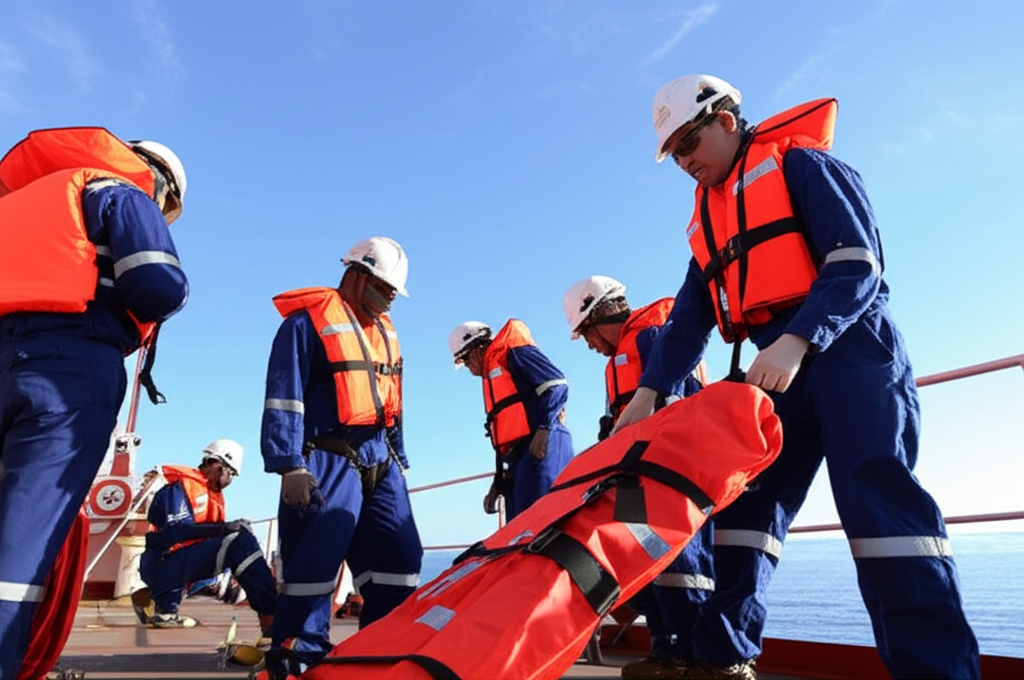
Diploma in Offshore Security
Why this certificate program?
The Diploma in High Seas Security
This program prepares you to face the critical challenges of the maritime environment, providing the necessary tools and knowledge to ensure the safety of the crew, cargo, and vessel. This intensive program covers everything from international regulations (SOLAS, ISM, ISPS) to emergency management and survival at sea, as well as occupational risk prevention and incident response. You will learn to implement effective safety protocols, use salvage and rescue equipment, and lead crisis situations with confidence and professionalism.
Differential Advantages
- Realistic Simulations: Hands-on training in state-of-the-art simulators to face emergency scenarios such as fires, floods, and ship abandonment.
- Industry Experts: Instructors with extensive experience in maritime safety, rescue, and risk management.
- International Certification: Obtain a globally recognized certification that validates your skills in offshore safety.
- Practical Approach: Learning based on real-world cases, practical exercises, and simulations to apply the knowledge acquired.
- Networking: Expand your professional network with colleagues and experts in the maritime sector.
- Modality: Online
- Level: Diplomado
- Hours: 800 H
- Start date: 13-06-2026
Availability: 1 in stock
Who is it aimed at?
- Security professionals seeking to specialize in the unique challenges of the maritime environment and the protection of critical infrastructure.
- Members of security and rescue forces wishing to expand their capabilities in search and rescue operations at sea.
- Shipping and maritime transport company personnel interested in strengthening their knowledge of risk prevention, emergency response, and regulatory compliance.
- Consultants and auditors seeking to deepen their knowledge of international maritime security best practices and standards to offer specialized services.
- Students and recent graduates in related fields aspiring to a career in the maritime sector with a focus on security and management Risks.
Flexibility and applicability: Online format with downloadable resources, real-world case studies, and internationally recognized maritime safety experts.
Objectives and competencies

Effectively manage maritime emergency situations:
Prioritize the safety of human life at sea, coordinating resources and communicating with the relevant authorities.

Apply international and national maritime safety regulations:
Implement the SOLAS Convention and its amendments, verifying compliance with equipment, training and emergency procedures requirements.

Monitor and maintain onboard safety and rescue systems:
“Inspect, test and maintain fire detection equipment, extinguishing systems and rescue equipment (boats, rafts, life jackets), ensuring their operability and regulatory compliance.”

Coordinate and lead teams in maritime security operations:
“Organize roles and responsibilities, optimize internal and external communication, and encourage effective decision-making under pressure, continuously evaluating team performance to ensure the achievement of objectives in critical situations.”

Assessing and mitigating risks in maritime security:
Implement and audit security protocols (ISPS, PBIP) and contingency plans, adapting them to the evolution of threats (cybersecurity, terrorism, hacking), knowing and using the available tools and technologies.

Conduct safety inspections and audits on ships and port facilities:
“Identify hazards, assess risks and propose corrective measures according to international (ISM, ISPS) and local regulations, documenting findings and follow-up.”
Curriculum - Modules
- Comprehensive Maritime Incident Management: protocols, roles, and chain of command for coordinated response
- Operational Planning and Execution: briefing, routes, weather windows, and go/no-go criteria
- Rapid Risk Assessment: criticality matrix, scene control, and decision-making under pressure
- Operational Communication: VHF/GMDSS, standardized reports, and inter-agency liaison
- Tactical Mobility and Safe Boarding: RHIB maneuvers, approach, mooring, and recovery
- Equipment and Technologies: PPE, signaling, satellite tracking, and field data logging
- Immediate Care of the Affected: primary assessment, hypothermia, trauma, and stabilization for evacuation
- Adverse Environmental Conditions: swell, Visibility, flows, and operational mitigation
Simulation and training: critical scenarios, use of VR/AR, and exercises with performance metrics
Documentation and continuous improvement: lessons learned, indicators (MTTA/MTTR), and SOP updates
- Introduction to ISPS: Objectives, Scope, and Code Structure
- Maritime Security Assessment: Identifying Threats and Vulnerabilities
- Port Facility Security Officer (PFSO): Responsibilities and Training
- Port Facility Security Plan (PFSP): Development, Approval, and Implementation
- Maritime Security Levels: Security Measures for Each Level
- Access Control to the Port Facility: Personnel, Vehicles, and Cargo
- Security Equipment: Surveillance, Detection, and Response Systems
- Emergency Management: Contingency Plans, Drills, and Coordination with Authorities
- Cooperation and Coordination: Between Authorities, PFSOs, and Ships and other stakeholders
- Maritime security audits and exercises: Maintenance and continuous improvement of the PPIP
‘
- Introduction to Survival: Principles, Psychology, and Mental Preparation
- Survival Equipment: Life Rafts, Immersion Suits, EPIRB, SART
- Survival Techniques at Sea: Floating, Swimming, Rescue, First Aid
- Survival in Extreme Climates: Heat, Cold, Wind, Sun Protection
- Distress Signals: Visual, Audible, Radio, Emergency Communications
- Basic First Aid: CPR, Hemorrhage Control, Treatment of Burns and Fractures
- Onboard Threats: Risks of Fire, Flooding, Collision, Pollution
- Firefighting Equipment: Extinguishers, Hoses, Self-Contained Breathing Apparatus (SCBA)
- Fire Extinguishing Techniques Fires: fire classification, attack strategies, ventilation
Onboard emergency organization and procedures: drills, roles, and responsibilities
‘
- Introduction to the ISPS Code: Objectives, scope, and structure.
- Risk assessment in maritime security: Identifying threats and vulnerabilities.
- Ship Security Officer (SSO): Roles, responsibilities, and training.
- Ship Security Plan (SSP): Development, implementation, and updating.
- Security levels: Level 1, Level 2, Level 3, and their corresponding measures.
- Control of access to the ship: Procedures and technologies.
- Handling cargo and provisions: Inspection and security control.
- Cooperation with authorities and other ships: Information sharing and coordination.
- Combating piracy: Preventive and reactive.
- Maritime security exercises and drills: Response preparation and evaluation.
‘
- Introduction to the ISM Code: Objectives, scope, and structure.
- Responsibilities and authorities: Designation of the Designated Person (DPA).
- Safety and environmental protection policy: Definition and implementation.
- Documented procedures: Development, control, and maintenance.
- Emergency preparedness and response: Planning and drills.
- Nonconformities, accidents, and hazardous events: Reporting, investigation, and analysis.
- Maintenance of the ship and equipment: Preventive maintenance program.
- ISPS Code: Objectives, roles, and responsibilities of the Ship Security Officer (SSO) and the Company Security Officer (CSO).
- Ship Security Assessment (SSA): Threat identification and vulnerabilities.
- Ship Security Plans (SSP): Development, implementation, and exercises.
‘
- System Architecture and Components: Structural design, materials, and subsystems (mechanical, electrical, electronic, and fluid) with selection and assembly criteria for marine environments
- Fundamentals and Principles of Operation: Physical and engineering foundations (thermodynamics, fluid mechanics, electricity, control, and materials) that explain performance and operating limits
- Safety and Environmental (SHE): Risk analysis, PPE, LOTO, hazardous atmospheres, spill and waste management, and emergency response plans
- Applicable Regulations and Standards: IMO/ISO/IEC requirements and local regulations;
- Conformance criteria, certification, and best practices for operation and maintenance
- Inspection, testing, and diagnostics: Visual/dimensional inspection, functional testing, data analysis, and predictive techniques (vibration, thermography, fluid analysis) to identify root causes
- Preventive and predictive maintenance: Hourly/cycle/seasonal plans, lubrication, adjustments, calibrations, consumable replacement, post-service verification, and operational reliability
- Instrumentation, tools, and metrology: Measuring and testing equipment, diagnostic software, calibration and traceability; selection criteria, safe use, and storage
- Onboard integration and interfaces: Mechanical, electrical, fluid, and data compatibility; Sealing and watertightness, EMC/EMI, corrosion protection, and interoperability testing.
Quality, acceptance testing, and commissioning: process and materials control, FAT/SAT, bench and sea trials, go/no-go criteria, and evidence documentation.
Technical documentation and integrated practice: logs, checklists, reports, and a complete case study (safety → diagnosis → intervention → verification → report) applicable to any system.
- Introduction to the ISPS Code: Objectives, Principles, and Structure
- Maritime Security Assessment (MSA): Methodology and Documentation
- Port Facility Security Officer (PFSO): Responsibilities and Training
- Ship Security Officer (SSO): Responsibilities and Training
- Maritime Security Levels: Level 1, Level 2, and Level 3
- Security Measures for Access to the Port Facility and the Ship
- Management of Threats and Emergency Situations: Contingency Plans
- Control of Persons and Baggage: Inspection and Search Procedures
- Cooperation with Authorities and Other Stakeholders: Communication and Coordination
Maritime security audits and exercises: Compliance and continuous improvement
‘
Career opportunities
- Security Officer on Merchant and Tanker Vessels: Implementation and supervision of security plans, access control, and emergency response.
- Security Supervisor on Offshore Platforms: Management of security at marine facilities, coordination of drills and security audits.
- Maritime Security Consultant: Security advice for shipping and port companies, development of contingency plans, and risk analysis.
- Maritime Security Inspector: Verification of compliance with security regulations on ships and at port facilities, investigation of maritime incidents and accidents.
- Risk Manager at Port Facilities: Identification and assessment of risks, implementation of preventive and corrective measures, and coordination of emergency response teams.
- Maritime Security Specialist: Development and implementation of protective measures against illicit acts, such as piracy and terrorism, on ships and in port facilities.
Maritime Security Trainer: Delivery of security training courses and programs for maritime and port personnel.
Security Management Systems Auditor: Evaluation of compliance with security standards and regulations in shipping and port companies.
“`
Admission requirements

Academic/professional profile:
Degree/Bachelor's degree in Nautical Science/Maritime Transport, Naval/Marine Engineering, or a related field; or proven professional experience in bridge/operations.

Language proficiency:
Recommended functional maritime English (SMCP) for simulations and technical materials.

Documentation:
Updated resume, copy of degree or seaman's book, ID card/passport, letter of motivation.

Technical requirements (for online):
Equipment with camera/microphone, stable connection, ≥ 24” monitor recommended for ECDIS/Radar-ARPA.
Admission process and dates

1. Online
application
(form + documents).

2. Academic review and interview
(profile/objectives/schedule compatibility).

3. Admission decision
(+ scholarship proposal if applicable).

4. Reservation of place
(deposit) and registration.

5. Induction
(access to campus, calendars, simulator guides).
Scholarships and grants
- Risk Analysis: Master the identification and assessment of threats in complex maritime environments.
- Maritime Law: Gain in-depth knowledge of international regulations and their practical application.
- Emergency Management: Develop crucial skills to respond effectively to critical situations.
- Cybersecurity: Protect naval operations against digital attacks and cyber threats.
- Security Technologies: Familiarize yourself with the most advanced systems and equipment for maritime security.
Testimonials
This diploma program exceeded my expectations. I acquired crucial practical and theoretical knowledge to work safely and efficiently on offshore platforms. The training in rescue, first aid, and emergency management, along with the focus on international regulations, allowed me to obtain a position as a Safety Supervisor at a leading company in the sector, significantly increasing my career opportunities and my salary.
The Diploma in Maritime Safety & Rescue exceeded my expectations. I acquired essential practical and theoretical knowledge, from international regulations to advanced rescue techniques, which allowed me to be promoted to Head of Safety at my company.
This diploma program exceeded my expectations. The combination of theory and practice, along with the instructors’ expertise, allowed me to acquire the necessary skills to work safely and efficiently on offshore platforms. Thanks to the training I received, I secured a position as a Safety Supervisor at a leading company in the sector, directly applying the knowledge I gained in the program.
This diploma program provided me with the tools and knowledge necessary to advance to the position of Security Supervisor. The hands-on training in emergency response and the focus on international regulations were key to my success.

Frequently asked questions
Oil and gas platforms, merchant ships, cruise ships, and other maritime installations.
Yes. The itinerary includes ECDIS/Radar-ARPA/BRM with harbor, ocean, fog, storm, and SAR scenarios.
Online with live sessions; hybrid option for simulator/practical placements through agreements.
It focuses on the physical security of offshore oil and gas platforms, including protection against threats such as terrorism, piracy, and sabotage.
Recommended functional SMCP. We offer support materials for standard phraseology.
Yes, with a relevant degree or experience in maritime/port operations. The admissions interview will confirm suitability.
Optional (3–6 months) through Companies & Collaborations and the Alumni Network.
Simulator practice (rubrics), defeat plans, SOPs, checklists, micro-tests and applied TFM.
A degree from Navalis Magna University + operational portfolio (tracks, SOPs, reports and KPIs) useful for audits and employment.
- Fire Theory: Fire triangle and tetrahedron, fire classes.
- Extinguishing Agents: Water, foam, dry chemical powder, CO2, clean agents.
- Extinguishing Equipment: Portable extinguishers, hoses, nozzles, fixed systems.
- Personal Protective Equipment (PPE): Firefighter suits, self-contained breathing apparatus (SCBA).
- Extinguishing Techniques: Cooling, smothering, fuel removal, inhibition.
- Emergency Planning: Risk assessment, evacuation routes, assembly points.
- Crowd Control: Basic principles, communication, persuasion techniques.
- Barriers and Containment: Types of barriers, strategic deployment, use of force.
- Emergency First Aid: Victim assessment, CPR, control of Hemorrhages.
- Drills and practical exercises: Design, execution, evaluation, and continuous improvement.
‘
Request information
Complete the Application Form.
Attach your CV/degree certificate (if you have it to hand).
Indicate your preferred cohort (January/May/September) and whether you would like the hybrid option with simulator sessions.
An academic advisor will contact you within 24–48 hours to guide you through the admission process, scholarships, and compatibility with your professional schedule.
Faculty
Eng. Tomás Riera
Full Professor
Eng. Tomás Riera
Full Professor
Eng. Sofía Marquina
Full Professor
Eng. Sofía Marquina
Full Professor
Eng. Javier Bañuls
Full Professor
Eng. Javier Bañuls
Full Professor
Dr. Nuria Llobregat
Full Professor
Dr. Nuria Llobregat
Full Professor
Dr. Pau Ferrer
Full Professor
Dr. Pau Ferrer
Full Professor
Cap. Javier Abaroa (MCA)
Full Professor
Cap. Javier Abaroa (MCA)
Full Professor

