
Effective Communication on Ships Course
This course is designed to improve safety and operational efficiency on board through clear and precise communication. You will learn to avoid critical misunderstandings, optimize teamwork, and manage emergency situations…
Prior Knowledge Assessment
These are the skills this programme builds. Tick the ones you already have and we will tell you which part of the syllabus is really for you.
What is the Effective Communication on Ships Course?
The Effective Communication on Ships
This course is designed to improve safety and operational efficiency on board through clear and precise communication. You will learn to avoid critical misunderstandings, optimize teamwork, and manage emergency situations effectively. This program addresses the specific characteristics of the maritime environment, with practical exercises and simulations that will allow you to apply communication techniques in real-life situations, from coordinating maneuvers to crisis management, in order to minimize risks and optimize collaboration among the crew.
Differential Advantages
- Practical Simulations: Realistic scenarios to improve communication in critical situations.
- Active Listening Techniques: Developing skills to understand and respond effectively.
- Intercultural Communication: Strategies to overcome language and cultural barriers.
- Conflict Management: Tools to resolve disagreements constructively.
- Nonverbal Communication: Interpreting and using body language to improve understanding.
Programme highlights
- Master Maritime Communication: Learn the key techniques for clear and effective communication in nautical environments.
- Protocols and Terminology: Familiarize yourself with standard protocols and specific vocabulary used on board and in communications with shore.
- Conflict Management: Acquire skills to resolve conflicts and improve collaboration among the crew.
- Emergency Communication: Prepare to communicate effectively in crisis situations, ensuring the safety of the vessel and crew.
- Intercultural Communication: Develop sensitivity and strategies to communicate with diverse crews and overcome cultural barriers.
- Increase the safety and efficiency of your vessel through effective and professional communication.
Programme Structure
The programme is structured in 5 modules, listed below in order of study.
Fundamentals of Operational Maritime Communication and Human Factors in Risk Environments
- On-board communication principles: clarity, brevity, confirmation and traceability of critical messages
- Human factors and communication error: biases, cognitive load, fatigue, stress and degradation of judgment
- Roles and flows of information: bridge–machines–deck–hotel–security and transfer points
- Communication in guards and manoeuvres: priorities, sequences, operational limits and “stop work” criteria
- Language standards and ambiguity zero: terminology, standardised phrases, and misunderstanding control
Communication Bridge–Bridge and Bridge–Earth: VHF, Standardized Messaging and Procedures
- VHF operation: channels, radio discipline, shifts, courtesy and call structure
- Critical Messages: Position, Intent, Manoeuvre, Restrictions and Confirmation of Reception
- Communications with VTS/port: reports, instructions, permits, inputs/exits and traffic coordination
- Emergency protocols: Mayday/PAN-PAN/Securité, relays, repetition and control of the channel
- Internal communications during incidents: chain of command, roles, “closed-loop” and scene control
Internal crew communication: briefings, debriefings and multi-departmental coordination
- Effective Operation Briefing: Objective, Risks, Roles, Limits, Success Criteria and Contingency Plan
- Improvement-oriented debriefing: facts, decisions, deviations, lessons learned and corrective actions
- Coordination between departments: guard handover, maintenance, housekeeping and deck operations
- Security Meetings and Toolbox Talks: Preparation, Participation, Documentation and Follow-up
- Management of night and fatigue communications: redundancies, confirmations and responsible scaling
Communication with passengers, customers and users of the service: experience, conflicts and reputation
- Communicational care in maritime services: expectations, operational empathy and control of promises
- Passenger Safety Messages: Clear Instructions, Signage, Megaphony, and Effective Repeat
- Complaints and Claims Management: Listening, Reformulation, Options, Closure and Documentation
- Conflict de-escalation: verbal techniques, limits, security and coordination with the team
- Communication in incidents with passengers: truthful information, calm, protocols and reputational protection
Measurement of communication performance and final project for the implementation of on-board protocols
- On-board communication audit: flow mapping, recurring failures and friction points
- Indicators and evaluation: incidents due to misunderstanding, response times, handover quality and compliance
- Practical training: simulations, drills, role-play and evaluation by communication rubrics
- Tools and templates: Briefing scripts, checklists, report formats and public address scripts
- Implementation and Cultural Change: Adoption, Resistance, Behavioural Reinforcement and Periodic Review
Study Time and Workload
300 hours of study, online and at your own pace. Move the slider to the hours a week you can really put in.
Officers and seamen of all ranks looking to improve clarity and accuracy in their onboard communications.Supervisors and department heads wanting to optimize coordination and information flow between teams.Deck and engine room personnel needing to reduce misunderstandings and avoid errors resulting from poor communication.New recruits and cadets aiming to master standard communication protoc
Academic direction and faculty
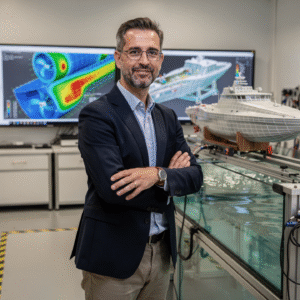
The teaching team at Navalis: working professionals who deliver and oversee the institute's programmes.




Student Reviews
Reviews collected and verified by Opynio, not written by us.
Learning Outcomes
- 01Establish and maintain active listening on board
- 02To give clear and concise instructions in emergency situations
- 03Use nonverbal communication to complement and reinforce key messages
- 04Adapt communication to the cultural and linguistic context of the crew
- 05Resolving conflicts on board through assertive communication
- 06To effectively coordinate ship maneuvers using standardized communication protocols
Career Opportunities
Entry Requirements
Admissions Process
No waiting for a phone call. If your documents are complete, you can pay in the same session.
Academic/Professional Profile:Work experience in the maritime sector (deck, engine room, passenger area); or training in communication, psychology, or HR; or STCW certification related to safety and emergencies.Language Proficiency:Native Spanish speaker (or equivalent proficiency). Basic knowledge of English (desirable).Skills:Teamwork, conflict resolution, active listening, and empathy.Documentation:Updated CV, boarding certificate (if applicable), ID/Passport.```
Frequently Asked Questions
Leave your details and admissions will write back. If you already know this is the one, go straight to the application and pay in the same session.
