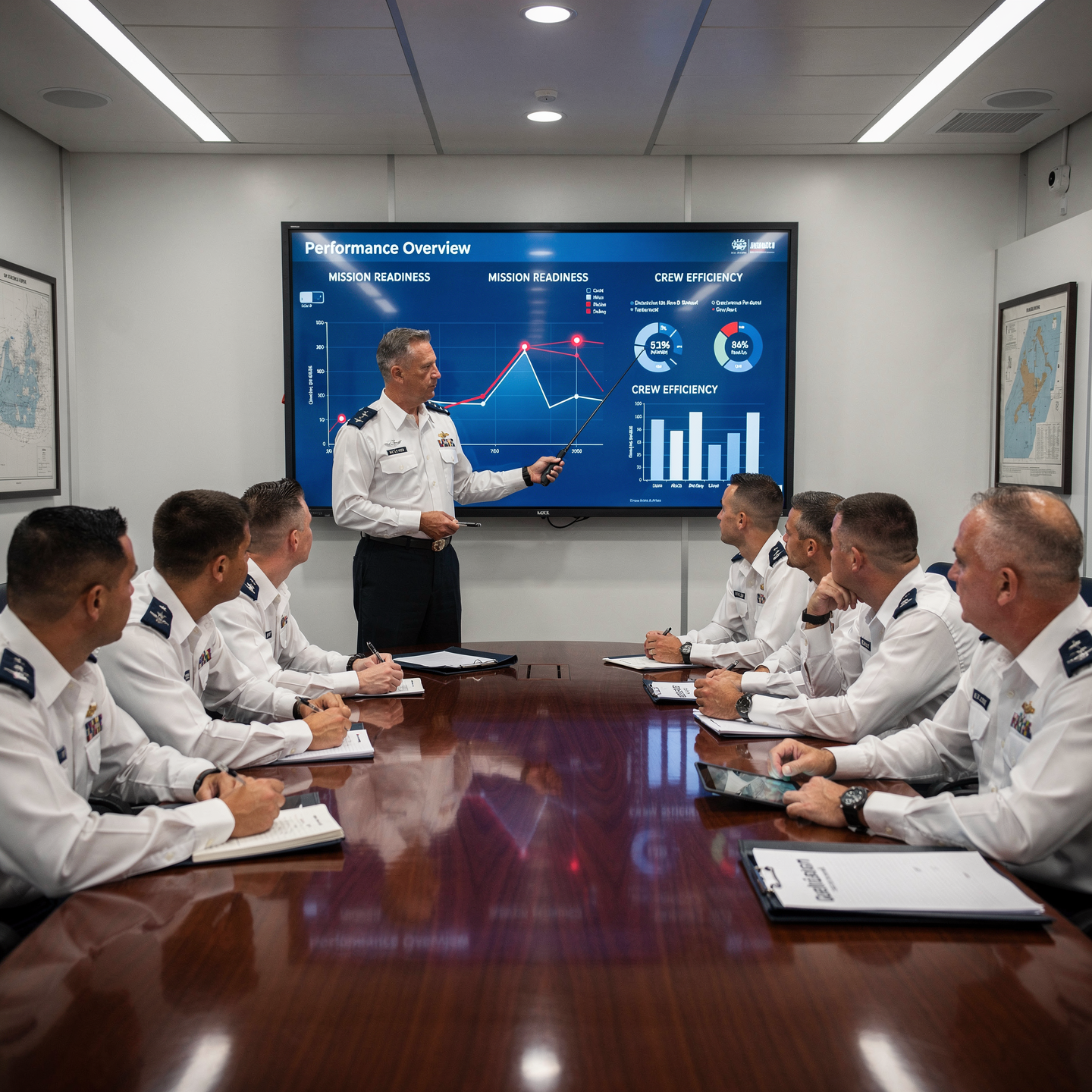
Crew Performance Evaluation Course
Why this course?
The Crew Performance Evaluation
course
Is designed to optimize the management of human talent on board, boosting efficiency and operational safety. You will learn to implement an objective and fair evaluation system that motivates the crew to reach their full potential. You will master constructive feedback techniques, identify areas for improvement, and develop personalized action plans, fostering an environment of continuous professional growth and strengthening effective leadership on board.
Differential Advantages
- Proven Methodologies: Implementation of assessment models based on competencies and clear objectives.
- Practical Tools: Use of standardized templates and forms for consistent and efficient assessment.
- Effective Communication: Development of skills to provide meaningful and motivating feedback.
- Conflict Resolution: Strategies to address underperformance situations and promote collaboration.
- Continuous Improvement: Focus on the professional development of the crew and strengthening the safety culture.
- Modality: Online
- Level: Cursos
- Hours: 150 H
- Start date: 25-04-2026
Availability: 1 in stock
Who is it aimed at?
- Fleet Managers and Personnel Managers seeking to optimize talent management on board and improve overall crew performance.
- Superintendents and Compliance Officers requiring effective tools to assess compliance with regulations and safety standards.
- Captains and First Officers wanting to lead high-performing teams through constructive feedback and professional development.
- Maritime Human Resources Departments interested in implementing objective assessment systems for informed decision-making regarding promotions and advancements.
- Maritime Auditors and Consultants needing validated methodologies for performance evaluation and identifying areas for improvement. Improvement in maritime operations.
Flexibility and Applicability
Training adaptable to industry needs: real-world case studies, practical tools, and implementation guides for different types of vessels.
Objectives and competencies

Identify and mitigate operational risks:
Implement emergency response plans, drills, and root cause analysis to prevent recurrence.

Optimize talent management on board:
Implement professional development programs and continuous performance evaluations to identify staff strengths and areas for improvement, fostering a collaborative and high-performance work environment.

Promote continuous improvement of individual and collective performance:
Implement performance analysis methodologies (KPIs), promote constructive feedback, and facilitate continuous training to optimize skills and processes.

Ensure compliance with safety and efficiency standards:
“Implement emergency and damage control procedures, demonstrating responsiveness to critical situations and minimizing risks to the crew, cargo, and the environment.”

Facilitate effective communication and teamwork:
“Implement agile methodologies and digital collaboration tools, fostering active listening and constructive conflict resolution.”

Provide constructive feedback and professional development opportunities:
“To encourage self-assessment, identify areas for improvement, and offer resources for continuous professional growth.”
Curriculum - Modules
- Comprehensive Maritime Incident Management: protocols, roles, and chain of command for coordinated response
- Operational Planning and Execution: briefing, routes, weather windows, and go/no-go criteria
- Rapid Risk Assessment: criticality matrix, scene control, and decision-making under pressure
- Operational Communication: VHF/GMDSS, standardized reports, and inter-agency liaison
- Tactical Mobility and Safe Boarding: RHIB maneuvers, approach, mooring, and recovery
- Equipment and Technologies: PPE, signaling, satellite tracking, and field data logging
- Immediate Care of the Affected: primary assessment, hypothermia, trauma, and stabilization for evacuation
- Adverse Environmental Conditions: swell, Visibility, flows, and operational mitigation
Simulation and training: critical scenarios, use of VR/AR, and exercises with performance metrics
Documentation and continuous improvement: lessons learned, indicators (MTTA/MTTR), and SOP updates
- Introduction to Competency Standards: Definition, types, and their importance in job performance.
- Identifying Key Competencies: Methodologies for determining the essential skills, knowledge, and attitudes for a position.
- Designing Performance Indicators: Creating objective and measurable metrics to evaluate the level of competency.
- The Feedback Process: Types of feedback, principles for effective communication, and how to create a conducive environment.
- Constructive Feedback Techniques: How to offer specific, balanced, and improvement-oriented feedback.
- 360-Degree Feedback: Implementation, benefits, and challenges of multi-source evaluation.
- Competency Gap Analysis: Identifying areas for individual and group improvement and development.
- Development Plans Individualized: Design of personalized training and development strategies.
Implementation of continuous improvement cycles: PDCA methodology (Plan, Do, Check, Act) applied to skills development.
Tools for monitoring and evaluation: Software and platforms for performance management and continuous improvement.
‘
- Fundamentals of Assessment: Purposes, principles, and ethics.
- Assessment criteria: Validity, reliability, objectivity, and fairness.
- Formative and summative assessment: Differences, advantages, and disadvantages.
- Assessment methods: Objective tests, essays, projects, portfolios, and observation.
- Design of assessment instruments: Rubrics, checklists, and rating scales.
- Development of assessment questions and tasks: Types, cognitive levels, and curriculum alignment.
- Data collection and analysis: Basic descriptive and inferential statistical techniques.
- Effective feedback: Characteristics, types, timing, and delivery strategies.
- Using feedback for continuous improvement: Improvement plans Action and monitoring of progress.
- Evaluation of educational programs and policies: Models and approaches.
‘
- Introduction to IMO Standards: Key Conventions, Codes, and Resolutions.
- IMO Competencies (STCW): Structure, Levels, and Updates.
- Competency Assessment: Methods and Tools.
- 360° Evaluation: Foundations, Benefits, and Challenges.
- Designing a 360° Evaluation Program Based on IMO Standards.
- Key Performance Indicators (KPIs) aligned with IMO Standards.
- Data Collection for 360° Evaluation: Observation, Questionnaires, Interviews.
- Results Analysis: Identifying Strengths and Areas for Improvement.
- Developing Customized Action Plans for the Development of competencies.
- Implementation and monitoring: Continuous evaluation and improvement of the program.
‘
- Fundamentals of Assessment: Purposes, principles, and types of assessment.
- Assessment Criteria: Definition, development, and alignment with learning objectives.
- Assessment Techniques and Instruments: Rubrics, checklists, portfolios, objective and subjective tests.
- Effective Feedback: Characteristics, timing, and channels for providing meaningful feedback.
- The Art of Feedback: Techniques for communicating constructive and motivating feedback.
- Continuous Improvement: The Deming Cycle (PDCA) and its application in assessment and learning.
- Analysis of Assessment Data: Identifying strengths, weaknesses, and areas for improvement.
- Improvement Strategies: Designing and implementing action plans based on the Evaluation.
- Formative and Summative Assessment: Differences, Purposes, and Application in the Teaching-Learning Process.
- Ethics in Assessment: Confidentiality, Transparency, and Fairness in the Application of Criteria.
‘
- System Architecture and Components: Structural design, materials, and subsystems (mechanical, electrical, electronic, and fluid) with selection and assembly criteria for marine environments
- Fundamentals and Principles of Operation: Physical and engineering foundations (thermodynamics, fluid mechanics, electricity, control, and materials) that explain performance and operating limits
- Safety and Environmental (SHE): Risk analysis, PPE, LOTO, hazardous atmospheres, spill and waste management, and emergency response plans
- Applicable Regulations and Standards: IMO/ISO/IEC requirements and local regulations;
- Conformance criteria, certification, and best practices for operation and maintenance
- Inspection, testing, and diagnostics: Visual/dimensional inspection, functional testing, data analysis, and predictive techniques (vibration, thermography, fluid analysis) to identify root causes
- Preventive and predictive maintenance: Hourly/cycle/seasonal plans, lubrication, adjustments, calibrations, consumable replacement, post-service verification, and operational reliability
- Instrumentation, tools, and metrology: Measuring and testing equipment, diagnostic software, calibration and traceability; selection criteria, safe use, and storage
- Onboard integration and interfaces: Mechanical, electrical, fluid, and data compatibility; Sealing and watertightness, EMC/EMI, corrosion protection, and interoperability testing.
Quality, acceptance testing, and commissioning: process and materials control, FAT/SAT, bench and sea trials, go/no-go criteria, and evidence documentation.
Technical documentation and integrated practice: logs, checklists, reports, and a complete case study (safety ā diagnosis ā intervention ā verification ā report) applicable to any system.
Plan de estudio - Módulos
- Comprehensive Maritime Incident Management: protocols, roles, and chain of command for coordinated response
- Operational Planning and Execution: briefing, routes, weather windows, and go/no-go criteria
- Rapid Risk Assessment: criticality matrix, scene control, and decision-making under pressure
- Operational Communication: VHF/GMDSS, standardized reports, and inter-agency liaison
- Tactical Mobility and Safe Boarding: RHIB maneuvers, approach, mooring, and recovery
- Equipment and Technologies: PPE, signaling, satellite tracking, and field data logging
- Immediate Care of the Affected: primary assessment, hypothermia, trauma, and stabilization for evacuation
- Adverse Environmental Conditions: swell, Visibility, flows, and operational mitigation
Simulation and training: critical scenarios, use of VR/AR, and exercises with performance metrics
Documentation and continuous improvement: lessons learned, indicators (MTTA/MTTR), and SOP updates
- Introduction to Competency Standards: Definition, types, and their importance in job performance.
- Identifying Key Competencies: Methodologies for determining the essential skills, knowledge, and attitudes for a position.
- Designing Performance Indicators: Creating objective and measurable metrics to evaluate the level of competency.
- The Feedback Process: Types of feedback, principles for effective communication, and how to create a conducive environment.
- Constructive Feedback Techniques: How to offer specific, balanced, and improvement-oriented feedback.
- 360-Degree Feedback: Implementation, benefits, and challenges of multi-source evaluation.
- Competency Gap Analysis: Identifying areas for individual and group improvement and development.
- Development Plans Individualized: Design of personalized training and development strategies.
Implementation of continuous improvement cycles: PDCA methodology (Plan, Do, Check, Act) applied to skills development.
Tools for monitoring and evaluation: Software and platforms for performance management and continuous improvement.
‘
- Fundamentals of Assessment: Purposes, principles, and ethics.
- Assessment criteria: Validity, reliability, objectivity, and fairness.
- Formative and summative assessment: Differences, advantages, and disadvantages.
- Assessment methods: Objective tests, essays, projects, portfolios, and observation.
- Design of assessment instruments: Rubrics, checklists, and rating scales.
- Development of assessment questions and tasks: Types, cognitive levels, and curriculum alignment.
- Data collection and analysis: Basic descriptive and inferential statistical techniques.
- Effective feedback: Characteristics, types, timing, and delivery strategies.
- Using feedback for continuous improvement: Improvement plans Action and monitoring of progress.
- Evaluation of educational programs and policies: Models and approaches.
‘
- Introduction to IMO Standards: Key Conventions, Codes, and Resolutions.
- IMO Competencies (STCW): Structure, Levels, and Updates.
- Competency Assessment: Methods and Tools.
- 360° Evaluation: Foundations, Benefits, and Challenges.
- Designing a 360° Evaluation Program Based on IMO Standards.
- Key Performance Indicators (KPIs) aligned with IMO Standards.
- Data Collection for 360° Evaluation: Observation, Questionnaires, Interviews.
- Results Analysis: Identifying Strengths and Areas for Improvement.
- Developing Customized Action Plans for the Development of competencies.
- Implementation and monitoring: Continuous evaluation and improvement of the program.
‘
- Fundamentals of Assessment: Purposes, principles, and types of assessment.
- Assessment Criteria: Definition, development, and alignment with learning objectives.
- Assessment Techniques and Instruments: Rubrics, checklists, portfolios, objective and subjective tests.
- Effective Feedback: Characteristics, timing, and channels for providing meaningful feedback.
- The Art of Feedback: Techniques for communicating constructive and motivating feedback.
- Continuous Improvement: The Deming Cycle (PDCA) and its application in assessment and learning.
- Analysis of Assessment Data: Identifying strengths, weaknesses, and areas for improvement.
- Improvement Strategies: Designing and implementing action plans based on the Evaluation.
- Formative and Summative Assessment: Differences, Purposes, and Application in the Teaching-Learning Process.
- Ethics in Assessment: Confidentiality, Transparency, and Fairness in the Application of Criteria.
‘
- System Architecture and Components: Structural design, materials, and subsystems (mechanical, electrical, electronic, and fluid) with selection and assembly criteria for marine environments
- Fundamentals and Principles of Operation: Physical and engineering foundations (thermodynamics, fluid mechanics, electricity, control, and materials) that explain performance and operating limits
- Safety and Environmental (SHE): Risk analysis, PPE, LOTO, hazardous atmospheres, spill and waste management, and emergency response plans
- Applicable Regulations and Standards: IMO/ISO/IEC requirements and local regulations;
- Conformance criteria, certification, and best practices for operation and maintenance
- Inspection, testing, and diagnostics: Visual/dimensional inspection, functional testing, data analysis, and predictive techniques (vibration, thermography, fluid analysis) to identify root causes
- Preventive and predictive maintenance: Hourly/cycle/seasonal plans, lubrication, adjustments, calibrations, consumable replacement, post-service verification, and operational reliability
- Instrumentation, tools, and metrology: Measuring and testing equipment, diagnostic software, calibration and traceability; selection criteria, safe use, and storage
- Onboard integration and interfaces: Mechanical, electrical, fluid, and data compatibility; Sealing and watertightness, EMC/EMI, corrosion protection, and interoperability testing.
Quality, acceptance testing, and commissioning: process and materials control, FAT/SAT, bench and sea trials, go/no-go criteria, and evidence documentation.
Technical documentation and integrated practice: logs, checklists, reports, and a complete case study (safety ā diagnosis ā intervention ā verification ā report) applicable to any system.
- Introduction to Behavioral Analysis: Principles, Objectives, and Applications in Navigation
- Navigation Data Collection: Metrics, Telemetry, Event Logs
- Analysis Tools: Visualization Software, Data Analysis Platforms
- Identifying Behavioral Patterns: Frequent Routes, Congestion Areas, Detours
- Risk and Safety Analysis: Identifying Dangerous Behaviors, Near Misses
- Human Factors and Errors: Root Cause Analysis, Cognitive Biases
- Designing Interventions and Improvements: Procedural Changes, Training, Technology
- Implementing Changes: A/B Testing, Phased Rollout, Change Management
- Measuring Impact and Monitoring: Key Performance Indicators (KPIs), Continuous Evaluation
- Culture of Improvement continuous: feedback, communication, organizational learning
‘
- Introduction to Performance Optimization: Key Concepts and Benefits
- Defining KPIs: Identifying Key Performance Indicators
- Data Collection and Analysis: Measurement Tools and Techniques
- Assessing Current Performance: Diagnosing Strengths and Weaknesses
- Identifying Areas for Improvement: Prioritizing Opportunities
- Setting SMART Goals: Defining Realistic and Measurable Goals
- Developing Action Plans: Strategies and Tactics for Improvement
- Implementing Improvements: Executing Action Plans
- Monitoring and Controlling Performance: Tracking Results and Making Adjustments
- Communication and Feedback: Fostering a Culture of Continuous Improvement
‘
- Introduction to evaluation criteria: definition, importance, and types.
- Evaluation tools: checklists, rubrics, rating scales.
- Data collection and analysis: quantitative and qualitative methods.
- Key performance indicators (KPIs): definition, selection, and monitoring.
- Benchmarking: identifying best practices and comparing them with the competition.
- Root cause analysis: identifying underlying problems and solutions.
- Continuous improvement cycle (PDCA): Plan, Do, Check, Act.
- Problem-solving techniques: Ishikawa diagrams, 5 Whys, etc.
- Implementing changes and monitoring Results.
- Communication and documentation of continuous improvement.
‘
- Introduction to Competency Standards: Models and Frameworks
- Performance Observation: Data Collection Techniques and Tools
- Observation Biases: Identification and Mitigation Strategies
- Effective Feedback: Principles, Structure, and Appropriate Language
- Assertive Communication: Active Listening, Empathy, and Rapport
- The Power of Positive Feedback: Recognition, Motivation, and Reinforcement
- Constructive Feedback: Areas for Improvement, Specific Examples, and Action Plans
- 360-Degree Feedback: Collection, Analysis, and Application of Results
- Coaching and Mentoring: Skills and Potential Development
- Measuring the Impact of Feedback on Performance and Culture organizational
‘
Career opportunities
- HR Manager in Shipping Companies: Design and implementation of specific performance evaluation systems for crew.
- Maritime Talent Management Consultant: Advising companies in the sector on optimizing crew performance through objective evaluations.
- Internal Auditor in Shipping Companies: Verifying compliance with quality and safety standards through crew performance evaluations.
- Performance Evaluation Skills Trainer: Training managers and supervisors in the application of objective evaluation tools and techniques.
- Crew Performance Data Analyst: Identifying areas for improvement and trends based on evaluation data analysis to optimize training and development.
- Crew Professional Development Program Manager: Designing and implementing customized training and development programs based on the results of performance evaluations.
- Mediator in onboard labor disputes: Using performance evaluations as a tool for conflict resolution and improving the work environment.
- Researcher in the field of crew performance: Developing innovative evaluation models and tools based on scientific research.
“`
Admission requirements

Academic/professional profile:
Degree/Bachelor's degree in Nautical Science/Maritime Transport, Naval/Marine Engineering, or a related field; or proven professional experience in bridge/operations.

Language proficiency:
Recommended functional maritime English (SMCP) for simulations and technical materials.

5. Induction
Updated resume, copy of degree or seaman's book, ID card/passport, letter of motivation.

Technical requirements (for online):
Equipment with camera/microphone, stable connection, ā„ 24ā monitor recommended for ECDIS/Radar-ARPA.
Admission process and dates

1. Online
application
(form + documents).

2. Academic review and interview
(profile/objectives/schedule compatibility).

3. Admission decision
(+ scholarship proposal if applicable).

4. Reservation of place
(deposit) and registration.

5. Induction
(access to campus, calendars, simulator guides).
Scholarships and grants
- Mastery of Techniques: Learn to conduct fair, objective, and effective performance reviews based on key performance indicators.
- Performance Improvement: Drive the individual and collective growth of your crew by identifying strengths and areas for improvement.
- Effective Communication: Develop skills to provide constructive and motivating feedback, fostering an environment of trust and collaboration.
- Practical Tools: Apply proven templates and methodologies to optimize the evaluation process and ensure its transparency and fairness.
- Regulatory Compliance: Ensure compliance with the Maritime sector regulations and standards regarding personnel management and safety. Maximize your crew’s potential through a strategic performance evaluation.
Testimonials
I implemented a performance evaluation system for my crew, and the results were excellent. Productivity increased by 15% in the last quarter, and communication among team members improved significantly. The evaluations allowed us to identify individual areas for improvement and provide targeted training, resulting in more efficient and satisfactory customer service. Furthermore, the process fostered a more transparent and motivating work environment.
I applied the assertive communication and conflict management skills I learned in the Maritime Psychology and Leadership course to resolve a dispute between two crew members that was impacting morale and productivity. I successfully mediated, facilitating a constructive dialogue that resulted in a mutually satisfactory agreement and the restoration of a collaborative work environment. This significantly improved the team’s efficiency for the remainder of the voyage.
I implemented a performance evaluation system based on key competencies for the crew, which resulted in a 15% increase in operational efficiency and a 20% reduction in reported incidents in the last quarter. Individualized feedback and personalized development plans enabled crew members to enhance their skills and contribute more effectively to team goals.
I implemented a performance evaluation system based on key competencies for flight crews, resulting in a 15% increase in flight punctuality and a 20% reduction in crew performance-related incident reports within six months.

Frequently asked questions
Improve the individual and collective performance of the crew to achieve operational objectives safely and efficiently.
Yes. The itinerary includes ECDIS/Radar-ARPA/BRM with harbor, ocean, fog, storm, and SAR scenarios.
Online with live sessions; hybrid option for simulator/practical placements through agreements.
Improve the individual and collective performance of the crew.
Recommended functional SMCP. We offer support materials for standard phraseology.
Yes, with a relevant degree or experience in maritime/port operations. The admissions interview will confirm suitability.
Optional (3ā6 months) through Companies & Collaborations and the Alumni Network.
Simulator practice (rubrics), defeat plans, SOPs, checklists, micro-tests and applied TFM.
A degree from Navalis Magna University + operational portfolio (tracks, SOPs, reports and KPIs) useful for audits and employment.
- Introduction to Competency Standards: Models and Frameworks
- Performance Observation: Data Collection Techniques and Tools
- Observation Biases: Identification and Mitigation Strategies
- Effective Feedback: Principles, Structure, and Appropriate Language
- Assertive Communication: Active Listening, Empathy, and Rapport
- The Power of Positive Feedback: Recognition, Motivation, and Reinforcement
- Constructive Feedback: Areas for Improvement, Specific Examples, and Action Plans
- 360-Degree Feedback: Collection, Analysis, and Application of Results
- Coaching and Mentoring: Skills and Potential Development
- Measuring the Impact of Feedback on Performance and Culture organizational
‘
Request information
- Complete the Application Form
- Attach your CV/Qualifications (if you have them to hand).
- Indicate your preferred cohort (January/May/September) and whether you want the hybrid option with simulator sessions.
Teachers
Eng. TomƔs Riera
Full Professor
Eng. TomƔs Riera
Full Professor
Eng. SofĆa Marquina
Full Professor
Eng. SofĆa Marquina
Full Professor
Eng. Javier BaƱuls
Full Professor
Eng. Javier BaƱuls
Full Professor
Dr. Nuria Llobregat
Full Professor
Dr. Nuria Llobregat
Full Professor
Dr. Pau Ferrer
Full Professor
Dr. Pau Ferrer
Full Professor
Cap. Javier Abaroa (MCA)
Full Professor
Cap. Javier Abaroa (MCA)
Full Professor

