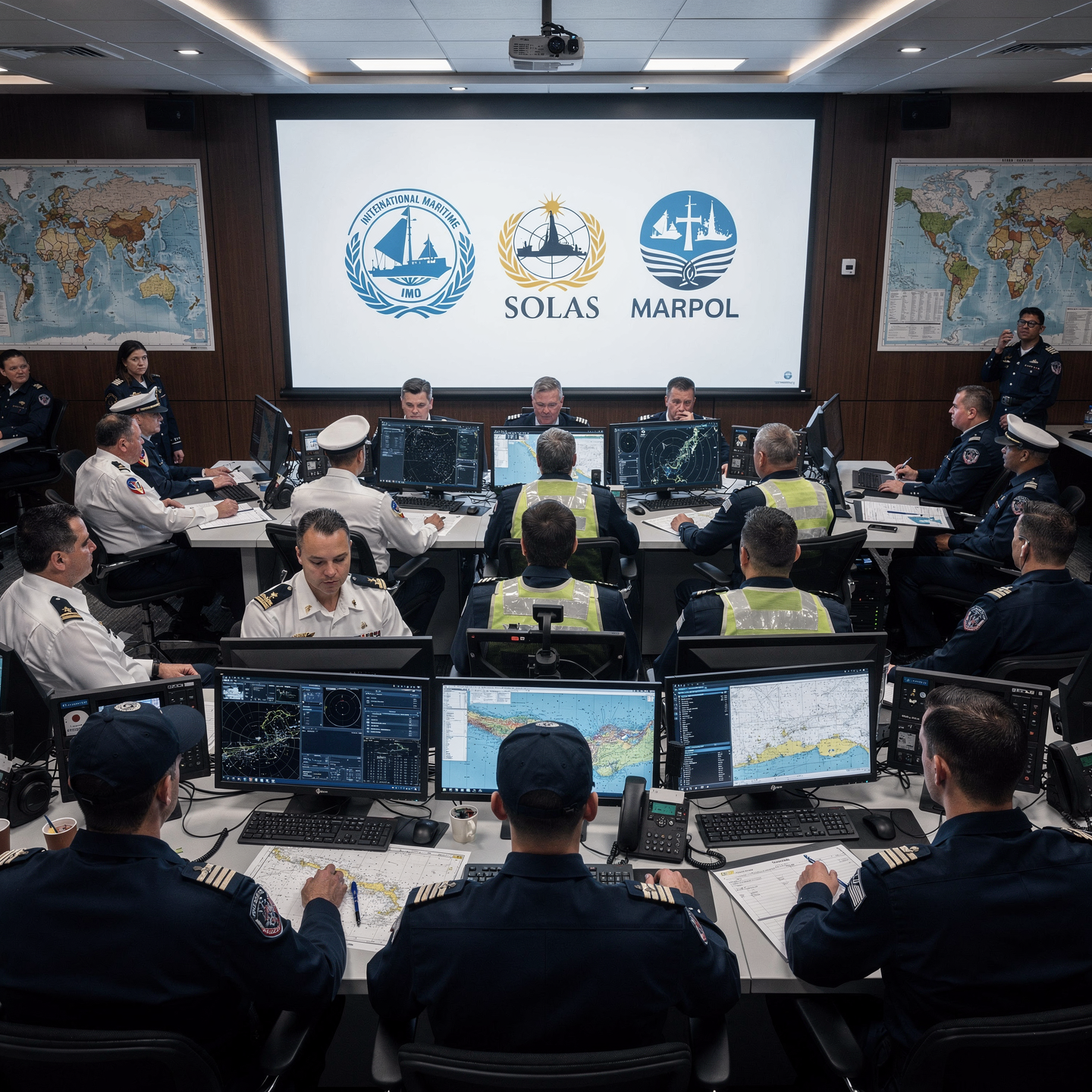
Master’s Degree in Maritime Security Policies (IMO, SOLAS, MARPOL)
Why this master’s programme?
The Master’s Degree in Maritime Safety Policy (IMO, SOLAS, MARPOL)
Offers an in-depth immersion in the international regulatory framework governing maritime safety. Acquire comprehensive knowledge of the IMO conventions, the fundamental principles of SOLAS, and the key guidelines of MARPOL. This program equips you to lead the implementation and enforcement of regulations, crucial for the safety of human life at sea and the protection of the marine environment. Develop analytical and strategic skills to address emerging challenges in global maritime security.
Differentiating Advantages
- Comprehensive Analysis: Gain in-depth knowledge of the interpretation and application of IMO, SOLAS, and MARPOL regulations.
- Practical Approach: Develop skills for the effective implementation of maritime security policies.
- Global Perspective: Understand emerging challenges and trends in international maritime security.
- Networking: Connect with leading experts and professionals in the maritime sector.
- Professional Development: Boost your career in maritime administration, the shipping industry, or consulting.
- Modality: Online
- Level: Masters
- Hours: 1600 H
- Start date:
Availability: 1 in stock
Who is it aimed at?
- Maritime professionals (shipowners, shipping companies, insurers) seeking to specialize in international regulations and risk management.
- Public administration officials (coast guards, port authorities) interested in implementing and monitoring maritime safety policies.
- Consultants and auditors wishing to expand their knowledge of IMO, SOLAS, and MARPOL regulations to offer specialized services.
- Graduates in Law, Nautical Studies, Naval Engineering, or related fields seeking to develop a professional career in the field of maritime safety.
- HSEQ managers needing to optimize safety management systems and regulatory compliance in their organizations.
Academic Flexibility:
Designed for working professionals: online modality, 24/7 access to content, and personalized tutoring.
Objectives and skills

Implement measures for the protection of ships and port facilities:
“Conduct risk assessments at the port facility, identifying threats and vulnerabilities to develop appropriate protection plans.”

Ensuring regulatory compliance in maritime safety management:
Implement the ISPS Code, verifying security levels and coordinating with port authorities.

Leading the response to emergencies and contingencies at sea:
Assess the situation, activate the ship’s emergency plan, communicate with the relevant authorities (MRCC/Coast Guard), and direct the crew to mitigate risks and protect human life, the environment, and the ship.

Optimizing the environmental management of maritime operations:
“Implement waste and wastewater management procedures on board, ensuring regulatory compliance and minimizing the impact on the marine ecosystem.”

Assessing and mitigating risks in the maritime supply chain:
Implement proactive contingency plans in the face of disruptions (weather, geopolitics, cyberattacks) and ensure operational continuity through diversification of suppliers and alternative routes.

Develop and implement cybersecurity strategies in the maritime sector:
“Implement cybersecurity frameworks (NIST, ISO 27001) adapted to the maritime OT/ICS environment, considering network segmentation and identity management.”
Study plan – Modules
- Global Regulatory Framework: Structure and Competence of the International Maritime Organization (IMO), Key Conventions, and Standards Adoption Mechanisms
- SOLAS Convention: Detailed Analysis of Chapters Related to Safety of Life at Sea, Construction Requirements, Equipment, and Safe Operations
- Marine Safety Information (MSI): Integration into Operations and Compliance with Notification and Warning Regulations
- MARPOL Convention: Fundamentals, Annexes I to VI, Prevention of Pollution by Oil, Noxious Substances, Garbage, Ballast Water, and Atmospheric Emissions
- Inspection and Verification Protocols: Certification Systems, Port State Control Inspections, and Compliance Audits
- Implementation and Management of Contingency Plans: Response to Spills, Pollution Incidents, and Environmental Emergencies in Areas Maritime
Operating procedures for environmental compliance: waste management, wastewater treatment, and air emissions control on ships
Integrated management systems: ISM and its interrelation with SOLAS and MARPOL to ensure operational safety and environmental protection
Marine environmental risk assessment: methodology, threat identification, and development of mitigation strategies based on IMO standards
Technological advances and their impact on regulatory compliance: monitoring sensors, electronic reporting, and emissions traceability
Training and awareness of maritime personnel on IMO regulations: training programs, certifications, and legal responsibilities
Case studies and major incident studies: analysis of compliance failures and lessons learned for continuous improvement
Contemporary challenges in marine environmental protection: climate change, plastic pollution, and sustainable ocean management in accordance with International agreements
Future perspectives: global maritime decarbonization initiatives, regulatory developments, and the role of public policies in safety and environmental protection
Effective implementation of maritime safety policies in multicultural and multinational environments: inter-institutional coordination and international cooperation
- Fundamentals of strategic risk management in the maritime sector: definition, scope, and modern approaches based on international standards
- IMO regulatory framework: detailed analysis of the SOLAS and MARPOL conventions, their structure, implementations, and key updates
- Identification and assessment of maritime risks: quantitative and qualitative methods, analysis of operational and environmental hazards
- Development and implementation of risk management plans in accordance with IMO requirements: establishing objectives, metrics, and action plans
- Advanced techniques for the prevention and mitigation of marine pollution: control of atmospheric emissions, oil spills, and solid waste management
- Monitoring and response to environmental incidents: early warning systems, contingency protocols, and coordination with Maritime Authorities
- Audits and continuous monitoring systems: implementation of the International Safety Management Code (ISM) to ensure regulatory compliance
Document management and environmental compliance reporting: preparation of MARPOL compliance reports, operational records, and internal audits
Training and continuing education: development of technical and operational skills for onboard and shore-based personnel in risk management and environmental protection
Case studies and practical simulations: application of policies and procedures in real-world risk management and pollution prevention scenarios
- International legal framework: comprehensive analysis of applicable IMO conventions, including SOLAS, MARPOL, ISPS, and ISM, with emphasis on their historical evolution and operational scope
- Technical and legal instruments for implementation: mechanisms for the adoption, ratification, and national adaptation of international regulations
- Compliance strategies in the maritime supply chain: roles and responsibilities of shipowners, operators, port authorities, and regulatory bodies
- Specific protocols for maritime safety: risk management, accident prevention, emergency response, and access control in accordance with the ISPS Code
- Mechanisms for the prevention and control of marine pollution: practical application of MARPOL in the management of waste, hydrocarbons, ballast water, and atmospheric emissions
- Environmental and safety risk assessment and management: technical analysis of mandatory audits, inspections, and certifications
- Integrated monitoring and compliance systems: advanced use of satellite technology, electronic surveillance, and regulatory reporting for continuous oversight
- Planning and execution of internal and external audits: preparation, inspection methodologies, and response to nonconformities
- Practical implications of regulatory non-compliance: sanctions, legal procedures, and dispute resolution in international jurisdictions
- Development of proactive corporate policies and continuing education programs to foster an organizational culture focused on regulatory compliance and maritime sustainability
- IMO Regulatory Framework: Structure, Relevant Conventions, and Roles of International Organizations in Maritime Safety
- IMO Audit Procedures: Types (Interim, Terminal, Internal), Phases (Preparation, On-Site, Reporting), and Evaluation Criteria according to SOLAS and MARPOL
- Comprehensive Nonconformity Management: Identification, Classification, Root Cause Analysis, and Advanced Methods for Implementing Corrective and Preventive Actions
- Safety Management Systems (SMS) in accordance with the ISM Code: Integration with SOLAS and MARPOL requirements, documentation, training, and continuous evaluation
- Certification and Recertification: Processes, Technical Requirements, Document Maintenance, External Audits, and Validation of Crew Competencies
- Continuous Monitoring and Auditing: Techniques for Compliance Control, Use of Digital Tools, and Specialized Platforms for Real-Time Monitoring
- Planning and Tactical Response to Maritime Incidents: Protocols for
- Emergencies, coordination with port authorities and international organizations, and management of environmental and security contingencies
- Operational risk assessment in accordance with SOLAS and MARPOL: scenario analysis, crisis simulations, and development of strategic and operational response plans
- Case studies of auditing and non-conformity response: study of real incidents, lessons learned, and best practices for continuous improvement in maritime safety
- Technological innovations in compliance management: use of artificial intelligence, big data, and blockchain for document traceability and improved regulatory control in maritime operations
- Fundamentals of Integrated Monitoring Systems: Architecture, Communication Protocols, and Applicable International Standards
- Advanced Sensors for Maritime Surveillance: LIDAR, Doppler Radar, Acoustic Sensors, and Multispectral Cameras
- Geographic Information Systems (GIS) applied to the real-time management and control of security and environmental incidents
- Integration of Data from Multiple Sources: AIS, Satellites, Drones, and Coastal Stations for a Holistic View of the Maritime Environment
- Command and Control Platforms: Design, Interoperability, and Early Warning Modules for Effective Emergency Management
- Secure Communication Protocols and Encryption in Critical Systems to Prevent Cyberattacks and Ensure Data Integrity
- Applications of Artificial Intelligence and Machine Learning in Predictive Risk Detection for Safety and environmental protection
Implementation of IMO, SOLAS, and MARPOL standards in the design and operation of automated control and monitoring systems
Simulations and computational modeling for the evaluation of accidental pollution scenarios and mitigation responses
Evaluation of the effectiveness of emerging technologies in reducing environmental impacts and improving operational safety through KPIs and continuous audits
- International Regulatory Framework: Detailed analysis of the IMO, SOLAS, and MARPOL Conventions and their impact on maritime operations
- Practical Implementation of SOLAS: Essential safety requirements, certifications, inspections, and compliance in onboard risk management
- MARPOL in Depth: Integrated marine pollution management, waste segregation, and hydrocarbon and ballast water treatment systems
- Development and Integration of the Safety Management System (SMS): Structure, roles, responsibilities, and internal audits in accordance with the ISM Code
- Advanced Strategies for Environmental Risk Prevention: Assessment, monitoring, and mitigation of impacts in maritime operations
- Protocols and Procedures for Responding to Environmental Emergencies: Spills, emissions, and chemical pollution in shipping
- Implementation of Monitoring Technologies and Systems: Sensors, remote monitoring, and data analysis to ensure compliance
- Regulatory
- Role of maritime and port control authorities: coordination, inspection, and enforcement measures in monitoring safety and environmental protection
- Training and continuing education of crew and personnel: specific programs to ensure competence in accordance with international standards
- Case studies and incident analysis: lessons learned and continuous improvement in the implementation of maritime safety and environmental protection policies
- International Regulatory Framework: Historical Evolution, Structure, and Jurisdiction of the IMO
- SOLAS Convention: Technical Requirements for the Safety of Life at Sea, Including Emergency Prevention and Response Systems
- MARPOL Convention: Categories of Marine Pollutants, Annexes, and Protocols for Pollution Prevention in Maritime Operations
- Practical Implementation of IMO Regulations in Port and Offshore Operations: Responsibilities and Obligations for Shipowners, Operators, and Crew
- Inspection and Compliance Mechanisms: Compliance Audits, Port State Control (PSC), and Corrective Actions for Regulatory Non-Compliance
- Integrated Safety Management Systems (ISM Code): Design, Implementation, Monitoring, and Continuous Improvement
- Risk Assessment and Operational Resilience: Vulnerability Analysis, Failure Mode and Effects Simulation, and Contingency Plans
- Environmental Monitoring Technologies and
- Security: Sensors, early warning systems, and traceability of critical events
- Inter-institutional coordination and international cooperation for safe and sustainable maritime management
- Case studies and best practices in the implementation of IMO policies for safety and environmental protection in commercial fleets and specialized vessels
- Fundamentals and Regulatory Structure: Comprehensive analysis of the IMO, SOLAS, and MARPOL conventions, their protocols, and current amendments applicable to maritime safety and environmental protection.
- Risk and Vulnerability Assessment: Advanced methodologies for identifying and quantifying risks in maritime operations, including natural, human, and technological hazards.
- Design of Integrated Safety Protocols: Development of standardized procedures for onboard risk management, in accordance with ISM, ISPS, and the Maritime Security Code.
- Practical Implementation of SOLAS: Specific applications in navigational safety levels, lifesaving equipment, emergency management, and dynamic stability control.
- Application of MARPOL in Environmental Management: Strategies for preventing marine pollution from hydrocarbons, sewage, solid waste, and emissions atmospheric conditions, including certification and compliance audits.
Advanced maritime incident simulation: design and execution of practical exercises for responding to spills, fires, collisions, and critical situations, with multidisciplinary monitoring.
Monitoring and control using maritime technology: integration of AIS, VTS, CCTV, and pollution sensors to monitor compliance with protocols in real time.
Development of contingency and environmental recovery plans: impact assessment, inter-institutional coordination, and deployment of resources for post-incident mitigation and restoration.
Documentation management and internal audits: preparation and maintenance of mandatory records, incident reports, regulatory reviews, and preparation for Port State Inspections and IMO audits.
Leadership and communication training in maritime safety: skills for the effective implementation of protocols, fostering a safety culture, and crisis management in the face of multidisciplinary teams.
- Fundamentals and legal structure of the International Maritime Organization (IMO): conventions, codes, and resolutions applicable to maritime safety
- Practical implementation of the SOLAS Convention (Safety of Life at Sea): technical requirements, documentation, certifications, and audits to ensure navigational safety
- MARPOL regulations for the prevention of marine pollution: identification and management of oil spills, solid waste, and ballast water
- Development and management of Safety Management Systems (SMS) in accordance with the ISM Code: policies, procedures, key roles, and responsibilities within the organization
- Integrated maritime risk assessment: advanced methodologies for hazard, vulnerability, and mitigation analysis in naval and port operations
- Contingency plans for responding to maritime and environmental emergencies: coordination with authorities, operators, and control centers
- Regulatory monitoring and compliance: techniques and tools for internal and external audits, Port State Control (PSC) inspections, and document review in accordance with IMO regulations.
Integrated incident management and lessons learned: protocols for notification, forensic analysis, and continuous improvement of operational safety.
Operational resilience in maritime fleets: strategies for adaptation and recovery from natural, technological, and human threats.
Training, education, and continuing education in IMO regulations: designing effective programs for crew and shore-based personnel with a focus on compliance and safety culture.
- Conceptual framework and theoretical foundations of the Maritime Safety Management System in accordance with IMO, SOLAS, and MARPOL regulations
- Detailed analysis of the international obligations arising from the SOLAS Convention and their application in the daily operation of ships
- Comprehensive study of the MARPOL Convention: prevention of marine pollution, technical requirements, and environmental controls
- Design and implementation of comprehensive safety and environmental protection policies aligned with the standards of the ISM Code
- Advanced methodologies for the identification, assessment, and mitigation of operational and environmental risks in the maritime sector
- Development of Standard Operating Procedures (SOPs) to ensure rigorous compliance with international and local regulations
- Technological integration in the management system: monitoring systems, digital reports, and electronic audits
- Analysis of the impact of regulatory compliance on operational efficiency, costs, and sustainability of operations Maritime Safety Management
Advanced document management: creation, control, and updating of safety manuals, contingency plans, and compliance records
Planning and execution of internal and external audits under IMO standards, including Port State Control audits
Training and development of human resources: ongoing training, roles, and responsibilities within the maritime safety management system
Mechanisms for continuous improvement: incident analysis, lessons learned, and implementation of corrective and preventive actions
Real-world case studies and simulations for the practical integration of the management system in multiple and complex scenarios
Final evaluation and presentation of the integrated project: consolidation of an operational, documented, and certified Maritime Safety and Environmental Protection Management System
Career prospects
“`html
- Maritime Safety Consultant: Advising on compliance with IMO, SOLAS, and MARPOL regulations.
- Maritime Safety Auditor: Conducting audits to verify compliance with safety regulations on ships and port facilities.
- Maritime Risk Management Specialist: Identifying, assessing, and mitigating risks in maritime operations.
- Compliance Officer in Shipping or Port Companies: Ensuring compliance with IMO, SOLAS, and MARPOL regulations.
- Maritime Safety Inspector: Inspecting ships and port facilities to guarantee compliance with regulations.
- Marine Pollution Prevention Technician: Developing and implementing measures to prevent marine pollution in accordance with MARPOL.
- Maritime Safety Trainer: Delivery of courses and training programs on IMO, SOLAS, and MARPOL regulations.
- Maritime Safety Investigator: Analysis of maritime incidents and development of recommendations to improve safety.
“`
Entry requirements

Academic/professional profile:
Bachelor’s degree in Nautical Science/Maritime Transport, Naval/Marine Engineering or a related qualification; or proven professional experience on the bridge/in operations.

Language proficiency:
Functional Maritime English (SMCP) recommended for simulations and technical materials.

Documentation:
Updated CV, copy of qualification or seaman’s book, national ID/passport, motivation letter.

Technical requirements (for online):
Device with camera/microphone, stable internet connection, monitor ≥ 24” recommended for ECDIS/Radar-ARPA.
Admissions process and dates

Online
application
(form + documents).

Academic review and interview
Admissions decision

Admissions decision
(+ scholarship offer if applicable).

Place reservation
(deposit) and enrolment.

Induction
(access to the virtual campus, calendars, simulator guides).
Scholarships and financial support
- Comprehensive Mastery: Delve into the IMO, SOLAS, and MARPOL conventions, pillars of global maritime security.
- Risk Management: Learn to identify, assess, and mitigate threats and vulnerabilities in the maritime environment.
- Regulatory Compliance: Acquire the tools to ensure strict compliance with national and international regulations.
- Strategic Leadership: Develop leadership and decision-making skills in critical security situations.
- Global Impact: Contribute to the security and sustainability of maritime transport at the global level global.
Testimonials
“Applying the knowledge acquired in the Master’s in Maritime Security Policies (IMO, SOLAS, MARPOL) allowed me to lead the implementation of a new onboard safety management system, reducing incidents related to compliance with international regulations by 25% and optimizing the operational efficiency of the fleet. This achievement was recognized by the company with a promotion to Maritime Safety Superintendent.”
During the Master’s in Maritime Law and Management, I applied the knowledge acquired to resolve a complex collision case in international waters, achieving a successful negotiation that minimized losses for my client and set a useful precedent for similar cases.
I applied the knowledge I gained from my Master’s degree in Maritime Security Policy directly to my work at the Port Authority. I successfully optimized SOLAS and MARPOL compliance inspections, reducing deficiencies detected on vessels by 15% and improving port efficiency without compromising safety. This achievement was recognized by the Directorate General, which highlighted my mastery of IMO regulations.
During my Master’s degree in Maritime Security Policy, I applied my knowledge of IMO, SOLAS, and MARPOL to develop an oil spill contingency plan for a high-traffic port. This plan, praised for its innovative approach to integrating response systems and minimizing environmental impact, was subsequently adopted by the port authority, demonstrating the practical effectiveness of the training I received.

Frequently asked questions
IMO, SOLAS and MARPOL.
Yes. The itinerary includes ECDIS/Radar-ARPA/BRM with harbor, ocean, fog, storm, and SAR scenarios.
Online with live sessions; hybrid option for simulator/practical placements through agreements.
IMO, SOLAS and MARPOL
Recommended functional SMCP. We offer support materials for standard phraseology.
Yes, with a relevant degree or experience in maritime/port operations. The admissions interview will confirm suitability.
Optional (3–6 months) through Companies & Collaborations and the Alumni Network.
Simulator practice (rubrics), defeat plans, SOPs, checklists, micro-tests and applied TFM.
A degree from Navalis Magna University + operational portfolio (tracks, SOPs, reports and KPIs) useful for audits and employment.
- Conceptual framework and theoretical foundations of the Maritime Safety Management System in accordance with IMO, SOLAS, and MARPOL regulations
- Detailed analysis of the international obligations arising from the SOLAS Convention and their application in the daily operation of ships
- Comprehensive study of the MARPOL Convention: prevention of marine pollution, technical requirements, and environmental controls
- Design and implementation of comprehensive safety and environmental protection policies aligned with the standards of the ISM Code
- Advanced methodologies for the identification, assessment, and mitigation of operational and environmental risks in the maritime sector
- Development of Standard Operating Procedures (SOPs) to ensure rigorous compliance with international and local regulations
- Technological integration in the management system: monitoring systems, digital reports, and electronic audits
- Analysis of the impact of regulatory compliance on operational efficiency, costs, and sustainability of operations Maritime Safety Management
Advanced document management: creation, control, and updating of safety manuals, contingency plans, and compliance records
Planning and execution of internal and external audits under IMO standards, including Port State Control audits
Training and development of human resources: ongoing training, roles, and responsibilities within the maritime safety management system
Mechanisms for continuous improvement: incident analysis, lessons learned, and implementation of corrective and preventive actions
Real-world case studies and simulations for the practical integration of the management system in multiple and complex scenarios
Final evaluation and presentation of the integrated project: consolidation of an operational, documented, and certified Maritime Safety and Environmental Protection Management System
Request information
Complete the Application Form.
Attach your CV/degree certificate (if you have it to hand).
Indicate your preferred cohort (January/May/September) and whether you would like the hybrid option with simulator sessions.
An academic advisor will contact you within 24–48 hours to guide you through the admission process, scholarships, and compatibility with your professional schedule.
Faculty
Eng. Tomás Riera
Full Professor
Eng. Tomás Riera
Full Professor
Eng. Sofía Marquina
Full Professor
Eng. Sofía Marquina
Full Professor
Eng. Javier Bañuls
Full Professor
Eng. Javier Bañuls
Full Professor
Dr. Nuria Llobregat
Full Professor
Dr. Nuria Llobregat
Full Professor
Dr. Pau Ferrer
Full Professor
Dr. Pau Ferrer
Full Professor
Cap. Javier Abaroa (MCA)
Full Professor
Cap. Javier Abaroa (MCA)
Full Professor

