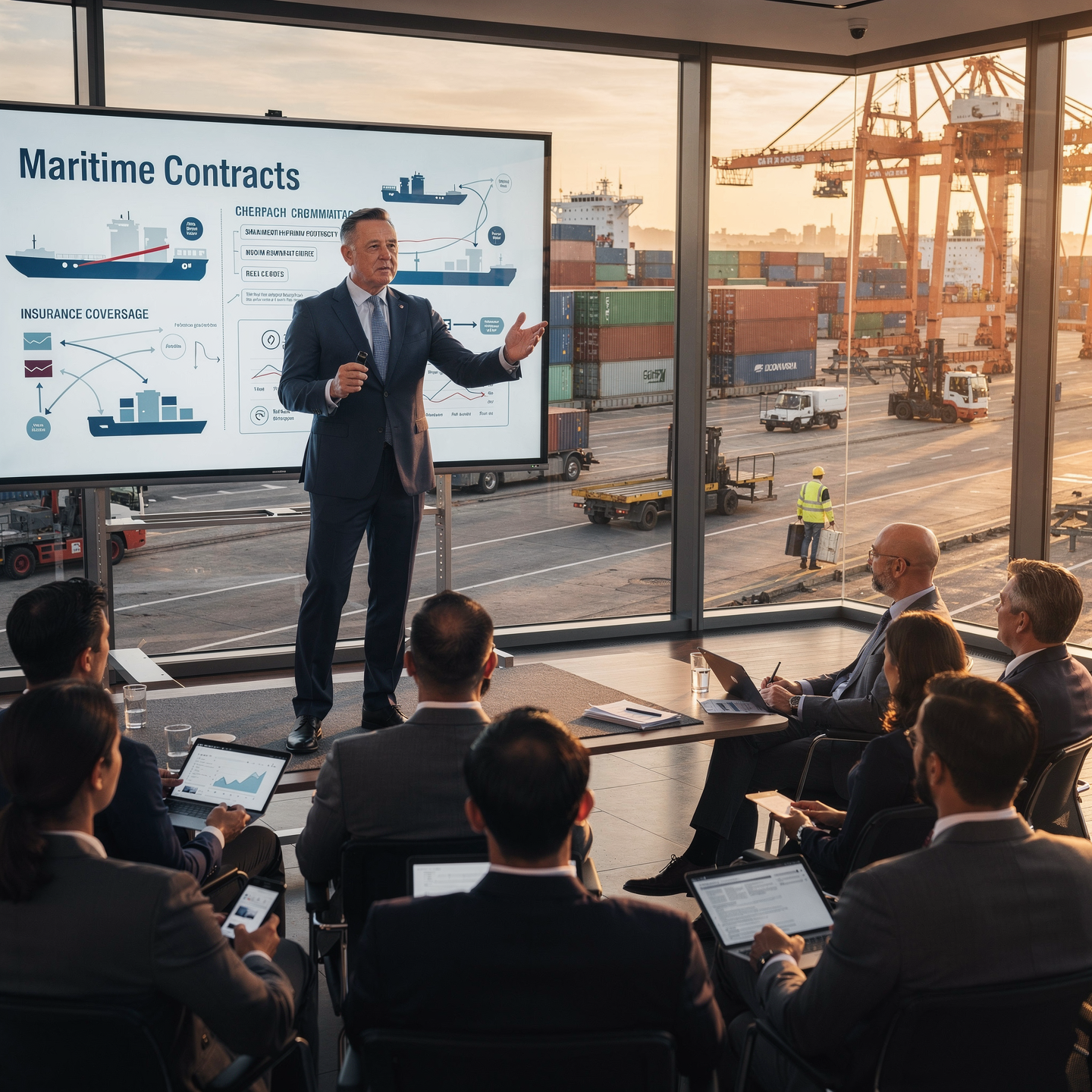
Diploma in Maritime Transport Contracts and Insurance

Why this certificate program?

The Diploma in Maritime Transport Contracts and Insurance

This program offers an in-depth immersion into the legal framework and insurance practices that govern international maritime trade. Master the types of charter party contracts, bills of lading, and international sales contracts, understanding their implications and associated risks. This program provides you with the tools to analyze and manage marine insurance, from hull and machinery coverage to civil liability and cargo risks. You will learn to interpret complex clauses, negotiate policies, and resolve claims efficiently, minimizing losses and optimizing the protection of your assets.

Differential Advantages

  • Comprehensive Analysis of Maritime Legislation: International Conventions, National Laws, and Relevant Case Law.
  • Comprehensive Risk Management: Identification, assessment, and mitigation of risks inherent in maritime transport.
  • Case Studies and Simulations: Real-world application of acquired knowledge in complex business scenarios.
  • Negotiation and Contract Drafting: Essential skills to protect your interests in maritime transactions.
  • Industry Experts: Instructors with extensive experience in maritime law, insurance, and international trade.
Contratos

Diploma in Maritime Transport Contracts and Insurance

Availability: 1 in stock

Who is it aimed at?

  • Maritime and corporate lawyers seeking to specialize in the negotiation, drafting, and management of transport contracts.
  • Marine insurance professionals needing to deepen their knowledge of coverage, claims, and risk management in the sector.
  • Logistics and supply chain managers needing to optimize costs and minimize risks in maritime freight transport.
  • Shipowners, port operators, and transport companies interested in strengthening their legal and contractual knowledge to make informed decisions.
  • Students and recent graduates in law, international business, or related fields seeking a competitive advantage in the maritime job market.

Flexibility for professionals Features:
Online diploma with content accessible 24/7, discussion forums and live virtual sessions to fit around your work schedule.

Contratos

Objectives and competencies

Effectively managing risks and responsibilities in maritime transport:

“Mastering the legal framework (Conventions, Codes) and documentation (policies, BLs) to mitigate contractual and extra-contractual liabilities.”

To correctly interpret and apply current maritime legislation:

“Identify the obligations of the captain and crew regarding maritime safety and protection of the marine environment, and act accordingly.”

Negotiate and draft maritime transport contracts, optimizing the company's interests:

“Analyze risks and contractual clauses (charter, policies) to ensure coverage and minimize disputes, considering applicable international legislation.”

Analyze and evaluate marine insurance coverage for comprehensive protection:

“Identify specific cargo and vessel risks, understand insurance clauses (ICC, IWL, etc.) and their scope, and analyze the adequacy of coverage against potential claims (general average, liability, pollution).”
Resolving disputes and claims in the maritime transport sector with legal soundness:

Analyze marine insurance policies, interpret contractual clauses (charter agreements, bill of lading) and apply international conventions (Brussels Convention, Hague-Visby Rules) to substantiate the defense or claim.

Optimizing logistics and document management in maritime transport operations:

Implement electronic document management and shipment traceability systems, integrated with maritime logistics management software, to streamline processes, reduce errors and optimize communication between supply chain actors.

Curriculum - Modules

  1. Comprehensive Maritime Incident Management: protocols, roles, and chain of command for coordinated response
  2. Operational Planning and Execution: briefing, routes, weather windows, and go/no-go criteria
  3. Rapid Risk Assessment: criticality matrix, scene control, and decision-making under pressure
  4. Operational Communication: VHF/GMDSS, standardized reports, and inter-agency liaison
  5. Tactical Mobility and Safe Boarding: RHIB maneuvers, approach, mooring, and recovery
  6. Equipment and Technologies: PPE, signaling, satellite tracking, and field data logging
  7. Immediate Care of the Affected: primary assessment, hypothermia, trauma, and stabilization for evacuation
  8. Adverse Environmental Conditions: swell, Visibility, flows, and operational mitigation

    Simulation and training: critical scenarios, use of VR/AR, and exercises with performance metrics

    Documentation and continuous improvement: lessons learned, indicators (MTTA/MTTR), and SOP updates

  1. Introduction to Maritime Law: Sources, International Conventions, and Jurisdiction.
  2. Charterhouse Contracts: Types (Time, Voyage, Bareboat), Key Clauses, and Liabilities.
  3. Bill of Lading (B/L): Functions, Types, Endorsement, and Legal Issues.
  4. Marine Insurance: H&M (Hull and Machinery) Policy, Coverage, Exclusions, and Valuation.
  5. P&I Clubs: Nature, Liability Coverage, Covered Risks, and Claims.
  6. Risks in Maritime Transport: Damage, Collisions, Pollution, Piracy, and Terrorism.
  7. Claims Management: Procedures, Documentation, and Time Limitations.
  8. Limitation of Liability: LLMC Convention, calculation and procedure.

    Legal aspects of maritime salvage: contract, Lloyd’s Open Form (LOF) and remuneration.

    Geopolitical and commercial risks: sanctions, embargoes and armed conflicts.

  1. Introduction to Risks in Maritime Transport: Types and Sources.
  2. Marine Insurance: History, Principles, and International Legal Framework.
  3. Marine Insurance Policies: Hull and Machinery Coverage, P&I, and Other Relevant Policies.
  4. Protection and Indemnity (P&I) Clauses: Scope and Exclusions.
  5. General Average: Principles, Calculation, and Adjustment of General Average.
  6. Maritime Civil Liability: Limits of Liability and International Conventions.
  7. Disputes in Maritime Transport: Types of Claims and Dispute Resolution.
  8. Salvage: Salvage Contracts and the Salvadoran’s Rights.
  9. Claims Management: Procedures, Documentation and negotiation.
  10. Risk prevention and best practices in maritime transport.

  1. Introduction to maritime transport: types of vessels, trade routes, and key players.
  2. Inherent risks of maritime transport: piracy, weather conditions, machinery failures, human error.
  3. International legal framework: UN Conventions, IMO Codes (SOLAS, MARPOL, etc.).
  4. Marine insurance: P&I, hull and machinery, cargo. Clauses and Coverage.
  5. General Average: Concept, Calculation, and Responsibilities.
  6. Limitation of Liability: Applicable Conventions and Procedures.
  7. Vessel Documentation: Certificates, Registrations, Licenses.
  8. Cargo Documentation: Bill of Lading (B/L), Charter Party (C/P), Manifests.
  9. Claims Management: Procedures, Timeframes, Required Documentation.
  10. Loss Prevention: Safety Measures, Risk Management, and Best Practices.

  1. Introduction to Maritime Law: Sources, Conventions, and Jurisdiction
  2. Contract of Carriage of Ships: Bill of Lading (B/L), Charter Parties
  3. Liability of the Shipowner: Brussels Convention, Hague-Visby Rules, Hamburg Rules, Rotterdam Rules
  4. Marine Insurance Policies: Types, Clauses, Coverage, Exclusions (ITC, ICC)
  5. Maritime Risks: General Average, Collision, Grounding, Pollution, Piracy
  6. General Average Claims: Adjustment, Settlement, Insurers’ Participation
  7. Salvage of Ships: London Convention, Salvage Contracts (Lloyd’s Open Form)
  8. Limitation of Liability: LLMC Convention, calculation of limits, procedures
  9. Maritime Litigation: competent jurisdiction, legal proceedings, arbitration
  10. Claims and Losses Management: documentation, expert reports, negotiation and settlement

  1. System Architecture and Components: Structural design, materials, and subsystems (mechanical, electrical, electronic, and fluid) with selection and assembly criteria for marine environments
  2. Fundamentals and Principles of Operation: Physical and engineering foundations (thermodynamics, fluid mechanics, electricity, control, and materials) that explain performance and operating limits
  3. Safety and Environmental (SHE): Risk analysis, PPE, LOTO, hazardous atmospheres, spill and waste management, and emergency response plans
  4. Applicable Regulations and Standards: IMO/ISO/IEC requirements and local regulations;
  5. Conformance criteria, certification, and best practices for operation and maintenance
  6. Inspection, testing, and diagnostics: Visual/dimensional inspection, functional testing, data analysis, and predictive techniques (vibration, thermography, fluid analysis) to identify root causes
  7. Preventive and predictive maintenance: Hourly/cycle/seasonal plans, lubrication, adjustments, calibrations, consumable replacement, post-service verification, and operational reliability
  8. Instrumentation, tools, and metrology: Measuring and testing equipment, diagnostic software, calibration and traceability; selection criteria, safe use, and storage
  9. Onboard integration and interfaces: Mechanical, electrical, fluid, and data compatibility; Sealing and watertightness, EMC/EMI, corrosion protection, and interoperability testing.

    Quality, acceptance testing, and commissioning: process and materials control, FAT/SAT, bench and sea trials, go/no-go criteria, and evidence documentation.

    Technical documentation and integrated practice: logs, checklists, reports, and a complete case study (safety → diagnosis → intervention → verification → report) applicable to any system.

  1. Introduction to Maritime Law: Sources, International Conventions, and National Legislation.
  2. Maritime Transport Contracts: Bill of Lading (B/L), Charter Party.
  3. Important Clauses in the B/L: Paramount Clause, Jurisdiction, Applicable Law, Demurrage.
  4. Carrier’s Liability Regime: Hague-Visby Rules, Hamburg Rules, Rotterdam Rules.
  5. Limitation of Liability: London Convention on Limitation of Liability for Ships.
  6. Marine Insurance: Types of Policies (Hull, Cargo, Civil Liability).
  7. Institute Cargo Clauses (ICC): A, B, C, and their sub-clauses Coverages.
  8. General Average: principles, contributions, and adjustment procedure.
  9. Cargo Damage Claims: documentation, time limits, and evidence.
  10. Maritime Litigation: jurisdiction, arbitration, and mediation.

Career opportunities

  • Maritime Transport Contract Manager: Drafting, negotiating, and administering charter parties, ship purchase agreements, and other agreements related to maritime transport.
  • Marine Insurance Analyst: Risk assessment, claims management, and advising on the procurement of marine insurance policies.
  • Maritime Trade Consultant: Advising importing and exporting companies on the legal and contractual aspects of maritime transport.
  • Maritime Lawyer: Legal representation in contractual disputes and marine insurance claims.
  • Marine Insurance Account Executive: Managing client portfolios and developing new marine insurance products and services.
  • Marine Transport and Logistics Manager: Optimizing the supply chain and managing transport and marine insurance contracts.
  • Court-appointed expert in maritime accidents: investigation of maritime accidents, damage assessment, and preparation of expert reports.
  • Civil servant in maritime transport regulatory bodies: supervision of compliance with maritime insurance and contractual regulations.

“`

Admission requirements

Academic/professional profile:

Degree/Bachelor's degree in Nautical Science/Maritime Transport, Naval/Marine Engineering, or a related field; or proven professional experience in bridge/operations.

Language proficiency:

Recommended functional maritime English (SMCP) for simulations and technical materials.

Documentation:

Updated resume, copy of degree or seaman's book, ID card/passport, letter of motivation.

Technical requirements (for online):

Equipment with camera/microphone, stable connection, ≥ 24” monitor recommended for ECDIS/Radar-ARPA.

Admission process and dates

1. Online
application

(form + documents).

2. Academic review and interview

(profile/objectives/schedule compatibility).

3. Admission decision

(+ scholarship proposal if applicable).

4. Reservation of place

(deposit) and registration.

5. Induction

(access to campus, calendars, simulator guides).

Scholarships and grants

  • Maritime Legal Framework: Master current legislation on charter agreements, bills of lading, and international sales contracts.
  • Insurance Management: Learn to identify and manage the risks inherent in maritime transport, optimizing insurance coverage and minimizing losses.
  • Negotiation and Drafting: Develop key skills for drafting and negotiating contracts, protecting your company’s interests.
  • Case Studies: Analyze real-world cases and learn from the experience of experts in maritime and insurance law.
  • Continuous Updates: Stay up-to-date with the latest trends and reforms in maritime law. international.
Boost your career and become an expert in risk and contract management in the maritime sector.

Testimonials

Frequently asked questions

Contracts and insurance for maritime transport.

Yes. The itinerary includes ECDIS/Radar-ARPA/BRM with harbor, ocean, fog, storm, and SAR scenarios.

Online with live sessions; hybrid option for simulator/practical placements through agreements.

Yes, this diploma course covers the legal aspects of contracts and insurance in maritime transport.

Recommended functional SMCP. We offer support materials for standard phraseology.

Yes, with a relevant degree or experience in maritime/port operations. The admissions interview will confirm suitability.

Optional (3–6 months) through Companies & Collaborations and the Alumni Network.

Simulator practice (rubrics), defeat plans, SOPs, checklists, micro-tests and applied TFM.

A degree from Navalis Magna University + operational portfolio (tracks, SOPs, reports and KPIs) useful for audits and employment.

  1. Introduction to Chartering: Types, Parties, and Key Concepts
  2. Legal Framework for Chartering: Applicable National and International Legislation
  3. Voyage Charter Contract: Clauses, Negotiation, and Execution
  4. Time Charter Contract: Clauses, Rights, and Obligations
  5. Risks Inherent in Chartering: Loss, Damage to Cargo, Delays, Disputes
  6. Charteror’s and Shipowner’s Liability: Limitations and Exceptions
  7. Marine Insurance Coverage: P&I, Hull, Cargo
  8. Force Majeure and Exceptions: Implications and Scope.

    Claims Management and Dispute Resolution: Arbitration and Litigation.

    Strategies to Mitigate Risks and Optimize Coverage in Chartering.

    “`

Request information

  1. Complete the Application Form.

  2. Attach your CV/degree certificate (if you have it to hand).

  3. Indicate your preferred cohort (January/May/September) and whether you would like the hybrid option with simulator sessions.

    An academic advisor will contact you within 24–48 hours to guide you through the admission process, scholarships, and compatibility with your professional schedule.

Please enable JavaScript in your browser to complete this form.
Click or drag a file to this area to upload.

Faculty

0
    0
    Tu carrito
    Tu carrito esta vacíoRegresar a la tienda
    Scroll to Top