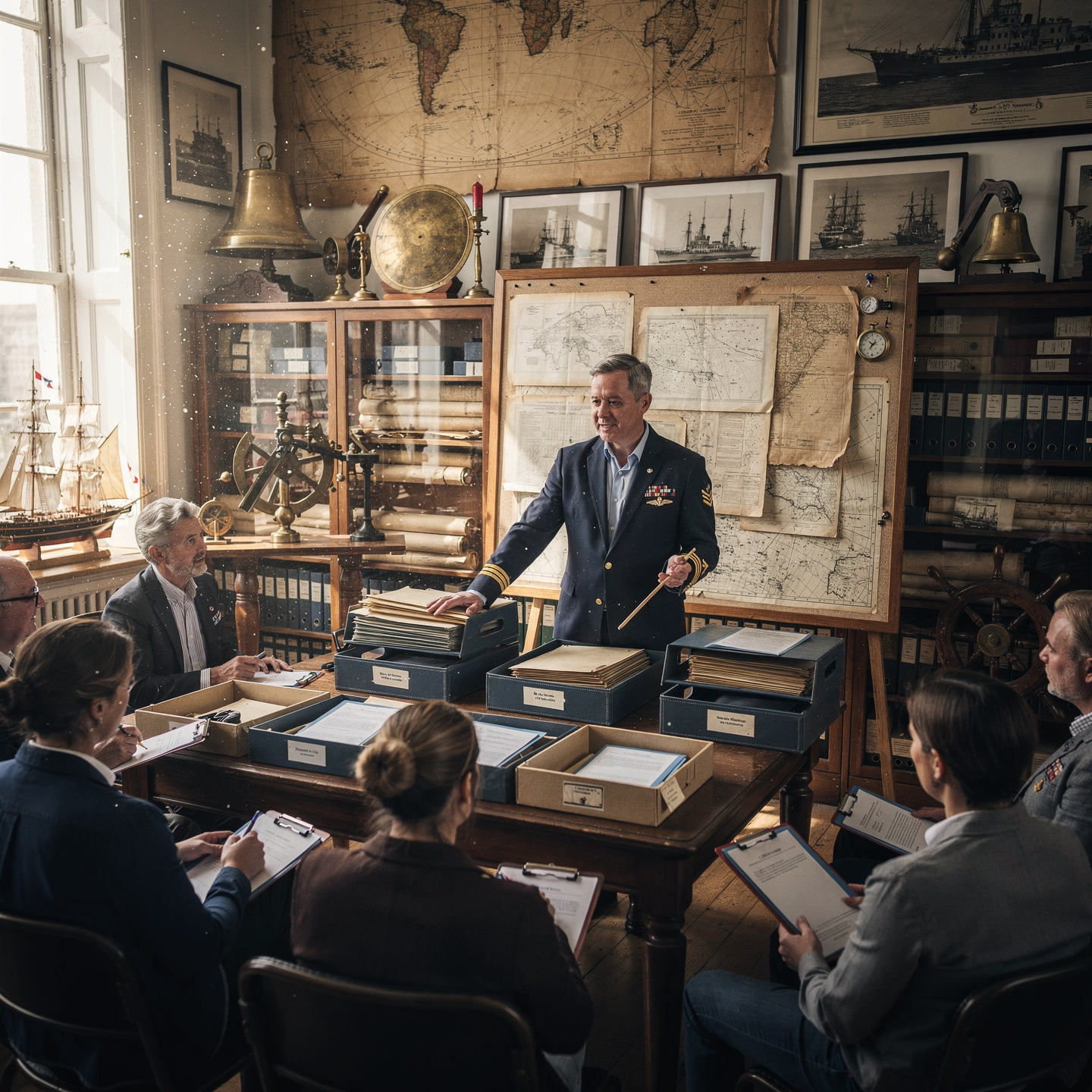
Diploma in Naval Archives and Documentation

Why this certificate program?

The Diploma in Naval Archives and Documentation

This program provides you with the essential tools and knowledge to manage, preserve, and access maritime documentary heritage. Learn to catalog, digitize, and organize historical and contemporary archives, ensuring their integrity and availability for research and consultation. This program equips you to meet the challenges of document management in a constantly evolving naval environment.

Differential Advantages

  • Practical Approach: Learn through real-world case studies and simulation exercises in naval archives management.
  • Digitization and Digital Preservation: Master the techniques for digitizing documents and ensuring their long-term preservation.
  • Regulations and Legislation: Understand the archival legislation applicable to the maritime and naval sector.
  • Access and Dissemination: Learn how to facilitate access to information and promote the dissemination of naval documentary heritage.
  • Network of Experts: Connect with professionals in the naval archives sector and expand your network.
Archivos

Diploma in Naval Archives and Documentation

Availability: 1 in stock

Who is it aimed at?

  • Archivists and librarians seeking to specialize in the management and preservation of historical naval documentation.
  • Historians and researchers interested in accessing and analyzing primary sources related to maritime and naval history.
  • Museum and documentation center professionals wishing to expand their knowledge in the cataloging and digitization of naval archives.
  • Navy personnel and personnel from other maritime institutions responsible for the management of their archives and documents.
  • Students of History, Archival Studies, or related fields seeking specialized training in naval archives and documentation.

Study Flexibility
Designed for professionals and students: modality online, access to materials 24/7 and personalized tutoring.

Archivos

Objectives and competencies

Managing and preserving naval documentary heritage:

“To catalogue, digitize and safeguard historical naval documentation, guaranteeing its access and long-term preservation.”

Apply archival techniques for the correct organization of naval documentation:

“Using classification, cataloging, and indexing principles to facilitate the retrieval and preservation of documentation.”

Analyze and classify naval documentation according to current regulations:

Identify and organize documentation (plans, manuals, certificates) in compliance with SOLAS, MARPOL and ISM.

Implement electronic document management systems to optimize access to and preservation of naval information:

“Establish digitized workflows, advanced indexing and version control, ensuring the integrity and availability of critical naval documentation.”

Evaluate and ensure the authenticity, integrity, and reliability of naval documents:

Implement cross-checking procedures, digital signature validation, and auditable record management to ensure traceability and non-manipulation of information.

To facilitate naval historical research through the organization and dissemination of documentary collections:

To catalog, digitize and make documents accessible to researchers, promoting transparency and knowledge of naval history.

Curriculum - Modules

  1. Comprehensive Maritime Incident Management: protocols, roles, and chain of command for coordinated response
  2. Operational Planning and Execution: briefing, routes, weather windows, and go/no-go criteria
  3. Rapid Risk Assessment: criticality matrix, scene control, and decision-making under pressure
  4. Operational Communication: VHF/GMDSS, standardized reports, and inter-agency liaison
  5. Tactical Mobility and Safe Boarding: RHIB maneuvers, approach, mooring, and recovery
  6. Equipment and Technologies: PPE, signaling, satellite tracking, and field data logging
  7. Immediate Care of the Affected: primary assessment, hypothermia, trauma, and stabilization for evacuation
  8. Adverse Environmental Conditions: swell, Visibility, flows, and operational mitigation

    Simulation and training: critical scenarios, use of VR/AR, and exercises with performance metrics

    Documentation and continuous improvement: lessons learned, indicators (MTTA/MTTR), and SOP updates

  1. Introduction to Maritime Documentary Heritage: Definition, scope, and typologies.
  2. National and International Legislation: Regulations for the protection of maritime documentary heritage.
  3. Risk Management: Identification, assessment, and mitigation of risks to heritage.
  4. Preventive Conservation: Environmental control, handling, and packaging of documents.
  5. Document Restoration: Basic intervention techniques and materials.
  6. Digitization: Standards, formats, and long-term digital preservation.
  7. Cataloging and Archival Description: ISAD(G), ISAAR(CPF), and EAD standards.
  8. Dissemination and Access: Dissemination strategies and tools for accessing heritage.
  9. Nautical Archives Management: Organization, description, and preservation of maritime archives.
  10. Professional Ethics: Responsibility and commitment to heritage preservation.

  1. Introduction to Naval Archival Science: History, evolution, and legal framework.
  2. Principles of Archival Science: Provenance, respect for the collections, original order.
  3. Life Cycle of Naval Documents: Creation, management, archiving, and final disposition.
  4. Document Identification and Appraisal: Document Retention Schedules.
  5. Archival Description: ISAD(G), ISAAR(CPF), and ISDIAH standards.
  6. Organization of Naval Collections: Classification and Arrangement.
  7. Facilities and Preventive Conservation: Environmental control, handling.
  8. Digitization and Digital Preservation: Formats, metadata, strategies.
  9. Access and Dissemination: User Services, Access Rights.
  10. Professional Ethics and Confidentiality in the Handling of Sensitive Information.

  1. Introduction to Naval Archival Science: Definition, scope, and historical evolution.
  2. Legal and Regulatory Framework: National and international archival legislation, specific regulations for the maritime sector.
  3. Document Management: Document lifecycle, from creation to final disposition.
  4. Principles of Archival Organization: Colleges, series, files.
  5. Archival Description: ISAD(G) and ISAAR(CPF) standards.
  6. Classification and Arrangement Systems: Alphabetical, numerical, chronological, thematic.
  7. Conservation and Preservation: Preventive measures, environmental control, basic restoration.
  8. Digitization of Naval Archives: Technologies, standards, metadata.
  9. Access and Dissemination of Documentary Heritage: Consultation, reproduction, exhibitions.
  10. Electronic Archives: Management, digital preservation, information security.

  1. Introduction to Naval Document Management: Importance, Objectives, and Scope.
  2. Legal and Regulatory Framework: National and International Legislation applicable to naval documentation.
  3. Naval Document Typology: Technical, Administrative, Operational, and Legal Documents.
  4. Document Lifecycle: Creation, Receipt, Registration, Distribution, Storage, Preservation, and Disposal.
  5. Classification and Organization Systems: Archival Principles, Classification Scheme, Document Series.
  6. Metadata and Document Description: ISAD(G) and ISAAR(CPF) Standards, Thesauri, and Controlled Vocabularies.
  7. Document Storage and Preservation: Types of Media, Environmental Conditions, Digitization, and Microfilming.
  8. Access and Consultation of Documents: Access policies, restrictions, copyright, and data protection.
  9. Electronic document management: Electronic signature, secure storage, and digital preservation.
  10. Document destruction: Weeding procedures, document retention schedules, and archival appraisal.

  1. System Architecture and Components: Structural design, materials, and subsystems (mechanical, electrical, electronic, and fluid) with selection and assembly criteria for marine environments
  2. Fundamentals and Principles of Operation: Physical and engineering foundations (thermodynamics, fluid mechanics, electricity, control, and materials) that explain performance and operating limits
  3. Safety and Environmental (SHE): Risk analysis, PPE, LOTO, hazardous atmospheres, spill and waste management, and emergency response plans
  4. Applicable Regulations and Standards: IMO/ISO/IEC requirements and local regulations;
  5. Conformance criteria, certification, and best practices for operation and maintenance
  6. Inspection, testing, and diagnostics: Visual/dimensional inspection, functional testing, data analysis, and predictive techniques (vibration, thermography, fluid analysis) to identify root causes
  7. Preventive and predictive maintenance: Hourly/cycle/seasonal plans, lubrication, adjustments, calibrations, consumable replacement, post-service verification, and operational reliability
  8. Instrumentation, tools, and metrology: Measuring and testing equipment, diagnostic software, calibration and traceability; selection criteria, safe use, and storage
  9. Onboard integration and interfaces: Mechanical, electrical, fluid, and data compatibility; Sealing and watertightness, EMC/EMI, corrosion protection, and interoperability testing.

    Quality, acceptance testing, and commissioning: process and materials control, FAT/SAT, bench and sea trials, go/no-go criteria, and evidence documentation.

    Technical documentation and integrated practice: logs, checklists, reports, and a complete case study (safety → diagnosis → intervention → verification → report) applicable to any system.

  1. Introduction to Naval Archives: History, Typology, and Functions
  2. Legal and Regulatory Framework: Archival Legislation, Protection of Naval Documentary Heritage
  3. Document Identification and Appraisal: Selection and Disposal Criteria, Document Retention Schedules
  4. Archival Organization and Description: Classification Principles and Methods, Development of Descriptive Tools
  5. Preventive Conservation: Factors of Deterioration, Environmental Control, Handling, and Packaging
  6. Document Restoration: Basic Intervention Techniques, Materials, and Action Criteria
  7. Digitization of Archives: Standards, Formats, Metadata, and Image Management
  8. Access and Dissemination: Access Policies, User Services, Outreach, and Promotion
  9. Document Management
  10. Electronic resources: challenges and opportunities, document management systems (DMS).

    Digital preservation planning: strategies, formats, migration, and emulation.

Career opportunities

  • Naval Archivist: Management and organization of historical naval archives.
  • Naval Documentalist: Analysis, classification, and preservation of naval documentation.
  • Naval Information Manager: Administration of naval information systems and databases.
  • Naval Historical Researcher: Research and analysis of historical naval documents for academic or outreach projects.
  • Naval Document Management Consultant: Advising naval institutions on the organization and digitization of their archives.
  • Naval Librarian: Cataloging and management of specialized bibliographic collections on naval topics.
  • Naval Archives Digitization Technician: Digitization and digital preservation of historical naval documents.
  • Corporate Archive Manager
  • Shipping Companies: Management of documentation generated by the company’s activity.

    “`

Admission requirements

Academic/professional profile:

Degree/Bachelor's degree in Nautical Science/Maritime Transport, Naval/Marine Engineering, or a related field; or proven professional experience in bridge/operations.

Language proficiency:

Recommended functional maritime English (SMCP) for simulations and technical materials.

Documentation:

Updated resume, copy of degree or seaman's book, ID card/passport, letter of motivation.

Technical requirements (for online):

Equipment with camera/microphone, stable connection, ≥ 24” monitor recommended for ECDIS/Radar-ARPA.

Admission process and dates

1. Online
application

(form + documents).

2. Academic review and interview

(profile/objectives/schedule compatibility).

3. Admission decision

(+ scholarship proposal if applicable).

4. Reservation of place

(deposit) and registration.

5. Induction

(access to campus, calendars, simulator guides).

Scholarships and grants

  • Comprehensive Management: Master the organization, preservation, and access to naval archives, from historical documents to contemporary records.
  • Legislation and Regulations: Delve into the legal framework governing naval documentation, ensuring compliance and transparency.
  • Information Technologies: Learn to implement digital solutions for efficient archive management, including digitization, indexing, and advanced search systems.
  • Conservation and Restoration: Acquire practical skills for the physical preservation of documents, combating deterioration and ensuring their longevity.
  • Research and Dissemination: Facilitate access to information for researchers and the general public, promoting knowledge and dissemination of naval heritage.
Boost your career in archives naval and become an expert in document management in the maritime industry.

Testimonials

Frequently asked questions

The management, preservation and analysis of archives and documentation related to naval history and operations.

Yes. The itinerary includes ECDIS/Radar-ARPA/BRM with harbor, ocean, fog, storm, and SAR scenarios.

Online with live sessions; hybrid option for simulator/practical placements through agreements.

Archives and document management sector, especially in naval, maritime or defense institutions.

Recommended functional SMCP. We offer support materials for standard phraseology.

Yes, with a relevant degree or experience in maritime/port operations. The admissions interview will confirm suitability.

Optional (3–6 months) through Companies & Collaborations and the Alumni Network.

Simulator practice (rubrics), defeat plans, SOPs, checklists, micro-tests and applied TFM.

A degree from Navalis Magna University + operational portfolio (tracks, SOPs, reports and KPIs) useful for audits and employment.

  1. Introduction to Naval Archives Management: History, Evolution, and Regulations
  2. Naval Technical Documentation: Plans, Manuals, Specifications, and Certificates
  3. Classification and Cataloging: Document Organization Systems Specific to the Naval Sector
  4. Document Digitization: Standards, Formats, and Metadata for Digital Preservation
  5. Storage and Preservation: Environmental Conditions, Packaging, and Handling of Documents
  6. Information Management in a Ship’s Lifecycle: From Construction to Scrapping
  7. Document Management Software: Tools for the Administration and Retrieval of Naval Archives
  8. Access and Consultation: Access, Security, and Data Protection Policies in Naval Archives
  9. Legal and Archival Regulations: Current Legislation in Subject matter of archives and documentary heritage.
  10. Case studies: examples of integrated archives management in different naval entities.

Request information

  1. Complete the Application Form.

  2. Attach your CV/degree certificate (if you have it to hand).

  3. Indicate your preferred cohort (January/May/September) and whether you would like the hybrid option with simulator sessions.

    An academic advisor will contact you within 24–48 hours to guide you through the admission process, scholarships, and compatibility with your professional schedule.

Please enable JavaScript in your browser to complete this form.
Click or drag a file to this area to upload.

Faculty

0
    0
    Tu carrito
    Tu carrito esta vacíoRegresar a la tienda
    Scroll to Top


