Master’s Degree in Climate Change and Oceans
Why this master’s programme?
The Master in Climate Change and Oceans
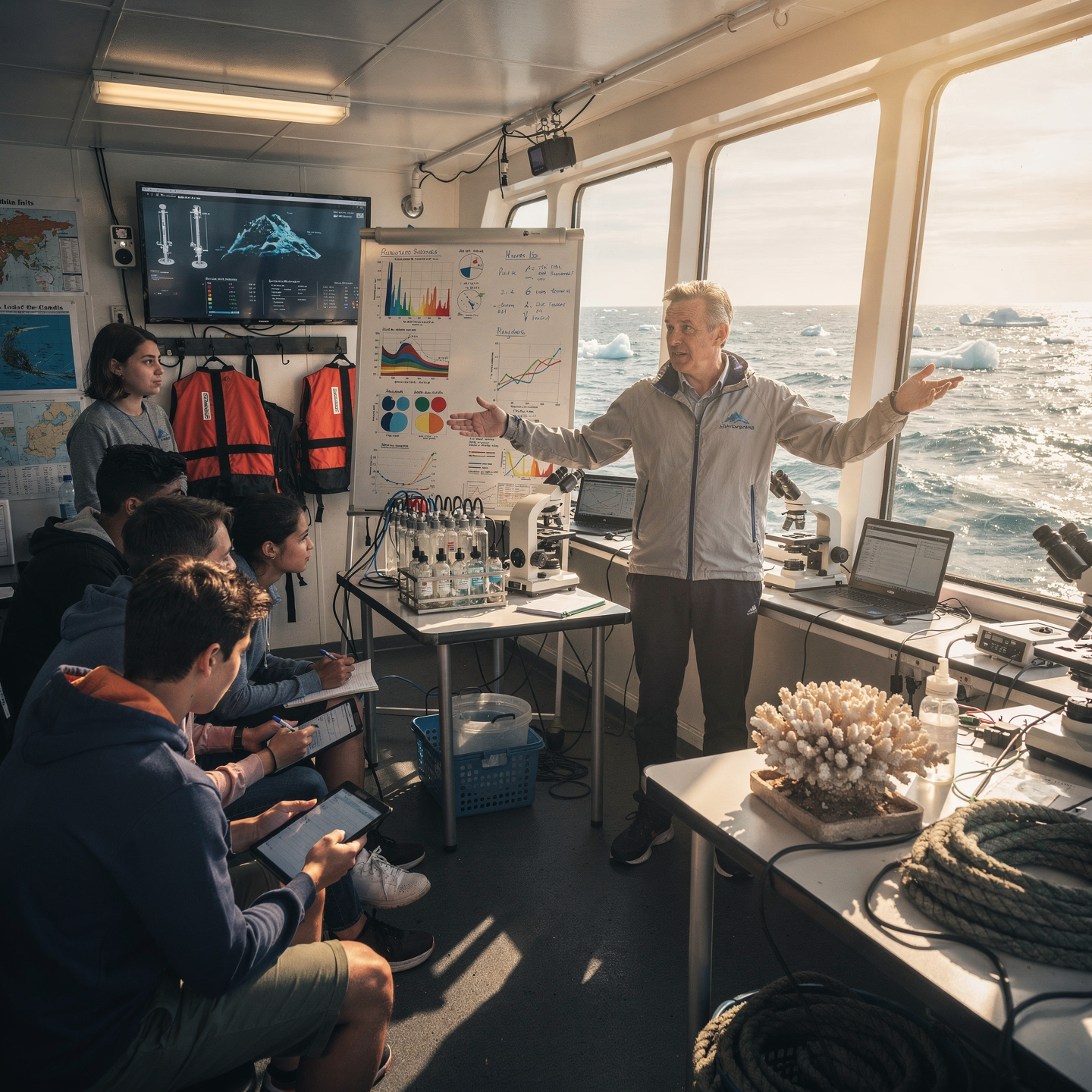
This program provides you with a comprehensive understanding of the vital interconnection between global climate and ocean health. You will explore the impacts of global warming, acidification, and pollution on marine ecosystems, as well as science-based solutions to mitigate and adapt to these challenges. This program prepares you to lead initiatives in research, conservation, and policy related to climate change and the oceans.
Differential Advantages
- Interdisciplinary Analysis: Integrates knowledge from oceanography, climatology, marine biology, and social sciences.
- Applied Research: Participate in cutting-edge research projects with experts in the field.
- Modeling Tools: Learn to use climate and oceanographic models to predict and analyze future scenarios.
- Policy Development: Understand the legal and regulatory framework for the sustainable management of marine resources.
- Global Networking: Connect with professionals and researchers from around the world at conferences and seminars.
- Modality: Online
- Level: Masters
- Hours: 1600 H
- Start date: 26-04-2026
Availability: 1 in stock
Who is it aimed at?
- Maritime and fisheries professionals who want to understand and mitigate the impacts of climate change on their operations.
- Environmental scientists and marine biologists seeking to deepen their research and management of ocean ecosystems in the face of climate change.
- Policymakers and coastal managers who need tools for the adaptation and resilience of coastal communities.
- Environmental consultants and engineers who aspire to develop innovative solutions for climate change mitigation and adaptation in marine environments.
- Graduates in environmental science, biology, engineering, and related fields seeking cutting-edge specialization in the study and management of climate change and the oceans.
Flexibility and applicability
Designed for active professionals: online format flexible, relevant case studies and direct connection with experts in the field.
Objectives and skills

Lead ocean mitigation strategies:
“Assess coastal vulnerabilities, select mitigation options (habitat restoration, green infrastructure) and prioritize cross-sector collaboration (science, policy, community).”

Assess coastal vulnerability to climate change:
“Identify and analyze the main risk factors (sea level rise, extreme weather events, erosion) and their impact on coastal infrastructure and ecosystems, using scientific data and predictive models.”

Develop predictive models of ocean climate impact:
“Integrating oceanographic data (temperature, salinity, currents) with climate models to forecast extreme events and their effects on marine ecosystems and coastal areas.”

Managing resilient coastal adaptation projects:
Assess current and future coastal vulnerability, incorporating climate change data and propose nature-based solutions.
Design ocean policies based on scientific evidence:
“Integrating oceanographic modeling and satellite observation data to predict the impacts of climate change on vulnerable marine ecosystems.”

Effectively communicating the science of ocean climate change:
Adapting communication to the audience, using clear analogies and visualizations to convey the complexity of ocean climate change and its impact, encouraging informed action.
Study plan – Modules
- Fundamentals of the marine biosphere: structure, function, and dynamics of ocean ecosystems
- Mechanisms of climate change: greenhouse gases, temperature increase, and ocean acidification
- Physical impacts on the oceans: sea level rise, thermal variability, and changes in ocean circulation
- Biological response of marine organisms: molecular adaptation, phenotypic changes, and geographic displacements
- Effects on marine biodiversity: loss of critical habitats, disruption of food webs, and extinction scenarios
- Changes in primary productivity and the carbon cycle in marine environments
- Climate modeling applied to the marine biosphere: tools, scales, and validation of predictions
- Impact of global warming on coral reefs and associated ecosystems
- Ecosystem-based mitigation and adaptation strategies:
- Restoration, marine reserves, and sustainable management
- International policies and regulatory frameworks for marine conservation in the face of climate change
- Technological innovations in monitoring and adaptive management of vulnerable oceans
- Case studies: local and regional responses to extreme events and prolonged changes
- Development of integrated strategic plans for the resilience of marine and coastal systems
- Socioeconomic assessment of the impacts and benefits derived from marine conservation and adaptation
- Interdisciplinary integration in decision-making for the sustainable management of the ocean under climate change scenarios
- Introduction to Ocean Dynamics: fundamental concepts and relevance to the global climate system
- Global Ocean Circulation: thermohaline structure, surface and deep circulation, and its role in heat redistribution
- Atmosphere-ocean interaction mechanisms: momentum, heat, and mass transfer
- Ocean Currents: factors that determine their formation, dynamics, and relevant episodes such as El Niño and La Niña
- Influence of Oceanographic Dynamics on the modulation of regional and global climate patterns
- Vertical mixing and stratification processes: implications for carbon and nutrient storage
- Interaction between oceans and the cryosphere: dynamics of ice shelves, sea ice, and their impact on ocean circulation
- Methods Advanced tools for the observation and numerical modeling of ocean dynamics: satellites, buoys, Argo, and coupled climate models.
Analysis of the influence of ocean variability on climate regulation at different time scales (seasonal, interannual, multidecadal).
Study of future scenarios: climate change simulations and the projected role of the oceans in mitigation and adaptation.
- Fundamentals of oceanographic modeling: physical, chemical, and biological principles applied to marine ecosystems
- Ocean fluid dynamics: Navier-Stokes equations, mass and energy transport
- Numerical models for oceans: types (deterministic, stochastic), spatial and temporal scales
- Remote sensing and in-situ sensors: principles, satellite technologies (altimetry, hyperspectral sensors), and ocean buoys
- Integrated monitoring systems: architecture, acquisition, storage, and management of ocean-atmospheric data
- Data assimilation: techniques and algorithms to improve the accuracy of predictive models in climatic contexts
- Analysis and modeling of ocean currents: general circulation models, vorticity foci, and water exchange patterns
- Simulation of biogeochemical processes: carbon, nitrogen, and phosphorus cycles in marine environments under climate change scenarios
- Impact of climate change on oceanographic processes: acidification, temperature increase, and extreme events
- Practical applications for environmental management: early warnings, risk assessment, and adaptation strategy design
- Advanced platforms and software: modelers (ROMS, HYCOM, MITgcm), visualization and analysis tools
- Model validation and calibration: statistical methods, quality control, and uncertainty management
- Case studies: monitoring extreme weather events in sensitive coastal and marine ecosystems
- International regulations and protocols for ocean and climate management: global agreements and public policies
- Future perspectives in oceanographic modeling: artificial intelligence, big data, and hybrid models for resilience environmental
- Foundations of Global and Regional Climate Policies: analysis of international regulatory frameworks (Paris Agreement, UN Framework Convention on Climate Change), country commitments, and impact assessment in coastal areas
- Climate Finance Mechanisms: public and private financing structures, green funds, blue bonds, resource transfer mechanisms, and the role of multilateral institutions in marine climate change mitigation and adaptation
- Sustainable Blue Economy: conceptualization and economic evaluation of sustainable maritime activities, valuation of marine ecosystem services, and innovative business models for the conservation and responsible exploitation of ocean resources
- Technologies for Mitigation and Adaptation: technical analysis of nature-based solutions, marine geoengineering, and emerging technologies for environmental monitoring and emissions reduction in coastal ecosystems
- Integrated Coastal Zone Governance: design and implementation of multi-scale governance frameworks, intersectoral coordination, and active participation of local communities in the sustainable management of marine and coastal ecosystems
- Restoration and Conservation of Marine Ecosystems: advanced techniques in the restoration of coral reefs, mangroves, and seagrass meadows; environmental impact assessment; and monitoring of the effectiveness of recovery projects
- Socioeconomic and Environmental Assessment Tools: quantitative and qualitative methods for measuring the economic and environmental impact of climate policies and coastal protection projects, including cost-benefit analysis and climate risk assessments
- Integrated Management and Territorial Planning Models: application of geographic information systems (GIS), predictive modeling, and development of marine and coastal territorial planning under climate change scenarios
- Case Studies and International Case Studies: Detailed analysis of successful initiatives in governance, financing, and restoration in different regions, focusing on lessons learned and replicable best practices.
Development of Innovative Projects and Policies: Design and formulation of public policy proposals, financing strategies, and technological projects for climate change mitigation and the integrated management of coastal zones and marine ecosystems.
[…]
- Fundamentals and principles of marine ecological restoration: definition, categories, and international regulatory frameworks
- Emerging technologies in marine ecosystem restoration: bioengineering, applied genetic engineering, and bioremediation
- Restoration based on the rehabilitation of critical habitats: coral reefs, seagrass meadows, and mangroves
- Nature-Based Solutions (NbS) for coastal resilience: integrating green and blue infrastructure into climate adaptation plans
- Advanced ecological modeling to assess the effectiveness of restorative interventions: dynamic simulations and predictive scenarios
- Applications of remote sensing and remote-sensing technologies in post-restoration marine monitoring
- Methodologies for in situ and ex situ restoration: transplantation, restocking, and genetically assisted restoration techniques
- Impact of the Ocean acidification and rising temperatures in coastal ecosystem restoration: adaptive mitigation strategies
Development of marine ecological corridors to improve biological connectivity and functional biodiversity
Integrated coastal zone management (ICZM): planning, governance, and community participation in restoration and resilience projects
Ecosystem assessment of the services provided by nature-based systems (NbS) for water security, storm protection, and blue carbon sequestration
Innovations in bio-inspired structures for sediment stabilization and shoreline protection
International protocols for the sustainable restoration and certification of marine and coastal projects
Advanced case studies: technical analysis of successful projects and lessons learned in global marine restoration
Future perspectives and disruptive technologies: artificial intelligence, population genetics, and nanotechnology applied to ecosystems marines
- Scientific foundations of marine climate change: atmospheric-oceanic dynamics, climate variability, and biogeochemical feedbacks
- Analysis of specific impacts on marine ecosystems: ocean acidification, temperature increases, deoxygenation, and alteration of nutrient cycles
- International legal framework and public policies: United Nations Convention on the Law of the Sea (UNCLOS), Paris Agreement, and regional protocols on marine conservation
- Design, implementation, and evaluation of mitigation strategies: blue economy, emissions reduction in marine and coastal sectors, and sustainable resource management
- Advanced technologies for monitoring and restoration: satellite remote sensing, in-situ sensors, climate modeling, and artificial intelligence tools applied to oceans
- Ecological restoration of critical habitats: techniques for rehabilitating coral reefs, salt marshes, mangroves, and seagrass beds
- Integrating nature-based solutions with technological approaches to increase resilience to extreme events and gradual changes
- Vulnerability and risk assessment: multi-criteria methodologies for prioritizing endangered areas and species under future scenarios
- Multi-sectoral strategic planning: aligning environmental, social, and economic objectives through adaptive governance tools
- Project financing and management models: access to international funds, public-private investment, and social and environmental return assessment
- Global and regional case studies: critical analysis of successful policies and lessons learned in marine restoration
- Developing technical skills and leadership for professionals: scientific communication, negotiation, and change management in multidisciplinary contexts
- Fundamentals of Marine Climate Change: physical and chemical mechanisms of ocean warming, seawater acidification, and its biogeochemical impact
- Advanced Oceanographic Monitoring Methodologies: remote sensors, autonomous buoys, acoustic profilers, and high-resolution in-situ observation systems
- Numerical climate models applied to marine ecosystems: atmosphere-ocean coupling, parameterization of biogeochemical processes, and validation of satellite data
- Biophysical indicators for assessing the health and resilience of coastal and pelagic ecosystems: biodiversity, primary productivity, and phenotypic responses
- Vulnerability and adaptation assessment: design of future scenarios under different emission trajectories and ecological sensitivity analysis
- International and regional policies for marine preservation: legal framework of the Framework Convention on Climate Change United Nations Framework Convention on Climate Change (UNFCCC), Paris Agreement, and conservation strategies of the International Union for Conservation of Nature (IUCN)
Economic and social instruments to incentivize sustainable management, including REDD+ mechanisms, payments for ecosystem services, and participatory governance
Design and implementation of comprehensive cost-ocean management plans and marine protected areas with a focus on climate resilience
Emerging technologies and Big Data: artificial intelligence for oceanographic data processing, predictive modeling, and real-time updating of early warning systems
Case studies and practical application: analysis of successful international projects and lessons learned for replicability and continuous improvement in public policy and environmental management
- Fundamentals of Technological Innovation in Marine Sciences: Principles, Methodologies, and Current Trends
- Coastal and Ocean Monitoring Technologies: Remote Sensors, Ocean Buoys, Autonomous Gliders, and Observation Satellites
- Numerical Models for Marine Climate Change: Simulation of Currents, Temperature, pH, and Future Scenarios
- Development and Application of Early Warning Systems for Extreme Weather Events in Coastal Areas
- Marine Bioremediation and Emerging Technologies for Pollutant and Blue Carbon Mitigation
- Resilient Coastal Infrastructures: Design, Materials, and Smart Systems for Adaptation to Sea Level Rise
- Integration of Marine Renewable Energies: Offshore Wind, Tidal, and Wave Energy for Footprint Reduction carbon
- Use of artificial intelligence and big data in the management and conservation of vulnerable marine ecosystems
- Public policies and regulatory frameworks for technological implementation in climate change mitigation and adaptation
- International case studies: critical evaluation of innovative projects in coastal and oceanic environments
- Fundamentals of marine climate change: natural and anthropogenic forcing factors, feedbacks, and historical trends
- Integrative environmental monitoring: in situ sensors, satellite observation, buoy networks, and autonomous platforms for monitoring oceanographic and biogeochemical variables
- Physical-ecological modeling of marine ecosystems: hydrodynamic coupling, carbon cycle modeling, and simulation of future climate scenarios
- Diagnosing resilience: biological, chemical, and physical indicators to assess the health and recovery capacity of marine ecosystems
- Adaptive ecosystem management strategies: incorporating the ecosystem approach into marine planning and conservation under climate uncertainty
- Design and implementation of public policies: international regulatory frameworks (United Nations Framework Convention on Climate Change, Paris Agreement) and their translation into local and regional instruments
- Governance Multilevel coordination among government agencies, scientific institutions, the private sector, and coastal communities for integrated management
Risk and vulnerability assessment: quantitative and qualitative methods to identify climate threats and their socioeconomic impact on marine-dependent communities
Technological tools for adaptive management: geographic information systems (GIS), predictive modeling, and collaborative platforms for real-time decision-making
International case studies: comparative analysis of successful responses and lessons learned in marine restoration and conservation in the face of climate change
Scientific communication and public awareness: strategies for the effective dissemination of scientific knowledge to decision-makers and civil society
Development of integrated projects: creation of monitoring plans, modeling, and adaptive policies tailored to local contexts with an interdisciplinary approach
- Scientific Foundations of Climate Change: Greenhouse Gases, Biogeochemical Cycles, and Climate Feedbacks
- Oceanic Dynamics and Ecosystem Functions: Trophic Structure, Ecosystem Services, and Marine Biodiversity
- Impacts of Climate Change on Oceans: Acidification, Sea Level Rise, Thermal and Salinity Changes
- Climate Modeling Applied to Marine Ecosystems: Emission Scenarios, Regional Modeling, and Vulnerability Prediction
- Assessment of Ecological Resilience: Metrics, Indicators, and Long-Term Monitoring Techniques
- Design and Implementation of Integrated Mitigation Strategies: Habitat Restoration, Protection of Blue Carbon Sinks, and Adaptive Management
- International Policies and Regulatory Frameworks for Ocean Conservation: Paris Convention, OSPAR, Convention on Biological Diversity (CBD)
- Tools Technologies for sustainable ocean management: remote sensing, geographic information systems (GIS), real-time monitoring platforms
Methodologies for risk assessment and coastal community adaptation: participatory approaches, cost-benefit analysis, and territorial planning
Implementation of pilot projects: design of success indicators, multi-sectoral integration, and stakeholder management
Socioeconomic impact of ocean degradation: assessment of livelihoods, environmental equity, and maritime governance
Advanced protocols for active and passive ecosystem restoration: techniques for rehabilitating reefs, mangroves, and seagrass beds
Monitoring and reporting of emissions and blue carbon credits: standards, certifications, and market mechanisms
Training in advanced analytical tools: multivariate analysis, machine learning applied to ocean data, and big data techniques
Final project development: hypothesis formulation, design Methodological framework, data collection and critical analysis for the proposal of integrated strategies
Career prospects
“`html
- Climate Change Consultant: Advising companies, public administrations, and non-governmental organizations on climate change mitigation and adaptation strategies.
- Research Scientist: Participating in research projects on the effects of climate change on the oceans, climate modeling, and developing innovative solutions.
- Environmental Project Manager: Designing, implementing, and managing projects related to marine conservation, sustainable management of ocean resources, and climate change adaptation.
- Marine Renewable Energy Technician: Developing and evaluating marine renewable energy projects (wind, wave, tidal) with environmental sustainability criteria.
- Environmental Educator: Designing and implementing education and awareness programs on climate change and the importance of environmental sustainability. Oceans for different audiences.
Sustainability Manager in Maritime Sector Companies: Implementation of sustainability strategies in shipping companies, ports, shipyards, and other companies in the maritime sector.
Environmental Policy Analyst: Preparation of reports and analyses on public policies related to climate change and the oceans, both nationally and internationally.
Science Communicator: Scientific dissemination about climate change and the oceans through different media (press, radio, television, social media).
“`
Entry requirements

Academic/professional profile:
Bachelor’s degree in Nautical Science/Maritime Transport, Naval/Marine Engineering or a related qualification; or proven professional experience on the bridge/in operations.

Language proficiency:
Functional Maritime English (SMCP) recommended for simulations and technical materials.

Documentation:
Updated CV, copy of qualification or seaman’s book, national ID/passport, motivation letter.

Technical requirements (for online):
Device with camera/microphone, stable internet connection, monitor ≥ 24” recommended for ECDIS/Radar-ARPA.
Admissions process and dates

Online
application
(form + documents).

Academic review and interview
Admissions decision

Admissions decision
(+ scholarship offer if applicable).

Place reservation
(deposit) and enrolment.

Induction
(access to the virtual campus, calendars, simulator guides).
Scholarships and financial support
- Comprehensive Analysis: Master the science of climate change and its impact on the oceans.
- Adaptation Strategies: Learn to design and implement innovative solutions for ocean resilience.
- Regulatory Framework: Delve into environmental policies and international maritime law.
- Applied Research: Participate in cutting-edge projects with experts in oceanography and climatology.
- Professional Development: Boost your career in government organizations, NGOs, and the private sector. Turn your passion for the ocean into a career with impact.
Testimonials
This master’s program provided me with the tools and knowledge necessary to lead a mangrove restoration project in my community. Thanks to my in-depth study of marine biology, climate modeling, and project management, we were able to secure international funding and significantly increase the mangrove area, protecting the coast from erosion and creating a vital habitat for diverse species. The program exceeded my expectations and boosted my career in marine conservation.
During my Master’s degree in Climate & Global Marine Change, I developed a predictive model of ocean acidification in the North Atlantic, integrating temperature, salinity, and CO2 data. This model, with 95% accuracy, was subsequently implemented by an NGO for planning coral reef conservation strategies, demonstrating the direct impact of training in applied research.
This master’s program provided me with the tools and knowledge necessary to lead a mangrove restoration project in my community. By applying the principles I learned about climate change mitigation and coastal ecosystem management, we increased the mangrove area by 15% in two years, improving local biodiversity and the resilience of the coast to extreme weather events. The program gave me a comprehensive understanding of the issue, allowing me to integrate scientific, social, and economic aspects to achieve a real and positive impact.
This master’s degree provided me with the tools and knowledge necessary to lead a mangrove restoration project in my community. Thanks to the solid scientific foundation I acquired, I was able to design an effective plan that not only restored a vital ecosystem but also generated new, sustainable economic opportunities for local residents. I have presented the results at international conferences, receiving recognition for the positive impact achieved.
Frequently asked questions
The oceans absorb much of the excess heat and carbon dioxide generated by human activities, causing acidification, warming of the water, deoxygenation and rising sea levels, impacting marine life and coastal communities.
Yes. The itinerary includes ECDIS/Radar-ARPA/BRM with harbor, ocean, fog, storm, and SAR scenarios.
Online with live sessions; hybrid option for simulator/practical placements through agreements.
Climate change and its impact on the oceans.
Recommended functional SMCP. We offer support materials for standard phraseology.
Yes, with a relevant degree or experience in maritime/port operations. The admissions interview will confirm suitability.
Optional (3–6 months) through Companies & Collaborations and the Alumni Network.
Simulator practice (rubrics), defeat plans, SOPs, checklists, micro-tests and applied TFM.
A degree from Navalis Magna University + operational portfolio (tracks, SOPs, reports and KPIs) useful for audits and employment.
- Scientific Foundations of Climate Change: Greenhouse Gases, Biogeochemical Cycles, and Climate Feedbacks
- Oceanic Dynamics and Ecosystem Functions: Trophic Structure, Ecosystem Services, and Marine Biodiversity
- Impacts of Climate Change on Oceans: Acidification, Sea Level Rise, Thermal and Salinity Changes
- Climate Modeling Applied to Marine Ecosystems: Emission Scenarios, Regional Modeling, and Vulnerability Prediction
- Assessment of Ecological Resilience: Metrics, Indicators, and Long-Term Monitoring Techniques
- Design and Implementation of Integrated Mitigation Strategies: Habitat Restoration, Protection of Blue Carbon Sinks, and Adaptive Management
- International Policies and Regulatory Frameworks for Ocean Conservation: Paris Convention, OSPAR, Convention on Biological Diversity (CBD)
- Tools Technologies for sustainable ocean management: remote sensing, geographic information systems (GIS), real-time monitoring platforms
Methodologies for risk assessment and coastal community adaptation: participatory approaches, cost-benefit analysis, and territorial planning
Implementation of pilot projects: design of success indicators, multi-sectoral integration, and stakeholder management
Socioeconomic impact of ocean degradation: assessment of livelihoods, environmental equity, and maritime governance
Advanced protocols for active and passive ecosystem restoration: techniques for rehabilitating reefs, mangroves, and seagrass beds
Monitoring and reporting of emissions and blue carbon credits: standards, certifications, and market mechanisms
Training in advanced analytical tools: multivariate analysis, machine learning applied to ocean data, and big data techniques
Final project development: hypothesis formulation, design Methodological framework, data collection and critical analysis for the proposal of integrated strategies
Request information
Complete the Application Form.
Attach your CV/degree certificate (if you have it to hand).
Indicate your preferred cohort (January/May/September) and whether you would like the hybrid option with simulator sessions.
An academic advisor will contact you within 24–48 hours to guide you through the admission process, scholarships, and compatibility with your professional schedule.
Faculty
Eng. Tomás Riera
Full Professor
Eng. Tomás Riera
Full Professor
Eng. Sofía Marquina
Full Professor
Eng. Sofía Marquina
Full Professor
Eng. Javier Bañuls
Full Professor
Eng. Javier Bañuls
Full Professor
Dr. Nuria Llobregat
Full Professor
Dr. Nuria Llobregat
Full Professor
Dr. Pau Ferrer
Full Professor
Dr. Pau Ferrer
Full Professor
Cap. Javier Abaroa (MCA)
Full Professor
Cap. Javier Abaroa (MCA)
Full Professor