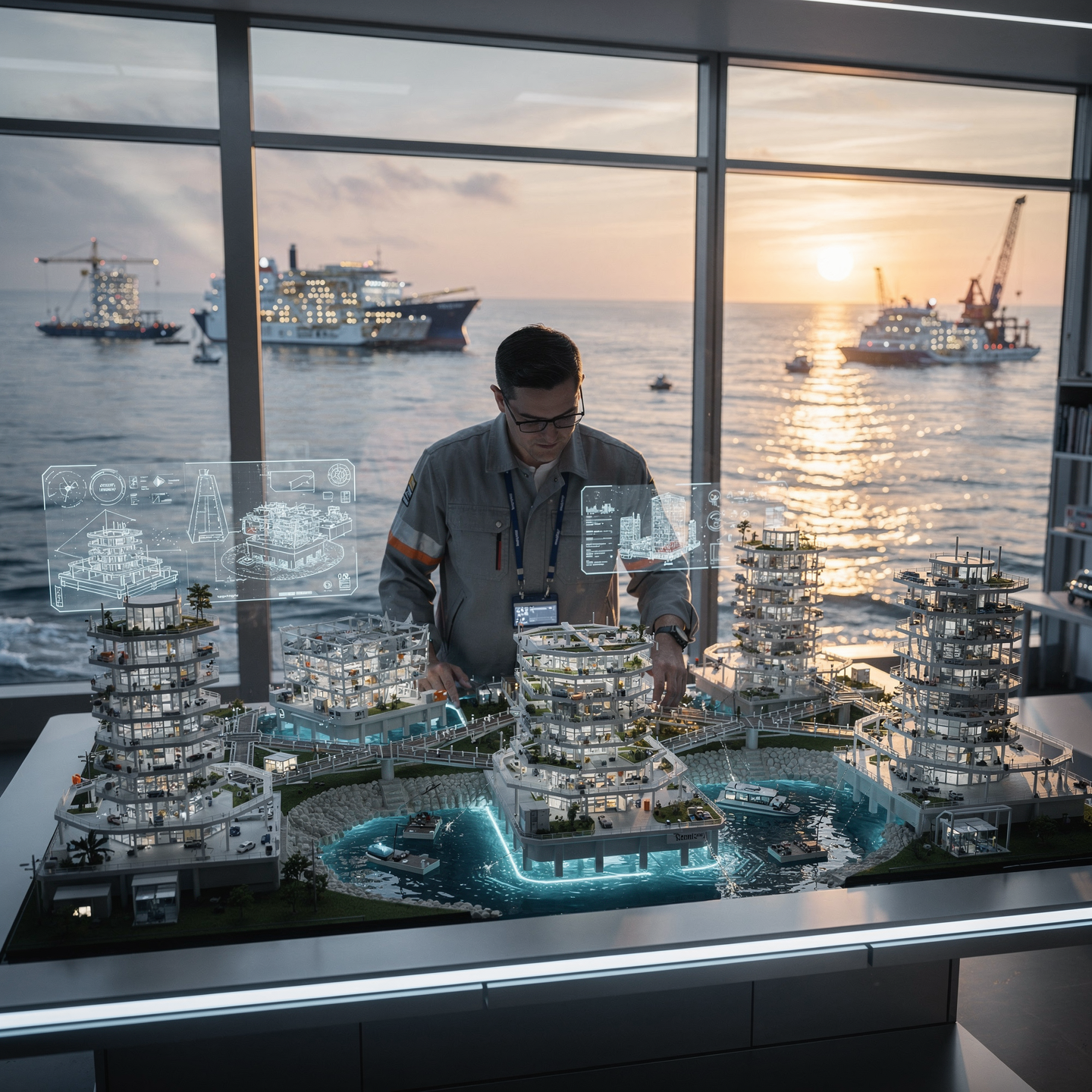
Master’s Degree in Floating Cities and Offshore Urban Planning

Why this master’s programme?

The Master’s in Floating Cities and Offshore Urban Planning

This is an innovative program that prepares you to lead the future of urban planning in a context of climate change and population growth. Learn to design, plan, and build resilient and sustainable cities on the water, integrating marine engineering, innovative architecture, and maritime legislation. Master the techniques for creating floating urban ecosystems that promote renewable energy, resource management, and social cohesion.

Differential Advantages

  • Multidisciplinary Approach: Combines knowledge from engineering, architecture, law, and environmental science.
  • Real-World Projects: Participate in the design and planning of floating city prototypes.
  • Cutting-Edge Technologies: Learn to use 3D simulation and modeling software for marine environments.
  • International Experts: Receive masterclasses from leaders in the field of offshore urbanism.
  • Opportunities Professionals: Access a network of contacts in companies and institutions dedicated to the development of floating cities.

Master’s Degree in Floating Cities and Offshore Urban Planning

Availability: 1 in stock

Who is it aimed at?

  • Architects, civil engineers, and urban planners interested in exploring innovative solutions for sustainable urban development and climate change adaptation.
  • Maritime and offshore professionals seeking to specialize in the design and management of habitable and sustainable maritime infrastructure.
  • Researchers and academics focused on new technologies, materials, and governance models for floating cities and offshore environments.
  • Entrepreneurs and business leaders wishing to identify business opportunities in the emerging market of floating cities and offshore urbanism.
  • Public policy and land-use planning officials seeking viable alternatives for urban sprawl and resource management in areas coastal areas.

Academic Flexibility
Online Master’s degree with live and recorded classes, discussion forums, and practical projects. Adaptable to your pace and compatible with your professional activity.

Objectives and skills

Designing resilient and sustainable infrastructures:

Implement redundancy and resource diversification strategies, optimizing the use of renewable energy and low environmental impact materials, to minimize the ecological footprint and ensure operational continuity in the face of disruptive events.

Managing complex projects in marine environments:

“Optimize planning and execution by considering oceanographic, meteorological and logistical variables, anticipating risks and adapting strategies in real time.”

Develop innovative marine habitability strategies:

Design modular and self-sustaining floating structures with integrated systems for renewable energy generation, waste management and food production.

Leading innovation in the governance of floating cities:

Promote agile and adaptive regulatory frameworks that balance safety, sustainability and economic development in dynamic maritime environments.

Integrating advanced technologies into offshore urban design:

Implement advanced BIM (Building Information Modeling) systems for design optimization, life cycle simulation and efficient management of complex marine infrastructures, ensuring interoperability and sustainability.

Optimizing logistics and transport in aquatic environments:

“Plan efficient routes considering currents, tides and adverse weather conditions, prioritizing safety and minimizing fuel consumption.”

Study plan – Modules

  1. Fundamentals of Integrated Design in Offshore Urban Infrastructure: Multidisciplinary Criteria and Systems Approaches
  2. Advanced Structural Analysis: Numerical Methods, Dynamics of Floating Platforms, and Seismic Resistance
  3. Innovative Materials and Emerging Technologies: Composites, Special Concretes, and Anti-Theft Solutions in Marine Environments
  4. Environmental Assessment and Impact Modeling: GIS Tools, Current Simulation, and Pollutant Dispersion
  5. Sustainable Energy Management: Integration of Offshore Renewable Energies (Wind, Wave, Floating Solar) and Advanced Storage
  6. Design of Water Efficiency Systems: Water Collection, Treatment, and Reuse in Closed Marine Ecosystems
  7. International Regulations and Technical Standards Applicable to Highly Complex Offshore Constructions
  8. Climate-Resilient Planning: Adaptation to Sea Level Rise, Extreme Events, and Ocean Variability
  9. Infrastructure for Mobility and Accessibility: Design of Underwater Transport Networks, Drones, and Autonomous Vehicles in Floating Environments
  10. Digital Integration and Remote Monitoring: Use of IoT, Digital Twins, and Predictive Maintenance for Operational Optimization
  11. Circular Economy Applied to Offshore Urban Planning: Reuse of Materials and Reduction of the Ecological Footprint in Modular Projects
  12. Sociocultural and Human Factors in Design: Habitability, Safety, and Well-being in High-Density Floating Cities
  13. International Case Studies: Critical Analysis of Landmark Projects, Success Stories, Challenges, and Lessons Learned
  14. Advanced Methodologies for Integrated Project Management: Interdisciplinary Coordination, Risk Planning, and Quality Assurance
  15. Innovations in Modular Construction and Prefabrication for Offshore Infrastructure: Techniques, Logistics, and Offshore Launching
  1. Fundamentals of advanced materials: mechanical properties, corrosion resistance, and marine adaptability
  2. Nanotechnology applied to offshore construction: self-cleaning and self-healing coatings for floating structures
  3. Composite materials and their applications: carbon fibers, reinforced polymers, and their behavior in aggressive marine environments
  4. Additive manufacturing technologies (3D printing) for high-strength, low-weight structural components
  5. Innovations in high-strength steels: properties, heat treatment, and corrosion protection techniques using galvanizing and polymer coatings
  6. Development and use of recycled and sustainable materials in offshore construction: environmental impact and life-cycle efficiency
  7. Intelligent structural monitoring systems: embedded sensors, fiber optics, and IoT systems for predictive maintenance and real-time control

    Advanced methodologies for assessing structural fatigue and deterioration in floating infrastructures subjected to dynamic ocean loads

    Waterproofing technologies and protection against marine biofouling using nano-coatings and smart biological waste

    Design and optimization of structures with hybrid materials: functional integration, chemical and mechanical compatibility to extend offshore service life

    Innovations in modular construction systems: advanced prefabrication, floating assemblies, and assembly in specialized shipyards

    Strategies for the effective repair and maintenance of floating infrastructures: use of drones, underwater robots, and non-invasive techniques

    Impact of new technologies and materials on international regulations applicable to urban planning Offshore and technical certifications

  8. Case studies on the successful implementation of advanced technologies and innovative materials in real-world floating city projects

    Future perspectives and emerging trends in the sustainable and resilient construction of floating cities: integrated renewable energy and the circular economy

  1. Fundamentals of Sustainability in Marine Environments: Ecological Principles Applied to Offshore Urban Planning
  2. Innovation in Materials and Technologies for Floating Infrastructure: Advanced Polymers, Eco-Friendly Composites, and Additive Manufacturing Techniques
  3. Integrated Design of Offshore Urban Systems: Synergies Between Architecture, Civil Engineering, and Maritime Technologies
  4. Digital Modeling and Advanced Simulation for the Assessment of Environmental and Structural Impacts
  5. Intelligent Management of Resources and Renewable Energies in Floating Cities: Integration of Photovoltaic Systems, Offshore Wind Power, and Ocean Thermal Conversion Systems
  6. Resilient Infrastructure in the Face of Extreme Climate Events: Adaptation and Mitigation Strategies at the Structural and Operational Levels
  7. Disruptive Technologies in Offshore Mobility and Transport: Autonomous Vehicles, Cargo Drones, and Navigation Systems Under Marine Conditions
  8. Methodologies for the Regeneration and Preservation of Ecosystems
  9. Marine environments associated with urban developments

    International regulations and regulatory frameworks applicable to offshore urban development: case studies and guidelines for legal and environmental compliance

    Economic evaluation and green financing models for floating urban infrastructure projects

    Implementation of real-time monitoring systems: IoT, environmental sensors, and big data platforms for the integrated management of offshore cities

    Case studies of technological innovation applied to urban infrastructure in extreme marine environments, with a focus on sustainability and environmental adaptation

    Social and cultural impacts of floating city development: community integration and participatory models in urban design

    Strategic planning for the scalable and modular expansion of offshore cities, considering infrastructure life cycles and maintenance

    Development of emergency protocols and advanced security systems for floating urban infrastructure

  1. Design and architecture of microgrids for offshore environments: integration of renewable energy sources, energy storage, and dynamic demand management
  2. Advanced water treatment and reuse systems: desalination technologies, reverse osmosis, bioreactors, and closed-loop recycling processes
  3. Circular management models for water and energy resources: circular economy applied to floating cities to maximize efficiency and minimize waste
  4. Automation and autonomous operation of integrated systems: SCADA control, artificial intelligence, and machine learning for real-time optimization
  5. Interconnection and synchronization of microgrids: communication protocols, network stability, and response to outages or demand spikes
  6. Sustainable offshore mobility: design of electric and autonomous fleets, wireless charging infrastructure, and integrated management of floating urban transport
  7. Environmental impact assessment and applicable regulations: compliance with international standards and strategies for pollution mitigation in ecosystems marine
  8. Advanced simulation and digital modeling of energy and water systems: use of digital twins for forecasting, predictive maintenance, and resilience

    Liquid and solid waste management in floating cities: separation, recovery, and minimization technologies for closed loops

    IoT devices and smart sensors for continuous monitoring: integration into digital ecosystems and applied cybersecurity protocols

    Strategic planning for energy self-sufficiency and water resilience: development of contingency plans and climate change adaptation scenarios

    Resource optimization through blockchain and decentralized systems: consumption traceability, green certification, and collaborative governance

  1. Fundamentals of strategic planning applied to marine urban environments: concepts, methodologies, and integrated approaches
  2. Analysis of natural and anthropogenic risks in floating cities: modeling of hydrometeorological, seismic, and structural anchoring hazards
  3. Design and application of risk management systems for offshore infrastructure: protocols, indicators, and contingency plans
  4. Predictive models and advanced simulation for managing extreme events: swells, storm surges, and climate variability
  5. Implementation of IoT and real-time sensor technologies for monitoring and response in smart floating cities
  6. Integration of early warning systems with urban and maritime control platforms: architecture, communications, and interoperable protocols
  7. Assessment and mitigation of risks associated with marine pollution and its impact on offshore urban habitability and sustainability
  8. International regulations and technical standards
  9. For planning and risk management in urban maritime environments: comparative analysis and practical application
  10. Citizen participation methodologies and collaborative governance in strategic planning processes for floating cities
  11. Case studies: successful implementation of strategic management and risk mitigation in offshore urbanism pilot projects
  1. Fundamentals and advances in smart materials for offshore infrastructure: self-healing composites, nano-coatings, and adaptive structural systems
  2. Integration of floating renewable energies: design and optimization of offshore wind farms, floating solar panels, and wave and tidal energy conversion systems
  3. Multiphysics simulation models for predictive analysis of structural behavior under extreme marine and climatic conditions
  4. Advanced waste and water resource management in floating urban environments: in-situ recycling technologies and autonomous desalination plants
  5. Real-time monitoring systems using IoT and sensor networks for structural integrity control, environmental quality, and operational safety
  6. Sustainable urbanism in floating cities: microclimate planning, marine ecological corridors, and adaptive biodiversity
  7. Innovations in modular design and Prefabricated for logistical facilities and efficient maintenance of offshore urban platforms

    Underwater automation and robotics applied to the inspection, repair, and expansion of complex floating infrastructures

    Urban adaptation and resilience protocols for extreme events: climate change predictive models and integrated mitigation strategies

    International standards and regulations for the certification of floating infrastructures with sustainability and operational safety criteria, including ISO, IEC, and IMO recommendations

  1. Fundamentals of Marine Infrastructure Design: Advanced Materials and Adaptive Construction Techniques for Offshore Environments
  2. Smart Structural Engineering: Integration of IoT Sensors for Real-Time Monitoring and Predictive Maintenance
  3. Resilient Design in the Face of Extreme Weather Events: Impact Analysis, Mitigation, and Adaptation Using Computational Models
  4. Sustainable Energy Systems: Incorporation of Offshore Renewable Energies (Wind, Wave, Floating Solar) and Integrated Storage
  5. Water Management and Treatment: Technologies for Recycling, Desalination, and Wastewater Management in Floating Cities
  6. Mobility and Connectivity: Development of Maritime Transport Networks, Drones, and Autonomous Vehicles for Efficient Logistics and Low Carbon Footprints
  7. Advanced Safety and Operational Resilience Protocols: Prevention, Detection, and Response to Natural and Civil Contingencies
  8. Technological aspects

  9. International standards and certifications applicable to smart marine infrastructure: environmental compliance, safety, and quality
  10. Offshore urban planning: integration of living spaces, commercial spaces, and marine ecosystems to maximize functionality and sustainability
  11. Digital modeling and advanced simulation: use of digital twins for optimizing the design, maintenance, and operation of floating cities
  1. Fundamentals of Governance in Maritime Environments: Structure, Actors, and Competencies
  2. International Legal Framework Applicable to Floating Cities and Offshore Platforms: UNCLOS, IMO Conventions, and Specific Treaties
  3. Development of Local and Supranational Regulations for the Management of Urban Marine Spaces
  4. Advanced Models of Collaborative Governance: Citizen Participation, Private Sector, and Multilateral Governments
  5. Design of Public Policies Oriented Towards Environmental, Economic, and Social Sustainability in Floating Environments
  6. Legal Instruments for Environmental Protection and Marine Resource Management: Impact, Assessment, and Mitigation
  7. Regulation and Management of Offshore Infrastructure: Zoning, Permits, Security, and Maintenance
  8. Territorial and Jurisdictional Rights in Limited Maritime Spaces and the High Seas
  9. Financing Mechanisms and Economic Models for the Development and Sustainability of Floating Cities
  10. Legal Risk Assessment and Crisis Management in Offshore Urban Environments: Protocols and Contingency Plans
  11. Public Policies for Social Integration and Well-being in Floating Communities: Health, Education, and Employment
  12. Legislative Innovation for Climate Change Adaptation and Resilience of Maritime Infrastructure
  13. Digital Tools for Smart Governance: Big Data, Blockchain, and Real-Time Monitoring Systems
  14. International Case Studies and Lessons Learned in the Governance of Floating Cities and Maritime Platforms
  15. Methodologies for Audits and Compliance Assessment in Offshore Urban Environments
  16. Participatory Design of Public Policies Oriented Towards the Blue Economy and Sustainable Marine Development
  17. Ethical Aspects and Human Rights in the Planning and Management of Floating Cities
  18. International Cooperation and Strategic Alliances for the Effective Governance of Maritime Urban Zones
  19. Implementation of Frameworks Dynamic regulatory frameworks: flexibility, monitoring, and regulatory updates

    Future trends in legislation and public policy for the expansion and consolidation of floating urban environments

  1. Fundamentals of technological innovation applied to floating infrastructures: advanced materials, intelligent systems, and automation
  2. Sustainable design in offshore urban development: criteria for energy efficiency, environmental impact, and resource circularity
  3. Emerging technologies for monitoring and remote control: IoT sensors, SCADA platforms, and predictive analytics
  4. Integration of renewable energies in floating structures: solar, offshore wind, and green hydrogen generation
  5. Advanced computational models for hydrodynamic and structural simulation in extreme marine conditions
  6. International standards and regulatory frameworks applicable to the governance of floating cities and offshore platforms
  7. Risk management and urban resilience: planning for severe weather events and natural disasters in maritime environments
  8. Smart governance architectures: integrated management systems, digital citizen participation, and operational transparency
  9. Life cycle assessment and analysis
  10. Ecological footprint in highly complex offshore urban development projects
  11. Case studies and global benchmarking: successful implementation of sustainable technological solutions in floating infrastructure
  1. Theoretical and conceptual framework: fundamentals of offshore urbanism, definition and characterization of floating cities, principles of sustainability and resilience applied to marine environments
  2. Advanced methodologies for comprehensive design: parametric modeling, environmental simulation, and multi-criteria analysis for the optimization of floating urban structures
  3. Evaluation of offshore construction technologies: ultralight materials, modular structures, mooring systems, and dynamic stabilization
  4. Planning and zoning in ocean environments: environmental impact analysis, use of GIS and georeferencing techniques for territorial planning in the open sea
  5. Life cycle management of floating cities: strategic planning, implementation of intelligent systems for predictive maintenance, and management of water and energy resources
  6. Integration of offshore renewable energies: design and analysis of photovoltaic, wind, and wave energy systems for urban energy self-sufficiency
  7. International regulations and applicable regulatory frameworks: evaluation of maritime legislation, international conventions, and safety and construction standards
  8. Design of critical infrastructure: transport networks, telecommunications, evacuation systems, and emergency response in hostile marine environments
  9. Digital tools for integrated management: BIM platforms, augmented reality, and IoT systems applied to offshore urban monitoring and control
  10. Development and presentation of the final project: integration of design components, execution, sustainable evaluation, and a comprehensive management proposal for an offshore floating city

Career prospects

“`html

  • Offshore Urban Designer/Planner: Creation and development of urban plans adapted to floating and offshore environments.
  • Marine Civil Engineering Consultant: Advising on the construction, maintenance, and adaptation of floating infrastructure.
  • Marine Renewable Energy Specialist: Design and implementation of sustainable energy systems in floating cities.
  • Offshore Project Manager: Leadership and coordination of construction and development projects for floating cities.
  • Floating Urbanism Researcher: Development of new technologies and solutions for habitability in aquatic environments.
  • Urban Sustainability and Resilience Expert: Design of strategies for sustainability and adaptation to climate change in floating cities.
  • “““““““““““““““““““““““
    `
    `
    `
    `
    `
    `

    `

    `

    <
    `

    < …

  • Naval Architect specializing in Urban Environments: Design of habitable and functional floating structures.
  • Offshore Urban Planning Regulator/Legislator: Development of legal and regulatory frameworks for the planning and management of floating cities.

“`

Entry requirements

Academic/professional profile:

Bachelor’s degree in Nautical Science/Maritime Transport, Naval/Marine Engineering or a related qualification; or proven professional experience on the bridge/in operations.

Language proficiency:

Functional Maritime English (SMCP) recommended for simulations and technical materials.

Documentation:

Updated CV, copy of qualification or seaman’s book, national ID/passport, motivation letter.

Technical requirements (for online):

Device with camera/microphone, stable internet connection, monitor ≥ 24” recommended for ECDIS/Radar-ARPA.

Admissions process and dates

Online
application

(form + documents).

Academic review and interview

Admissions decision

Admissions decision

(+ scholarship offer if applicable).

Place reservation

(deposit) and enrolment.

Induction

(access to the virtual campus, calendars, simulator guides).

Scholarships and financial support

  • Design the urban future: Learn to create resilient and sustainable cities in aquatic environments.
  • Innovative technologies: Master the latest naval engineering and architecture techniques applied to offshore urbanism.
  • Global perspective: Explore international case studies and the legal, economic, and environmental implications of floating cities.
  • Hands-on experience: Participate in real-world projects and simulations to develop innovative solutions.
  • Career opportunities: Prepare to lead urban planning, sustainable development, and coastal engineering projects globally.
Boost your career in the urbanism of the future and contributes to the creation of innovative living spaces.

Testimonials

Frequently asked questions

Marine and coastal environments, including the design, construction, management and sustainability of floating infrastructure and cities on the ocean.

Yes. The itinerary includes ECDIS/Radar-ARPA/BRM with harbor, ocean, fog, storm, and SAR scenarios.

Online with live sessions; hybrid option for simulator/practical placements through agreements.

Aquatic urban environments, specifically the design, construction and management of floating cities and other offshore infrastructure.

Recommended functional SMCP. We offer support materials for standard phraseology.

Yes, with a relevant degree or experience in maritime/port operations. The admissions interview will confirm suitability.

Optional (3–6 months) through Companies & Collaborations and the Alumni Network.

Simulator practice (rubrics), defeat plans, SOPs, checklists, micro-tests and applied TFM.

A degree from Navalis Magna University + operational portfolio (tracks, SOPs, reports and KPIs) useful for audits and employment.

  1. Theoretical and conceptual framework: fundamentals of offshore urbanism, definition and characterization of floating cities, principles of sustainability and resilience applied to marine environments
  2. Advanced methodologies for comprehensive design: parametric modeling, environmental simulation, and multi-criteria analysis for the optimization of floating urban structures
  3. Evaluation of offshore construction technologies: ultralight materials, modular structures, mooring systems, and dynamic stabilization
  4. Planning and zoning in ocean environments: environmental impact analysis, use of GIS and georeferencing techniques for territorial planning in the open sea
  5. Life cycle management of floating cities: strategic planning, implementation of intelligent systems for predictive maintenance, and management of water and energy resources
  6. Integration of offshore renewable energies: design and analysis of photovoltaic, wind, and wave energy systems for urban energy self-sufficiency
  7. International regulations and applicable regulatory frameworks: evaluation of maritime legislation, international conventions, and safety and construction standards
  8. Design of critical infrastructure: transport networks, telecommunications, evacuation systems, and emergency response in hostile marine environments
  9. Digital tools for integrated management: BIM platforms, augmented reality, and IoT systems applied to offshore urban monitoring and control
  10. Development and presentation of the final project: integration of design components, execution, sustainable evaluation, and a comprehensive management proposal for an offshore floating city

Request information

  1. Complete the Application Form.

  2. Attach your CV/degree certificate (if you have it to hand).

  3. Indicate your preferred cohort (January/May/September) and whether you would like the hybrid option with simulator sessions.

    An academic advisor will contact you within 24–48 hours to guide you through the admission process, scholarships, and compatibility with your professional schedule.

Please enable JavaScript in your browser to complete this form.
Click or drag a file to this area to upload.

Faculty

0
    0
    Tu carrito
    Tu carrito esta vacíoRegresar a la tienda
    Scroll to Top


