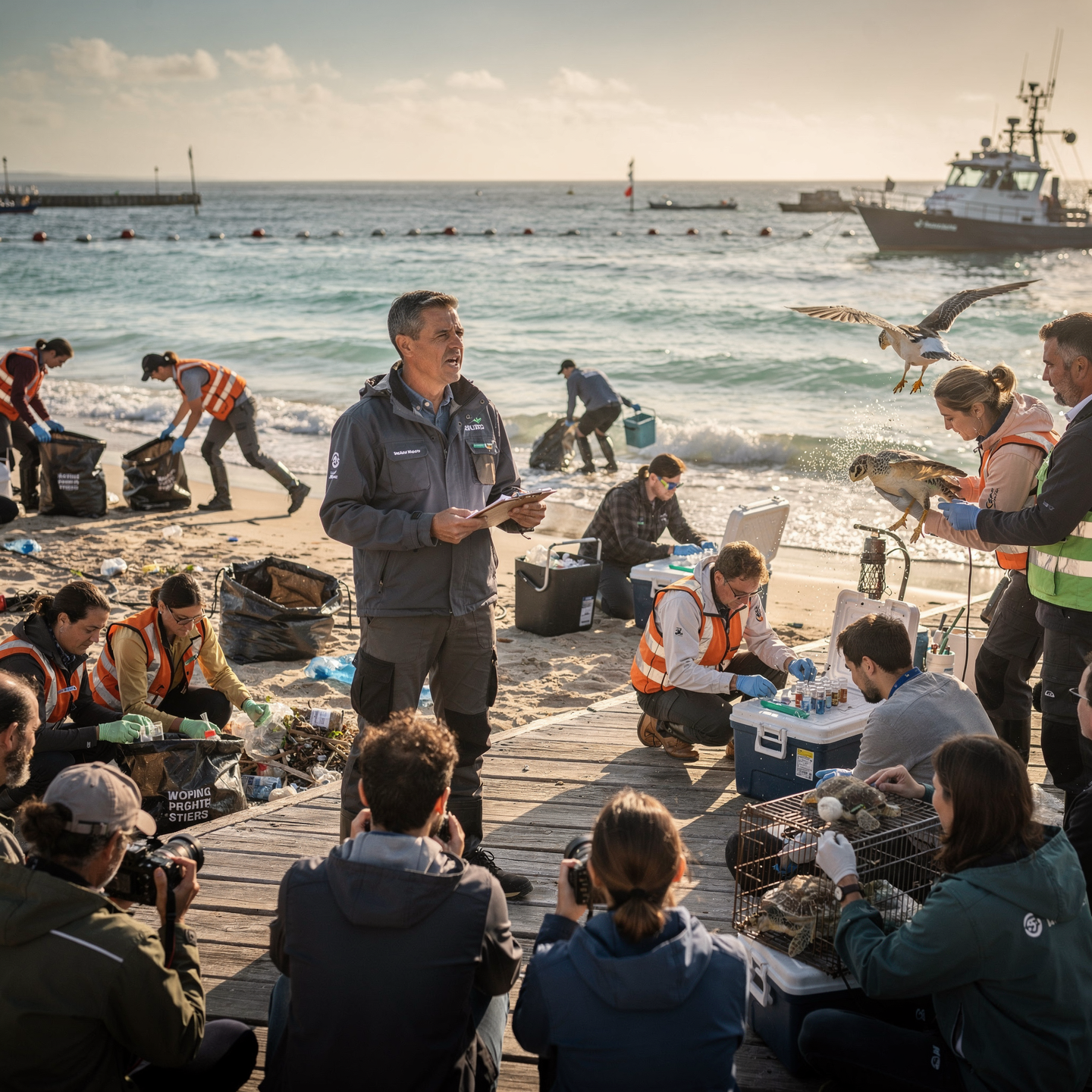
Diploma in Marine Ecosystem Conservation

Conservación

Diploma in Marine Ecosystem Conservation

Availability: 1 in stock

Who is it aimed at?

  • Marine biologists, environmental engineers, and coastal management professionals seeking to deepen their knowledge of conservation strategies, habitat restoration, and sustainable management of marine resources.
  • Environmental consultants and NGO technicians requiring up-to-date knowledge of marine environmental legislation, environmental impact assessment, and conservation projects.
  • Environmental educators and science communicators wishing to develop innovative tools and methodologies for disseminating information and raising awareness about the importance of marine ecosystems.
  • Public policymakers and decision-makers interested in implementing integrated coastal zone management plans and strategies for climate change adaptation in the marine environment.
  • Students in related fields seeking specialization in marine conservation. with a practical approach applied to the reality of marine ecosystems.

    Study flexibility

    Designed for professionals and students: 24/7 access to content, interactive discussion forums, and personalized follow-up by subject matter experts.

Conservación

Objectives and competencies

Assess and mitigate environmental impacts:

Implement waste management and spill prevention procedures, minimizing marine pollution and protecting biodiversity.

Design and implement marine conservation strategies:

“Assess the vulnerability of key ecosystems, prioritize conservation areas, and establish adaptive management measures based on scientific data and community participation.”

Managing marine resources sustainably:

“Minimizing the environmental impact of maritime operations, complying with MARPOL and local regulations, and optimizing routes to reduce fuel consumption and emissions.”

Restoring degraded marine ecosystems:

Implement ecological restoration techniques (coral planting, artificial reefs, etc.) monitoring their long-term effectiveness and adapting strategies according to results and environmental changes.

Monitoring the health of marine ecosystems:

“Analyze water quality data, identify sources of contamination, and propose corrective measures.”

Educating and raising awareness about the importance of marine conservation:

Promote sustainable practices in fishing and tourism, highlighting the economic and ecological value of healthy marine ecosystems.

Curriculum - Modules

1.1 Marine biomes and habitat types: littoral, pelagic, deep-sea, polar, estuarine.
1.2 Primary production and food webs: plankton dynamics, energy flow, trophic cascades.
1.3 Biogeochemical cycles: carbon, nitrogen, and phosphorus in ocean systems.
1.4 Population ecology: recruitment, connectivity, metapopulations, and dispersal larval stage.
1.5 Community ecology: diversity, functional roles, keystone species, and resilience.
1.6 Habitat complexity: seagrass meadows, kelp forests, reefs, mangroves, and engineer species.
1.7 Oceanography for conservation: currents, upwelling, stratification, and productivity hotspots.
<strong data-start="787" 1.8 Ecological indicators: biodiversity metrics, health indices, and early signs.
1.9 Baselines and shifting baselines: historical ecology and reference conditions.
1.10 Conservation science: principles, objectives, and evidence-based decision-making.

2.1 Coral reefs: ecological function, vulnerabilities, and conservation priorities.
2.2 Seagrass meadows: blue carbon, nurseries, and coastal protection.
2.3 Mangroves and salt marshes: storm buffering, biodiversity, and ecosystem services.
2.4 Kelp forests: productivity, link with Fisheries and climate sensitivity.
2.5 Estuaries and coastal lagoons: nutrient cycling, migratory corridors, and anthropogenic pressures.
2.6 Sandy and rocky coasts: zonation, disturbances, and adaptive management.
2.7 Open ocean ecosystems: fronts, gyres, migratory species, and governance challenges.
<strong 2.8 Deep-sea habitats: seamounts, hydrothermal vents, and emerging hazards.
2.9 Polar ecosystems: sea ice dynamics, trophic changes, and conservation.
2.10 Habitat mapping and classification: scales, uncertainty, and applications.

3.1 Climate change: warming, marine heatwaves, deoxygenation, and regime shifts.
3.2 Ocean acidification: impacts on calcifiers and structuring habitats.
3.3 Sea level rise and coastal squeeze: habitat loss and adaptation.
3.4 Overfishing and bycatch: stock depletion and effects Trophic factors.
3.5 Destructive fishing and bottom damage: trawling, recovery, and mitigation measures.
3.6 Marine pollution: nutrients, plastics, chemicals, heavy metals, and spills.
3.7 Underwater noise: navigation, surveying, and effects on marine mammals and fish.
<strong data-start="2795" 3.8 Invasive species and biofouling: vectors, risk assessment and control.
3.9 Coastal development and dredging: sedimentation, turbidity and cumulative effects.
3.10 Cumulative impacts: interaction of pressures, thresholds and prioritization.

4.1 Goals and objectives: representativeness, replication, connectivity, and persistence.
4.2 Spatial prioritization: selection of areas based on biodiversity, threats, and viability.
4.3 Connectivity: larval dispersal, stepping stones, and network design.
4.4 Marine spatial planning: zoning, uses, conflicts, and trade-offs. 4.5 Environmental Impact Assessment (EIA): Scope, Baselines, Mitigation, and Monitoring.
4.6 Strategic Environmental Assessment (SEA): Policy-Level Planning and Accumulation.
4.7 Ecosystem-Based Management: Integrating Fisheries, Habitats, and Human Uses.
4.8 Climate scenarios: adaptation pathways, decision points, and adaptive management.
4.9 Uncertainty and the precautionary principle: robust decisions with incomplete data.
4.10 Implementation: governance, resources, timelines, and accountability.

5.1 Types of MPAs: no extraction, multiple uses, seasonal closures, and OECM.
5.2 Design of effective MPAs: size, connectivity, representativeness, and feasibility of control.
5.3 Management plan: regulations, permits, zoning, and compliance measures.
5.4 Monitoring and control: patrol models, support technology, and Deterrence.
5.5 Ecological monitoring: indicators, sampling design, and baseline establishment.
5.6 Socioeconomic dimension: effects on livelihoods, transition costs, and benefits.
5.7 Co-management and participatory governance: agreements, legitimacy, and conflict resolution.
<strong data-start="4756" 5.8 Effectiveness evaluation: ecological outcomes, compliance, and management performance.
5.9 Sustainable financing: mechanisms, costs, and spending efficiency.
5.10 Adaptive management: learning cycles, review of measures, and response to change.

6.1 Restoration principles: feasibility, baseline conditions, and success criteria.
6.2 Seagrass restoration: site selection, planting techniques, and survival.
6.3 Mangrove/salt marsh restoration: hydrology, sediments, and long-term stability.
6.4 Coral restoration and reef rehabilitation: nurseries, transplants, and Thermal resilience.
6.5 Kelp restoration: herbivory control, restocking, and ecological feedbacks.
6.6 Oyster and bivalve reefs: water quality improvement and habitat restoration.
6.7 Coastal solutions: “living shorelines” and hybrid approaches with engineering.
<strong data-start="5785" 6.8 Biosecurity in restoration: prevention of invasive species and disease transmission.
6.9 Monitoring of outcomes: ecological, geomorphological, and ecosystem service metrics.
6.10 Scaling up and governance: permits, maintenance, funding, and agreements.

7.1 Sampling design: statistical power, biases, and variable control.
7.2 Field methods: transects, quadrats, BRUVS, acoustics, and habitat assessment.
7.3 Water quality monitoring: nutrients, turbidity, pollutants, and microbial indicators.
7.4 Population monitoring: CPUE, demography, recruitment, and Indices.
7.5 Biodiversity assessment: functional diversity, indicator species, and community indices.
7.6 Emerging tools: eDNA/metabarcoding, autonomous platforms, and sensors.
7.7 Remote sensing: satellites, drones, bathymetry, and habitat classification.
<strong data-start="6785" 7.8 Data Management: QA/QC, metadata, reproducibility, and best practices.
7.9 Ecological Modeling: species distribution, risk maps, and scenarios.
7.10 Communicating Results: technical reports, uncertainty, and decision support.

Career opportunities

  • Marine Protected Area Management Technician: Development and monitoring of management plans, control and surveillance of activities.
  • Marine Environmental Consultant: Environmental impact assessment, marine biodiversity studies, and advising on conservation projects.
  • Marine Scientific Researcher: Participation in research projects on marine ecology, species and habitat conservation.
  • Marine Environmental Educator: Design and implementation of education and awareness programs on the importance of marine ecosystems.
  • Sustainable Aquaculture Technician: Implementation of aquaculture practices that respect the marine environment.
  • Marine Ecological Restoration Project Manager: Planning and execution of projects to recover degraded habitats, such as coral reefs or seagrass meadows.
  • Technician in Marine wildlife rescue and rehabilitation centers: Care and rehabilitation of injured or stranded marine animals.

    Marine ecotourism guide: Leading environmentally friendly tourist activities, such as snorkeling or interpretive diving.

    “`

Admission requirements

Academic/professional profile:

Degree/Bachelor's degree in Nautical Science/Maritime Transport, Naval/Marine Engineering, or a related field; or proven professional experience in bridge/operations.

Language proficiency:

Recommended functional maritime English (SMCP) for simulations and technical materials.

Documentation:

Updated resume, copy of degree or seaman's book, ID card/passport, letter of motivation.

Technical requirements (for online):

Equipment with camera/microphone, stable connection, ≥ 24” monitor recommended for ECDIS/Radar-ARPA.

Admission process and dates

1. Online
application

(form + documents).

2. Academic review and interview

(profile/objectives/schedule compatibility).

3. Admission decision

(+ scholarship proposal if applicable).

4. Reservation of place

(deposit) and registration.

5. Induction

(access to campus, calendars, simulator guides).

Scholarships and grants

  • Fundamentals of Marine Conservation: Understand the importance of marine ecosystems and the threats they face.
  • Conservation Strategies: Learn to design and implement effective strategies for the protection of marine biodiversity.
  • Tools and Techniques: Master the most advanced tools and techniques for monitoring, restoring, and managing marine ecosystems.
  • Legal Framework and Policies: Familiarize yourself with national and international legislation and policies that regulate marine conservation.
  • Sustainable Resource Management: Acquire the skills to promote the sustainable management of marine resources, benefiting both the environment and local communities.
Prepare to lead the conservation of our oceans and contribute to a healthier marine future.

Testimonials

Frequently asked questions

To provide participants with the knowledge and skills necessary to understand, protect and restore marine ecosystems.

Yes. The itinerary includes ECDIS/Radar-ARPA/BRM with harbor, ocean, fog, storm, and SAR scenarios.

Online with live sessions; hybrid option for simulator/practical placements through agreements.

Recommended functional SMCP. We offer support materials for standard phraseology.

Yes, with a relevant degree or experience in maritime/port operations. The admissions interview will confirm suitability.

Optional (3–6 months) through Companies & Collaborations and the Alumni Network.

Simulator practice (rubrics), defeat plans, SOPs, checklists, micro-tests and applied TFM.

A degree from Navalis Magna University + operational portfolio (tracks, SOPs, reports and KPIs) useful for audits and employment.

#VALUE!

Request information

  1. Complete the Application Form.

  2. Attach your CV/degree certificate (if you have it to hand).

  3. Indicate your preferred cohort (January/May/September) and whether you would like the hybrid option with simulator sessions.

    An academic advisor will contact you within 24–48 hours to guide you through the admission process, scholarships, and compatibility with your professional schedule.

Please enable JavaScript in your browser to complete this form.
Click or drag a file to this area to upload.

Faculty

0
    0
    Tu carrito
    Tu carrito esta vacíoRegresar a la tienda
    Scroll to Top


