Basic First Aid Course
Why this course?
The Basic First Aid course
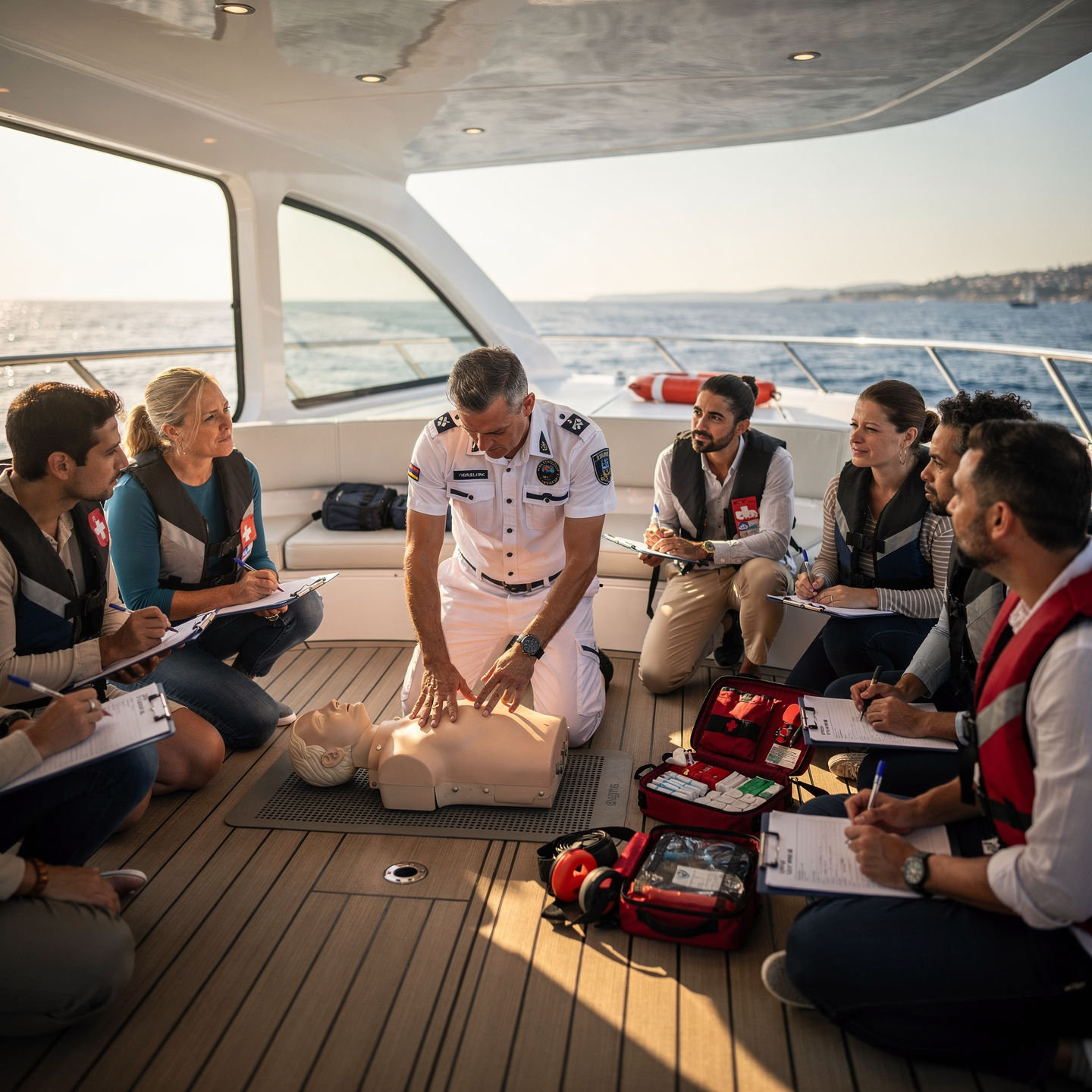
This course provides you with the essential skills to act confidently and effectively in emergency situations. Learn to quickly assess the situation, apply cardiopulmonary resuscitation (CPR) techniques, control bleeding, and treat common injuries such as burns, fractures, and sprains. This program equips you to be a valuable first responder, providing crucial assistance until professional medical help arrives.
First Aid
Key Benefits
- Practical Knowledge: You will master proven and effective first aid techniques.
- Confidence in Action: You will overcome the fear of acting in emergencies, taking control of the situation.
- Recognized Certification: You will obtain a certification that validates your skills as a first responder.
- Safety for You and Others: You will protect the health and safety of your loved ones and the community.
- Dynamic Learning: You will participate in realistic simulations and interactive practice.
- Modality: Online
- Level: Cursos
- Hours: 150 H
- Start date: 24-07-2026
Availability: 1 in stock
Who is it aimed at?
- Parents who want to be prepared to handle minor medical emergencies at home and during outdoor activities.
- Caregivers of children and the elderly who need basic knowledge to respond to emergency situations and provide appropriate first aid.
- Professionals in the education and sports fields who require first aid training to ensure the safety of participants in their activities.
- Volunteers and members of community organizations who want to acquire skills to assist people in emergency situations in their community.
- Anyone interested in learning basic first aid techniques to be prepared for any eventuality.
Flexibility and Accessibility
Course designed to adapt to your pace: online learning materials, practical exercises, and certification upon completion.
Objectives and competencies

Assess and act in life-threatening emergencies:
“Prioritize the safety of human life, quickly assess the situation, activate emergency protocols, and coordinate available resources.”

Apply basic life support techniques:
“Quickly and efficiently, prioritizing patient safety and applying the CPR protocol according to current guidelines.”

Identify and treat common injuries:
“Recognize vital signs, perform basic CPR, and apply first aid for burns, fractures, and wounds.”

Prevent complications and promote initial recovery:
“Monitor vital signs and ensure a patent airway, prioritizing transfer and communication with the coordinating center.”

Ensure the safety of the rescuer and the victim:
“Assess risks, secure the scene, and use appropriate personal protective equipment (PPE).”

Communicate the situation effectively to the emergency services:
“Transmit clear, concise, and relevant information (location, nature of the emergency, number of people affected, assistance needed) using the appropriate channel and protocol (DSC, VHF radio).”
Curriculum - Modules
- Comprehensive Maritime Incident Management: protocols, roles, and chain of command for coordinated response
- Operational Planning and Execution: briefing, routes, weather windows, and go/no-go criteria
- Rapid Risk Assessment: criticality matrix, scene control, and decision-making under pressure
- Operational Communication: VHF/GMDSS, standardized reports, and inter-agency liaison
- Tactical Mobility and Safe Boarding: RHIB maneuvers, approach, mooring, and recovery
- Equipment and Technologies: PPE, signaling, satellite tracking, and field data logging
- Immediate Care of the Affected: primary assessment, hypothermia, trauma, and stabilization for evacuation
- Adverse Environmental Conditions: swell, Visibility, flows, and operational mitigation
Simulation and training: critical scenarios, use of VR/AR, and exercises with performance metrics
Documentation and continuous improvement: lessons learned, indicators (MTTA/MTTR), and SOP updates
- Introduction to Life Support: Definitions and Objectives.
- Scene Assessment: Safety, Mechanism of Injury, and Number of Victims.
- Primary Assessment: ABCs (Airway, Breathing, Circulation).
- Airway Obstruction: Heimlich Maneuver and Other Techniques.
- Artificial Respiration: Mouth-to-mouth, mouth-to-nose, use of barriers.
- Chest Compressions and CPR (Cardiopulmonary Resuscitation) in Adults, Children, and Infants.
- Use of the AED (Automated External Defibrillator): Operation and Precautions.
- Bleeding: Types, direct control, pressure points, and tourniquets.
- Shock: Types, signs, symptoms, and initial management.
- Ethical and Legal Considerations in First Aid.
‘
- Introduction to First Aid: Objectives, principles, and legal framework.
- Initial patient assessment: Vital signs, level of consciousness, and ABCs.
- CPR (Cardiopulmonary Resuscitation): Adults, children, and infants. Use of the AED.
Choking: The Heimlich maneuver in different situations.
Bleeding: Types, direct control, tourniquets, and bandages.
Wounds and burns: Cleaning, disinfection, dressings, and treatment.
Trauma: Fractures, sprains, dislocations, and immobilization.
Head and spinal cord injuries: Proper management and transport.
Common medical conditions: Asthma attacks, hypoglycemia, seizures, and allergic reactions.
First aid kit: Basic contents and maintenance.
‘
- Introduction to Primary Care: Concepts, levels, and the professional’s role.
- Legal and Ethical Framework: Health legislation, informed consent, confidentiality.
- Initial Patient Assessment: Medical history, basic physical examination, and vital signs.
- Emergency Response Protocols: Management of the polytrauma patient, cardiac arrest, and shock.
- Basic Life Support (BLS): CPR in adults, children, and infants; use of an AED.
- First Aid for Trauma: Fractures, dislocations, sprains, wounds, and bleeding.
- First Aid for Common Illnesses: Asthma attack, hypoglycemia, and reactions Allergic reactions, seizures.
- Management of Burns, Frostbite, and Chemical Injuries: Classification, initial treatment, and referral.
- Immobilization and Transfer of the Patient: Immobilization techniques, use of mobilization equipment, and medical transport.
- Psychological Aspects in Emergency Care: Stress management, communication with the patient and family.
‘
- Introduction to Basic Life Support (BLS): Definition, importance, and chain of survival.
- Legal and Ethical Aspects: Consent, duty to act, and legal responsibility.
- Scene Assessment: Safety, mechanism of injury, and number of victims.
- Patient Assessment: Level of consciousness, airway, breathing, and circulation (ABCs).
- Foreign Body Airway Obstruction (FBAO): Heimlich maneuver in adults, children, and infants.
- Cardiopulmonary Resuscitation (CPR): CPR techniques in adults, children, and infants.
- Use of the Automated External Defibrillator (AED): Rhythm recognition Defibrillatable devices, patch application, and shock delivery.
- Recovery Position (RP): Indications and correct technique.
- Hemorrhage: Types, direct control, indirect pressure, and tourniquets (use and risks).
- Burns: Classification, initial treatment, and prevention of complications.
‘
- System Architecture and Components: Structural design, materials, and subsystems (mechanical, electrical, electronic, and fluid) with selection and assembly criteria for marine environments
- Fundamentals and Principles of Operation: Physical and engineering foundations (thermodynamics, fluid mechanics, electricity, control, and materials) that explain performance and operating limits
- Safety and Environmental (SHE): Risk analysis, PPE, LOTO, hazardous atmospheres, spill and waste management, and emergency response plans
- Applicable Regulations and Standards: IMO/ISO/IEC requirements and local regulations;
- Conformance criteria, certification, and best practices for operation and maintenance
- Inspection, testing, and diagnostics: Visual/dimensional inspection, functional testing, data analysis, and predictive techniques (vibration, thermography, fluid analysis) to identify root causes
- Preventive and predictive maintenance: Hourly/cycle/seasonal plans, lubrication, adjustments, calibrations, consumable replacement, post-service verification, and operational reliability
- Instrumentation, tools, and metrology: Measuring and testing equipment, diagnostic software, calibration and traceability; selection criteria, safe use, and storage
- Onboard integration and interfaces: Mechanical, electrical, fluid, and data compatibility; Sealing and watertightness, EMC/EMI, corrosion protection, and interoperability testing.
Quality, acceptance testing, and commissioning: process and materials control, FAT/SAT, bench and sea trials, go/no-go criteria, and evidence documentation.
Technical documentation and integrated practice: logs, checklists, reports, and a complete case study (safety → diagnosis → intervention → verification → report) applicable to any system.
Plan de estudio - Módulos
- Comprehensive Maritime Incident Management: protocols, roles, and chain of command for coordinated response
- Operational Planning and Execution: briefing, routes, weather windows, and go/no-go criteria
- Rapid Risk Assessment: criticality matrix, scene control, and decision-making under pressure
- Operational Communication: VHF/GMDSS, standardized reports, and inter-agency liaison
- Tactical Mobility and Safe Boarding: RHIB maneuvers, approach, mooring, and recovery
- Equipment and Technologies: PPE, signaling, satellite tracking, and field data logging
- Immediate Care of the Affected: primary assessment, hypothermia, trauma, and stabilization for evacuation
- Adverse Environmental Conditions: swell, Visibility, flows, and operational mitigation
Simulation and training: critical scenarios, use of VR/AR, and exercises with performance metrics
Documentation and continuous improvement: lessons learned, indicators (MTTA/MTTR), and SOP updates
- Introduction to Life Support: Definitions and Objectives.
- Scene Assessment: Safety, Mechanism of Injury, and Number of Victims.
- Primary Assessment: ABCs (Airway, Breathing, Circulation).
- Airway Obstruction: Heimlich Maneuver and Other Techniques.
- Artificial Respiration: Mouth-to-mouth, mouth-to-nose, use of barriers.
- Chest Compressions and CPR (Cardiopulmonary Resuscitation) in Adults, Children, and Infants.
- Use of the AED (Automated External Defibrillator): Operation and Precautions.
- Bleeding: Types, direct control, pressure points, and tourniquets.
- Shock: Types, signs, symptoms, and initial management.
- Ethical and Legal Considerations in First Aid.
‘
- Introduction to First Aid: Objectives, principles, and legal framework.
- Initial patient assessment: Vital signs, level of consciousness, and ABCs.
- CPR (Cardiopulmonary Resuscitation): Adults, children, and infants. Use of the AED.
Choking: The Heimlich maneuver in different situations.
Bleeding: Types, direct control, tourniquets, and bandages.
Wounds and burns: Cleaning, disinfection, dressings, and treatment.
Trauma: Fractures, sprains, dislocations, and immobilization.
Head and spinal cord injuries: Proper management and transport.
Common medical conditions: Asthma attacks, hypoglycemia, seizures, and allergic reactions.
First aid kit: Basic contents and maintenance.
‘
- Introduction to Primary Care: Concepts, levels, and the professional’s role.
- Legal and Ethical Framework: Health legislation, informed consent, confidentiality.
- Initial Patient Assessment: Medical history, basic physical examination, and vital signs.
- Emergency Response Protocols: Management of the polytrauma patient, cardiac arrest, and shock.
- Basic Life Support (BLS): CPR in adults, children, and infants; use of an AED.
- First Aid for Trauma: Fractures, dislocations, sprains, wounds, and bleeding.
- First Aid for Common Illnesses: Asthma attack, hypoglycemia, and reactions Allergic reactions, seizures.
- Management of Burns, Frostbite, and Chemical Injuries: Classification, initial treatment, and referral.
- Immobilization and Transfer of the Patient: Immobilization techniques, use of mobilization equipment, and medical transport.
- Psychological Aspects in Emergency Care: Stress management, communication with the patient and family.
‘
- Introduction to Basic Life Support (BLS): Definition, importance, and chain of survival.
- Legal and Ethical Aspects: Consent, duty to act, and legal responsibility.
- Scene Assessment: Safety, mechanism of injury, and number of victims.
- Patient Assessment: Level of consciousness, airway, breathing, and circulation (ABCs).
- Foreign Body Airway Obstruction (FBAO): Heimlich maneuver in adults, children, and infants.
- Cardiopulmonary Resuscitation (CPR): CPR techniques in adults, children, and infants.
- Use of the Automated External Defibrillator (AED): Rhythm recognition Defibrillatable devices, patch application, and shock delivery.
- Recovery Position (RP): Indications and correct technique.
- Hemorrhage: Types, direct control, indirect pressure, and tourniquets (use and risks).
- Burns: Classification, initial treatment, and prevention of complications.
‘
- System Architecture and Components: Structural design, materials, and subsystems (mechanical, electrical, electronic, and fluid) with selection and assembly criteria for marine environments
- Fundamentals and Principles of Operation: Physical and engineering foundations (thermodynamics, fluid mechanics, electricity, control, and materials) that explain performance and operating limits
- Safety and Environmental (SHE): Risk analysis, PPE, LOTO, hazardous atmospheres, spill and waste management, and emergency response plans
- Applicable Regulations and Standards: IMO/ISO/IEC requirements and local regulations;
- Conformance criteria, certification, and best practices for operation and maintenance
- Inspection, testing, and diagnostics: Visual/dimensional inspection, functional testing, data analysis, and predictive techniques (vibration, thermography, fluid analysis) to identify root causes
- Preventive and predictive maintenance: Hourly/cycle/seasonal plans, lubrication, adjustments, calibrations, consumable replacement, post-service verification, and operational reliability
- Instrumentation, tools, and metrology: Measuring and testing equipment, diagnostic software, calibration and traceability; selection criteria, safe use, and storage
- Onboard integration and interfaces: Mechanical, electrical, fluid, and data compatibility; Sealing and watertightness, EMC/EMI, corrosion protection, and interoperability testing.
Quality, acceptance testing, and commissioning: process and materials control, FAT/SAT, bench and sea trials, go/no-go criteria, and evidence documentation.
Technical documentation and integrated practice: logs, checklists, reports, and a complete case study (safety → diagnosis → intervention → verification → report) applicable to any system.
- Introduction to Initial Life Support and First Aid: Objectives and scope of ILS.
- Patient Assessment: Primary (ABCDE) and secondary assessment.
- Cardiopulmonary Resuscitation (CPR): CPR in adults, children, and infants.
- Airway Obstruction: Maneuvers for choking in different age groups.
- Hemorrhage and Shock: Control of external and internal bleeding, management of hypovolemic shock.
- Wounds and Burns: Initial treatment of different types of wounds and burns.
- Musculoskeletal Injuries: Immobilization of fractures, sprains, and dislocations.
- Common Medical Conditions: Initial management of seizures, hypoglycemia, and allergic reactions.
- Patient Transfer: Techniques for mobilizing and safely transporting injured patients.
- Legal and ethical aspects of providing first aid.
‘
- Introduction to Initial Life Support: Concepts, objectives, and scope.
- Scene Assessment: Safety, mechanism of injury/nature of illness, number of victims.
- Primary Assessment: ABCs (Airway, Breathing, Circulation) and initial management.
- Airway Obstruction: Causes, recognition, and removal maneuvers (Heimlich maneuver, chest compressions).
- Basic Life Support (BLS): CPR (Cardiopulmonary Resuscitation) in adults, children, and infants.
- Use of the Automated External Defibrillator (AED): Rhythm recognition, indications, and contraindications.
- Hemorrhage: Types, direct control of hemorrhage, and use of tourniquets.
- Shock: Types, signs and symptoms, initial management.
- First Aid for Common Injuries: Burns, fractures, sprains, dislocations.
- Legal and Ethical Aspects of Initial Life Support and First Aid.
‘
- Introduction to Initial Life Support (ILS): Definition, objectives, and scope.
- Legal and Ethical Framework: Obligations of the first responder and ethical considerations.
- Scene Assessment: Safety, hazard identification, and number of victims.
- Biosafety and Personal Protection: Use of personal protective equipment (PPE).
- Initial Patient Assessment: Consciousness, breathing, and circulation (ABCs).
- Recovery Position (RP): Indications and correct technique.
- Foreign Body Airway Obstruction (FBAO): Heimlich maneuver.
- Cardiopulmonary Resuscitation (CPR): Technique in adults, children, and Infants.
- Use of the Automated External Defibrillator (AED): Indications and procedure.
- Activation of the Emergency Medical Services (EMS): Key information and effective communication.
‘
- Introduction to Primary Intervention: Objectives and Scope
- Basic Anatomy and Physiology: Vital systems and their function.
- Patient Assessment: Triage, vital signs, basic medical history.
- Basic Life Support (BLS): CPR in adults, children, and infants, AED.
- Airway Obstruction: Heimlich maneuver in different age groups.
- Hemorrhage and Shock: Hemorrhage control, types of shock, and their initial management.
- Common Traumatic Injuries: Fractures, sprains, dislocations, wounds.
- Burns: Types, assessment of extent and depth, first aid.
- Poisonings and Intoxications: Routes of entry, identification, and initial management.
- Emergency Response Protocols: Activation of the emergency system, effective communication.
‘
Career opportunities
- Lifeguard: On beaches, at swimming pools, at sporting events, and other places where immediate assistance is required.
- Security Personnel: In companies, shopping centers, events, and shows, providing first response in emergencies.
- Activity Leader: At camps, summer programs, excursions, and outdoor activities, ensuring the safety of participants.
- Volunteer in Humanitarian Aid Organizations: Assisting in the care of people affected by natural disasters or emergency situations.
- Sports Center Staff: In gyms, sports clubs, and other facilities, offering basic assistance in case of injuries.
- Childcare/Elder Care: In daycare centers, schools, residences, and private homes, providing initial care when needed.
- Employee in Companies: Training Part of occupational risk prevention teams and acting as first responders in case of accidents.
Member of emergency response teams: Supporting emergency services in events or situations requiring additional assistance.
“`
Admission requirements

Academic/professional profile:
Degree/Bachelor's degree in Nautical Science/Maritime Transport, Naval/Marine Engineering, or a related field; or proven professional experience in bridge/operations.

Language proficiency:
Recommended functional maritime English (SMCP) for simulations and technical materials.

5. Induction
Updated resume, copy of degree or seaman's book, ID card/passport, letter of motivation.

Technical requirements (for online):
Equipment with camera/microphone, stable connection, ≥ 24” monitor recommended for ECDIS/Radar-ARPA.
Admission process and dates

1. Online
application
(form + documents).

2. Academic review and interview
(profile/objectives/schedule compatibility).

3. Admission decision
(+ scholarship proposal if applicable).

4. Reservation of place
(deposit) and registration.

5. Induction
(access to campus, calendars, simulator guides).
Scholarships and grants
- Learn: the essential first aid techniques to act safely and effectively in emergency situations.
- Master: cardiopulmonary resuscitation (CPR), the management of wounds and bleeding, and the care of burns and fractures.
- Gain: theoretical and practical knowledge taught by qualified healthcare professionals.
- Receive: a certificate upon completion of the course.
- Act: with confidence and decisiveness to save lives.
Testimonials
I successfully performed the Heimlich maneuver on a coworker who was choking, allowing him to breathe again and preventing a potential tragedy. His recovery was complete thanks to the quick response I was trained to provide.
I successfully applied the techniques learned in the Marine Health and First Aid course to stabilize a crew member who suffered a severe burn during a voyage, allowing for his safe evacuation and full recovery.
I successfully performed the Heimlich maneuver on a colleague who was choking in a restaurant, saving his life.
I successfully performed the Heimlich maneuver on a coworker who was choking, enabling him to dislodge the obstructing object and regain breathing. His rapid recovery was due to the first aid training I received, where I learned to recognize and respond effectively to this type of emergency.

Frequently asked questions
Check if the scene is safe.
Yes. The itinerary includes ECDIS/Radar-ARPA/BRM with harbor, ocean, fog, storm, and SAR scenarios.
Online with live sessions; hybrid option for simulator/practical placements through agreements.
Check if the scene is safe.
Recommended functional SMCP. We offer support materials for standard phraseology.
Yes, with a relevant degree or experience in maritime/port operations. The admissions interview will confirm suitability.
Optional (3–6 months) through Companies & Collaborations and the Alumni Network.
Simulator practice (rubrics), defeat plans, SOPs, checklists, micro-tests and applied TFM.
A degree from Navalis Magna University + operational portfolio (tracks, SOPs, reports and KPIs) useful for audits and employment.
- Introduction to Primary Intervention: Objectives and Scope
- Basic Anatomy and Physiology: Vital systems and their function.
- Patient Assessment: Triage, vital signs, basic medical history.
- Basic Life Support (BLS): CPR in adults, children, and infants, AED.
- Airway Obstruction: Heimlich maneuver in different age groups.
- Hemorrhage and Shock: Hemorrhage control, types of shock, and their initial management.
- Common Traumatic Injuries: Fractures, sprains, dislocations, wounds.
- Burns: Types, assessment of extent and depth, first aid.
- Poisonings and Intoxications: Routes of entry, identification, and initial management.
- Emergency Response Protocols: Activation of the emergency system, effective communication.
‘
Request information
- Complete the Application Form
- Attach your CV/Qualifications (if you have them to hand).
- Indicate your preferred cohort (January/May/September) and whether you want the hybrid option with simulator sessions.
Teachers
Eng. Tomás Riera
Full Professor
Eng. Tomás Riera
Full Professor
Eng. Sofía Marquina
Full Professor
Eng. Sofía Marquina
Full Professor
Eng. Javier Bañuls
Full Professor
Eng. Javier Bañuls
Full Professor
Dr. Nuria Llobregat
Full Professor
Dr. Nuria Llobregat
Full Professor
Dr. Pau Ferrer
Full Professor
Dr. Pau Ferrer
Full Professor
Cap. Javier Abaroa (MCA)
Full Professor
Cap. Javier Abaroa (MCA)
Full Professor