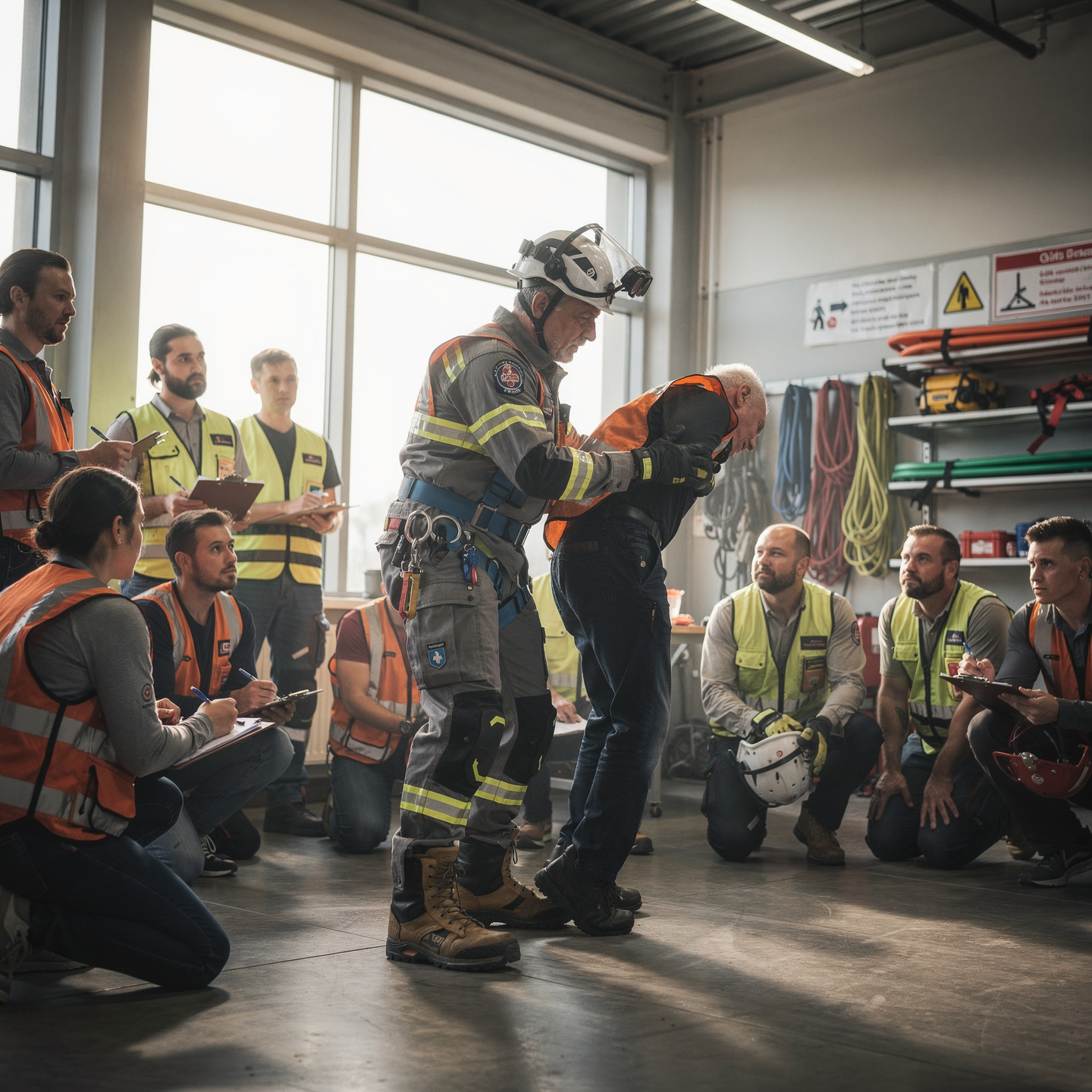
Basic Evacuation and Rescue Course
Why this course?
The Basic Evacuation and Rescue course
This course provides you with the essential skills to act quickly and effectively in emergency situations. You will learn evacuation protocols, primary rescue techniques, and the proper use of safety equipment. This program is designed to prepare you for fires, earthquakes, and other critical situations, ensuring your personal safety and the safety of others.
Differential Advantages
- Practical Simulations: Realistic evacuation exercises in different scenarios.
- Rescue Techniques: Immobilization, transport of the injured, and basic first aid.
- Equipment Use: Handling of fire extinguishers, ropes, and other rescue equipment.
- Planning and Prevention: Risk identification and development of effective evacuation plans.
- Certification: Obtain a recognized certification that validates your evacuation and rescue skills.
- Modality: Online
- Level: Cursos
- Hours: 150 H
- Start date: 17-05-2026
Availability: 1 in stock
Who is it aimed at?
- First responders (firefighters, rescuers, medical personnel) seeking updated protocols and safe techniques in emergency scenarios.
- Workers at heights or in confined spaces requiring certified training for self-rescue and assisting colleagues in hazardous situations.
- Members of industrial safety teams and occupational risk prevention specialists interested in optimizing emergency plans and staff training.
- Civil protection volunteers and humanitarian organizations wishing to acquire essential skills in evacuation and rescue in the event of natural or man-made disasters.
- General public interested in learning basic survival techniques and first aid in critical situations, promoting Self-protection and assistance to others.
Adaptability
Modular course with in-person and online options, downloadable materials, and practical simulations adapted to different work environments and risk scenarios.
Objectives and competencies

Apply vertical rescue techniques:
“Safely, using appropriate equipment, ensuring the safety of both the rescuer and the victim, and following communication protocols.”

Use personal and collective protective equipment:
“Select, inspect, use and maintain PPE/PCP according to regulations, assessed risks and procedures, ensuring its effectiveness in each task.”

Establish an effective communication system:
Use the SMCP (Standard Marine Communication Phrases) and adapt it to the situation, confirming mutual understanding and managing language barriers if necessary.

Assess and mitigate risks in emergency scenarios:
“Implement contingency plans, prioritizing crew safety and vessel integrity, communicating effectively with authorities and emergency services.”

Provide basic first aid to victims:
Assess the victim’s condition, activate the EMS (Emergency Medical Services) and apply basic CPR until professional assistance arrives.

Organize and lead evacuation teams:
“Establish priorities based on risk assessment, assign clear roles, and ensure effective communication under pressure.”
Curriculum - Modules
- Comprehensive Maritime Incident Management: protocols, roles, and chain of command for coordinated response
- Operational Planning and Execution: briefing, routes, weather windows, and go/no-go criteria
- Rapid Risk Assessment: criticality matrix, scene control, and decision-making under pressure
- Operational Communication: VHF/GMDSS, standardized reports, and inter-agency liaison
- Tactical Mobility and Safe Boarding: RHIB maneuvers, approach, mooring, and recovery
- Equipment and Technologies: PPE, signaling, satellite tracking, and field data logging
- Immediate Care of the Affected: primary assessment, hypothermia, trauma, and stabilization for evacuation
- Adverse Environmental Conditions: swell, Visibility, flows, and operational mitigation
Simulation and training: critical scenarios, use of VR/AR, and exercises with performance metrics
Documentation and continuous improvement: lessons learned, indicators (MTTA/MTTR), and SOP updates
- Introduction to Initial Intervention: Key Concepts and Objectives
- Legal and Ethical Framework: Responsibilities and Limits of Intervention
- Initial Risk Assessment: Identification, Prioritization, and Mitigation
- Basic Intervention Equipment: Selection, Use, and Maintenance
- Communication in Emergency Situations: Protocols and Skills
- Basic Life Support (BLS) Techniques: CPR, Airway Obstruction Reduction
- Hemorrhage Control: Direct Pressure Techniques, Tourniquets, and Bandaging
- Immobilization and Transport of Injured Persons: Principles and Safe Methods
- Emergency Psychology: Emotional support and stress management.
- Coordination with Emergency Services: Information sharing and collaboration.
‘
- Introduction to E&R: Definitions, scope, and legal framework.
- Personal Protective Equipment (PPE): Types, selection, use, maintenance, and limitations.
- Vertical Rescue Equipment: Ropes, harnesses, descenders, pulleys, and anchor systems.
- Water Rescue Equipment: Wetsuits/dry suits, life jackets, floating ropes, and boats.
- Extrication Equipment: Hydraulic, pneumatic, and manual tools.
- Communications in E&R: Radio communication, visual signals, and communication codes.
- Emergency Response Protocols: Assessment, stabilization, extraction, and transport of victims.
- Rescue Techniques in Confined spaces: Identification, ventilation, entry, and extraction.
High-angle rescue techniques: Progression, securing, controlled descent, and hoist rescue.
Emergency psychology: Stress management, communication with victims, and teamwork.
‘
- Introduction to Emergencies and Safety: Key Concepts and Types of Incidents
- Legal and Regulatory Framework: Current Legislation on Emergencies and Safety
- Personal Protective Equipment (PPE): Selection, Use, Maintenance, and Limitations
- Initial Response to Emergencies: Situation Assessment and Priorities
- Basic First Aid: Life Support, Hemorrhage Control, and Wound Treatment
- Emergency Communication: Communication Systems, Protocols, and Terminology
- Basic Firefighting: Types of Fire, Extinguishing Agents, and Extinguishing Techniques
- Evacuation and Rescue: Evacuation Plans, Rescue Techniques, and Crowd Management
- Management Risk assessment: identification, evaluation, and control of occupational risks.
- Drills and practical exercises: preparation, execution, and evaluation.
‘
- Introduction to Rescue: Definitions, types of incidents, and resources.
- Initial Incident Assessment: Scene safety, hazard identification, number and condition of victims.
- Personal Protective Equipment (PPE): Selection, use, and proper maintenance.
- Basic First Aid: Basic Life Support (BLS), hemorrhage control, wound and fracture management.
- Vehicle Extrication Techniques: Vehicle assessment, stabilization, and victim access.
- Confined Space Rescue: Hazard identification, ventilation, and entry and exit procedures.
- Vertical Rescue: Anchorage systems, ropes, pulleys, and ascent and descent techniques.
- Rescue Aquatic Safety: Water safety, swimming techniques, and rescue with and without equipment.
Emergency Communication: Use of radios, signals, and effective communication protocols.
Psychological Considerations: Stress management in rescue situations and victim support.
‘
- System Architecture and Components: Structural design, materials, and subsystems (mechanical, electrical, electronic, and fluid) with selection and assembly criteria for marine environments
- Fundamentals and Principles of Operation: Physical and engineering foundations (thermodynamics, fluid mechanics, electricity, control, and materials) that explain performance and operating limits
- Safety and Environmental (SHE): Risk analysis, PPE, LOTO, hazardous atmospheres, spill and waste management, and emergency response plans
- Applicable Regulations and Standards: IMO/ISO/IEC requirements and local regulations;
- Conformance criteria, certification, and best practices for operation and maintenance
- Inspection, testing, and diagnostics: Visual/dimensional inspection, functional testing, data analysis, and predictive techniques (vibration, thermography, fluid analysis) to identify root causes
- Preventive and predictive maintenance: Hourly/cycle/seasonal plans, lubrication, adjustments, calibrations, consumable replacement, post-service verification, and operational reliability
- Instrumentation, tools, and metrology: Measuring and testing equipment, diagnostic software, calibration and traceability; selection criteria, safe use, and storage
- Onboard integration and interfaces: Mechanical, electrical, fluid, and data compatibility; Sealing and watertightness, EMC/EMI, corrosion protection, and interoperability testing.
Quality, acceptance testing, and commissioning: process and materials control, FAT/SAT, bench and sea trials, go/no-go criteria, and evidence documentation.
Technical documentation and integrated practice: logs, checklists, reports, and a complete case study (safety ā diagnosis ā intervention ā verification ā report) applicable to any system.
Plan de estudio - Módulos
- Comprehensive Maritime Incident Management: protocols, roles, and chain of command for coordinated response
- Operational Planning and Execution: briefing, routes, weather windows, and go/no-go criteria
- Rapid Risk Assessment: criticality matrix, scene control, and decision-making under pressure
- Operational Communication: VHF/GMDSS, standardized reports, and inter-agency liaison
- Tactical Mobility and Safe Boarding: RHIB maneuvers, approach, mooring, and recovery
- Equipment and Technologies: PPE, signaling, satellite tracking, and field data logging
- Immediate Care of the Affected: primary assessment, hypothermia, trauma, and stabilization for evacuation
- Adverse Environmental Conditions: swell, Visibility, flows, and operational mitigation
Simulation and training: critical scenarios, use of VR/AR, and exercises with performance metrics
Documentation and continuous improvement: lessons learned, indicators (MTTA/MTTR), and SOP updates
- Introduction to Initial Intervention: Key Concepts and Objectives
- Legal and Ethical Framework: Responsibilities and Limits of Intervention
- Initial Risk Assessment: Identification, Prioritization, and Mitigation
- Basic Intervention Equipment: Selection, Use, and Maintenance
- Communication in Emergency Situations: Protocols and Skills
- Basic Life Support (BLS) Techniques: CPR, Airway Obstruction Reduction
- Hemorrhage Control: Direct Pressure Techniques, Tourniquets, and Bandaging
- Immobilization and Transport of Injured Persons: Principles and Safe Methods
- Emergency Psychology: Emotional support and stress management.
- Coordination with Emergency Services: Information sharing and collaboration.
‘
- Introduction to E&R: Definitions, scope, and legal framework.
- Personal Protective Equipment (PPE): Types, selection, use, maintenance, and limitations.
- Vertical Rescue Equipment: Ropes, harnesses, descenders, pulleys, and anchor systems.
- Water Rescue Equipment: Wetsuits/dry suits, life jackets, floating ropes, and boats.
- Extrication Equipment: Hydraulic, pneumatic, and manual tools.
- Communications in E&R: Radio communication, visual signals, and communication codes.
- Emergency Response Protocols: Assessment, stabilization, extraction, and transport of victims.
- Rescue Techniques in Confined spaces: Identification, ventilation, entry, and extraction.
High-angle rescue techniques: Progression, securing, controlled descent, and hoist rescue.
Emergency psychology: Stress management, communication with victims, and teamwork.
‘
- Introduction to Emergencies and Safety: Key Concepts and Types of Incidents
- Legal and Regulatory Framework: Current Legislation on Emergencies and Safety
- Personal Protective Equipment (PPE): Selection, Use, Maintenance, and Limitations
- Initial Response to Emergencies: Situation Assessment and Priorities
- Basic First Aid: Life Support, Hemorrhage Control, and Wound Treatment
- Emergency Communication: Communication Systems, Protocols, and Terminology
- Basic Firefighting: Types of Fire, Extinguishing Agents, and Extinguishing Techniques
- Evacuation and Rescue: Evacuation Plans, Rescue Techniques, and Crowd Management
- Management Risk assessment: identification, evaluation, and control of occupational risks.
- Drills and practical exercises: preparation, execution, and evaluation.
‘
- Introduction to Rescue: Definitions, types of incidents, and resources.
- Initial Incident Assessment: Scene safety, hazard identification, number and condition of victims.
- Personal Protective Equipment (PPE): Selection, use, and proper maintenance.
- Basic First Aid: Basic Life Support (BLS), hemorrhage control, wound and fracture management.
- Vehicle Extrication Techniques: Vehicle assessment, stabilization, and victim access.
- Confined Space Rescue: Hazard identification, ventilation, and entry and exit procedures.
- Vertical Rescue: Anchorage systems, ropes, pulleys, and ascent and descent techniques.
- Rescue Aquatic Safety: Water safety, swimming techniques, and rescue with and without equipment.
Emergency Communication: Use of radios, signals, and effective communication protocols.
Psychological Considerations: Stress management in rescue situations and victim support.
‘
- System Architecture and Components: Structural design, materials, and subsystems (mechanical, electrical, electronic, and fluid) with selection and assembly criteria for marine environments
- Fundamentals and Principles of Operation: Physical and engineering foundations (thermodynamics, fluid mechanics, electricity, control, and materials) that explain performance and operating limits
- Safety and Environmental (SHE): Risk analysis, PPE, LOTO, hazardous atmospheres, spill and waste management, and emergency response plans
- Applicable Regulations and Standards: IMO/ISO/IEC requirements and local regulations;
- Conformance criteria, certification, and best practices for operation and maintenance
- Inspection, testing, and diagnostics: Visual/dimensional inspection, functional testing, data analysis, and predictive techniques (vibration, thermography, fluid analysis) to identify root causes
- Preventive and predictive maintenance: Hourly/cycle/seasonal plans, lubrication, adjustments, calibrations, consumable replacement, post-service verification, and operational reliability
- Instrumentation, tools, and metrology: Measuring and testing equipment, diagnostic software, calibration and traceability; selection criteria, safe use, and storage
- Onboard integration and interfaces: Mechanical, electrical, fluid, and data compatibility; Sealing and watertightness, EMC/EMI, corrosion protection, and interoperability testing.
Quality, acceptance testing, and commissioning: process and materials control, FAT/SAT, bench and sea trials, go/no-go criteria, and evidence documentation.
Technical documentation and integrated practice: logs, checklists, reports, and a complete case study (safety ā diagnosis ā intervention ā verification ā report) applicable to any system.
- Fundamentals of Evacuation and Rescue: Definitions, principles, and regulations.
- Basic Evacuation Equipment: Types, characteristics, maintenance, and inspection (ropes, harnesses, descenders, etc.).
- Knots and Anchors: Types, applications, and safety.
- Vertical and Horizontal Progression Techniques: Ascent, descent, zip lines, etc.
- Risk Assessment in Emergency Situations: Hazard identification, vulnerability analysis, and preventive measures.
- Emergency Communications: Protocols, equipment, and signals.
- First Aid and Basic Life Support: Victim assessment, CPR, and wound treatment.
- Rescue Techniques in
- Rescue of suspended victims, lifting and lowering of stretchers.
- Personal Protective Equipment (PPE): Selection, correct use, and maintenance.
- Workplace Safety: Safety standards, emergency procedures, and accident prevention.
‘
- Communication Systems: radios, satellite, emergency protocols.
- Personal Protective Equipment (PPE): types, use, and maintenance.
- Basic Life Support (BLS) and Advanced Life Support (ALS): algorithms and updated techniques.
- Immobilization and Transfer of Patients: splints, stretchers, and mobilization techniques.
- Airway Management: suctioning, orotracheal intubation, supraglottic airway devices.
- Hemorrhage Control: tourniquets, compression bandages, hemostatic agents.
- Initial Trauma Care: primary and secondary assessment, shock management.
- Mass Casualty Incidents (MCI): triage, organization, and Coordination.
Rescue equipment: extrication tools, ropes, harnesses.
Disinfection and sterilization: protocols for equipment and materials.
‘
- Introduction to Emergencies and Initial Response (ERB): Types and Scenarios.
- Personal Protective Equipment (PPE): Selection, Use, and Maintenance.
- Initial Scene Assessment: Risks, Safety, and Number of Victims.
- Establishing a Security Perimeter and Access Control.
- Initial Communication: Notification of Emergency Services and Authorities.
- Initial Triage: Classification of Victims According to Priority of Care.
- Basic First Aid: Hemorrhage Control, CPR, and Shock Management.
- Basic Fire Extinguishing: Use of Fire Extinguishers and Fire Blankets.
- Basic Decontamination Protocols: Hazardous Substances and Cleanup.
- Psychological Safety and Management of stress in ERB situations.
‘
- Legal Framework for Emergencies: National and International Regulations
- Emergency Plans: Development, Implementation, and Maintenance
- Emergency Response Teams: Types, Functions, and Organization
- Equipment for Response Teams: Selection, Use, and Maintenance
- First Aid: Initial Assessment, CPR, and Hemorrhage Control
- Evacuation: Procedures, Escape Routes, and Meeting Points
- Fires: Prevention, Detection, and Extinguishing
- Earthquakes: Action Protocols and Safety Measures
- Drills: Planning, Execution, and Evaluation
- Emergency Communication: Systems and Protocols
‘
Career opportunities
- Firefighter: Emergency response, high-angle and confined space rescue, firefighting.
- Emergency Medical Technician: Pre-hospital care, traffic accident rescue, basic life support.
- Security Personnel: Facility evacuation, access control, risk management.
- Lifeguard: Aquatic rescue, first aid, accident prevention.
- Civil Protection Volunteer: Emergency support, population evacuation, humanitarian logistics.
- Construction/Industrial Worker: Application of safety protocols, coworker rescue, incident response.
- Outdoor Activities/Adventure Sports Instructor: Risk management, mountain/wildlife rescue Natural sciences, first aid.
- Member of specialized rescue teams: Canine units, vertical rescue groups, maritime rescue teams.
“`
Admission requirements

Academic/professional profile:
Degree/Bachelor's degree in Nautical Science/Maritime Transport, Naval/Marine Engineering, or a related field; or proven professional experience in bridge/operations.

Language proficiency:
Recommended functional maritime English (SMCP) for simulations and technical materials.

5. Induction
Updated resume, copy of degree or seaman's book, ID card/passport, letter of motivation.

Technical requirements (for online):
Equipment with camera/microphone, stable connection, ā„ 24ā monitor recommended for ECDIS/Radar-ARPA.
Admission process and dates

1. Online
application
(form + documents).

2. Academic review and interview
(profile/objectives/schedule compatibility).

3. Admission decision
(+ scholarship proposal if applicable).

4. Reservation of place
(deposit) and registration.

5. Induction
(access to campus, calendars, simulator guides).
Scholarships and grants
- Evacuation Fundamentals: Learn the basic principles and essential protocols for a safe and effective evacuation.
- Rescue Techniques: Master fundamental rescue techniques in various scenarios, prioritizing the safety of both the rescuer and the victim.
- Essential Equipment: Familiarize yourself with basic evacuation and rescue equipment, including its correct use and maintenance.
- Basic First Aid: Gain essential first aid knowledge to treat injured people during evacuation or rescue.
- Practical Drills: Participate in realistic drills to apply your acquired knowledge and improve your emergency response.
Testimonials
During the fire drill at the chemical plant, thanks to my training in basic evacuation and rescue, I was able to guide my team to the safe zone in less than 5 minutes, including a colleague with reduced mobility, applying the dragging techniques learned and securing the area before proceeding.
I successfully applied the techniques learned in the Marine Health and First Aid course to stabilize a crewmate who suffered a severe burn during a storm, allowing for his safe evacuation and full recovery.
During the fire drill, I correctly applied the evacuation techniques I had learned, guiding my group to the safe zone in record time and without incident, even assisting a person with reduced mobility.
“During the fire drill at the plant, my basic evacuation and rescue skills were crucial. I successfully guided my team to the safe zone within the allotted time, applying the triage techniques I had learned and providing first aid to a colleague with a sprained ankle until the paramedics arrived. My performance was highlighted by the instructor as an example of efficiency and composure in emergency situations.”

Frequently asked questions
Move people to a safe place away from danger.
Yes. The itinerary includes ECDIS/Radar-ARPA/BRM with harbor, ocean, fog, storm, and SAR scenarios.
Online with live sessions; hybrid option for simulator/practical placements through agreements.
To move people from a dangerous area to a safe place.
Recommended functional SMCP. We offer support materials for standard phraseology.
Yes, with a relevant degree or experience in maritime/port operations. The admissions interview will confirm suitability.
Optional (3ā6 months) through Companies & Collaborations and the Alumni Network.
Simulator practice (rubrics), defeat plans, SOPs, checklists, micro-tests and applied TFM.
A degree from Navalis Magna University + operational portfolio (tracks, SOPs, reports and KPIs) useful for audits and employment.
- Legal Framework for Emergencies: National and International Regulations
- Emergency Plans: Development, Implementation, and Maintenance
- Emergency Response Teams: Types, Functions, and Organization
- Equipment for Response Teams: Selection, Use, and Maintenance
- First Aid: Initial Assessment, CPR, and Hemorrhage Control
- Evacuation: Procedures, Escape Routes, and Meeting Points
- Fires: Prevention, Detection, and Extinguishing
- Earthquakes: Action Protocols and Safety Measures
- Drills: Planning, Execution, and Evaluation
- Emergency Communication: Systems and Protocols
‘
Request information
- Complete the Application Form
- Attach your CV/Qualifications (if you have them to hand).
- Indicate your preferred cohort (January/May/September) and whether you want the hybrid option with simulator sessions.
Teachers
Eng. TomƔs Riera
Full Professor
Eng. TomƔs Riera
Full Professor
Eng. SofĆa Marquina
Full Professor
Eng. SofĆa Marquina
Full Professor
Eng. Javier BaƱuls
Full Professor
Eng. Javier BaƱuls
Full Professor
Dr. Nuria Llobregat
Full Professor
Dr. Nuria Llobregat
Full Professor
Dr. Pau Ferrer
Full Professor
Dr. Pau Ferrer
Full Professor
Cap. Javier Abaroa (MCA)
Full Professor
Cap. Javier Abaroa (MCA)
Full Professor

