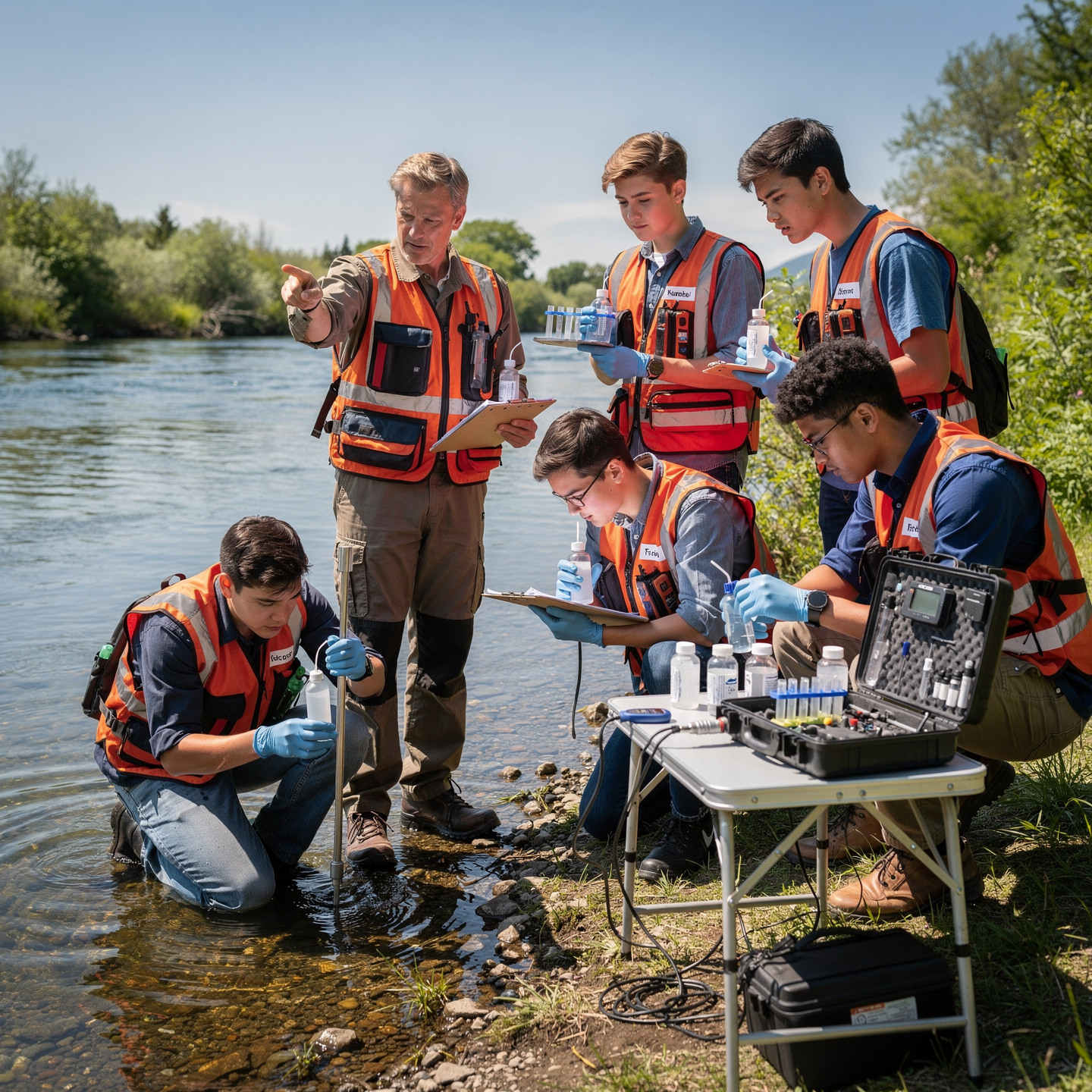
Water Quality Monitoring Course
Why this course?
The Water Quality Monitoring
This course provides you with the essential tools and knowledge to assess and manage this vital resource. You will learn to perform accurate sampling, use advanced measuring equipment, and interpret analytical data to identify contaminants and their sources. This program will enable you to actively contribute to environmental protection and public health.
This course provides you with the essential tools and knowledge to assess and manage this vital resource. You will learn to perform accurate sampling, use advanced measuring equipment, and interpret analytical data to identify contaminants and their sources.
Differential Advantages
- Standardized Methodologies: You will learn the most internationally recognized sampling and analysis techniques.
- Interpretation of Results: You will master data evaluation and the preparation of clear and concise technical reports.
- Environmental Legislation: You will learn about current regulations and how to apply them in water quality monitoring.
- Case Studies: You will analyze real-world scenarios and develop effective solutions for pollution problems.
- Multidisciplinary Approach: You will integrate knowledge of chemistry, biology, and environmental management for a comprehensive understanding.
- Modality: Online
- Level: Cursos
- Hours: 150 H
- Start date: 25-04-2026
Availability: 1 in stock
Who is it aimed at?
- Laboratory technicians and water analysts seeking to update their knowledge of regulations, methodologies, and new monitoring technologies.
- Environmental engineers and consultants requiring practical tools for the design and implementation of water quality monitoring plans.
- Compliance officers in industries needing to ensure compliance with discharge and water quality standards.
- Water resource managers and government personnel interested in the assessment and sustainable management of water resources.
- Students in environmental and related fields seeking specialized and practical training in water quality monitoring. water.
Learning flexibility:
Access the content at your own pace, with downloadable materials and consultation forums to resolve your doubts.
Objectives and competencies

Evaluate the effectiveness of water treatments:
Analyze physicochemical and microbiological parameters of treated water, comparing them with regulations and quality standards to ensure potability or safe industrial use.

Identify and mitigate sources of water pollution:
Implement waste management and spill control practices, inspecting equipment and using biodegradable materials to minimize the environmental impact on bodies of water.

Ensure compliance with environmental regulations:
Implement a certified and auditable environmental management system, minimizing the ecological footprint and ensuring the traceability of waste and emissions.

Optimize sampling and analysis processes:
Implement robust statistical methodologies, control variability, and ensure complete traceability from sampling to the final report.

Interpreting and communicating water quality data:
“With precision and clarity, adapting the message to the recipient (technicians, community, authorities), using effective visualizations and reporting deviations according to protocols.”

Develop and implement quality control protocols:
“Implement sampling, analysis, and documentation procedures to ensure compliance with standards and specifications.”
Curriculum - Modules
- Comprehensive Maritime Incident Management: protocols, roles, and chain of command for coordinated response
- Operational Planning and Execution: briefing, routes, weather windows, and go/no-go criteria
- Rapid Risk Assessment: criticality matrix, scene control, and decision-making under pressure
- Operational Communication: VHF/GMDSS, standardized reports, and inter-agency liaison
- Tactical Mobility and Safe Boarding: RHIB maneuvers, approach, mooring, and recovery
- Equipment and Technologies: PPE, signaling, satellite tracking, and field data logging
- Immediate Care of the Affected: primary assessment, hypothermia, trauma, and stabilization for evacuation
- Adverse Environmental Conditions: swell, Visibility, flows, and operational mitigation
Simulation and training: critical scenarios, use of VR/AR, and exercises with performance metrics
Documentation and continuous improvement: lessons learned, indicators (MTTA/MTTR), and SOP updates
- Introduction to Water Quality: Importance, Regulations, and Legislation.
- Hydrological Cycle: Water balance, natural processes, and human alteration.
- Physicochemical Parameters: Temperature, pH, conductivity, dissolved oxygen, turbidity.
- Water Sampling: Types of samples, collection techniques, preservation, and transport.
- Microbiological Analysis: Indicators of fecal contamination, bacterial and pathogen counts.
- Inorganic Contaminants: Heavy metals, nitrates, phosphates, arsenic.
- Organic Contaminants: Pesticides, hydrocarbons, pharmaceutical compounds, and endocrine disruptors.
- Control Quality Assurance: Quality assurance, equipment calibration, and method validation.
Interpretation of Results: Comparison with standards, risk assessment, and decision-making.
Water Treatment: Conventional and advanced technologies for drinking water treatment and purification.
‘
- Introduction to the integrated water cycle: collection, treatment, distribution, and sanitation.
- Water legislation and regulations: European directives, national and local legislation.
- Water quality: physical, chemical, and microbiological parameters, drinking water standards.
- Water collection: surface and groundwater sources, water resource assessment.
- Drinking water treatment: purification processes, conventional and advanced technologies.
- Water distribution networks: design, materials, loss management, and optimization.
- Wastewater treatment: sewer systems, wastewater treatment plants (WWTPs).
- Wastewater treatment processes: primary, secondary, and tertiary treatments, Reuse.
- Sludge Management: treatment, recovery, and disposal of wastewater treatment plant sludge.
- Water Quality Control: sampling, analysis, interpretation of results, and control plans.
‘
- Introduction to Water Quality Analysis: Importance and Objectives
- Legal and Regulatory Framework: European Directives, National and International Legislation
- Water Sampling: Planning, Sample Types, Sampling Techniques
- Physicochemical Parameters: Temperature, pH, Conductivity, Dissolved Oxygen, Turbidity
- Microbiological Analysis: Indicators of Fecal Contamination, Microorganism Counts
- Inorganic Contaminants: Heavy Metals, Nitrates, Phosphates, Chlorides
- Organic Contaminants: Pesticides, Hydrocarbons, Pharmaceuticals
- Analytical Quality Control: Equipment Calibration, Blanks, Standards, Statistical Process Control
- Interpretation of Results: Comparison with standards, risk assessment
Results report: Preparation of technical reports, communication of results
‘
- Introduction to the hydrological cycle: components, balances, and scales
- Water legislation and regulations: framework directives, hydrological plans
- Characterization of river basins: geomorphology, soils, vegetation
- Estimation of water availability: precipitation, runoff, infiltration
- Water quality: physical, chemical, and biological parameters, pollution
- Water sampling and analysis techniques: protocols, interpretation of results
- Hydrological modeling: conceptual, empirical, and process-based models
- Water resources management: allocation, prioritization, and conflicts
- Infrastructure Hydraulics: dams, canals, pumping stations
Water risks: floods, droughts, and mitigation strategies
‘
- System Architecture and Components: Structural design, materials, and subsystems (mechanical, electrical, electronic, and fluid) with selection and assembly criteria for marine environments
- Fundamentals and Principles of Operation: Physical and engineering foundations (thermodynamics, fluid mechanics, electricity, control, and materials) that explain performance and operating limits
- Safety and Environmental (SHE): Risk analysis, PPE, LOTO, hazardous atmospheres, spill and waste management, and emergency response plans
- Applicable Regulations and Standards: IMO/ISO/IEC requirements and local regulations;
- Conformance criteria, certification, and best practices for operation and maintenance
- Inspection, testing, and diagnostics: Visual/dimensional inspection, functional testing, data analysis, and predictive techniques (vibration, thermography, fluid analysis) to identify root causes
- Preventive and predictive maintenance: Hourly/cycle/seasonal plans, lubrication, adjustments, calibrations, consumable replacement, post-service verification, and operational reliability
- Instrumentation, tools, and metrology: Measuring and testing equipment, diagnostic software, calibration and traceability; selection criteria, safe use, and storage
- Onboard integration and interfaces: Mechanical, electrical, fluid, and data compatibility; Sealing and watertightness, EMC/EMI, corrosion protection, and interoperability testing.
Quality, acceptance testing, and commissioning: process and materials control, FAT/SAT, bench and sea trials, go/no-go criteria, and evidence documentation.
Technical documentation and integrated practice: logs, checklists, reports, and a complete case study (safety → diagnosis → intervention → verification → report) applicable to any system.
Plan de estudio - Módulos
- Comprehensive Maritime Incident Management: protocols, roles, and chain of command for coordinated response
- Operational Planning and Execution: briefing, routes, weather windows, and go/no-go criteria
- Rapid Risk Assessment: criticality matrix, scene control, and decision-making under pressure
- Operational Communication: VHF/GMDSS, standardized reports, and inter-agency liaison
- Tactical Mobility and Safe Boarding: RHIB maneuvers, approach, mooring, and recovery
- Equipment and Technologies: PPE, signaling, satellite tracking, and field data logging
- Immediate Care of the Affected: primary assessment, hypothermia, trauma, and stabilization for evacuation
- Adverse Environmental Conditions: swell, Visibility, flows, and operational mitigation
Simulation and training: critical scenarios, use of VR/AR, and exercises with performance metrics
Documentation and continuous improvement: lessons learned, indicators (MTTA/MTTR), and SOP updates
- Introduction to Water Quality: Importance, Regulations, and Legislation.
- Hydrological Cycle: Water balance, natural processes, and human alteration.
- Physicochemical Parameters: Temperature, pH, conductivity, dissolved oxygen, turbidity.
- Water Sampling: Types of samples, collection techniques, preservation, and transport.
- Microbiological Analysis: Indicators of fecal contamination, bacterial and pathogen counts.
- Inorganic Contaminants: Heavy metals, nitrates, phosphates, arsenic.
- Organic Contaminants: Pesticides, hydrocarbons, pharmaceutical compounds, and endocrine disruptors.
- Control Quality Assurance: Quality assurance, equipment calibration, and method validation.
Interpretation of Results: Comparison with standards, risk assessment, and decision-making.
Water Treatment: Conventional and advanced technologies for drinking water treatment and purification.
‘
- Introduction to the integrated water cycle: collection, treatment, distribution, and sanitation.
- Water legislation and regulations: European directives, national and local legislation.
- Water quality: physical, chemical, and microbiological parameters, drinking water standards.
- Water collection: surface and groundwater sources, water resource assessment.
- Drinking water treatment: purification processes, conventional and advanced technologies.
- Water distribution networks: design, materials, loss management, and optimization.
- Wastewater treatment: sewer systems, wastewater treatment plants (WWTPs).
- Wastewater treatment processes: primary, secondary, and tertiary treatments, Reuse.
- Sludge Management: treatment, recovery, and disposal of wastewater treatment plant sludge.
- Water Quality Control: sampling, analysis, interpretation of results, and control plans.
‘
- Introduction to Water Quality Analysis: Importance and Objectives
- Legal and Regulatory Framework: European Directives, National and International Legislation
- Water Sampling: Planning, Sample Types, Sampling Techniques
- Physicochemical Parameters: Temperature, pH, Conductivity, Dissolved Oxygen, Turbidity
- Microbiological Analysis: Indicators of Fecal Contamination, Microorganism Counts
- Inorganic Contaminants: Heavy Metals, Nitrates, Phosphates, Chlorides
- Organic Contaminants: Pesticides, Hydrocarbons, Pharmaceuticals
- Analytical Quality Control: Equipment Calibration, Blanks, Standards, Statistical Process Control
- Interpretation of Results: Comparison with standards, risk assessment
Results report: Preparation of technical reports, communication of results
‘
- Introduction to the hydrological cycle: components, balances, and scales
- Water legislation and regulations: framework directives, hydrological plans
- Characterization of river basins: geomorphology, soils, vegetation
- Estimation of water availability: precipitation, runoff, infiltration
- Water quality: physical, chemical, and biological parameters, pollution
- Water sampling and analysis techniques: protocols, interpretation of results
- Hydrological modeling: conceptual, empirical, and process-based models
- Water resources management: allocation, prioritization, and conflicts
- Infrastructure Hydraulics: dams, canals, pumping stations
Water risks: floods, droughts, and mitigation strategies
‘
- System Architecture and Components: Structural design, materials, and subsystems (mechanical, electrical, electronic, and fluid) with selection and assembly criteria for marine environments
- Fundamentals and Principles of Operation: Physical and engineering foundations (thermodynamics, fluid mechanics, electricity, control, and materials) that explain performance and operating limits
- Safety and Environmental (SHE): Risk analysis, PPE, LOTO, hazardous atmospheres, spill and waste management, and emergency response plans
- Applicable Regulations and Standards: IMO/ISO/IEC requirements and local regulations;
- Conformance criteria, certification, and best practices for operation and maintenance
- Inspection, testing, and diagnostics: Visual/dimensional inspection, functional testing, data analysis, and predictive techniques (vibration, thermography, fluid analysis) to identify root causes
- Preventive and predictive maintenance: Hourly/cycle/seasonal plans, lubrication, adjustments, calibrations, consumable replacement, post-service verification, and operational reliability
- Instrumentation, tools, and metrology: Measuring and testing equipment, diagnostic software, calibration and traceability; selection criteria, safe use, and storage
- Onboard integration and interfaces: Mechanical, electrical, fluid, and data compatibility; Sealing and watertightness, EMC/EMI, corrosion protection, and interoperability testing.
Quality, acceptance testing, and commissioning: process and materials control, FAT/SAT, bench and sea trials, go/no-go criteria, and evidence documentation.
Technical documentation and integrated practice: logs, checklists, reports, and a complete case study (safety → diagnosis → intervention → verification → report) applicable to any system.
- Introduction to Water Quality: Definition, Importance, and Regulations
- Water Cycle: Components, Processes, and Anthropogenic Alterations
- Physicochemical Parameters: Temperature, pH, Conductivity, Dissolved Oxygen, Turbidity
- Water Sampling: Sample Types, Planning, Techniques, and Preservation
- Microbiological Analysis: Indicators of Fecal Contamination, Microorganism Counts
- Inorganic Contaminants: Heavy Metals, Nitrates, Phosphates, Chlorides
- Organic Contaminants: Pesticides, Hydrocarbons, Pharmaceutical Compounds
- Quality Control: Quality Assurance and Control in the Laboratory, Validation of Methods
- Interpretation of results: Comparison with regulations, risk assessment
- Water treatment: Potabilization and purification technologies
‘
- Introduction to Water Quality: Definition, Importance, and Scope.
- Water Contaminants: Types, Sources, and Effects on Health and the Environment.
- Water Sampling: Techniques, Protocols, and Safety Considerations.
- Physicochemical Analysis: Key Parameters (pH, Conductivity, Turbidity, Dissolved Oxygen).
- Microbiological Analysis: Indicators of Fecal Contamination, Pathogens.
- Regulations and Legislation: Water Quality Standards (Drinking, Irrigation, Industrial).
- Drinking Water Treatment: Purification, Disinfection, and Fluoridation Processes.
- Wastewater Treatment: Treatments Primary, secondary, and tertiary.
- Water quality control: Monitoring, assessment, and risk management.
- Case studies: Analysis of water quality problems and implemented solutions.
‘
- Introduction to Water Analysis: Types, Sources, and Uses
- Water Sampling: Techniques, Preservation, and Transport of Samples
- Physicochemical Analysis: pH, Conductivity, Turbidity, Color, Total Solids
- Determination of Main Ions: Chlorides, Sulfates, Nitrates, Phosphates
- Microbiological Analysis: Bacterial Count, Total and Fecal Coliforms
- Detection of Pathogenic Microorganisms: E. coli, Salmonella, Vibrio cholerae
- Aquatic Ecotoxicology: Toxicity Tests with Indicator Organisms
- Evaluation of Heavy Metals: Lead, Mercury, Cadmium, Arsenic
- Environmental regulations and legislation related to water quality
- Interpretation of results and preparation of technical reports
‘
- Introduction to the physicochemical analysis of water: parameters and importance.
- Water sampling: planning, techniques, preservation, and transport of samples.
- Physicochemical parameters I: Temperature, pH, conductivity, dissolved oxygen, and turbidity.
- Physicochemical parameters II: Solids (total, dissolved, suspended), color, and odor.
- Analysis of cations and anions: methods of determination and regulations.
- Organic contaminants: identification and quantification of hydrocarbons, pesticides, and other compounds.
- Water quality indices: calculation and interpretation.
- Water legislation and regulations: European directives and national legislation.
- Integrated water resources management: planning, efficient use, and protection.
- Wastewater treatment: technologies and processes.
‘
Career opportunities
- Environmental Laboratory Technician: Water sample analysis, quality control, and data validation.
- Water Quality Inspector: Evaluating regulatory compliance in industries, municipalities, and other organizations.
- Environmental Consultant: Advising on water resource management, wastewater treatment, and pollution control.
- Water Resource Manager: Planning and managing the sustainable use of water in river basins and aquifers.
- Water Quality Researcher: Developing new technologies and methodologies for water monitoring and treatment.
- Drinking Water and Wastewater Treatment Plant Technician: Operating and maintaining water treatment systems.
- Environmental Educator: Promoting awareness and knowledge about the importance of water quality.
- Environmental Auditor: Verification of compliance with environmental legislation regarding water quality.
“`
Admission requirements

Academic/professional profile:
Degree/Bachelor's degree in Nautical Science/Maritime Transport, Naval/Marine Engineering, or a related field; or proven professional experience in bridge/operations.

Language proficiency:
Recommended functional maritime English (SMCP) for simulations and technical materials.

5. Induction
Updated resume, copy of degree or seaman's book, ID card/passport, letter of motivation.

Technical requirements (for online):
Equipment with camera/microphone, stable connection, ≥ 24” monitor recommended for ECDIS/Radar-ARPA.
Admission process and dates

1. Online
application
(form + documents).

2. Academic review and interview
(profile/objectives/schedule compatibility).

3. Admission decision
(+ scholarship proposal if applicable).

4. Reservation of place
(deposit) and registration.

5. Induction
(access to campus, calendars, simulator guides).
Scholarships and grants
- Fundamentals of Monitoring: Learn the scientific and regulatory foundations for water quality assessment.
- Sampling Techniques: Master the correct protocols for collecting representative and reliable samples.
- Analysis of Key Parameters: Gain in-depth knowledge of the interpretation of essential physical, chemical, and biological indicators.
- Quality Control and Assurance: Implement strategies to guarantee the accuracy and validity of the data obtained.
- Interpretation of Results and Corrective Actions: Develop skills to assess the impact and propose effective solutions.
Testimonials
During my training in water quality monitoring, I led a project that identified a previously unknown source of contamination in a local stream, using my skills in sample analysis and GIS. This enabled the authorities to take corrective action, significantly improving water quality for the benefit of the community.
The Marine Energy and Environment course provided me with the necessary tools to understand the complex interaction between energy exploitation and marine ecosystems. I applied the knowledge I gained to the development of a wave energy project, minimizing environmental impact and maximizing energy efficiency, resulting in a viable and sustainable proposal that was selected for funding.
I implemented a real-time water quality monitoring system that reduced contamination incidents by 60% and allowed for a faster and more effective response to any anomalies, saving the company $20,000 in remediation costs during the first quarter.
I implemented a real-time water quality monitoring system for a treatment plant, which allowed me to detect a chemical leak and correct it in less than 24 hours, avoiding a significant environmental fine and protecting public health.

Frequently asked questions
Evaluate the state of the water and determine if it meets the quality standards for its different uses.
Yes. The itinerary includes ECDIS/Radar-ARPA/BRM with harbor, ocean, fog, storm, and SAR scenarios.
Online with live sessions; hybrid option for simulator/practical placements through agreements.
Evaluate the state of the water and its suitability for various uses, identifying possible contaminants and their sources in order to implement protection and management measures.
Recommended functional SMCP. We offer support materials for standard phraseology.
Yes, with a relevant degree or experience in maritime/port operations. The admissions interview will confirm suitability.
Optional (3–6 months) through Companies & Collaborations and the Alumni Network.
Simulator practice (rubrics), defeat plans, SOPs, checklists, micro-tests and applied TFM.
A degree from Navalis Magna University + operational portfolio (tracks, SOPs, reports and KPIs) useful for audits and employment.
- Introduction to the physicochemical analysis of water: parameters and importance.
- Water sampling: planning, techniques, preservation, and transport of samples.
- Physicochemical parameters I: Temperature, pH, conductivity, dissolved oxygen, and turbidity.
- Physicochemical parameters II: Solids (total, dissolved, suspended), color, and odor.
- Analysis of cations and anions: methods of determination and regulations.
- Organic contaminants: identification and quantification of hydrocarbons, pesticides, and other compounds.
- Water quality indices: calculation and interpretation.
- Water legislation and regulations: European directives and national legislation.
- Integrated water resources management: planning, efficient use, and protection.
- Wastewater treatment: technologies and processes.
‘
Request information
- Complete the Application Form
- Attach your CV/Qualifications (if you have them to hand).
- Indicate your preferred cohort (January/May/September) and whether you want the hybrid option with simulator sessions.
Teachers
Eng. Tomás Riera
Full Professor
Eng. Tomás Riera
Full Professor
Eng. Sofía Marquina
Full Professor
Eng. Sofía Marquina
Full Professor
Eng. Javier Bañuls
Full Professor
Eng. Javier Bañuls
Full Professor
Dr. Nuria Llobregat
Full Professor
Dr. Nuria Llobregat
Full Professor
Dr. Pau Ferrer
Full Professor
Dr. Pau Ferrer
Full Professor
Cap. Javier Abaroa (MCA)
Full Professor
Cap. Javier Abaroa (MCA)
Full Professor

