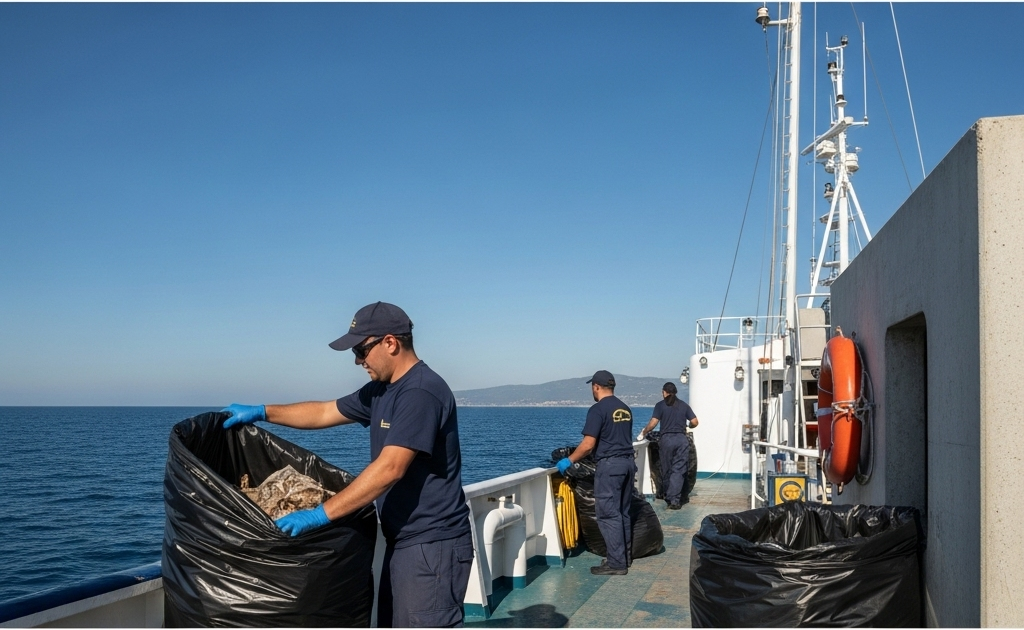
Waste management course for ships
Why this course?
The Vessel Waste Management
course
This course will provide you with the necessary tools and knowledge to comply with environmental regulations and optimize waste management on board. You will learn to identify, classify, and treat the different types of waste generated on vessels, minimizing their impact on the marine environment. This program will allow you to implement sustainable practices, reduce costs associated with waste management, and ensure compliance with national and international regulations.
Key Benefits
- Regulatory Compliance: Comprehensive knowledge of the laws and regulations applicable to waste management on vessels.
- Cost Reduction: Strategies to optimize waste management and minimize the costs associated with its treatment and disposal.
- Environmental Protection: Implementation of sustainable practices to reduce the environmental impact of maritime operations.
- Health and Safety: Protocols for the safe handling of hazardous waste, protecting the health of the crew and the environment.
- Enhanced Corporate Image: Demonstrate your commitment to sustainability and improve your company’s reputation in the maritime sector.
- Modality: Online
- Level: Cursos
- Hours: 150 H
- Start date: 25-04-2026
Availability: 1 in stock
Who is it aimed at?
- Deck and engine room crew seeking to understand MARPOL regulations and avoid environmental penalties.
- Safety Officers (SSOs) needing to implement effective waste management plans and comply with ISM audits.
- Shipping company and waste management company personnel interested in optimizing onboard recycling processes and reducing waste management costs.
- Port inspectors and maritime authorities wishing to update their knowledge of the latest technologies and best practices in ship waste management.
- Nautical and Marine Engineering students aspiring to a career with a strong commitment to environmental sustainability in the maritime sector.
Flexibility and practical approach
100% online course with practical case studies and examples real, adaptable to your schedule and with 24-hour access to the material for learning at your own pace.
Objectives and competencies

Minimize waste generation and maximize its proper segregation on board:
“Implement specific waste management protocols for each type, train the crew, and optimize onboard storage spaces.”

Comply with current maritime environmental regulations regarding waste management:
Properly manage waste generated on board, separating, storing and delivering it to authorized port facilities, keeping records up to date and complying with local and international regulations.

Establish efficient protocols for the temporary storage and proper delivery of waste at port:
Implement a waste segregation system on board, detailing labeling procedures, specific containers and recording of quantities, aligned with MARPOL regulations and local port regulations.

Raising awareness and training the crew on best practices for waste management on board:
Minimize spills, recycle efficiently and comply with MARPOL regulations.

Reducing the environmental impact of maritime operations by optimizing waste management:
Implement protocols for segregation, storage and delivery of waste to certified port facilities, minimizing accidental spills.

Implement recording and control systems to monitor the quantity and type of waste generated on the vessel:
“Using digital or physical logs, detailing type, volume and final destination, complying with MARPOL and local legislation.”
Curriculum - Modules
- Comprehensive Maritime Incident Management: protocols, roles, and chain of command for coordinated response
- Operational Planning and Execution: briefing, routes, weather windows, and go/no-go criteria
- Rapid Risk Assessment: criticality matrix, scene control, and decision-making under pressure
- Operational Communication: VHF/GMDSS, standardized reports, and inter-agency liaison
- Tactical Mobility and Safe Boarding: RHIB maneuvers, approach, mooring, and recovery
- Equipment and Technologies: PPE, signaling, satellite tracking, and field data logging
- Immediate Care of the Affected: primary assessment, hypothermia, trauma, and stabilization for evacuation
- Adverse Environmental Conditions: swell, Visibility, flows, and operational mitigation
Simulation and training: critical scenarios, use of VR/AR, and exercises with performance metrics
Documentation and continuous improvement: lessons learned, indicators (MTTA/MTTR), and SOP updates
- International and national regulatory framework on waste management MARPOL Annex V.
- Types of waste generated on board: classification and characteristics.
- Equipment and systems for segregation: containers, signage, location.
- Segregation procedures: organic waste, plastics, oils, chemicals, etc.
- Temporary waste storage: conditions, safety, and risk prevention.
- Treatment of waste on board: compaction, incineration, shredding (when applicable).
- Discharge of waste in port: requirements, port facilities, and documentation.
- Documentation and records: waste logbook, management plans, and manifests.
- Crew training and awareness: best practices and Responsibilities.
- Audits and inspections: Preparation and compliance with requirements.
‘
- Introduction to Maritime Environmental Management: International Regulations and Conventions (MARPOL, IMO).
- Onboard Waste Management: Types of waste, segregation, storage, and treatment.
- Oil Pollution Prevention: Loading/unloading procedures, SOPEP plans.
- Wastewater Treatment Systems: Operation, maintenance, and regulatory compliance.
- Ballast Water Management: Environmental impact, BMW Convention, ballast water treatment systems.
- Hazardous Substances: Identification, safe handling, and emergency response.
- Safety at Work onboard: Hazard identification, work permits, and personal protective equipment (PPE).
- Confined Spaces: Safe entry procedures, hazardous atmospheres, and equipment for Monitoring.
Fire prevention and fighting: Detection and extinguishing systems, emergency plans.
First aid on board: Basic procedures, emergency kit, communication with medical assistance.
‘
- Introduction to Waste Management: Environmental Impact and Global Regulations
- MARPOL Annex V: Types of Waste, Discharge Restrictions, and Exceptions
- Onboard Equipment: Incinerators, Compactors, Shredders, and Holding Tanks
- Waste Management Plan (WMP): Development, Implementation, and Maintenance
- Waste Classification and Segregation: Procedures and Best Practices
- Record-Keeping and Documentation: Waste Logbook, Receipts, and Declarations
- Plastics Management: Minimization, Reuse, and Recycling
- Waste Discharge at Ports: Port Reception Facilities (PRFs) and Procedures
- Training on the Crew: Responsibilities and environmental awareness.
Inspections and regulatory compliance: Port State Control preparation and audits.
‘
- Introduction to Maritime Environmental Management and the MARPOL Convention
- MARPOL Annex I: Regulations for the Prevention of Pollution by Oil
- MARPOL Annex IV: Regulations for the Prevention of Pollution by Sewage
- MARPOL Annex V: Regulations for the Prevention of Pollution by Garbage
- MARPOL Annex VI: Regulations for the Prevention of Air Pollution from Ships
- Onboard Waste Management Systems: Segregation, Storage, and Treatment
- Oil and Other Hazardous Substance Spill Response Equipment
- Onboard Garbage and Sewage Management Plans
- Port Discharge Procedures: Regulations and Documentation
- National and international legislation on waste management and marine environmental protection
‘
- System Architecture and Components: Structural design, materials, and subsystems (mechanical, electrical, electronic, and fluid) with selection and assembly criteria for marine environments
- Fundamentals and Principles of Operation: Physical and engineering foundations (thermodynamics, fluid mechanics, electricity, control, and materials) that explain performance and operating limits
- Safety and Environmental (SHE): Risk analysis, PPE, LOTO, hazardous atmospheres, spill and waste management, and emergency response plans
- Applicable Regulations and Standards: IMO/ISO/IEC requirements and local regulations;
- Conformance criteria, certification, and best practices for operation and maintenance
- Inspection, testing, and diagnostics: Visual/dimensional inspection, functional testing, data analysis, and predictive techniques (vibration, thermography, fluid analysis) to identify root causes
- Preventive and predictive maintenance: Hourly/cycle/seasonal plans, lubrication, adjustments, calibrations, consumable replacement, post-service verification, and operational reliability
- Instrumentation, tools, and metrology: Measuring and testing equipment, diagnostic software, calibration and traceability; selection criteria, safe use, and storage
- Onboard integration and interfaces: Mechanical, electrical, fluid, and data compatibility; Sealing and watertightness, EMC/EMI, corrosion protection, and interoperability testing.
Quality, acceptance testing, and commissioning: process and materials control, FAT/SAT, bench and sea trials, go/no-go criteria, and evidence documentation.
Technical documentation and integrated practice: logs, checklists, reports, and a complete case study (safety ā diagnosis ā intervention ā verification ā report) applicable to any system.
Plan de estudio - Módulos
- Comprehensive Maritime Incident Management: protocols, roles, and chain of command for coordinated response
- Operational Planning and Execution: briefing, routes, weather windows, and go/no-go criteria
- Rapid Risk Assessment: criticality matrix, scene control, and decision-making under pressure
- Operational Communication: VHF/GMDSS, standardized reports, and inter-agency liaison
- Tactical Mobility and Safe Boarding: RHIB maneuvers, approach, mooring, and recovery
- Equipment and Technologies: PPE, signaling, satellite tracking, and field data logging
- Immediate Care of the Affected: primary assessment, hypothermia, trauma, and stabilization for evacuation
- Adverse Environmental Conditions: swell, Visibility, flows, and operational mitigation
Simulation and training: critical scenarios, use of VR/AR, and exercises with performance metrics
Documentation and continuous improvement: lessons learned, indicators (MTTA/MTTR), and SOP updates
- International and national regulatory framework on waste management MARPOL Annex V.
- Types of waste generated on board: classification and characteristics.
- Equipment and systems for segregation: containers, signage, location.
- Segregation procedures: organic waste, plastics, oils, chemicals, etc.
- Temporary waste storage: conditions, safety, and risk prevention.
- Treatment of waste on board: compaction, incineration, shredding (when applicable).
- Discharge of waste in port: requirements, port facilities, and documentation.
- Documentation and records: waste logbook, management plans, and manifests.
- Crew training and awareness: best practices and Responsibilities.
- Audits and inspections: Preparation and compliance with requirements.
‘
- Introduction to Maritime Environmental Management: International Regulations and Conventions (MARPOL, IMO).
- Onboard Waste Management: Types of waste, segregation, storage, and treatment.
- Oil Pollution Prevention: Loading/unloading procedures, SOPEP plans.
- Wastewater Treatment Systems: Operation, maintenance, and regulatory compliance.
- Ballast Water Management: Environmental impact, BMW Convention, ballast water treatment systems.
- Hazardous Substances: Identification, safe handling, and emergency response.
- Safety at Work onboard: Hazard identification, work permits, and personal protective equipment (PPE).
- Confined Spaces: Safe entry procedures, hazardous atmospheres, and equipment for Monitoring.
Fire prevention and fighting: Detection and extinguishing systems, emergency plans.
First aid on board: Basic procedures, emergency kit, communication with medical assistance.
‘
- Introduction to Waste Management: Environmental Impact and Global Regulations
- MARPOL Annex V: Types of Waste, Discharge Restrictions, and Exceptions
- Onboard Equipment: Incinerators, Compactors, Shredders, and Holding Tanks
- Waste Management Plan (WMP): Development, Implementation, and Maintenance
- Waste Classification and Segregation: Procedures and Best Practices
- Record-Keeping and Documentation: Waste Logbook, Receipts, and Declarations
- Plastics Management: Minimization, Reuse, and Recycling
- Waste Discharge at Ports: Port Reception Facilities (PRFs) and Procedures
- Training on the Crew: Responsibilities and environmental awareness.
Inspections and regulatory compliance: Port State Control preparation and audits.
‘
- Introduction to Maritime Environmental Management and the MARPOL Convention
- MARPOL Annex I: Regulations for the Prevention of Pollution by Oil
- MARPOL Annex IV: Regulations for the Prevention of Pollution by Sewage
- MARPOL Annex V: Regulations for the Prevention of Pollution by Garbage
- MARPOL Annex VI: Regulations for the Prevention of Air Pollution from Ships
- Onboard Waste Management Systems: Segregation, Storage, and Treatment
- Oil and Other Hazardous Substance Spill Response Equipment
- Onboard Garbage and Sewage Management Plans
- Port Discharge Procedures: Regulations and Documentation
- National and international legislation on waste management and marine environmental protection
‘
- System Architecture and Components: Structural design, materials, and subsystems (mechanical, electrical, electronic, and fluid) with selection and assembly criteria for marine environments
- Fundamentals and Principles of Operation: Physical and engineering foundations (thermodynamics, fluid mechanics, electricity, control, and materials) that explain performance and operating limits
- Safety and Environmental (SHE): Risk analysis, PPE, LOTO, hazardous atmospheres, spill and waste management, and emergency response plans
- Applicable Regulations and Standards: IMO/ISO/IEC requirements and local regulations;
- Conformance criteria, certification, and best practices for operation and maintenance
- Inspection, testing, and diagnostics: Visual/dimensional inspection, functional testing, data analysis, and predictive techniques (vibration, thermography, fluid analysis) to identify root causes
- Preventive and predictive maintenance: Hourly/cycle/seasonal plans, lubrication, adjustments, calibrations, consumable replacement, post-service verification, and operational reliability
- Instrumentation, tools, and metrology: Measuring and testing equipment, diagnostic software, calibration and traceability; selection criteria, safe use, and storage
- Onboard integration and interfaces: Mechanical, electrical, fluid, and data compatibility; Sealing and watertightness, EMC/EMI, corrosion protection, and interoperability testing.
Quality, acceptance testing, and commissioning: process and materials control, FAT/SAT, bench and sea trials, go/no-go criteria, and evidence documentation.
Technical documentation and integrated practice: logs, checklists, reports, and a complete case study (safety ā diagnosis ā intervention ā verification ā report) applicable to any system.
- Introduction to marine debris: Types, sources, and global distribution
- Impact of marine debris: effects on wildlife, habitats, and human health
- Microplastics and nanoplastics: origin, transport, accumulation, and toxicity
- Strategies for onboard waste management: minimization, segregation, and storage
- Beach and ocean cleanup techniques: manual, mechanical, and bioremediation
- Technologies for recycling and recovery of marine debris: plastics, fishing nets, and other materials
- International legal framework on marine debris: MARPOL Convention Annex V, London Convention, and other agreements
- National and regional legislation on the Marine waste management
- Extended Producer Responsibility (EPR) and its application to products that generate marine waste
- Action plans and strategies for the reduction of marine waste: examples and best practices
‘
- Introduction to Marine Waste Management: Types, Sources, and Environmental Issues.
- Legal and Regulatory Framework: International Conventions, National and Local Legislation.
- Waste Identification and Classification: Hazardous, Non-Hazardous, and Special Waste.
- Onboard Management: Segregation, Temporary Storage, Labeling, and Documentation.
- Equipment and Technologies for Onboard Waste Management: Compactors, Shredders, and Incinerators.
- Port Management: Port Reception Facilities (PRFs), Delivery Procedures, and Costs.
- Occupational Health and Safety: Risks Associated with Waste Management and Personal Protective Equipment (PPE).
- Waste Management Plans: Development, Implementation, and Monitoring onboard and in port.
- Emergencies and Spills: Contingency plans, response teams, and notifications.
- Good Environmental Practices: Waste minimization, reuse, and recycling.
‘
- Introduction to MARPOL: Annexes and their scope (I to VI)
- Annex I: Oil Pollution: Types of Discharges, Exceptions, and Prohibitions
- Annex II: Noxious Liquid Substances in Bulk: Categories, Discharges, and Tank Cleaning
- Annex III: Harmful Substances Carried in Packages: Packaging, Stowage, and Waste Management
- Annex IV: Sewage: Treatment, Discharge, and Special Areas
- Annex V: Garbage: Classification, Management on Board, and Discharge Prohibitions
- Annex VI: Air Pollution: SOx, NOx, ODS, and Energy Efficiency
- Equipment Onboard pollution prevention systems: OWS, incinerators, treatment plants
Onboard emergency plans: SOPEP, SMPEP and incident management
Crew responsibilities in pollution prevention and mandatory records
‘
- Introduction to onboard waste management: Legal and regulatory framework (MARPOL Annex V).
- Types of waste generated onboard: Classification, identification, and characterization.
- Waste management equipment and systems: Compactors, incinerators, shredders, oil/water separators.
- Temporary waste storage: Containers, location, segregation, and labeling.
- Delivery procedures ashore: Planning, documentation, port waste reception facilities (IPRR).
- Minimizing waste generation: Prevention, reduction, and reuse strategies.
- Management of plastic waste: Alternatives, recycling, and proper disposal.
- Waste handling Hazardous materials: Used oils, batteries, chemicals, paints.
Records and documentation: Waste logbook, reports, and audits.
Good practices and environmental awareness of the crew.
‘
Career opportunities
- Onboard Waste Manager: Responsible for the proper segregation, storage, and delivery of waste in port, complying with current regulations.
- Maritime Environmental Consultant: Advising shipping companies and ports on the implementation of waste management plans and regulatory compliance.
- Port Waste Management Inspector: Supervising and monitoring compliance with waste management regulations by vessels and port facilities.
- Port Waste Treatment Technician: Operating and maintaining waste treatment equipment (incinerators, recycling plants, etc.) in the port area.
- Environmental Management Systems Auditor on Vessels: Verifying compliance with vessels’ environmental management systems in relation to waste management.
- Waste Management Trainer
- Marine Waste: Delivery of courses and workshops on best practices in waste management on board ships and in port facilities.
- Purchasing and Logistics Manager in companies specializing in marine waste management: Acquisition and management of equipment and products necessary for waste management on ships and in ports.
- Researcher in marine waste treatment technologies: Development and improvement of technologies for the efficient and sustainable management of waste generated by ships.
“`
Admission requirements

Academic/professional profile:
Degree/Bachelor's degree in Nautical Science/Maritime Transport, Naval/Marine Engineering, or a related field; or proven professional experience in bridge/operations.

Language proficiency:
Recommended functional maritime English (SMCP) for simulations and technical materials.

5. Induction
Updated resume, copy of degree or seaman's book, ID card/passport, letter of motivation.

Technical requirements (for online):
Equipment with camera/microphone, stable connection, ā„ 24ā monitor recommended for ECDIS/Radar-ARPA.
Admission process and dates

1. Online
application
(form + documents).

2. Academic review and interview
(profile/objectives/schedule compatibility).

3. Admission decision
(+ scholarship proposal if applicable).

4. Reservation of place
(deposit) and registration.

5. Induction
(access to campus, calendars, simulator guides).
Scholarships and grants
- Understand current regulations on onboard waste management and its environmental impact.
- Learn best practices for the segregation, storage, and treatment of waste on vessels.
- Implement an effective waste management plan that complies with regulations and minimizes risks.
- Reduce costs and improve efficiency in waste management through innovative strategies.
- Contribute to the protection of the marine environment through responsible management of waste generated onboard.
Testimonials
I implemented an onboard waste management system that reduced our waste volume by 30% and disposal costs by 25% in six months, exceeding company expectations and receiving praise for my initiative and leadership in sustainability.
The Marine Energy and Environment course provided me with a crucial holistic understanding of the complex interactions between energy generation and marine ecosystems. I gained practical knowledge of marine renewable energy technologies, their environmental impact, and mitigation strategies, which enabled me to develop an innovative final project on integrating wave energy into a coastal community. This project received excellent feedback for its feasibility and sustainable approach.
I implemented an onboard waste management system that reduced waste volume by 30% and disposal costs by 25%, while improving compliance with MARPOL regulations.
I implemented an onboard waste management system that reduced our plastic waste by 60% and improved efficiency in waste separation and storage, exceeding the expectations of the environmental audit.

Frequently asked questions
Minimize the environmental impact of waste generated on board, preventing marine pollution and protecting aquatic ecosystems.
Yes. The itinerary includes ECDIS/Radar-ARPA/BRM with harbor, ocean, fog, storm, and SAR scenarios.
Online with live sessions; hybrid option for simulator/practical placements through agreements.
Marine pollution from waste generated on ships.
Recommended functional SMCP. We offer support materials for standard phraseology.
Yes, with a relevant degree or experience in maritime/port operations. The admissions interview will confirm suitability.
Optional (3ā6 months) through Companies & Collaborations and the Alumni Network.
Simulator practice (rubrics), defeat plans, SOPs, checklists, micro-tests and applied TFM.
A degree from Navalis Magna University + operational portfolio (tracks, SOPs, reports and KPIs) useful for audits and employment.
- Introduction to onboard waste management: Legal and regulatory framework (MARPOL Annex V).
- Types of waste generated onboard: Classification, identification, and characterization.
- Waste management equipment and systems: Compactors, incinerators, shredders, oil/water separators.
- Temporary waste storage: Containers, location, segregation, and labeling.
- Delivery procedures ashore: Planning, documentation, port waste reception facilities (IPRR).
- Minimizing waste generation: Prevention, reduction, and reuse strategies.
- Management of plastic waste: Alternatives, recycling, and proper disposal.
- Waste handling Hazardous materials: Used oils, batteries, chemicals, paints.
Records and documentation: Waste logbook, reports, and audits.
Good practices and environmental awareness of the crew.
‘
Request information
- Complete the Application Form
- Attach your CV/Qualifications (if you have them to hand).
- Indicate your preferred cohort (January/May/September) and whether you want the hybrid option with simulator sessions.
Teachers
Eng. TomƔs Riera
Full Professor
Eng. TomƔs Riera
Full Professor
Eng. SofĆa Marquina
Full Professor
Eng. SofĆa Marquina
Full Professor
Eng. Javier BaƱuls
Full Professor
Eng. Javier BaƱuls
Full Professor
Dr. Nuria Llobregat
Full Professor
Dr. Nuria Llobregat
Full Professor
Dr. Pau Ferrer
Full Professor
Dr. Pau Ferrer
Full Professor
Cap. Javier Abaroa (MCA)
Full Professor
Cap. Javier Abaroa (MCA)
Full Professor

