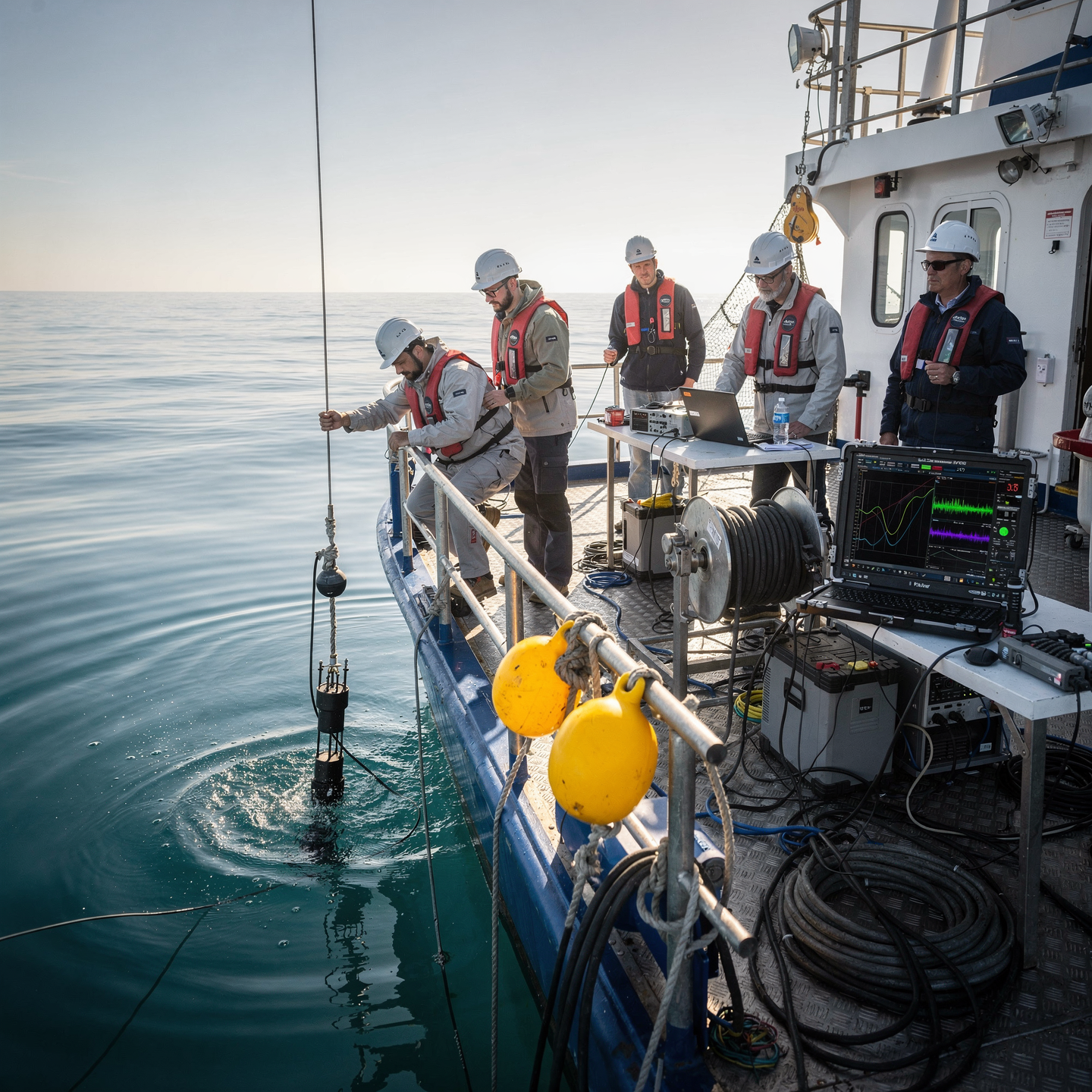
Course on Marine Noise Pollution
Why this course?
The Marine Noise Pollution: Impact and Solutions course
This course will provide you with a deep understanding of the sources, propagation, and effects of underwater noise on marine ecosystems. You will learn to identify and assess the impacts on marine life, from marine mammals to invertebrates, and to apply the best practices and available technologies for mitigation. This program will equip you with the knowledge necessary to contribute to the conservation of marine biodiversity and compliance with environmental regulations.
Differential Advantages
- Real-world case studies: environmental impact studies, marine construction projects, and shipping operations.
- Acoustic modeling tools: simulation of sound propagation in different marine environments.
- Innovative mitigation strategies: noise reduction technologies, design of quiet infrastructure, and management of human activities.
- Legal and regulatory framework: international and national legislation on marine noise pollution.
- Collaboration with experts: participation of renowned scientists, engineers, and environmental managers.
- Modality: Online
- Level: Cursos
- Hours: 150 H
- Start date: 25-04-2026
Availability: 1 in stock
Who is it aimed at?
- Marine biologists and oceanographers interested in understanding and mitigating the effects of underwater noise on marine fauna.
- Acoustic engineers and environmental consultants seeking tools to assess and model noise pollution in marine environments.
- Marine resource managers and decision-makers who need information to establish noise protection and management policies.
- Maritime professionals (shipowners, shipping companies, shipyards) seeking to comply with environmental regulations and minimize the acoustic impact of their activities.
- Students and researchers wishing to expand their knowledge of marine acoustics and its implications for marine environmental conservation.
Professional Application
Ideal for developing research projects, conducting environmental impact assessments, and implementing mitigation measures in the marine environment. Practical sessions and relevant case studies.
Objectives and competencies

Assess the impact of noise pollution on marine fauna:
“Analyze bioacoustic and behavioral data to identify affected species, assess the short- and long-term effects on their health and reproduction, and propose mitigation measures.”

Implement mitigation measures to reduce underwater noise emissions:
“Using quieter propulsion technologies and propeller designs, limiting speed in sensitive areas, and optimizing routes to avoid areas with high concentrations of marine life.”

Develop technologies and strategies for continuous monitoring of ocean noise:
Implement a network of autonomous hydrophones with real-time data transmission and automated analysis using AI, calibrating the models with on-site measurement campaigns and validation with satellite data.

Promote collaboration between industries, governments and scientists to address the problem of marine noise:
To encourage the development and adoption of innovative technologies and practices for noise mitigation, facilitating knowledge exchange and the standardization of regulations.

Raising awareness and educating society about the harmful effects of noise on the oceans:
“Promote the adoption of quieter navigation and propulsion technologies on ships.”

Establish limits and regulations for noise emissions in maritime activities:
“Understand IMO regulations on underwater noise and adapt procedures to minimize acoustic impact on marine fauna, especially in sensitive areas.”
Curriculum - Modules
- Comprehensive Maritime Incident Management: protocols, roles, and chain of command for coordinated response
- Operational Planning and Execution: briefing, routes, weather windows, and go/no-go criteria
- Rapid Risk Assessment: criticality matrix, scene control, and decision-making under pressure
- Operational Communication: VHF/GMDSS, standardized reports, and inter-agency liaison
- Tactical Mobility and Safe Boarding: RHIB maneuvers, approach, mooring, and recovery
- Equipment and Technologies: PPE, signaling, satellite tracking, and field data logging
- Immediate Care of the Affected: primary assessment, hypothermia, trauma, and stabilization for evacuation
- Adverse Environmental Conditions: swell, Visibility, flows, and operational mitigation
Simulation and training: critical scenarios, use of VR/AR, and exercises with performance metrics
Documentation and continuous improvement: lessons learned, indicators (MTTA/MTTR), and SOP updates
- Introduction to Underwater Noise: Definition, Sources, and Propagation
- Underwater Acoustic Physics: Sound waves, speed of sound, absorption
- Sources of Anthropogenic Noise: Shipping, construction, energy, military
- Impact of Noise on Marine Fauna: Marine mammals, fish, invertebrates
- Noise Assessment Methodologies: Hydrophones, calibration, spectral analysis
- Modeling Noise Propagation: Numerical models, software, and validation
- Noise Mitigation Techniques: Vessel design, acoustic barriers
- International and National Legislation: Directives, standards, protected areas
- Long-Term Monitoring and Tracking: Indicators, Adaptive Management
- Case Studies: Environmental Impact Assessment and Best Practices
‘
- Introduction to underwater noise: natural and anthropogenic sources
- Basic acoustic physics: sound propagation in water, impedance, reflection
- Acoustic measurement equipment: hydrophones, calibration, analysis software
- Legislation and regulations: European directives, international conventions, national standards
- Assessment of acoustic impact: acoustic modeling, noise maps, metrics (SEL, RMS)
- Sources of vessel noise: cavitation, machinery, propellers, quiet design
- Impact on marine fauna: physiological, behavioral, and population effects
- Mitigation techniques: acoustic barriers, bubble curtains, modifications Operational activities
- Monitoring and follow-up: monitoring plans, trend analysis, reports
- Case studies: assessment and mitigation in specific projects
‘
- Introduction to underwater noise: natural and anthropogenic sources
- Physics of sound in water: propagation, attenuation, acoustic impedance
- Sources of anthropogenic noise: shipping, marine construction, seismic exploration, sonar
- Underwater noise measurement equipment: hydrophones, calibration, deployment
- Noise measurement protocols: ANSI/ASA standards, EU guidelines
- Effects of noise on marine fauna: physiological, behavioral, masking
- Effects of noise on marine mammals: strandings, behavioral changes, hearing loss
- Effects of noise on fish and Invertebrates: Tissue damage, stress, impaired reproduction
Noise propagation modeling: Simulation tools and software
Noise mitigation measures: Noise reduction technologies, management of noisy activities‘
- Introduction to Underwater Noise Impact: sources, propagation, and effects.
- Physics of sound in water: speed, attenuation, refraction, and reflection.
- Measurement equipment: hydrophones, calibration, and recording techniques.
- Legislation and regulations: applicable international and national standards.
- Environmental impact assessment: methodologies and acoustic modeling.
- Effects on marine fauna: behavior, physiology, and ecology.
- Mitigation techniques: acoustic barriers, source reduction, and time management.
- Post-mitigation monitoring: evaluation of the effectiveness of the measures.
- Case studies: project analysis and lessons learned.
- Communication and dissemination: awareness and public participation.
‘
- System Architecture and Components: Structural design, materials, and subsystems (mechanical, electrical, electronic, and fluid) with selection and assembly criteria for marine environments
- Fundamentals and Principles of Operation: Physical and engineering foundations (thermodynamics, fluid mechanics, electricity, control, and materials) that explain performance and operating limits
- Safety and Environmental (SHE): Risk analysis, PPE, LOTO, hazardous atmospheres, spill and waste management, and emergency response plans
- Applicable Regulations and Standards: IMO/ISO/IEC requirements and local regulations;
- Conformance criteria, certification, and best practices for operation and maintenance
- Inspection, testing, and diagnostics: Visual/dimensional inspection, functional testing, data analysis, and predictive techniques (vibration, thermography, fluid analysis) to identify root causes
- Preventive and predictive maintenance: Hourly/cycle/seasonal plans, lubrication, adjustments, calibrations, consumable replacement, post-service verification, and operational reliability
- Instrumentation, tools, and metrology: Measuring and testing equipment, diagnostic software, calibration and traceability; selection criteria, safe use, and storage
- Onboard integration and interfaces: Mechanical, electrical, fluid, and data compatibility; Sealing and watertightness, EMC/EMI, corrosion protection, and interoperability testing.
Quality, acceptance testing, and commissioning: process and materials control, FAT/SAT, bench and sea trials, go/no-go criteria, and evidence documentation.
Technical documentation and integrated practice: logs, checklists, reports, and a complete case study (safety → diagnosis → intervention → verification → report) applicable to any system.
Plan de estudio - Módulos
- Comprehensive Maritime Incident Management: protocols, roles, and chain of command for coordinated response
- Operational Planning and Execution: briefing, routes, weather windows, and go/no-go criteria
- Rapid Risk Assessment: criticality matrix, scene control, and decision-making under pressure
- Operational Communication: VHF/GMDSS, standardized reports, and inter-agency liaison
- Tactical Mobility and Safe Boarding: RHIB maneuvers, approach, mooring, and recovery
- Equipment and Technologies: PPE, signaling, satellite tracking, and field data logging
- Immediate Care of the Affected: primary assessment, hypothermia, trauma, and stabilization for evacuation
- Adverse Environmental Conditions: swell, Visibility, flows, and operational mitigation
Simulation and training: critical scenarios, use of VR/AR, and exercises with performance metrics
Documentation and continuous improvement: lessons learned, indicators (MTTA/MTTR), and SOP updates
- Introduction to Underwater Noise: Definition, Sources, and Propagation
- Underwater Acoustic Physics: Sound waves, speed of sound, absorption
- Sources of Anthropogenic Noise: Shipping, construction, energy, military
- Impact of Noise on Marine Fauna: Marine mammals, fish, invertebrates
- Noise Assessment Methodologies: Hydrophones, calibration, spectral analysis
- Modeling Noise Propagation: Numerical models, software, and validation
- Noise Mitigation Techniques: Vessel design, acoustic barriers
- International and National Legislation: Directives, standards, protected areas
- Long-Term Monitoring and Tracking: Indicators, Adaptive Management
- Case Studies: Environmental Impact Assessment and Best Practices
‘
- Introduction to underwater noise: natural and anthropogenic sources
- Basic acoustic physics: sound propagation in water, impedance, reflection
- Acoustic measurement equipment: hydrophones, calibration, analysis software
- Legislation and regulations: European directives, international conventions, national standards
- Assessment of acoustic impact: acoustic modeling, noise maps, metrics (SEL, RMS)
- Sources of vessel noise: cavitation, machinery, propellers, quiet design
- Impact on marine fauna: physiological, behavioral, and population effects
- Mitigation techniques: acoustic barriers, bubble curtains, modifications Operational activities
- Monitoring and follow-up: monitoring plans, trend analysis, reports
- Case studies: assessment and mitigation in specific projects
‘
- Introduction to underwater noise: natural and anthropogenic sources
- Physics of sound in water: propagation, attenuation, acoustic impedance
- Sources of anthropogenic noise: shipping, marine construction, seismic exploration, sonar
- Underwater noise measurement equipment: hydrophones, calibration, deployment
- Noise measurement protocols: ANSI/ASA standards, EU guidelines
- Effects of noise on marine fauna: physiological, behavioral, masking
- Effects of noise on marine mammals: strandings, behavioral changes, hearing loss
- Effects of noise on fish and Invertebrates: Tissue damage, stress, impaired reproduction
Noise propagation modeling: Simulation tools and software
Noise mitigation measures: Noise reduction technologies, management of noisy activities‘
- Introduction to Underwater Noise Impact: sources, propagation, and effects.
- Physics of sound in water: speed, attenuation, refraction, and reflection.
- Measurement equipment: hydrophones, calibration, and recording techniques.
- Legislation and regulations: applicable international and national standards.
- Environmental impact assessment: methodologies and acoustic modeling.
- Effects on marine fauna: behavior, physiology, and ecology.
- Mitigation techniques: acoustic barriers, source reduction, and time management.
- Post-mitigation monitoring: evaluation of the effectiveness of the measures.
- Case studies: project analysis and lessons learned.
- Communication and dissemination: awareness and public participation.
‘
- System Architecture and Components: Structural design, materials, and subsystems (mechanical, electrical, electronic, and fluid) with selection and assembly criteria for marine environments
- Fundamentals and Principles of Operation: Physical and engineering foundations (thermodynamics, fluid mechanics, electricity, control, and materials) that explain performance and operating limits
- Safety and Environmental (SHE): Risk analysis, PPE, LOTO, hazardous atmospheres, spill and waste management, and emergency response plans
- Applicable Regulations and Standards: IMO/ISO/IEC requirements and local regulations;
- Conformance criteria, certification, and best practices for operation and maintenance
- Inspection, testing, and diagnostics: Visual/dimensional inspection, functional testing, data analysis, and predictive techniques (vibration, thermography, fluid analysis) to identify root causes
- Preventive and predictive maintenance: Hourly/cycle/seasonal plans, lubrication, adjustments, calibrations, consumable replacement, post-service verification, and operational reliability
- Instrumentation, tools, and metrology: Measuring and testing equipment, diagnostic software, calibration and traceability; selection criteria, safe use, and storage
- Onboard integration and interfaces: Mechanical, electrical, fluid, and data compatibility; Sealing and watertightness, EMC/EMI, corrosion protection, and interoperability testing.
Quality, acceptance testing, and commissioning: process and materials control, FAT/SAT, bench and sea trials, go/no-go criteria, and evidence documentation.
Technical documentation and integrated practice: logs, checklists, reports, and a complete case study (safety → diagnosis → intervention → verification → report) applicable to any system.
- Introduction to Underwater Noise: Sources, Propagation, and Characteristics
- Marine Acoustic Physics: Speed of Sound, Absorption, Refraction, and Reflection
- Sources of Anthropogenic Noise: Navigation, Construction, Energy, Sonar
- Impact on Marine Fauna: Behavior, Physiology, Communication
- International and National Legislation: Directives, Regulations, and Standards
- Underwater Noise Measurement and Monitoring: Hydrophones, Calibration, Analysis
- Acoustic Modeling: Sound Propagation, Scenarios, and Predictions
- Mitigation Techniques: Source Reduction, Noise Barriers, Scheduling
- Environmental Impact Assessment: Methodologies, Indicators, and Monitoring
- Case Studies
Study: Application of mitigation measures and lessons learned
‘
- Introduction to Underwater Noise: Definition, Sources, and Propagation
- Underwater Acoustic Physics: Speed of Sound, Attenuation, Reflection, and Refraction
- Sources of Anthropogenic Noise: Maritime Traffic, Offshore Construction, Sonar, Explosions
- Acoustic Measurement Equipment: Hydrophones, Calibration, Deployment, and Data Analysis
- Assessment Methodologies: Sound Pressure Levels (SPL), Sound Exposure Levels (SEL), Octave Bands
- Impact on Marine Fauna: Physiological, Behavioral, and Population Effects
- Legislation and Regulations: European Directives, International Conventions, IMO Standards
- Techniques of Mitigation: Source reduction, acoustic barriers, spatial planning
Acoustic Modeling: Prediction software, scenarios, and validation
Case Studies: Examples of assessment and mitigation in different marine environments
‘
- Introduction to Underwater Noise: Sources, Propagation, and Characteristics
- Legal and Regulatory Framework: International Directives, Standards, and Guidelines
- Measurement Equipment and Techniques: Hydrophones, Calibration, and Data Analysis
- Modeling Sound Propagation: Software and Environmental Parameters
- Sources of Underwater Noise: Navigation, Construction, Energy, and Sonar
- Impact of Noise on Marine Fauna: Behavior, Physiology, and Communication
- Mitigation Strategies: Design, Technology, and Operational Practices
- Monitoring and Follow-up: Indicators, Evaluation of Effectiveness
- Risk Management and Strategic Environmental Assessment (SEA)
- Case Studies and Best Practices in Underwater noise management
‘
- Introduction to Marine Acoustics: Physical Foundations of Sound in Water.
- Sources of Underwater Noise: Natural (wind, waves, biota) and anthropogenic (shipping, construction, seismic activities).
- Sound Propagation in the Sea: Factors Affecting Transmission (temperature, salinity, depth, seabed type).
- Acoustic Measurement Equipment: Hydrophones, sonobuoys, calibration, and deployment.
- Acoustic Assessment Methodologies: Sampling, spectral analysis, calculation of sound pressure levels (SPL) and sound exposure level (SEL).
- Impact of Noise on Marine Fauna: Physiological effects (hearing damage, stress) and behavioral effects (masking, displacement).
- Noise mitigation techniques: Insulation, acoustic barriers, operational modifications.
- International and national regulations: European directives, national environmental protection laws, IMO standards.
- Case studies: Acoustic impact assessment in marine projects (wind farms, port construction, seismic exploration).
- Acoustic modeling tools: Simulation of sound propagation for planning and mitigation.
‘
Career opportunities
- Marine Environmental Consultant: Assessment of the acoustic impact of construction projects, seismic surveys, and shipping activities.
- Scientific Researcher: Study of the effects of noise on marine fauna, development of new acoustic mitigation technologies.
- Marine Protected Area Manager: Implementation of measures to reduce noise pollution in sensitive areas.
- Marine Acoustics Technician: Conducting noise measurements, acoustic modeling, and data analysis.
- Environmental Policy Advisor: Development of legislation and regulations to control underwater noise.
- Environmental Educator: Dissemination of information about the effects of marine noise pollution and promotion of sustainable practices.
- Marine Renewable Energy Engineer: Development of energy technologies Oceanic with low noise impact.
- Compliance Officer: Verification of compliance with marine noise regulations in the maritime industry.
“`
Admission requirements

Academic/professional profile:
Degree/Bachelor's degree in Nautical Science/Maritime Transport, Naval/Marine Engineering, or a related field; or proven professional experience in bridge/operations.

Language proficiency:
Recommended functional maritime English (SMCP) for simulations and technical materials.

5. Induction
Updated resume, copy of degree or seaman's book, ID card/passport, letter of motivation.

Technical requirements (for online):
Equipment with camera/microphone, stable connection, ≥ 24” monitor recommended for ECDIS/Radar-ARPA.
Admission process and dates

1. Online
application
(form + documents).

2. Academic review and interview
(profile/objectives/schedule compatibility).

3. Admission decision
(+ scholarship proposal if applicable).

4. Reservation of place
(deposit) and registration.

5. Induction
(access to campus, calendars, simulator guides).
Scholarships and grants
- Understand: the fundamentals of marine noise pollution and its main sources.
- Identify: the effects of noise on marine life, from behavior to physiology.
- Learn: the international regulations and legislation for underwater noise management.
- Develop: strategies and technologies for noise pollution mitigation and monitoring.
- Apply: the knowledge acquired for the conservation and protection of the marine environment.
Testimonials
I successfully identified and classified the sources of anthropogenic noise in the ocean, assessed their impact on various marine species, and proposed effective mitigation measures, including quieter ship designs and maritime traffic regulation in sensitive areas. My analysis directly contributed to the development of an action plan to reduce noise pollution in a marine protected area, demonstrating a significant decrease in noise levels and an improvement in humpback whale communication.
This course provided me with a deep understanding of the complex interactions between energy and the marine environment. I gained crucial knowledge about marine renewable energy, its environmental impacts, and mitigation strategies, which enabled me to develop an innovative final project on optimizing wave energy while minimizing its impact on coastal biodiversity. The practical application of the concepts learned and the focus on sustainability prepared me to make a significant contribution to the energy transition in the marine sector.
I was able to identify and quantify the impact of vessel noise on the communication of a dolphin population, demonstrating a direct correlation between the increase in maritime traffic and the decrease in their vocalizations, which contributed to the implementation of noise mitigation measures in the study area.
I successfully identified and classified the sources of anthropogenic noise in a specific marine ecosystem, quantifying its impact on local fauna (dolphins) by analyzing acoustic recordings and correlating them with behavioral patterns. This allowed me to propose effective mitigation measures to reduce noise pollution and present them to local authorities for their consideration and implementation.

Frequently asked questions
Commercial maritime traffic.
Yes. The itinerary includes ECDIS/Radar-ARPA/BRM with harbor, ocean, fog, storm, and SAR scenarios.
Online with live sessions; hybrid option for simulator/practical placements through agreements.
Maritime traffic (mainly merchant and recreational ships), oil and gas exploration and extraction (including seismic), military sonar, and marine construction (such as the installation of piles for wind farms).
Recommended functional SMCP. We offer support materials for standard phraseology.
Yes, with a relevant degree or experience in maritime/port operations. The admissions interview will confirm suitability.
Optional (3–6 months) through Companies & Collaborations and the Alumni Network.
Simulator practice (rubrics), defeat plans, SOPs, checklists, micro-tests and applied TFM.
A degree from Navalis Magna University + operational portfolio (tracks, SOPs, reports and KPIs) useful for audits and employment.
- Introduction to Marine Acoustics: Physical Foundations of Sound in Water.
- Sources of Underwater Noise: Natural (wind, waves, biota) and anthropogenic (shipping, construction, seismic activities).
- Sound Propagation in the Sea: Factors Affecting Transmission (temperature, salinity, depth, seabed type).
- Acoustic Measurement Equipment: Hydrophones, sonobuoys, calibration, and deployment.
- Acoustic Assessment Methodologies: Sampling, spectral analysis, calculation of sound pressure levels (SPL) and sound exposure level (SEL).
- Impact of Noise on Marine Fauna: Physiological effects (hearing damage, stress) and behavioral effects (masking, displacement).
- Noise mitigation techniques: Insulation, acoustic barriers, operational modifications.
- International and national regulations: European directives, national environmental protection laws, IMO standards.
- Case studies: Acoustic impact assessment in marine projects (wind farms, port construction, seismic exploration).
- Acoustic modeling tools: Simulation of sound propagation for planning and mitigation.
‘
Request information
- Complete the Application Form
- Attach your CV/Qualifications (if you have them to hand).
- Indicate your preferred cohort (January/May/September) and whether you want the hybrid option with simulator sessions.
Teachers
Eng. Tomás Riera
Full Professor
Eng. Tomás Riera
Full Professor
Eng. Sofía Marquina
Full Professor
Eng. Sofía Marquina
Full Professor
Eng. Javier Bañuls
Full Professor
Eng. Javier Bañuls
Full Professor
Dr. Nuria Llobregat
Full Professor
Dr. Nuria Llobregat
Full Professor
Dr. Pau Ferrer
Full Professor
Dr. Pau Ferrer
Full Professor
Cap. Javier Abaroa (MCA)
Full Professor
Cap. Javier Abaroa (MCA)
Full Professor

