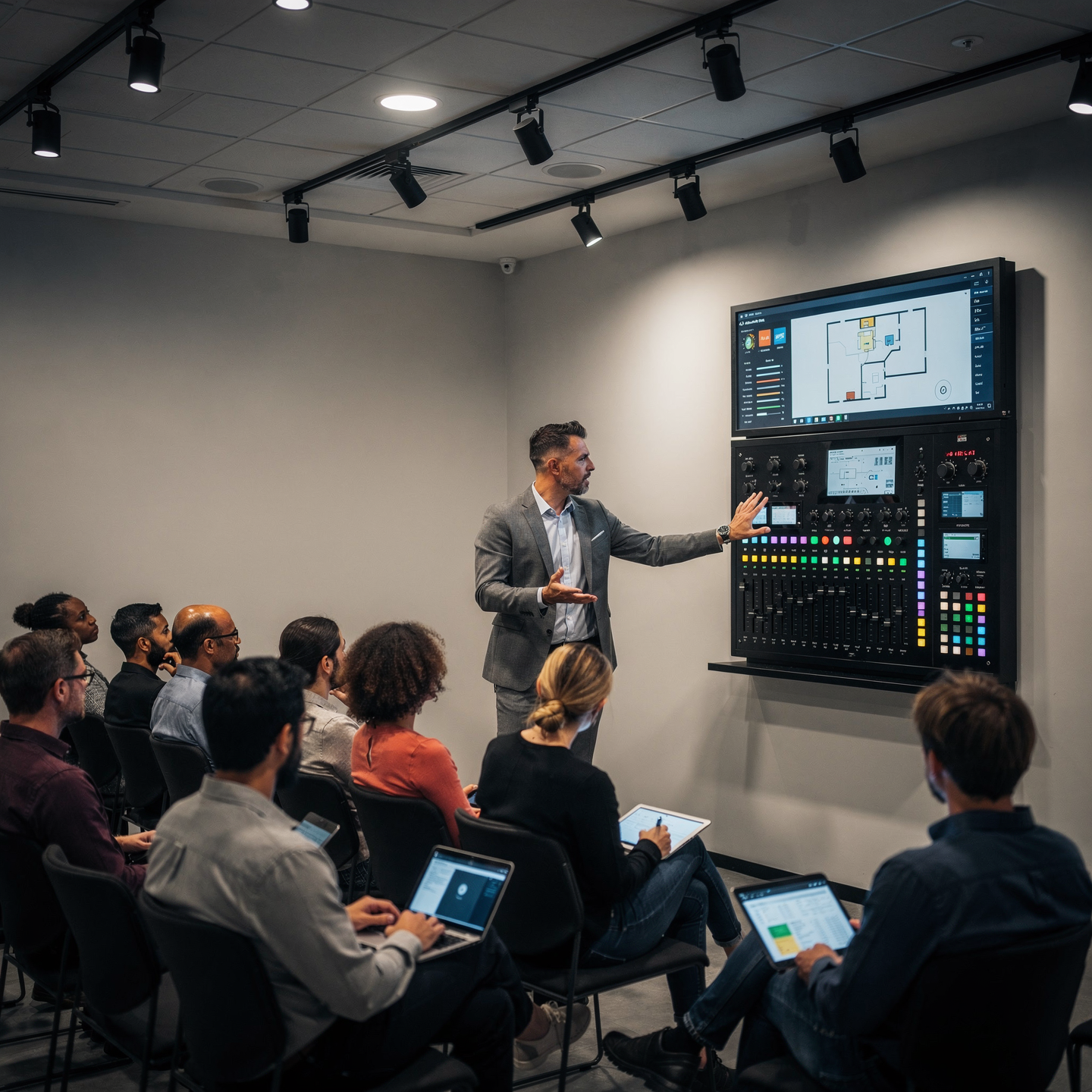
Lighting Control Systems Course
Why this course?
The Lighting Control Systems course
This course provides you with the necessary tools to design, implement, and manage efficient and customized lighting solutions. Learn to master LED, DALI, KNX, and other technologies, optimizing energy consumption and creating tailored lighting environments. This program equips you to lead smart lighting projects in various sectors, from residential to industrial.
Differential Advantages
- Efficient Lighting Design: Lighting calculation, luminaire selection, and energy optimization.
- DALI/KNX System Programming: Configuration, addressing, and creation of custom scenes.
- Remote Control and Monitoring: Lighting management via web platforms and mobile applications.
- Integration with Home Automation Systems: Synchronization with other smart devices for a connected home.
- Practical Case Studies and Real-World Projects: Application of acquired knowledge in real-world situations.
- Modality: Online
- Level: Cursos
- Hours: 150 H
- Start date: 24-07-2026
Availability: 1 in stock
Who is it aimed at?
- Architects and interior designers who seek to master the creation of atmospheres through intelligent and efficient lighting.
- Electricians and lighting technicians who wish to specialize in the installation and programming of state-of-the-art control systems.
- Engineers and construction project managers interested in optimizing energy consumption and integrating innovative solutions.
- Maintenance managers and facility managers who aspire to automate and centralize the control of lighting in large spaces.
- Lighting students and professionals seeking a in-depth knowledge of protocols, standards, and emerging technologies.
Flexibility and applicability
Adapted For professionals with demanding schedules: 24/7 accessible online content, practical exercises based on real cases and permanent consultation forum.
Objectives and competencies

Programming and configuring lighting control systems:
Implement communication protocols (DALI, DMX) and ensure proper integration with other building systems (BMS, security), optimizing energy consumption and event response.

Diagnosing and troubleshooting lighting control system failures:
“Use electrical diagrams, diagnostic tools, and specialized software to identify faulty components and restore system functionality, prioritizing safety.”

Selecting and sizing components for lighting control systems:
Consider energy efficiency, safety regulations, and compatibility with communication protocols (DALI, DMX) to optimize costs and performance.

Implement and maintain energy-efficient lighting control systems:
“Select energy-efficient LED lights, program on/off times according to occupancy and natural light, and integrate presence/light sensors to regulate light intensity.”

Integrate lighting control systems with other automation systems:
“Configure communication protocols (BACnet, Modbus, DALI) and APIs for interoperability with HVAC, safety and energy management, ensuring efficiency and centralized monitoring.”

Design and install lighting control systems according to the client's needs:
“Select efficient components, program adaptive control logic, and verify regulatory compliance to ensure lighting comfort and energy savings.”
Curriculum - Modules
- Comprehensive Maritime Incident Management: protocols, roles, and chain of command for coordinated response
- Operational Planning and Execution: briefing, routes, weather windows, and go/no-go criteria
- Rapid Risk Assessment: criticality matrix, scene control, and decision-making under pressure
- Operational Communication: VHF/GMDSS, standardized reports, and inter-agency liaison
- Tactical Mobility and Safe Boarding: RHIB maneuvers, approach, mooring, and recovery
- Equipment and Technologies: PPE, signaling, satellite tracking, and field data logging
- Immediate Care of the Affected: primary assessment, hypothermia, trauma, and stabilization for evacuation
- Adverse Environmental Conditions: swell, Visibility, flows, and operational mitigation
Simulation and training: critical scenarios, use of VR/AR, and exercises with performance metrics
Documentation and continuous improvement: lessons learned, indicators (MTTA/MTTR), and SOP updates
- Introduction to home lighting automation: concepts, benefits, and trends
- DALI fundamentals: protocol, architecture, addressing, and commands
- DALI system components: controllers, ballasts, sensors, and interfaces
- Installation and configuration of DALI networks: cabling, topologies, and tools
- DALI programming: software, parameters, scenes, and groups
- Integrating DALI with other systems: BMS, IoT, and management platforms
- Energy efficiency in lighting: standards, calculations, and strategies
- Lighting control based on occupancy and natural light: sensors, algorithms, and optimization
- Maintenance and troubleshooting of DALI systems: diagnostics, tools, and best practices
- Case studies and practical examples
of lighting automation projects with DALI
‘
- Introduction to home automation and lighting control: basic concepts and evolution
- Lighting fundamentals: magnitudes, types of lamps, energy efficiency
- Communication protocols: KNX, DALI, Zigbee, Z-Wave (advantages and disadvantages)
- Components of a home automation lighting system: sensors, actuators, controllers
- Electrical schematic design: standards, symbols, load calculations
- Lighting design and simulation software: DIALux, RELUX, and online tools
- Selection of materials and equipment: technical and economic criteria
- Basic controller programming: Boolean logic, timers, scenes
- User interface configuration: panels Touchscreens, mobile apps, voice assistants
- Security in home automation systems: protection against power surges, short circuits, hacking
‘
- Lighting Fundamentals: Types of light, photometric quantities, visual comfort, and energy efficiency.
- Lighting Technologies: Incandescent, fluorescent, halogen, and LED lamps (advantages, disadvantages, and applications).
- Lighting Controllers: Dimming, color temperature control, presence/light sensors, and actuators.
- Home Automation Communication Protocols: Zigbee, Z-Wave, KNX, and DALI (characteristics, topologies, advantages, and disadvantages).
- Lighting Management Systems: Centralized control platforms and user interfaces (apps, touch panels, and voice assistants).
- Lighting Scene Design: Creating ambiances, scheduling, and adapting to different needs.
- Integration with Other Home Automation Systems: Security, climate control, audio/video (automation scenarios).
- Energy Efficiency in Lighting: Calculating consumption, system optimization, energy-saving strategies.
- Regulations and Safety in Home Automation Lighting Installations: Low-voltage electrotechnical regulations, certifications, electrical safety.
- Case Studies and Future Trends: Examples of installations, new technologies, human-centered lighting.
Activities and users.
‘
- Introduction to Home Lighting Automation: Basic Concepts and Evolution.
- Lighting Fundamentals: Types of Lights, Characteristics, and Regulations.
- Communication Protocols in Home Automation: Zigbee, Z-Wave, KNX, WiFi.
- Programming Lighting Systems: Platforms and Programming Languages (IFTTT, Node-RED).
- Lighting Sensors and Actuators: Types, Operation, and Integration.
- Intelligent Lighting Control: Scenarios, Automation, and Customization.
- Calculating and Designing Energy Efficiency in Lighting: Energy Savings and Sustainability.
- Integration with Building Management Systems
Building Management System (BMS): Centralized communication and control.
Security and Privacy in Home Lighting Automation Systems: Data and access protection.
Case studies and future trends in home lighting automation.
‘
- System Architecture and Components: Structural design, materials, and subsystems (mechanical, electrical, electronic, and fluid) with selection and assembly criteria for marine environments
- Fundamentals and Principles of Operation: Physical and engineering foundations (thermodynamics, fluid mechanics, electricity, control, and materials) that explain performance and operating limits
- Safety and Environmental (SHE): Risk analysis, PPE, LOTO, hazardous atmospheres, spill and waste management, and emergency response plans
- Applicable Regulations and Standards: IMO/ISO/IEC requirements and local regulations;
- Conformance criteria, certification, and best practices for operation and maintenance
- Inspection, testing, and diagnostics: Visual/dimensional inspection, functional testing, data analysis, and predictive techniques (vibration, thermography, fluid analysis) to identify root causes
- Preventive and predictive maintenance: Hourly/cycle/seasonal plans, lubrication, adjustments, calibrations, consumable replacement, post-service verification, and operational reliability
- Instrumentation, tools, and metrology: Measuring and testing equipment, diagnostic software, calibration and traceability; selection criteria, safe use, and storage
- Onboard integration and interfaces: Mechanical, electrical, fluid, and data compatibility; Sealing and watertightness, EMC/EMI, corrosion protection, and interoperability testing.
Quality, acceptance testing, and commissioning: process and materials control, FAT/SAT, bench and sea trials, go/no-go criteria, and evidence documentation.
Technical documentation and integrated practice: logs, checklists, reports, and a complete case study (safety → diagnosis → intervention → verification → report) applicable to any system.
Plan de estudio - Módulos
- Comprehensive Maritime Incident Management: protocols, roles, and chain of command for coordinated response
- Operational Planning and Execution: briefing, routes, weather windows, and go/no-go criteria
- Rapid Risk Assessment: criticality matrix, scene control, and decision-making under pressure
- Operational Communication: VHF/GMDSS, standardized reports, and inter-agency liaison
- Tactical Mobility and Safe Boarding: RHIB maneuvers, approach, mooring, and recovery
- Equipment and Technologies: PPE, signaling, satellite tracking, and field data logging
- Immediate Care of the Affected: primary assessment, hypothermia, trauma, and stabilization for evacuation
- Adverse Environmental Conditions: swell, Visibility, flows, and operational mitigation
Simulation and training: critical scenarios, use of VR/AR, and exercises with performance metrics
Documentation and continuous improvement: lessons learned, indicators (MTTA/MTTR), and SOP updates
- Introduction to home lighting automation: concepts, benefits, and trends
- DALI fundamentals: protocol, architecture, addressing, and commands
- DALI system components: controllers, ballasts, sensors, and interfaces
- Installation and configuration of DALI networks: cabling, topologies, and tools
- DALI programming: software, parameters, scenes, and groups
- Integrating DALI with other systems: BMS, IoT, and management platforms
- Energy efficiency in lighting: standards, calculations, and strategies
- Lighting control based on occupancy and natural light: sensors, algorithms, and optimization
- Maintenance and troubleshooting of DALI systems: diagnostics, tools, and best practices
- Case studies and practical examples
of lighting automation projects with DALI
‘
- Introduction to home automation and lighting control: basic concepts and evolution
- Lighting fundamentals: magnitudes, types of lamps, energy efficiency
- Communication protocols: KNX, DALI, Zigbee, Z-Wave (advantages and disadvantages)
- Components of a home automation lighting system: sensors, actuators, controllers
- Electrical schematic design: standards, symbols, load calculations
- Lighting design and simulation software: DIALux, RELUX, and online tools
- Selection of materials and equipment: technical and economic criteria
- Basic controller programming: Boolean logic, timers, scenes
- User interface configuration: panels Touchscreens, mobile apps, voice assistants
- Security in home automation systems: protection against power surges, short circuits, hacking
‘
- Lighting Fundamentals: Types of light, photometric quantities, visual comfort, and energy efficiency.
- Lighting Technologies: Incandescent, fluorescent, halogen, and LED lamps (advantages, disadvantages, and applications).
- Lighting Controllers: Dimming, color temperature control, presence/light sensors, and actuators.
- Home Automation Communication Protocols: Zigbee, Z-Wave, KNX, and DALI (characteristics, topologies, advantages, and disadvantages).
- Lighting Management Systems: Centralized control platforms and user interfaces (apps, touch panels, and voice assistants).
- Lighting Scene Design: Creating ambiances, scheduling, and adapting to different needs.
- Integration with Other Home Automation Systems: Security, climate control, audio/video (automation scenarios).
- Energy Efficiency in Lighting: Calculating consumption, system optimization, energy-saving strategies.
- Regulations and Safety in Home Automation Lighting Installations: Low-voltage electrotechnical regulations, certifications, electrical safety.
- Case Studies and Future Trends: Examples of installations, new technologies, human-centered lighting.
Activities and users.
‘
- Introduction to Home Lighting Automation: Basic Concepts and Evolution.
- Lighting Fundamentals: Types of Lights, Characteristics, and Regulations.
- Communication Protocols in Home Automation: Zigbee, Z-Wave, KNX, WiFi.
- Programming Lighting Systems: Platforms and Programming Languages (IFTTT, Node-RED).
- Lighting Sensors and Actuators: Types, Operation, and Integration.
- Intelligent Lighting Control: Scenarios, Automation, and Customization.
- Calculating and Designing Energy Efficiency in Lighting: Energy Savings and Sustainability.
- Integration with Building Management Systems
Building Management System (BMS): Centralized communication and control.
Security and Privacy in Home Lighting Automation Systems: Data and access protection.
Case studies and future trends in home lighting automation.
‘
- System Architecture and Components: Structural design, materials, and subsystems (mechanical, electrical, electronic, and fluid) with selection and assembly criteria for marine environments
- Fundamentals and Principles of Operation: Physical and engineering foundations (thermodynamics, fluid mechanics, electricity, control, and materials) that explain performance and operating limits
- Safety and Environmental (SHE): Risk analysis, PPE, LOTO, hazardous atmospheres, spill and waste management, and emergency response plans
- Applicable Regulations and Standards: IMO/ISO/IEC requirements and local regulations;
- Conformance criteria, certification, and best practices for operation and maintenance
- Inspection, testing, and diagnostics: Visual/dimensional inspection, functional testing, data analysis, and predictive techniques (vibration, thermography, fluid analysis) to identify root causes
- Preventive and predictive maintenance: Hourly/cycle/seasonal plans, lubrication, adjustments, calibrations, consumable replacement, post-service verification, and operational reliability
- Instrumentation, tools, and metrology: Measuring and testing equipment, diagnostic software, calibration and traceability; selection criteria, safe use, and storage
- Onboard integration and interfaces: Mechanical, electrical, fluid, and data compatibility; Sealing and watertightness, EMC/EMI, corrosion protection, and interoperability testing.
Quality, acceptance testing, and commissioning: process and materials control, FAT/SAT, bench and sea trials, go/no-go criteria, and evidence documentation.
Technical documentation and integrated practice: logs, checklists, reports, and a complete case study (safety → diagnosis → intervention → verification → report) applicable to any system.
- Home Automation Fundamentals: history, evolution, standards, and protocols
- Principles of Intelligent Lighting: energy efficiency, visual comfort, circadian rhythms
- Components of a Home Lighting Automation System: sensors, actuators, controllers, interfaces
- Communication Protocols in Home Automation: Zigbee, Z-Wave, Wi-Fi, Bluetooth, KNX, DALI
- Design of Intelligent Lighting Systems: needs analysis, component selection, plans, and schematics
- Installation and Configuration of Lighting Devices: wiring, addressing, basic programming
- Lighting Programming and Control: scenes, schedules, automations, remote control
- Integration with Other Systems
Home Automation Systems: security, climate control, multimedia
Security in Home Automation Lighting Systems: vulnerabilities, data protection, privacy
Maintenance and Troubleshooting: diagnostics, updates, technical support
‘
- Introduction to Smart Lighting: Concepts, Benefits, and Trends
- Fundamentals of Light: Electromagnetic Spectrum, Photometry, Colorimetry
- Lighting Technologies: LED, OLED, Discharge Lamps, Energy Efficiency
- Sensors and Actuators: Types, Operation, and Integration into Lighting Systems
- Communication Protocols: DALI, Zigbee, Bluetooth, KNX
- Controllers and Management Platforms: Interfaces, Programming, and Monitoring
- Lighting Design: Simulation Software, Calculating Lighting Levels, Regulations
- Installation and Wiring: Safety Standards, Grounding, Surge Protection
- Maintenance of Lighting Systems: Troubleshooting, Component Replacement, cleaning
- Cybersecurity in smart lighting systems: protection against attacks and vulnerabilities
‘
- Introduction to Lighting Control Protocols: DALI and DMX.
- DALI Fundamentals: architecture, components, addressing.
- DALI Message Structure: commands, responses, data frames.
- Practical Implementation of DALI: wiring, configuration, commissioning.
- DMX Fundamentals: DMX universe, channels, addressing.
- DMX Message Structure: packets, start code, data slots.
- Practical Implementation of DMX: wiring, terminators, consoles.
- DALI vs. DMX Comparison: advantages, disadvantages, applications.
- DALI and DMX Integration: Gateways, converters, hybrid systems.
- Troubleshooting: troubleshooting, diagnostic tools.
‘
- Introduction to Home Lighting Automation: Concepts, Benefits, and Applications
- Communication Protocols: DALI, KNX, Zigbee, Z-Wave, and their characteristics
- Lighting Technologies: LED, OLED, Fluorescent, and their energy efficiency
- Sensors and Actuators: Presence, light, and temperature detectors, and luminaire control
- Design of Intelligent Lighting Systems: Planning, wiring, and configuration
- Integration with BMS/BAS Systems: Communication, centralized control, and monitoring
- Energy Efficiency in Lighting: Control, optimization, and savings strategies
- Programming and Control: Software platforms, user interfaces, and Automation
- Security and Cybersecurity: Data protection, access, and intrusion prevention
- Regulations and Standards: UNE-EN, IEC, and applicable regulations
‘
Career opportunities
- Lighting Technician for Live Performances: Design, installation, and operation of lighting systems for theater, concerts, and events.
- Architectural Lighting Technician: Planning and execution of lighting projects for buildings, public spaces, and residences.
- Lighting Console Programmer: Advanced operation of software and hardware for real-time lighting control.
- Lighting Designer: Creation of innovative and functional lighting concepts tailored to client needs.
- Lighting Consultant: Advising on energy efficiency, regulations, and lighting trends.
- Lighting Control System Installer: Installation and configuration of automation systems for lighting control in homes and businesses.
- Lighting System Maintenance Technician: Repair and optimization of lighting systems. Existing lighting.
- Sales and technical support for lighting products: marketing and assistance in the use of lighting equipment.
“`
Admission requirements

Academic/professional profile:
Degree/Bachelor's degree in Nautical Science/Maritime Transport, Naval/Marine Engineering, or a related field; or proven professional experience in bridge/operations.

Language proficiency:
Recommended functional maritime English (SMCP) for simulations and technical materials.

5. Induction
Updated resume, copy of degree or seaman's book, ID card/passport, letter of motivation.

Technical requirements (for online):
Equipment with camera/microphone, stable connection, ≥ 24” monitor recommended for ECDIS/Radar-ARPA.
Admission process and dates

1. Online
application
(form + documents).

2. Academic review and interview
(profile/objectives/schedule compatibility).

3. Admission decision
(+ scholarship proposal if applicable).

4. Reservation of place
(deposit) and registration.

5. Induction
(access to campus, calendars, simulator guides).
Scholarships and grants
- Master Smart Lighting: Learn to design, implement, and control advanced lighting systems to optimize energy consumption and create personalized atmospheres.
- Protocols and Standards: Explore the most widely used communication protocols (DALI, KNX, Zigbee) and learn about energy efficiency standards.
- Control Software: Become familiar with software tools for managing and programming lighting systems, from basic configuration to creating complex scenes.
- IoT Integration: Discover how to integrate lighting control systems with other Internet of Things technologies to create smart, connected solutions.
- Energy Savings and Sustainability: Learn to maximize energy efficiency and reduce environmental impact through the use of lighting control strategies intelligent.
Testimonials
I implemented a lighting control system in a manufacturing plant that reduced energy consumption by 35% and improved visibility in work areas, resulting in a 10% increase in productivity.
During the Marine Electronics and Automation course, I applied my programming skills to develop an automated control system for managing a ship’s ballast, optimizing stability and reducing fuel consumption by 12% in simulations. This project was praised by the instructors for its innovation and practical applicability.
I implemented a DALI lighting control system in a 10-story office building, achieving 40% energy savings and a significant improvement in user comfort thanks to scene automation and individualized lighting management.
I implemented a lighting control system in a factory that reduced energy consumption by 35% and improved visibility in work areas, which increased productivity by 12%.

Frequently asked questions
Maximize energy efficiency and user comfort by managing lighting according to needs and environmental conditions.
Yes. The itinerary includes ECDIS/Radar-ARPA/BRM with harbor, ocean, fog, storm, and SAR scenarios.
Online with live sessions; hybrid option for simulator/practical placements through agreements.
Maximize energy efficiency and user comfort by managing lighting according to needs.
Recommended functional SMCP. We offer support materials for standard phraseology.
Yes, with a relevant degree or experience in maritime/port operations. The admissions interview will confirm suitability.
Optional (3–6 months) through Companies & Collaborations and the Alumni Network.
Simulator practice (rubrics), defeat plans, SOPs, checklists, micro-tests and applied TFM.
A degree from Navalis Magna University + operational portfolio (tracks, SOPs, reports and KPIs) useful for audits and employment.
- Introduction to Home Lighting Automation: Concepts, Benefits, and Applications
- Communication Protocols: DALI, KNX, Zigbee, Z-Wave, and their characteristics
- Lighting Technologies: LED, OLED, Fluorescent, and their energy efficiency
- Sensors and Actuators: Presence, light, and temperature detectors, and luminaire control
- Design of Intelligent Lighting Systems: Planning, wiring, and configuration
- Integration with BMS/BAS Systems: Communication, centralized control, and monitoring
- Energy Efficiency in Lighting: Control, optimization, and savings strategies
- Programming and Control: Software platforms, user interfaces, and Automation
- Security and Cybersecurity: Data protection, access, and intrusion prevention
- Regulations and Standards: UNE-EN, IEC, and applicable regulations
‘
Request information
- Complete the Application Form
- Attach your CV/Qualifications (if you have them to hand).
- Indicate your preferred cohort (January/May/September) and whether you want the hybrid option with simulator sessions.
Teachers
Eng. Tomás Riera
Full Professor
Eng. Tomás Riera
Full Professor
Eng. Sofía Marquina
Full Professor
Eng. Sofía Marquina
Full Professor
Eng. Javier Bañuls
Full Professor
Eng. Javier Bañuls
Full Professor
Dr. Nuria Llobregat
Full Professor
Dr. Nuria Llobregat
Full Professor
Dr. Pau Ferrer
Full Professor
Dr. Pau Ferrer
Full Professor
Cap. Javier Abaroa (MCA)
Full Professor
Cap. Javier Abaroa (MCA)
Full Professor

