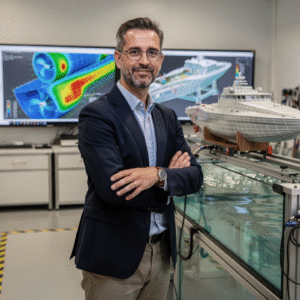
Diploma in Container and Bulk Transport
Why this certificate program?
The Diploma in Container and Bulk Transport
This program provides you with a comprehensive and up-to-date overview of logistics and operations in maritime trade. You will learn about types of vessels, stowage and lashing, international regulations, and the efficient management of the supply chain for containerized and bulk cargo. Master the challenges of modern maritime transport, from route optimization to compliance with environmental regulations.
Differential Advantages
- Real-world case studies: analysis of port operations and risk management.
- Industry experts: instructors with extensive experience in shipping lines and port terminals.
- Management tools: software and platforms for cargo planning and control.
- Networking: opportunities to connect with industry professionals.
- Flexibility: online format with multimedia resources and discussion forums.
- Modality: Online
- Level: Diplomado
- Hours: 800 H
- Start date: 30-09-2026
Availability: 1 in stock
Who is it aimed at?
- Logistics and transportation professionals looking to specialize in the efficient handling of containers and bulk cargo.
- Port operators and freight forwarders who need to delve deeper into process optimization, regulations, and document management.
- Supply chain managers who need to control costs, minimize risks, and improve merchandise traceability.
- Business owners and entrepreneurs interested in expanding their business into international trade and fleet management.
- Graduates in related fields and industry professionals seeking career advancement and certification in the transportation of Load.
Flexible scheduling
Adaptable to your lifestyle: live and recorded online classes, downloadable materials, and 24/7 access to the platform.
Objectives and competencies

Optimize cargo logistics management:
“Effectively manage cargo documentation (BL, manifests, etc.) and optimize communication with customs and port terminals.”

Efficiently manage port operations:
“Optimize loading and unloading planning, minimizing downtime and ensuring cargo integrity.”

Mastering international transport regulations:
To know and apply IMO regulations (SOLAS, MARPOL, STCW) to ensure safe, efficient and environmentally friendly transport operations, adapting to different jurisdictions and inspection regimes (Port State Control).

Evaluate and select the most suitable modes of transport:
Consider factors such as cost, time, safety, type of load, distance and regulations, choosing the option that optimizes efficiency and minimizes risks.

Supervise and control cargo transport safety:
Implement and audit security protocols, including verification of documentation, cargo status and compliance with national and international regulations, to prevent incidents and ensure the integrity of the logistics chain.

Effectively coordinate transport documentation:
Maintain up-to-date and accessible documentation, integrating information from different sources (meteorology, routes, ports) and ensuring its correct distribution to interested parties.
Curriculum - Modules
- Comprehensive Maritime Incident Management: protocols, roles, and chain of command for coordinated response
- Operational Planning and Execution: briefing, routes, weather windows, and go/no-go criteria
- Rapid Risk Assessment: criticality matrix, scene control, and decision-making under pressure
- Operational Communication: VHF/GMDSS, standardized reports, and inter-agency liaison
- Tactical Mobility and Safe Boarding: RHIB maneuvers, approach, mooring, and recovery
- Equipment and Technologies: PPE, signaling, satellite tracking, and field data logging
- Immediate Care of the Affected: primary assessment, hypothermia, trauma, and stabilization for evacuation
- Adverse Environmental Conditions: swell, Visibility, flows, and operational mitigation
Simulation and training: critical scenarios, use of VR/AR, and exercises with performance metrics
Documentation and continuous improvement: lessons learned, indicators (MTTA/MTTR), and SOP updates
- Introduction to Port Operations: Types of ports and their functions
- Legal and Regulatory Framework: National and international port legislation
- Security in the Port Environment: Security plans, access control
- Logistics Chain Management: Intermodality, maritime and land transport
- Loading and Unloading Operations: Types of cargo, equipment, and procedures
- Storage and Distribution: Warehouse management, inventory, and picking
- Port Documentation: Bills of lading, manifests, etc.
- Information Technologies: Port Operations Systems (TOS)
- Risk Prevention
Workplace: Regulations, protective equipment, emergencies
Sustainability and Environment: Environmental impact, waste management
‘
- Introduction to Logistics and the Supply Chain: Key Concepts and Evolution
- Demand Planning: Forecasting, Inventory Management, and Replenishment Systems
- Warehouse Management: Design, Layout, Processes, Picking, and Packing
- Transportation Optimization: routes, Modes of Transport (Road, Rail, Sea, Air), and Combinations
- Transportation Costs: Analysis, Calculation, and Reduction Strategies
- Information Technologies in Logistics: TMS (Transportation Management Systems), WMS (Warehouse Management Systems), ERP (Enterprise Resource Planning)
- Transportation Legislation and Regulations: National and International, Agreements, and Insurance
- Last-Mile Management: Challenges and innovative solutions (drones, autonomous vehicles)
Key performance indicators (KPIs) in logistics and transport: measurement and continuous improvement
Future trends in logistics: automation, artificial intelligence, sustainability, and the sharing economy
‘
- Introduction to Port Operations: Roles, Stakeholders, and Legal Framework
- Port Infrastructure: Docks, Terminals, Warehouses, and Access Roads
- Types of Cargo: General, Bulk, Containers, Special Cargo
- Port Equipment: Cranes, Reach Stackers, Conveyor Belts
- Stowage and Unstowage: Planning, Safety, and Efficiency
- Port Documentation: Bill of Lading, Packing List, Manifests, Customs Declarations
- Logistics Chain: Transportation, Storage, and Distribution
- Customs Management: Customs Regimes, Tariffs, Taxes
- Import and Export Operations: Procedures and Requirements
- Safety and Security in Port Operations: ISPS, AEO, Risks labors
‘
- Introduction to Port Operations: Types of Ports, Stakeholders, and Regulations
- Port Security: ISPS, Access Control, Surveillance, and Protection
- Types of Cargo: General, Bulk, Containers, IMO, and Special Cargo
- Stowage and Lashing: Principles, Methods, Materials, and Regulations
- Cargo Handling Equipment: Cranes, Reach Stackers, Conveyors, etc.
- Cargo Planning: Stowage Plan, Loading/Unloading Sequence
- Cargo Documentation: Bills of Lading, Manifests, Certificates, etc.
- Risk Management in Port Operations: Identification, Assessment, and Control
- Port Environment: Waste Management, Emissions, and Discharges
- Port emergencies: contingency plans, drills and response
‘
- System Architecture and Components: Structural design, materials, and subsystems (mechanical, electrical, electronic, and fluid) with selection and assembly criteria for marine environments
- Fundamentals and Principles of Operation: Physical and engineering foundations (thermodynamics, fluid mechanics, electricity, control, and materials) that explain performance and operating limits
- Safety and Environmental (SHE): Risk analysis, PPE, LOTO, hazardous atmospheres, spill and waste management, and emergency response plans
- Applicable Regulations and Standards: IMO/ISO/IEC requirements and local regulations;
- Conformance criteria, certification, and best practices for operation and maintenance
- Inspection, testing, and diagnostics: Visual/dimensional inspection, functional testing, data analysis, and predictive techniques (vibration, thermography, fluid analysis) to identify root causes
- Preventive and predictive maintenance: Hourly/cycle/seasonal plans, lubrication, adjustments, calibrations, consumable replacement, post-service verification, and operational reliability
- Instrumentation, tools, and metrology: Measuring and testing equipment, diagnostic software, calibration and traceability; selection criteria, safe use, and storage
- Onboard integration and interfaces: Mechanical, electrical, fluid, and data compatibility; Sealing and watertightness, EMC/EMI, corrosion protection, and interoperability testing.
Quality, acceptance testing, and commissioning: process and materials control, FAT/SAT, bench and sea trials, go/no-go criteria, and evidence documentation.
Technical documentation and integrated practice: logs, checklists, reports, and a complete case study (safety → diagnosis → intervention → verification → report) applicable to any system.
- Introduction to Port Operations: Types of Ports and Terminals
- Stowage: Basic principles, stowage methods, symbols
- Types of Cargo: Containers, bulk cargo, general cargo, dangerous goods
- Cargo Handling Equipment: Cranes, reach stackers, conveyor belts
- Safety Regulations in Port Operations: IMO, ILO, local legislation
- Risk Management: Hazard identification, risk assessment, preventive measures
- Safety in Stowage and Unstowage: Safe procedures, personal protective equipment
- Port Emergencies: Response plans, drills, communication
- Warehousing: Types of warehouses, inventory management, access control
- Environmental impact of port operations: Mitigation measures, waste management
‘
Career opportunities
- Container Logistics Specialist: Supply chain planning and optimization, fleet management, and intermodal coordination.
- Container and Bulk Terminal Manager: Supervision of loading/unloading operations, warehousing, and inland transport.
- Shipping Operator: Rate negotiation, service contracting, and shipment tracking.
- Transport Market Analyst: Trend research, risk assessment, and business strategy development.
- International Trade Consultant: Advising on customs regulations, documentation, and transport risk management.
- Transport Procurement and Contracting Manager: Supplier selection, contract negotiation, and quality control.
- Safety and Risk Prevention Specialist: Implementation of security measures Safety, emergency management, and regulatory compliance.
- Quality Control Technician: Inspection of containers and bulk cargo, verification of standards, and claims management.
- Administrative Assistant in Transportation Companies: Document management, invoicing, and customer service.
“`
Admission requirements

Academic/professional profile:
Degree/Bachelor's degree in Nautical Science/Maritime Transport, Naval/Marine Engineering, or a related field; or proven professional experience in bridge/operations.

Language proficiency:
Recommended functional maritime English (SMCP) for simulations and technical materials.

Documentation:
Updated resume, copy of degree or seaman's book, ID card/passport, letter of motivation.

Technical requirements (for online):
Equipment with camera/microphone, stable connection, ≥ 24” monitor recommended for ECDIS/Radar-ARPA.
Admission process and dates

1. Online
application
(form + documents).

2. Academic review and interview
(profile/objectives/schedule compatibility).

3. Admission decision
(+ scholarship proposal if applicable).

4. Reservation of place
(deposit) and registration.

5. Induction
(access to campus, calendars, simulator guides).
Scholarships and grants
- Comprehensive Mastery: Gain a complete and up-to-date overview of container and bulk transport, from global logistics to international regulations.
- Efficient Strategies: Learn to optimize the supply chain, reducing costs and improving operational efficiency in cargo handling.
- Case Studies: Analyze real-world examples and simulate complex situations to develop decision-making skills in dynamic environments.
- Professional Networking: Connect with industry experts and expand your network, opening doors to new job and business opportunities.
- Certification Recognized: Earn a diploma that validates your knowledge and skills, boosting your professional career in the maritime and land transport sector. Prepare to lead the future of freight transport with a practical and global approach.
Testimonials
This diploma program provided me with the tools and knowledge necessary to optimize container and bulk cargo transport operations at my company. Thanks to the training I received, I was able to implement a new logistics system that reduced transport costs by 15% and increased efficiency by 20%, resulting in a significant increase in profitability.
The Diploma in Logistics & Maritime Operations provided me with the tools and knowledge necessary to optimize my company’s supply chain. Thanks to the application of the concepts learned, we were able to reduce delivery times by 15% and operating costs by 10%, positively impacting profitability and customer satisfaction.
This diploma program provided me with the tools and knowledge necessary to optimize my company’s logistics. Thanks to the training I received in container and bulk transport, we were able to reduce shipping costs by 15% and increase efficiency in supply chain management.
This diploma program provided me with the necessary tools to optimize my company’s logistics. Thanks to the knowledge I gained about container and bulk cargo transport, we were able to reduce costs by 15% and improve the efficiency of our supply chain management.
Frequently asked questions
Containerized cargo is transported in standardized units (containers), while bulk cargo is transported unpackaged, in large quantities, directly into the holds of ships or by other suitable means of transport.
Yes. The itinerary includes ECDIS/Radar-ARPA/BRM with harbor, ocean, fog, storm, and SAR scenarios.
Online with live sessions; hybrid option for simulator/practical placements through agreements.
Recommended functional SMCP. We offer support materials for standard phraseology.
Yes, with a relevant degree or experience in maritime/port operations. The admissions interview will confirm suitability.
Optional (3–6 months) through Companies & Collaborations and the Alumni Network.
Simulator practice (rubrics), defeat plans, SOPs, checklists, micro-tests and applied TFM.
A degree from Navalis Magna University + operational portfolio (tracks, SOPs, reports and KPIs) useful for audits and employment.
- Introduction to Port Operations: Actors, Roles, and Responsibilities
- Port Legislation: Applicable National and International Regulations
- Traceability in the Port Logistics Chain: Identification and Tracking of Goods
- Information Systems for Document Management: EDI, Web Portals, and Collaborative Platforms
- Goods Entry and Exit Documentation: DUA, BL, Packing List
- Stock Management in Port Terminals: Storage, Inventory, and Space Optimization
- Cargo Handling Equipment: Cranes, Reach Stackers, Forklifts
- Safety and Occupational Risk Prevention in Port Operations
- Quality Control and audits in port processes.
- New technologies applied to port operations: IoT, blockchain, artificial intelligence.
‘
Request information
Complete the Application Form.
Attach your CV/degree certificate (if you have it to hand).
Indicate your preferred cohort (January/May/September) and whether you would like the hybrid option with simulator sessions.
An academic advisor will contact you within 24–48 hours to guide you through the admission process, scholarships, and compatibility with your professional schedule.
Faculty
Eng. Tomás Riera
Full Professor
Eng. Tomás Riera
Full Professor
Eng. Sofía Marquina
Full Professor
Eng. Sofía Marquina
Full Professor
Eng. Javier Bañuls
Full Professor
Eng. Javier Bañuls
Full Professor
Dr. Nuria Llobregat
Full Professor
Dr. Nuria Llobregat
Full Professor
Dr. Pau Ferrer
Full Professor
Dr. Pau Ferrer
Full Professor
Cap. Javier Abaroa (MCA)
Full Professor
Cap. Javier Abaroa (MCA)
Full Professor