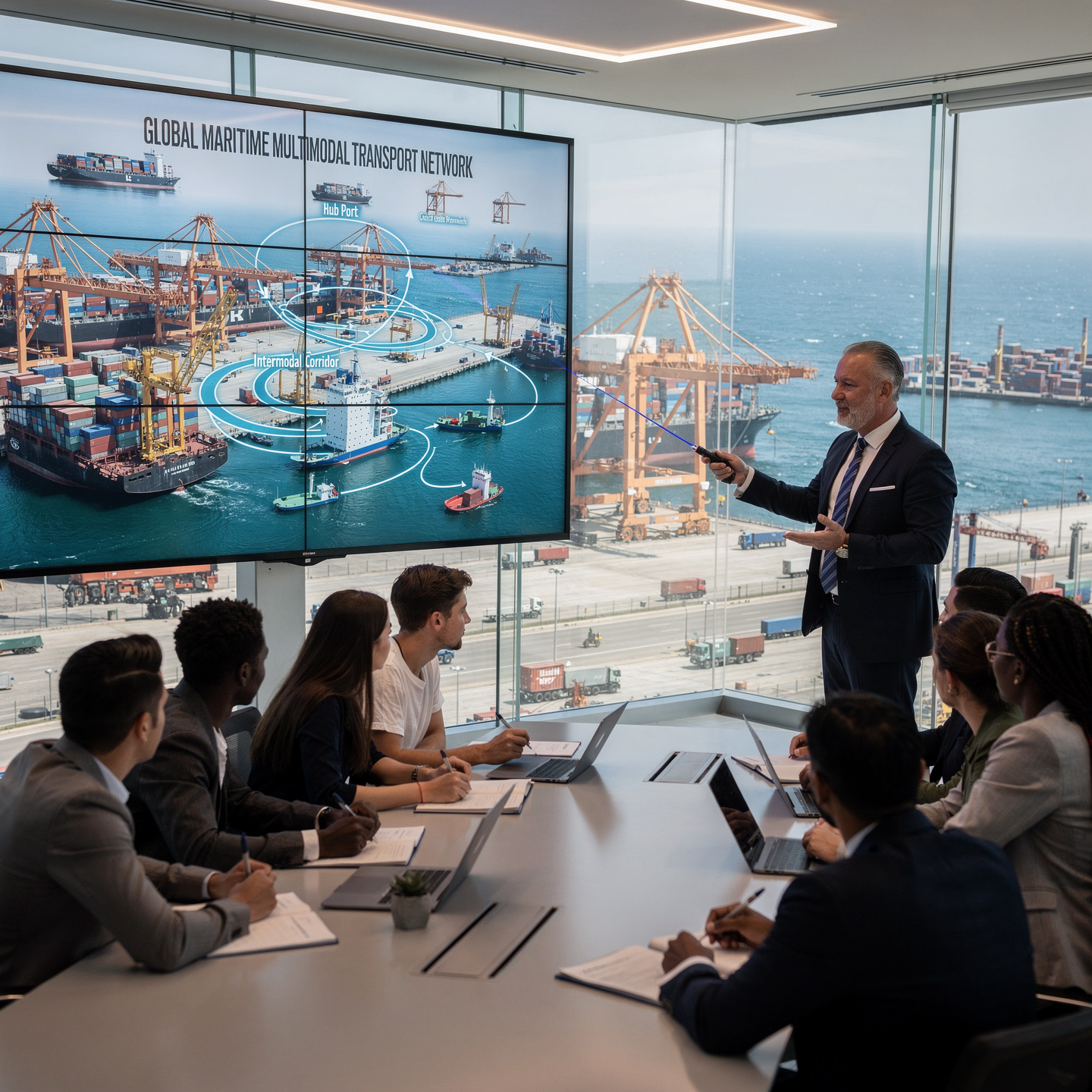
Diploma in Multimodal Maritime Transport
Why this certificate program?
The Diploma in Multimodal Maritime Transport
This program offers you a comprehensive and up-to-date overview of the global logistics chain, with an emphasis on process optimization and efficient resource management. Learn to integrate different modes of transport, from maritime to land and air, to create competitive and cost-effective logistics solutions. This program will provide you with the tools and knowledge necessary to meet the challenges of international trade and successfully lead multimodal transport projects.
Differential Advantages
- Strategic Analysis: Identify opportunities and risks in the global supply chain.
- Document Management: Master the regulations and documentation required in multimodal transport.
- Cost Optimization: Apply techniques to reduce costs and improve operational efficiency.
- Real-World Case Studies: Learn through the analysis of successful situations and projects.
- Professional Networking: Connect with experts and professionals in the sector.
- Modality: Online
- Level: Diplomado
- Hours: 800 H
- Start date: 11-06-2026
Availability: 1 in stock
Who is it aimed at?
- Logistics and international trade professionals seeking to specialize in the complexities of multimodal maritime transport.
- Executives from shipping lines, logistics operators, and freight forwarders interested in optimizing their operations and reducing costs in the supply chain.
- Importers and exporters who wish to thoroughly understand maritime and land transport regulations and policies for an efficient flow of goods.
- Port and customs professionals seeking to expand their knowledge of the latest trends and technologies in multimodal transport.
- Students and recent graduates in related fields aspiring to a successful career in the dynamic world of maritime transport and the Logistics.
Flexibility and applicability
Designed for professionals with demanding schedules: flexible online format, relevant case studies, and networking with industry experts.
Objectives and competencies

Optimizing the logistics management of maritime transport:
“To efficiently manage customs and port documentation, optimizing clearance times and minimizing the risk of delays.”

Efficiently manage customs documentation and procedures:
“Mastering customs regulations, optimizing time and minimizing the risk of penalties.”

Mastering international and local regulations in multimodal maritime transport:
“Interpreting and applying INCOTERMS in the distribution of responsibilities and costs.”

To effectively coordinate loading and unloading operations at maritime terminals:
Efficiently manage documentation, schedule resources (personnel, equipment) and ensure compliance with safety and environmental regulations, minimizing waiting times and optimizing ship rotation.

Assess and mitigate the risks inherent in multimodal maritime transport:
Implement security protocols and contingency plans for emergencies, considering climatic factors, critical routes and the nature of the cargo, with effective communication between all actors in the logistics chain.

Develop cost optimization strategies in the maritime supply chain:
“Implement route optimization models, considering variable fuel prices, port tolls, and draft restrictions.”
Curriculum - Modules
- Comprehensive Maritime Incident Management: protocols, roles, and chain of command for coordinated response
- Operational Planning and Execution: briefing, routes, weather windows, and go/no-go criteria
- Rapid Risk Assessment: criticality matrix, scene control, and decision-making under pressure
- Operational Communication: VHF/GMDSS, standardized reports, and inter-agency liaison
- Tactical Mobility and Safe Boarding: RHIB maneuvers, approach, mooring, and recovery
- Equipment and Technologies: PPE, signaling, satellite tracking, and field data logging
- Immediate Care of the Affected: primary assessment, hypothermia, trauma, and stabilization for evacuation
- Adverse Environmental Conditions: swell, Visibility, flows, and operational mitigation
Simulation and training: critical scenarios, use of VR/AR, and exercises with performance metrics
Documentation and continuous improvement: lessons learned, indicators (MTTA/MTTR), and SOP updates
- Introduction to port operations: types of ports and their functions.
- Port agents: shipping agents, freight forwarders, stevedores, tugboats.
- Port documentation: bills of lading, manifests, declarations.
- Loading and unloading operations: types of cranes and equipment, stowage, lashing.
- Chartering: types of contracts (Time Charter, Voyage Charter, Bareboat Charter).
- Essential clauses in charter contracts: laytime, demurrage, despatch.
- Marine insurance: hull and machinery policies, P&I, cargo insurance.
- Management of Marine losses: claims, general average, salvage.
- Legal and regulatory aspects of port operations and marine insurance.
- Risk management in port operations: safety, environment, security.
‘
- Introduction to Port Logistics: History, Evolution, and Current Trends
- Legal and Regulatory Framework: Port and Customs Laws and International Treaties
- Port Infrastructure: Types of Ports, Terminals, Docks, and Equipment
- Loading and Unloading Operations: Procedures, Equipment, and Safety
- Customs: Functions, Customs Regimes, Tariffs, and Taxes
- Customs Documentation: Cargo Manifests, Bills of Lading, Packing Lists, and Certificates
- Risk Management in the Supply Chain: Identification, Assessment, and Mitigation
- Multimodal Transport: Combination of Transport Modes, Documentation, and Coordination
- Storage and Inventory Management: Types of Warehouses, Management Techniques, and Optimization
- Information technologies in port logistics: management systems, traceability and security
‘
- Introduction to Maritime Logistics: Global Supply Chain and Key Players
- International Trade Documentation: Commercial Invoice, Packing List, Bill of Lading (B/L), etc.
- Incoterms 2020: Buyer and Seller Responsibilities in Maritime Transport
- Shipping Containers: Types, Dimensions, Characteristics, and Stowage
- Port Operations: Loading, Unloading, Handling, and Storage of Goods
- Multimodal Transport: Combining Maritime Transport with Other Modes (Road, Rail, Air)
- Customs and International Trade: Customs Regulations, Tariffs, Taxes, and Non-Tariff Barriers
- Special Customs Procedures: Temporary Admission, Customs Warehousing, Processing Assets/Liabilities.
- Marine Insurance: Types of policies (cargo, hull and machinery, civil liability), coverages and exclusions.
- Risk Management in the Maritime Logistics Chain: Identification, Assessment and Mitigation.
‘
- Introduction to Integrated Logistics and the Maritime Supply Chain
- International Maritime Transport: Types of Vessels, Routes, and Regulations
- Inventory Management: Inventory Models, Stock Optimization, and Cost Control
- Port Warehousing and Distribution: Loading/Unloading Operations, Storage, and Inland Transport
- Customs and Foreign Trade: Customs Procedures, Documentation, and Special Customs Regimes
- Marine Transport Insurance: Types of Policies, Coverage, and Claims Management
- Information Technologies in Maritime Logistics: Warehouse Management Systems (WMS) and Transportation Management Systems (TMS)
- Route Optimization and Cargo Planning: Optimization models, cargo consolidation, and cross-docking
Quality and safety management in the maritime supply chain: ISO standards, AEO certification, and operational safety
Sustainability and corporate social responsibility in maritime logistics‘
- System Architecture and Components: Structural design, materials, and subsystems (mechanical, electrical, electronic, and fluid) with selection and assembly criteria for marine environments
- Fundamentals and Principles of Operation: Physical and engineering foundations (thermodynamics, fluid mechanics, electricity, control, and materials) that explain performance and operating limits
- Safety and Environmental (SHE): Risk analysis, PPE, LOTO, hazardous atmospheres, spill and waste management, and emergency response plans
- Applicable Regulations and Standards: IMO/ISO/IEC requirements and local regulations;
- Conformance criteria, certification, and best practices for operation and maintenance
- Inspection, testing, and diagnostics: Visual/dimensional inspection, functional testing, data analysis, and predictive techniques (vibration, thermography, fluid analysis) to identify root causes
- Preventive and predictive maintenance: Hourly/cycle/seasonal plans, lubrication, adjustments, calibrations, consumable replacement, post-service verification, and operational reliability
- Instrumentation, tools, and metrology: Measuring and testing equipment, diagnostic software, calibration and traceability; selection criteria, safe use, and storage
- Onboard integration and interfaces: Mechanical, electrical, fluid, and data compatibility; Sealing and watertightness, EMC/EMI, corrosion protection, and interoperability testing.
Quality, acceptance testing, and commissioning: process and materials control, FAT/SAT, bench and sea trials, go/no-go criteria, and evidence documentation.
Technical documentation and integrated practice: logs, checklists, reports, and a complete case study (safety → diagnosis → intervention → verification → report) applicable to any system.
- Introduction to Port Management: Evolution, Types of Ports, Key Stakeholders
- Port and Customs Legislation: National and International Legal Framework, Incoterms
- Port Operations: Loading and Unloading, Warehousing, Stowage and Unstowage
- Customs: Customs Regimes, Documentation, Customs Valuation
- Integrated Logistics: Supply Chain, Multimodal Transport, Distribution Centers
- Port Security Management: ISPS, Access Control, Facility Protection
- Information Technologies in the Port and Logistics Sector: Management Systems, EDI, Blockchain
- Risk Management in the Port Logistics Chain: Identification, Assessment, and Mitigation
- Sustainability in Port Management: Environmental Impact, Renewable Energies, Social Responsibility
- International Trade: Trade Agreements, Tariff and Non-Tariff Barriers, Trade Facilitation
‘
Career opportunities
- Multimodal Logistics Specialist: Coordination of sea, land, and air transport, route optimization, and supply chain management.
- Port Operations Manager: Planning and supervision of loading and unloading, terminal management, and coordination with shipping agents.
- Maritime Transport Analyst: Evaluation of costs, risks, and efficiency in multimodal transport operations.
- International Trade Manager: Management of customs documentation, import and export procedures, and compliance with international regulations.
- Multimodal Transport Consultant: Advising companies on transport strategies, mode selection, and logistics chain optimization.
- Transport Insurance Specialist: Risk assessment, claims management, and procurement of insurance policies for multimodal transport.
- Planner of
- Maritime routes: Design of efficient routes, considering factors such as weather conditions, navigation restrictions, and fuel costs.
- Port infrastructure project manager: Participation in expansion and modernization projects for ports, terminals, and logistics distribution centers.
“`
Admission requirements

Academic/professional profile:
Degree/Bachelor's degree in Nautical Science/Maritime Transport, Naval/Marine Engineering, or a related field; or proven professional experience in bridge/operations.

Language proficiency:
Recommended functional maritime English (SMCP) for simulations and technical materials.

Documentation:
Updated resume, copy of degree or seaman's book, ID card/passport, letter of motivation.

Technical requirements (for online):
Equipment with camera/microphone, stable connection, ≥ 24” monitor recommended for ECDIS/Radar-ARPA.
Admission process and dates

1. Online
application
(form + documents).

2. Academic review and interview
(profile/objectives/schedule compatibility).

3. Admission decision
(+ scholarship proposal if applicable).

4. Reservation of place
(deposit) and registration.

5. Induction
(access to campus, calendars, simulator guides).
Scholarships and grants
- Comprehensive Mastery: Delve into the logistics chain of multimodal maritime transport, from strategic planning to operational execution.
- Legal and Regulatory Framework: Understand the international regulations, transport contracts, and risk management associated with the sector.
- Optimization and Efficiency: Learn to optimize routes, reduce costs, and improve efficiency in cargo and transport management.
- Disruptive Technologies: Explore the latest technological trends, such as blockchain, the IoT and automation applied to maritime transport. Professional Development: Boost your career with tools and knowledge applicable to strategic decision-making in the maritime sector. Prepare to lead the transformation of maritime transport with a global and strategic vision.
Testimonials
The Diploma in Multimodal Maritime Transport exceeded my expectations. I gained a solid understanding of port logistics, supply chain management, and international regulations, enabling me to optimize my company’s operations and negotiate more favorable contracts. Thanks to the hands-on training and networking with industry professionals, I was promoted to International Logistics Manager just six months after completing the program.
The Diploma in Logistics & Freight Transport provided me with the necessary tools and knowledge to optimize my company’s distribution routes, resulting in a 15% reduction in logistics costs and a 10% increase in delivery efficiency in the last quarter.
The Diploma in Multimodal Maritime Transport exceeded my expectations. I gained in-depth, practical knowledge of the comprehensive management of the maritime logistics chain, from contracting to final delivery, including crucial aspects such as documentation, insurance, and international regulations. Thanks to the tools and knowledge I acquired, I was able to implement significant improvements in my company’s logistics management, optimizing time and reducing costs.
This diploma program provided me with the necessary tools to optimize my company’s logistics chain. Thanks to the knowledge I gained in multimodal maritime transport, we were able to reduce shipping costs by 15% and increase delivery efficiency by 20%. The practical training and the instructors’ experience were key to my success.

Frequently asked questions
Maritime transport.
Yes. The itinerary includes ECDIS/Radar-ARPA/BRM with harbor, ocean, fog, storm, and SAR scenarios.
Online with live sessions; hybrid option for simulator/practical placements through agreements.
Maritime transport.
Recommended functional SMCP. We offer support materials for standard phraseology.
Yes, with a relevant degree or experience in maritime/port operations. The admissions interview will confirm suitability.
Optional (3–6 months) through Companies & Collaborations and the Alumni Network.
Simulator practice (rubrics), defeat plans, SOPs, checklists, micro-tests and applied TFM.
A degree from Navalis Magna University + operational portfolio (tracks, SOPs, reports and KPIs) useful for audits and employment.
- Introduction to the Multimodal Logistics Chain: Definition, Actors, and Flows
- Legal and Regulatory Framework: International Agreements, National and Customs Regulations
- Land Transport: Trucks, Railways, Route Regulation and Optimization
- Sea Transport: Types of Vessels, Ports, Loading/Unloading Operations, and Container Management
- Air Transport: Airports, Air Cargo, Security, and IATA Regulations
- Inland Waterway and Pipeline Transport: Characteristics, Advantages, and Limitations
- Logistics Infrastructure: Dry Ports, Logistics Platforms, Distribution Centers
- Documentation in Multimodal Transport: Bill of Lading, Air Waybill, CMR, Single Administrative Document (SAD), and Other Relevant Documents
- Insurance and Civil Liability in the Supply Chain Multimodal logistics
Sustainability in the logistics chain: emissions reduction and energy efficiency
‘
Request information
Complete the Application Form.
Attach your CV/degree certificate (if you have it to hand).
Indicate your preferred cohort (January/May/September) and whether you would like the hybrid option with simulator sessions.
An academic advisor will contact you within 24–48 hours to guide you through the admission process, scholarships, and compatibility with your professional schedule.
Faculty
Eng. Tomás Riera
Full Professor
Eng. Tomás Riera
Full Professor
Eng. Sofía Marquina
Full Professor
Eng. Sofía Marquina
Full Professor
Eng. Javier Bañuls
Full Professor
Eng. Javier Bañuls
Full Professor
Dr. Nuria Llobregat
Full Professor
Dr. Nuria Llobregat
Full Professor
Dr. Pau Ferrer
Full Professor
Dr. Pau Ferrer
Full Professor
Cap. Javier Abaroa (MCA)
Full Professor
Cap. Javier Abaroa (MCA)
Full Professor

