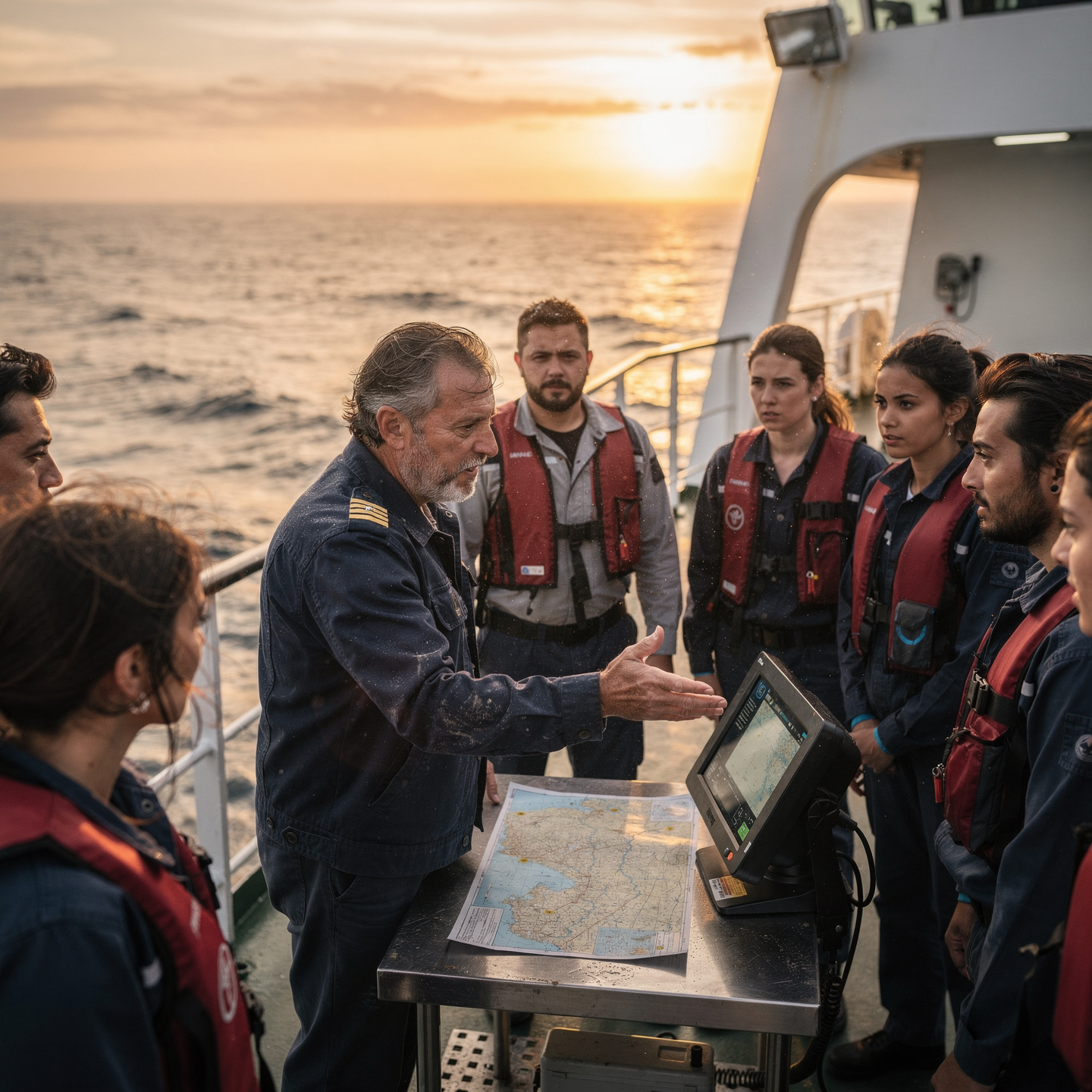
Diploma in Offshore Team Management
Why this certificate program?
The Diploma in Offshore Team Management
This program prepares you to lead successfully in complex and challenging maritime environments. Learn to optimize your team’s performance, ensuring safety and efficiency in offshore operations. This program provides you with tools and strategies for personnel management, critical decision-making, and effective communication under pressure. Master safety protocols, risk management, and best practices for building a cohesive, high-performing team in the maritime industry.
Differentiating Advantages
- Situational Leadership: Adapt your leadership style to the needs of the team and the environment.
- Crisis Management: Develop skills to respond effectively to emergency situations.
- Intercultural Communication: Learn to communicate with diverse teams and overcome cultural barriers.
- Human Resource Management: Optimize task allocation and staff professional development.
- Practical Simulations: Apply the knowledge acquired in realistic offshore scenarios.
- Modality: Online
- Level: Diplomado
- Hours: 800 H
- Start date: 30-09-2026
Availability: 1 in stock
Who is it aimed at?
- Supervisors and team coordinators on oil platforms, offshore wind farms, and construction vessels seeking to optimize performance, communication, and safety.
- Offshore engineers, technicians, and specialists who wish to develop leadership and personnel management skills in complex and demanding environments.
- Department heads and project managers who need to strengthen their capabilities in decision-making, conflict resolution, and motivating multidisciplinary teams.
- HR and HSE professionals involved in offshore personnel management seeking to update their knowledge of best practices in team management and occupational risk prevention.
- Any professional with leadership potential in the offshore sector who aspires to advance your career and take on team management responsibilities.
Flexibility and applicability
Designed for working professionals: adaptable online format, practical case studies based on offshore realities, and networking with industry experts.
Objectives and competencies

Promote team cohesion and optimal performance:
“Establish clear and effective communication, promoting trust and collaboration to achieve common goals, resolving conflicts constructively, and celebrating team successes.”

Effectively manage available resources in challenging situations:
Anticipate risks, evaluate options and make timely decisions prioritizing navigational safety and environmental protection.

Leading and motivating the crew towards success on sea voyages:
“Promoting effective communication and collaborative decision-making in high-pressure situations, prioritizing the safety and well-being of the crew.”

Making strategic and operational decisions under pressure:
Assess risks, prioritize actions, and effectively communicate decisions to the team, while remaining calm and clear under time or situational pressure.

Implement rigorous safety protocols for the protection of the crew and the vessel:
“Establish inspection and preventive maintenance routines, conduct emergency drills (fire, abandonment, man overboard) and ensure compliance with ISM/PBIP regulations.”

Optimize communication and coordination among team members:
Implement agile project management methodologies, promoting transparency, continuous feedback, and flexible adaptation to change.
Curriculum - Modules
- Comprehensive Maritime Incident Management: protocols, roles, and chain of command for coordinated response
- Operational Planning and Execution: briefing, routes, weather windows, and go/no-go criteria
- Rapid Risk Assessment: criticality matrix, scene control, and decision-making under pressure
- Operational Communication: VHF/GMDSS, standardized reports, and inter-agency liaison
- Tactical Mobility and Safe Boarding: RHIB maneuvers, approach, mooring, and recovery
- Equipment and Technologies: PPE, signaling, satellite tracking, and field data logging
- Immediate Care of the Affected: primary assessment, hypothermia, trauma, and stabilization for evacuation
- Adverse Environmental Conditions: swell, Visibility, flows, and operational mitigation
Simulation and training: critical scenarios, use of VR/AR, and exercises with performance metrics
Documentation and continuous improvement: lessons learned, indicators (MTTA/MTTR), and SOP updates
- Definition and Leadership Styles: Transformational, situational, and adaptive leadership in marine environments.
- Effective Communication at Sea: Verbal and nonverbal communication, active listening, and constructive feedback.
- Time Management and Prioritization: Time management techniques, prioritization, and effective delegation.
- Stress Management Techniques: Identifying sources of stress, relaxation techniques, and mindfulness.
- Emotional Intelligence: Self-awareness, self-regulation, empathy, and social skills in the marine context.
- Conflict Resolution and Negotiation: Conflict resolution strategies, collaborative negotiation, and disagreement management.
- Motivation and Team Development: Theories of motivation and fostering teamwork Teamwork and development of individual potential.
Decision-making under pressure: Decision-making process, risk assessment, and uncertainty management.
Communication in emergency situations: Communication protocols, clarity, and precision in information transmission.
Resilience and adaptation to change: Developing resilience, adapting to changing environments, and managing uncertainty in the maritime industry.
‘
- Introduction to Situational Leadership: Concepts and Models
- Leadership Theory: Leadership Styles and Their Application
- Situational Diagnosis: Team and Task Assessment
- Leadership Adaptation: Flexibility and Effective Communication
- Motivation and Empowerment: Developing Team Potential
- Fundamentals of Crisis Management in the Maritime Environment
- Risk Identification: Threat Analysis and Assessment
- Response Planning: Strategies and Action Protocols
- Crisis Communication: Transparency and Information Management
- Decision-Making Under Pressure: Leadership in Critical Situations
‘
- Introduction to Situational Leadership: Models and Approaches
- Diagnosing Situations: Team and Task Assessment
- Leadership Styles: Directing, Coaching, Supporting, and Delegating
- Leadership Adaptation: Flexibility and Responsiveness
- Effective Communication: Active Listening, Feedback, and Clarity of Messages
- Conflict Management: Identification, Analysis, and Strategies
- Negotiation and Problem Solving: Techniques and Tools
- Mediation: The Leader’s Role as Facilitator and Conciliator
- Emotional Intelligence: Self-Awareness, Regulation, and Empathy
- Culture of Collaboration and High Performance: Fostering Respect and Trust
‘
- Introduction to Situational Leadership: Models and Evolution
- Situational Diagnosis: Assessing Team Maturity and Competence
- Leadership Styles: Directive, Coaching, Supportive, Delegating
- Leadership Adaptation: Flexibility According to the Situation and the Individual
- Assertive Communication: Active Listening, Effective Feedback, Handling Objections
- Nonverbal Communication: Body Language, Tone, Facial Expression
- Conflict Management: Identification, Resolution, Negotiation
- Emotional Intelligence: Self-Awareness, Self-Management, Empathy, Social Skills
- Communication in Crisis Situations: Clarity, Conciseness, Transparency
- Intercultural Communication: Sensitivity, Respect, Adaptation to Different Maritime Cultures
‘
- System Architecture and Components: Structural design, materials, and subsystems (mechanical, electrical, electronic, and fluid) with selection and assembly criteria for marine environments
- Fundamentals and Principles of Operation: Physical and engineering foundations (thermodynamics, fluid mechanics, electricity, control, and materials) that explain performance and operating limits
- Safety and Environmental (SHE): Risk analysis, PPE, LOTO, hazardous atmospheres, spill and waste management, and emergency response plans
- Applicable Regulations and Standards: IMO/ISO/IEC requirements and local regulations;
- Conformance criteria, certification, and best practices for operation and maintenance
- Inspection, testing, and diagnostics: Visual/dimensional inspection, functional testing, data analysis, and predictive techniques (vibration, thermography, fluid analysis) to identify root causes
- Preventive and predictive maintenance: Hourly/cycle/seasonal plans, lubrication, adjustments, calibrations, consumable replacement, post-service verification, and operational reliability
- Instrumentation, tools, and metrology: Measuring and testing equipment, diagnostic software, calibration and traceability; selection criteria, safe use, and storage
- Onboard integration and interfaces: Mechanical, electrical, fluid, and data compatibility; Sealing and watertightness, EMC/EMI, corrosion protection, and interoperability testing.
Quality, acceptance testing, and commissioning: process and materials control, FAT/SAT, bench and sea trials, go/no-go criteria, and evidence documentation.
Technical documentation and integrated practice: logs, checklists, reports, and a complete case study (safety → diagnosis → intervention → verification → report) applicable to any system.
- Introduction to Performance Management: Definition, Objectives, and Benefits.
- The Performance Management Cycle: Planning, Monitoring, Evaluation, and Development.
- Setting SMART Goals: Specific, Measurable, Achievable, Relevant, and Time-bound.
- Effective Feedback Techniques: Constructive Communication, Recognition, and Areas for Improvement.
- Performance Appraisal: Methods, Tools, and Common Biases.
- Situational Leadership: Hersey and Blanchard’s Model, Adaptability, and Diagnosis.
- Leadership Styles: Directive, Coaching, Supportive, and Delegating.
- Developing Leadership Skills: Communication, Motivation, Delegation, and Conflict Resolution.
- Talent Management: Employee Identification, Development, and Retention high potential.
- Individual Development Plans: Design, Implementation, and Monitoring.
‘
Career opportunities
- Offshore Platform Team Manager: Leading multidisciplinary teams, coordinating complex operations, and managing human and material resources.
- Offshore Maritime Operations Supervisor: Planning and executing projects, ensuring quality control, safety, and regulatory compliance.
- Offshore Logistics and Maritime Transport Coordinator: Optimizing routes, managing the supply chain, and negotiating with suppliers and clients.
- Offshore Team and Project Management Consultant: Advising companies in the sector on improving efficiency, productivity, and safety.
- Trainer in Leadership and Team Management in Marine Environments: Developing training programs, delivering courses and workshops, and evaluating performance.
- Occupational Safety and Risk Prevention Specialist at Sea: Implementing safety protocols, investigating accidents, and providing training in Risk prevention.
- Internal Auditor in offshore maritime companies: Verification of compliance with standards and procedures, identification of areas for improvement, preparation of reports and recommendations.
- Human Resources Manager in offshore maritime companies: Selection, recruitment, training and development of personnel, payroll and benefits management, labor relations.
“`
Admission requirements

Academic/professional profile:
Degree/Bachelor's degree in Nautical Science/Maritime Transport, Naval/Marine Engineering, or a related field; or proven professional experience in bridge/operations.

Language proficiency:
Recommended functional maritime English (SMCP) for simulations and technical materials.

Documentation:
Updated resume, copy of degree or seaman's book, ID card/passport, letter of motivation.

Technical requirements (for online):
Equipment with camera/microphone, stable connection, ≥ 24” monitor recommended for ECDIS/Radar-ARPA.
Admission process and dates

1. Online
application
(form + documents).

2. Academic review and interview
(profile/objectives/schedule compatibility).

3. Admission decision
(+ scholarship proposal if applicable).

4. Reservation of place
(deposit) and registration.

5. Induction
(access to campus, calendars, simulator guides).
Scholarships and grants
- Strategic Maritime Leadership: Master the techniques for managing diverse and multicultural teams in challenging onboard environments.
- Effective Communication: Learn to convey clear instructions, resolve conflicts, and foster a collaborative work environment.
- Critical Decision Making: Develop skills to assess risks, make quick decisions, and confidently manage emergency situations.
- Performance Management: Implement strategies to motivate your crew, set clear objectives, and optimize performance at sea.
- Maritime Legal Framework: Understand international regulations and the legal responsibilities associated with leading onboard teams.
Testimonials
This diploma program provided me with the crucial tools and knowledge to lead offshore teams more effectively. I learned to manage complex logistics, mitigate risks specific to the offshore environment, and, above all, foster cohesion and high performance in teams working under pressure and in challenging conditions. Thanks to the training I received, I was able to optimize my team’s productivity by 15% and significantly reduce safety incidents in our last drilling campaign.
This diploma program provided me with the tools and perspectives necessary to significantly improve my leadership. I learned to manage teams more effectively, communicate more clearly, and motivate my crews to achieve common goals, resulting in a 15% increase in productivity and a notable improvement in the work environment.
“This diploma program provided me with the tools and knowledge necessary to effectively lead my team at sea. Thanks to the strategies I learned on effective communication, conflict management, and situational leadership, we increased productivity by 15% and reduced safety incidents by 10% in the last quarter. I feel much more confident in my role and better able to make assertive decisions in complex environments.”
“The Diploma in Offshore Team Management provided me with the tools and knowledge necessary to successfully lead a drilling team in challenging conditions. The training in crisis management, effective communication, and operational safety allowed me to optimize productivity and minimize risks, resulting in a 20% reduction in reported incidents and a 15% increase in operational efficiency during the last quarter. I highly recommend this program to any professional looking to excel in the offshore industry.”

Frequently asked questions
Maritime work environments, especially those related to offshore equipment.
Yes. The itinerary includes ECDIS/Radar-ARPA/BRM with harbor, ocean, fog, storm, and SAR scenarios.
Online with live sessions; hybrid option for simulator/practical placements through agreements.
Human team management.
Recommended functional SMCP. We offer support materials for standard phraseology.
Yes, with a relevant degree or experience in maritime/port operations. The admissions interview will confirm suitability.
Optional (3–6 months) through Companies & Collaborations and the Alumni Network.
Simulator practice (rubrics), defeat plans, SOPs, checklists, micro-tests and applied TFM.
A degree from Navalis Magna University + operational portfolio (tracks, SOPs, reports and KPIs) useful for audits and employment.
- Introduction to Situational Leadership: Models and Approaches
- Diagnosing the Level of Development: Team and Task Assessment
- Situational Leadership Styles: Directing, Coaching, Supporting, and Delegating
- Leadership Adaptation: Flexibility and Adjustment to Team Needs
- Effective Communication: Active Listening, Feedback, and Clarity of Instructions
- Effective Delegation: Assigning Responsibilities and Empowering
- Conflict Management: Identification, Analysis, and Resolution
- Conflict Resolution Strategies: Negotiation, Mediation, and Arbitration
- Conflict Prevention: Establishing Norms and Communication Channels
- Leadership in Crisis Situations: Decision-Making Under Pressure and Stress Management
‘
Request information
Complete the Application Form.
Attach your CV/degree certificate (if you have it to hand).
Indicate your preferred cohort (January/May/September) and whether you would like the hybrid option with simulator sessions.
An academic advisor will contact you within 24–48 hours to guide you through the admission process, scholarships, and compatibility with your professional schedule.
Faculty
Eng. Tomás Riera
Full Professor
Eng. Tomás Riera
Full Professor
Eng. Sofía Marquina
Full Professor
Eng. Sofía Marquina
Full Professor
Eng. Javier Bañuls
Full Professor
Eng. Javier Bañuls
Full Professor
Dr. Nuria Llobregat
Full Professor
Dr. Nuria Llobregat
Full Professor
Dr. Pau Ferrer
Full Professor
Dr. Pau Ferrer
Full Professor
Cap. Javier Abaroa (MCA)
Full Professor
Cap. Javier Abaroa (MCA)
Full Professor

