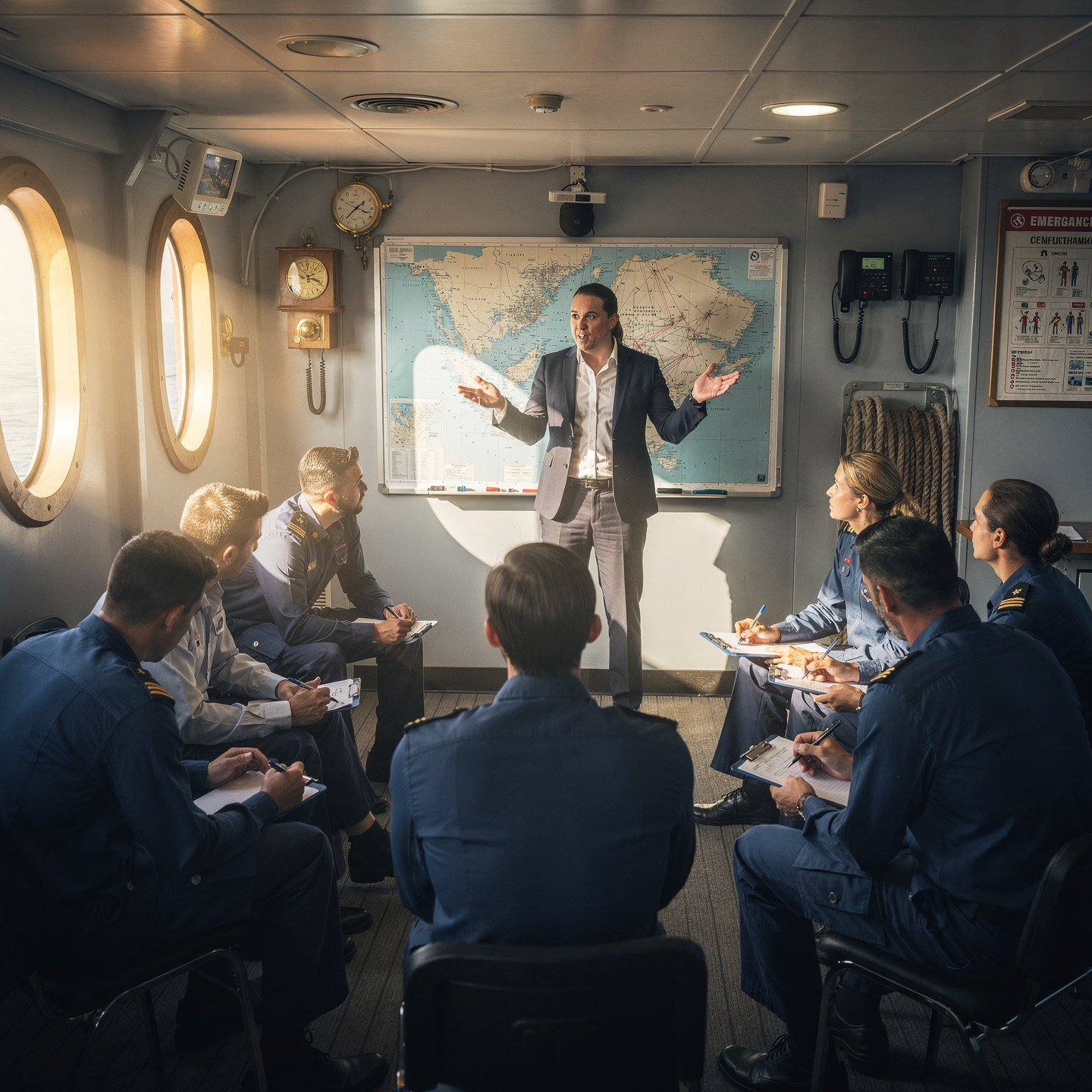
Diploma in Crew Psychology and Conflict Resolution

Why this certificate program?

The Diploma in Crew Psychology and Conflict Resolution

This program provides you with the essential tools to effectively manage interpersonal dynamics in high-pressure environments. Learn to identify and address the psychological factors that influence crew performance and well-being, transforming challenges into opportunities to build cohesive and resilient teams. This program will equip you with the skills needed to prevent, mediate, and resolve conflicts, fostering a positive and productive work environment.

Differential Advantages

  • Analysis of Individual and Group Psychology: Understand the motivations, behaviors, and needs of crew members.
  • Effective Communication Strategies: Master techniques for clear, empathetic, and assertive communication in stressful situations.
  • Management of Interpersonal and Workplace Conflicts: Learn to identify the underlying causes of conflicts and apply constructive resolution methods.
  • Development of Positive Leadership: Foster leadership that promotes trust, respect, and collaboration within the team.
  • Practical Application Through Real-World Case Studies: Analyze real-life situations and develop effective solutions for the crew’s everyday challenges.
PsicologĂ­a

Diploma in Crew Psychology and Conflict Resolution

Availability: 1 in stock

Who is it aimed at?

  • Officers and supervisors seeking to improve the work environment, manage multicultural teams, and optimize onboard communication.
  • Human resources and fleet management personnel interested in reducing turnover, promoting mental well-being, and preventing interpersonal conflicts.
  • Onboard doctors and nurses wishing to deepen their understanding of crew mental health and develop crisis intervention skills.
  • Captains and chief engineers aspiring to lead with emotional intelligence, resolve disputes effectively, and foster a safe and productive work environment.
  • Psychology students and professionals seeking specialization in the maritime context, acquiring tools to address specific problems of life at sea. mar.

Flexibility for working professionals:
Designed to fit demanding schedules: live online classes, 24/7 access to study materials, and personalized tutoring.

PsicologĂ­a

Objectives and competencies

Optimizing stress management and psychological well-being:

“Implementing mindfulness and emotional management techniques to cope with high-pressure and fatigue situations, fostering a safe and collaborative work environment.”

Implement effective communication and mediation strategies:

Establish clear channels and communication protocols (internal/external) for conflict resolution and crisis situations.

Develop leadership skills and group cohesion:

Promote assertive communication, effective delegation, and collaborative conflict resolution within the team.

Assess and mitigate psychosocial risks in high-pressure environments:

Implement assertive communication and stress management protocols to foster individual and collective resilience.

Intervening in crisis and emergency situations with psychological protocols:

“Implement emotional stabilization techniques, prioritizing safety and applying psychological first aid.”

Analyze and improve interpersonal dynamics and the work environment:

Implement assertive communication and conflict resolution strategies, fostering empathy and mutual respect.

Curriculum - Modules

  1. Comprehensive Maritime Incident Management: protocols, roles, and chain of command for coordinated response
  2. Operational Planning and Execution: briefing, routes, weather windows, and go/no-go criteria
  3. Rapid Risk Assessment: criticality matrix, scene control, and decision-making under pressure
  4. Operational Communication: VHF/GMDSS, standardized reports, and inter-agency liaison
  5. Tactical Mobility and Safe Boarding: RHIB maneuvers, approach, mooring, and recovery
  6. Equipment and Technologies: PPE, signaling, satellite tracking, and field data logging
  7. Immediate Care of the Affected: primary assessment, hypothermia, trauma, and stabilization for evacuation
  8. Adverse Environmental Conditions: swell, Visibility, flows, and operational mitigation

    Simulation and training: critical scenarios, use of VR/AR, and exercises with performance metrics

    Documentation and continuous improvement: lessons learned, indicators (MTTA/MTTR), and SOP updates

  1. Introduction to Aviation Psychology: History, scope, and applications.
  2. Human Factors in Aviation: SHEL Model, CRM, and ergonomics.
  3. Stress and Fatigue in the Aviation Environment: Identification, prevention, and management.
  4. Effective Communication: Active listening, assertiveness, and nonverbal communication in the cockpit.
  5. Decision-Making in Critical Situations: Cognitive biases, heuristics, and situational analysis.
  6. Leadership and Teamwork: Roles, responsibilities, and group dynamics in the crew.
  7. In-Flight Crisis Management: Procedures, coordination, and communication with ground control.
  8. Emergency and Survival Psychology: Mental preparation, coping, and Resilience.
  9. Safety Culture: Incident reporting, organizational learning, and continuous improvement.
  10. Legal and ethical aspects: Professional responsibility, confidentiality, and staff well-being.

  1. Introduction to Psychological Well-being: Definition, Components, and Relevance in High-Pressure Environments.
  2. Assertive Communication: Principles, Techniques, and Its Impact on Conflict Management.
  3. Stress: Nature, Causes, and Consequences in Personal and Professional Life.
  4. Identifying Stress Factors in High-Pressure Environments: Analysis of the Work and Personal Context.
  5. Stress Coping Techniques: Cognitive, Emotional, and Behavioral Strategies.
  6. Emotional Regulation: Tools for Managing Anxiety, Frustration, and Anger.
  7. Effective Communication Skills: Active Listening, Empathy, and Clear Expression of Ideas.
  8. Setting Boundaries and Time Management: Prioritizing Tasks and Efficient Delegation.
  9. Developing Resilience: Adaptability and overcoming adversity.
  10. Self-care and healthy habits: promoting physical, mental, and social well-being.

  1. Introduction to Human Factors: Definition, scope, and importance in the maritime environment.
  2. Effective Communication: Barriers to communication, active listening, nonverbal communication, and assertiveness.
  3. Teamwork: Roles, responsibilities, synergy, and coordination within the crew.
  4. Stress Management: Identifying stressors, coping techniques, and resilience.
  5. Situational Awareness: Perception, understanding, projection, and decision-making under pressure.
  6. Leadership and Authority: Leadership styles, delegation, motivation, and conflict management.
  7. Safety Culture: Promoting a preventative culture, incident reporting, and continuous improvement.
  8. Fatigue and Rhythms
  9. Circadian Rhythms: Impact on performance, sleep management, and mitigation strategies.

    Crisis Decision-Making: Risk assessment, action prioritization, and emergency communication.

    Legislation and Regulations: Compliance with national and international regulations on human factors.

  1. Introduction to Human Factors in the Maritime Environment.
  2. Effective Communication: Active Listening, Assertiveness, and Clarity.
  3. Situational Awareness: Perception, Understanding, and Projection.
  4. Decision-Making: Models, Cognitive Biases, and Risk Analysis.
  5. Leadership and Teamwork: Roles, Responsibilities, and Synergy.
  6. Stress Management: Identification, Prevention, and Coping.
  7. Fatigue: Causes, Effects, and Mitigation Strategies.
  8. Safety Culture: Reporting, Feedback, and Continuous Improvement.
  9. Intercultural Communication: Cultural Differences and Adaptation.
  10. Dispute Resolution conflicts: negotiation, mediation, and escalation.

  1. System Architecture and Components: Structural design, materials, and subsystems (mechanical, electrical, electronic, and fluid) with selection and assembly criteria for marine environments
  2. Fundamentals and Principles of Operation: Physical and engineering foundations (thermodynamics, fluid mechanics, electricity, control, and materials) that explain performance and operating limits
  3. Safety and Environmental (SHE): Risk analysis, PPE, LOTO, hazardous atmospheres, spill and waste management, and emergency response plans
  4. Applicable Regulations and Standards: IMO/ISO/IEC requirements and local regulations;
  5. Conformance criteria, certification, and best practices for operation and maintenance
  6. Inspection, testing, and diagnostics: Visual/dimensional inspection, functional testing, data analysis, and predictive techniques (vibration, thermography, fluid analysis) to identify root causes
  7. Preventive and predictive maintenance: Hourly/cycle/seasonal plans, lubrication, adjustments, calibrations, consumable replacement, post-service verification, and operational reliability
  8. Instrumentation, tools, and metrology: Measuring and testing equipment, diagnostic software, calibration and traceability; selection criteria, safe use, and storage
  9. Onboard integration and interfaces: Mechanical, electrical, fluid, and data compatibility; Sealing and watertightness, EMC/EMI, corrosion protection, and interoperability testing.

    Quality, acceptance testing, and commissioning: process and materials control, FAT/SAT, bench and sea trials, go/no-go criteria, and evidence documentation.

    Technical documentation and integrated practice: logs, checklists, reports, and a complete case study (safety → diagnosis → intervention → verification → report) applicable to any system.

  1. Introduction to Human Factors: definition, impact on maritime safety
  2. Effective Communication: active listening, assertiveness, clarity, and conciseness
  3. Situational Leadership: leadership styles, adapting to the crew and the situation
  4. Teamwork: roles, responsibilities, synergy, and cooperation
  5. Situational Awareness: perception, understanding, and projection
  6. Decision-making: models, cognitive biases, risk management
  7. Stress and Fatigue Management: identification, prevention, and mitigation
  8. Safety Culture: error reporting, organizational learning, continuous improvement
  9. Communication in Emergency Situations: protocols, clarity, and effectiveness
  10. Bridge Resource Management (BRM): applying the principles on the bridge command

Career opportunities

  • Crew Psychologist in Shipping Companies: Selection, evaluation, and psychological support for crew members.
  • Onboard Conflict Mediator: Management and resolution of interpersonal and group conflicts in maritime environments.
  • Human Resources Consultant for Companies in the Maritime Sector: Improvement of the work environment, stress management, and burnout prevention.
  • Trainer in Communication and Conflict Resolution Skills: Training crews in team management and leadership.
  • Maritime Safety Advisor: Analysis of human factors in accidents and development of prevention strategies.
  • Researcher in Maritime Psychology: Study of human behavior in maritime environments and development of interventions.
  • Occupational Risk Prevention Technician in the Maritime Sector: Identification and evaluation of psychosocial risks On board.
  • Personal coach for crew members: developing coping skills and stress management in maritime life.

“`

Admission requirements

Academic/professional profile:

Degree/Bachelor's degree in Nautical Science/Maritime Transport, Naval/Marine Engineering, or a related field; or proven professional experience in bridge/operations.

Language proficiency:

Recommended functional maritime English (SMCP) for simulations and technical materials.

Documentation:

Updated resume, copy of degree or seaman's book, ID card/passport, letter of motivation.

Technical requirements (for online):

Equipment with camera/microphone, stable connection, ≥ 24” monitor recommended for ECDIS/Radar-ARPA.

Admission process and dates

1. Online
application

(form + documents).

2. Academic review and interview

(profile/objectives/schedule compatibility).

3. Admission decision

(+ scholarship proposal if applicable).

4. Reservation of place

(deposit) and registration.

5. Induction

(access to campus, calendars, simulator guides).

Scholarships and grants

  • Understand individual and group psychology in the maritime environment, crucial for crew well-being and performance.
  • Master effective communication and conflict resolution techniques, minimizing risks and optimizing onboard coexistence.
  • Apply strategies for stress management, burnout prevention, and promoting a healthy work environment.
  • Develop leadership and team management skills, fostering cohesion and superior performance in challenging situations.
  • Acquire practical tools for crisis intervention and managing onboard emergencies.
Prepare to be a leader in crew well-being, creating a safe and productive work environment.

Testimonials

Frequently asked questions

Managing and resolving conflicts within a crew team, considering the psychological aspects of its members.

Yes. The itinerary includes ECDIS/Radar-ARPA/BRM with harbor, ocean, fog, storm, and SAR scenarios.

Online with live sessions; hybrid option for simulator/practical placements through agreements.

Professionals who work with crews, such as in aviation, navigation, or work teams in high-pressure environments.

Recommended functional SMCP. We offer support materials for standard phraseology.

Yes, with a relevant degree or experience in maritime/port operations. The admissions interview will confirm suitability.

Optional (3–6 months) through Companies & Collaborations and the Alumni Network.

Simulator practice (rubrics), defeat plans, SOPs, checklists, micro-tests and applied TFM.

A degree from Navalis Magna University + operational portfolio (tracks, SOPs, reports and KPIs) useful for audits and employment.

  1. Introduction to Human Factors: definition, impact, and models.
  2. Effective Communication: active listening, assertiveness, and constructive feedback.
  3. Teamwork: roles, responsibilities, coordination, and leadership.
  4. Situational Awareness: perception, understanding, and projection.
  5. Decision-Making Under Pressure: heuristics, biases, and strategies.
  6. Stress and Fatigue Management: impact on performance and coping strategies.
  7. Types of Crises: natural, technological, human, and reputational.
  8. Crisis Management Planning: risk identification, protocols, and resources.
  9. Crisis Communication: transparency, empathy, and Information management.
  10. Post-crisis recovery: analysis, learning, and continuous improvement.

Request information

  1. Complete the Application Form.

  2. Attach your CV/degree certificate (if you have it to hand).

  3. Indicate your preferred cohort (January/May/September) and whether you would like the hybrid option with simulator sessions.

    An academic advisor will contact you within 24–48 hours to guide you through the admission process, scholarships, and compatibility with your professional schedule.

Please enable JavaScript in your browser to complete this form.
Click or drag a file to this area to upload.

Faculty

0
    0
    Tu carrito
    Tu carrito esta vacĂ­oRegresar a la tienda
    Scroll to Top


