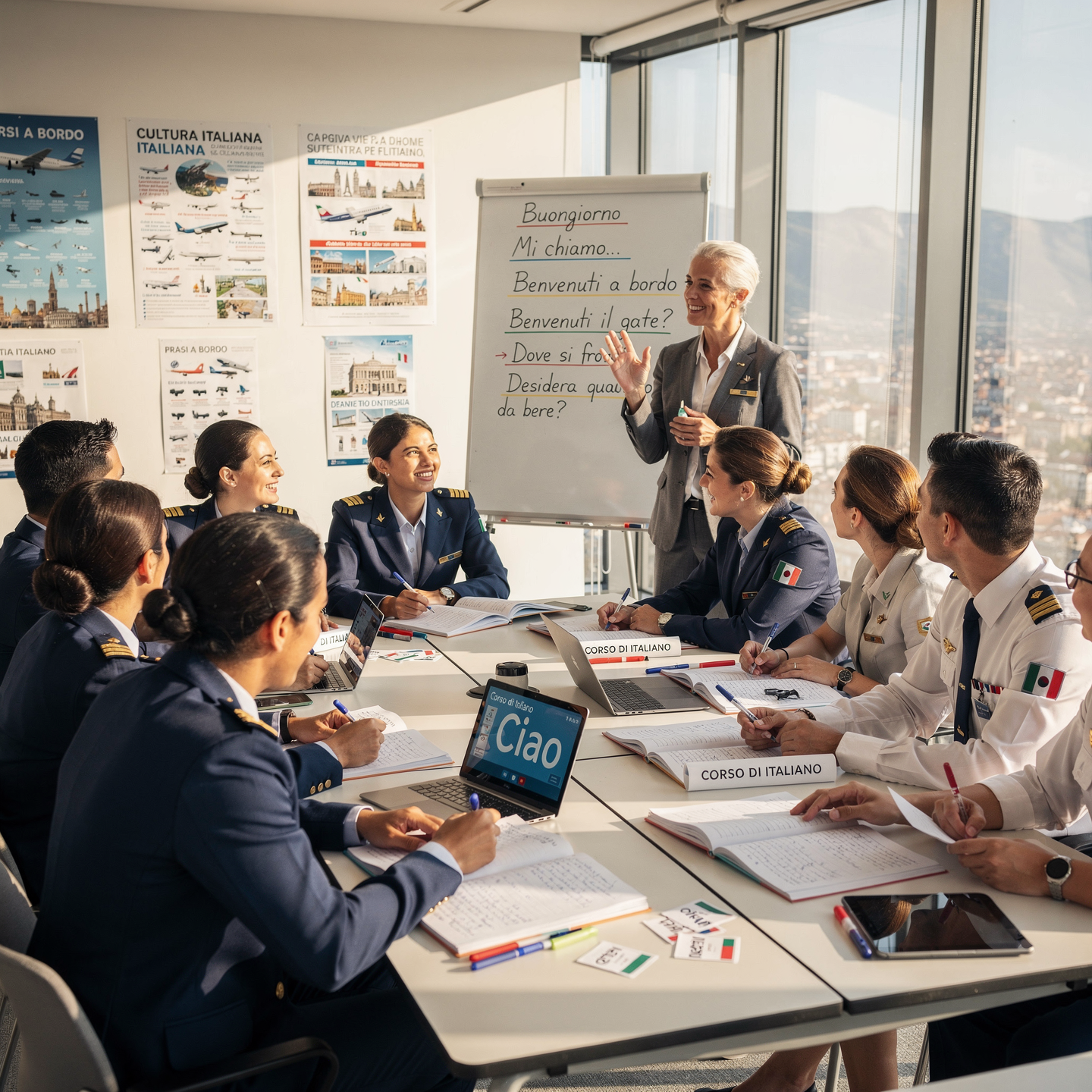
Course on Technical Terms in Italian
Why this course?
The Technical Terms in Italian
course
Immerses you in the essential vocabulary to communicate confidently in Italian professional environments. Learn to master the specific terminology of your sector, from engineering and marketing to design and gastronomy. This program provides you with the necessary tools to communicate effectively with Italian colleagues, clients, and suppliers, avoiding misunderstandings and boosting your career opportunities. Delve into the grammar applied to technical language and practice with practical exercises and simulations of real-life situations.
Differential Advantages
- Practical Approach: Learning based on real-world cases and professional communication simulations.
- Specialized Vocabulary: Comprehensive coverage of technical terms in various fields.
- Pronunciation and Intonation: Improve your fluency and listening comprehension with specific exercises.
- Online Resources: Access to glossaries, dictionaries, and downloadable support materials.
- Certification: Obtain a certificate that accredits your mastery of technical terms in Italian.
- Modality: Online
- Level: Cursos
- Hours: 150 H
- Start date: 25-07-2026
Availability: 1 in stock
Who is it aimed at?
- Translators and interpreters looking to specialize in the Italian technical and scientific sector.
- Engineers, technicians, and professionals who need to understand and communicate effectively in Italian in their field.
- Advanced Italian students interested in expanding their vocabulary and knowledge in technical areas.
- Companies and organizations working with Italian partners and requiring staff trained in technical terminology.
- Documentation and information professionals who need to access and process technical texts in Italian.
Learning flexibility
Tailored to your needs: live online classes, access to downloadable materials, and personalized follow-up.
Objectives and competencies

Develop and implement dynamic pricing strategies:
“Analyze market data, demand, and competition to adjust prices in real time, maximizing revenue and optimizing occupancy/sales.”

Identify and analyze the "best practices" of the sector.
Continuous benchmarking of competitors and industry leaders, adapting proven strategies to our specific context and fostering a culture of continuous improvement based on data and results.

Master and contextualize the specific jargon of the field.
Understand and use marine insurance terminology (P&I, hull, cargo) in the management of losses and claims.

Optimize technical and commercial communication:
Adapt the language to the audience (technicians, clients, managers), using clear data and visualizations to support arguments and proposals.

Implement efficient and scalable workflows:
“Automate repetitive tasks, optimize communication and monitoring, and facilitate adaptation to changes in demand or resources.”

Standardize and globalize key terminology:
“Use standard IMO terminology in internal and external communications (SMCP).”
Curriculum - Modules
- Comprehensive Maritime Incident Management: protocols, roles, and chain of command for coordinated response
- Operational Planning and Execution: briefing, routes, weather windows, and go/no-go criteria
- Rapid Risk Assessment: criticality matrix, scene control, and decision-making under pressure
- Operational Communication: VHF/GMDSS, standardized reports, and inter-agency liaison
- Tactical Mobility and Safe Boarding: RHIB maneuvers, approach, mooring, and recovery
- Equipment and Technologies: PPE, signaling, satellite tracking, and field data logging
- Immediate Care of the Affected: primary assessment, hypothermia, trauma, and stabilization for evacuation
- Adverse Environmental Conditions: swell, Visibility, flows, and operational mitigation
Simulation and training: critical scenarios, use of VR/AR, and exercises with performance metrics
Documentation and continuous improvement: lessons learned, indicators (MTTA/MTTR), and SOP updates
- Phonetics and pronunciation of technical maritime Italian: accents, diphthongs, key words.
- Essential vocabulary: parts of the ship, navigation equipment, maneuvers.
- Common phrases and expressions in the maritime environment: orders, notices, instructions.
- International regulations: SOLAS, MARPOL, and STCW Conventions (terminology in Italian).
- Radio Regulations: key terms and abbreviations in Italian.
- Maritime documentation: bill of lading, crew list, manifests (terminology).
- Radio communications: VHF, MF/HF (standardized phrases in Italian).
- Reports Meteorological terms: interpretation and transmission in Italian.
Nautical terms related to safety: emergency, rescue, pollution.
Specialized glossary: creation and maintenance of a personal bilingual glossary.
‘
- Essential Grammar of Technical Italian: Maritime Nouns, Adjectives, and Verbs
- Specific Navigation Vocabulary: Courses, Distances, Speeds, Positions
- Meteorological Terms in Italian: Wind, Sea, Visibility, Forecasts
- IMO Standard Phraseology: Understanding and Use in Communications
- VHF Communication: Procedures and Terminology in Italian
- Port Maneuvers: Vocabulary and Expressions for Berthing and Unberthing
- Maritime Safety: Emergency Terms and Protocols in Italian
- Description of Navigation Equipment: Radar, GPS, ECDIS, etc.
- Report and Logbook Writing: Style and Vocabulary technical.
- Simulations and role-playing: practicing communication in real-life situations.
‘
**Essential Maritime Vocabulary**: parts of the ship, navigation equipment, measuring instruments.
**IMO Standard Phraseology**: routine and emergency communications in Italian.
**Meteorology**: meteorological terms, parts of the report, storm warnings.
**Nautical Charts**: symbols, abbreviations, relevant information in Italian.
**International Regulations for Preventing Collisions at Sea (COLREGs)**: key terminology and common scenarios.
**Ship Maneuvers**: helm and engine commands, typical berthing and unberthing situations.
**Safety Equipment**: description and operation of equipment, emergency procedures.
**Cargo Operations**: types of cargo, handling, safety.
**Maintenance**: technical vocabulary related to onboard maintenance.
**Communication with authorities**: reporting and contact procedures with port and maritime authorities.
‘
- Introduzione all’Italian technical maritime and portual: definitions and ambiti.
- The ship: nomenclature of the main parts and onboard equipment.
- The port: infrastructure, bench, terminal and port services.
- Operazioni di ormeggio e disormeggio: terminologia e procedure.
- Navigation: navigation card, navigation tools and security.
- Meteorology: atmospheric conditions, forecasts and maritime forecasts.
- Comunicazioni: radio communications, VHF and terminology standard.
- Safety: anti-fire regulations, rescue and prompt rescue.
- Documentazione: documents on board, manifests and said documents.
- Acronyms and community abbreviations in the maritime and port system.
‘
- System Architecture and Components: Structural design, materials, and subsystems (mechanical, electrical, electronic, and fluid) with selection and assembly criteria for marine environments
- Fundamentals and Principles of Operation: Physical and engineering foundations (thermodynamics, fluid mechanics, electricity, control, and materials) that explain performance and operating limits
- Safety and Environmental (SHE): Risk analysis, PPE, LOTO, hazardous atmospheres, spill and waste management, and emergency response plans
- Applicable Regulations and Standards: IMO/ISO/IEC requirements and local regulations;
- Conformance criteria, certification, and best practices for operation and maintenance
- Inspection, testing, and diagnostics: Visual/dimensional inspection, functional testing, data analysis, and predictive techniques (vibration, thermography, fluid analysis) to identify root causes
- Preventive and predictive maintenance: Hourly/cycle/seasonal plans, lubrication, adjustments, calibrations, consumable replacement, post-service verification, and operational reliability
- Instrumentation, tools, and metrology: Measuring and testing equipment, diagnostic software, calibration and traceability; selection criteria, safe use, and storage
- Onboard integration and interfaces: Mechanical, electrical, fluid, and data compatibility; Sealing and watertightness, EMC/EMI, corrosion protection, and interoperability testing.
Quality, acceptance testing, and commissioning: process and materials control, FAT/SAT, bench and sea trials, go/no-go criteria, and evidence documentation.
Technical documentation and integrated practice: logs, checklists, reports, and a complete case study (safety → diagnosis → intervention → verification → report) applicable to any system.
Plan de estudio - Módulos
- Comprehensive Maritime Incident Management: protocols, roles, and chain of command for coordinated response
- Operational Planning and Execution: briefing, routes, weather windows, and go/no-go criteria
- Rapid Risk Assessment: criticality matrix, scene control, and decision-making under pressure
- Operational Communication: VHF/GMDSS, standardized reports, and inter-agency liaison
- Tactical Mobility and Safe Boarding: RHIB maneuvers, approach, mooring, and recovery
- Equipment and Technologies: PPE, signaling, satellite tracking, and field data logging
- Immediate Care of the Affected: primary assessment, hypothermia, trauma, and stabilization for evacuation
- Adverse Environmental Conditions: swell, Visibility, flows, and operational mitigation
Simulation and training: critical scenarios, use of VR/AR, and exercises with performance metrics
Documentation and continuous improvement: lessons learned, indicators (MTTA/MTTR), and SOP updates
- Phonetics and pronunciation of technical maritime Italian: accents, diphthongs, key words.
- Essential vocabulary: parts of the ship, navigation equipment, maneuvers.
- Common phrases and expressions in the maritime environment: orders, notices, instructions.
- International regulations: SOLAS, MARPOL, and STCW Conventions (terminology in Italian).
- Radio Regulations: key terms and abbreviations in Italian.
- Maritime documentation: bill of lading, crew list, manifests (terminology).
- Radio communications: VHF, MF/HF (standardized phrases in Italian).
- Reports Meteorological terms: interpretation and transmission in Italian.
Nautical terms related to safety: emergency, rescue, pollution.
Specialized glossary: creation and maintenance of a personal bilingual glossary.
‘
- Essential Grammar of Technical Italian: Maritime Nouns, Adjectives, and Verbs
- Specific Navigation Vocabulary: Courses, Distances, Speeds, Positions
- Meteorological Terms in Italian: Wind, Sea, Visibility, Forecasts
- IMO Standard Phraseology: Understanding and Use in Communications
- VHF Communication: Procedures and Terminology in Italian
- Port Maneuvers: Vocabulary and Expressions for Berthing and Unberthing
- Maritime Safety: Emergency Terms and Protocols in Italian
- Description of Navigation Equipment: Radar, GPS, ECDIS, etc.
- Report and Logbook Writing: Style and Vocabulary technical.
- Simulations and role-playing: practicing communication in real-life situations.
‘
**Essential Maritime Vocabulary**: parts of the ship, navigation equipment, measuring instruments.
**IMO Standard Phraseology**: routine and emergency communications in Italian.
**Meteorology**: meteorological terms, parts of the report, storm warnings.
**Nautical Charts**: symbols, abbreviations, relevant information in Italian.
**International Regulations for Preventing Collisions at Sea (COLREGs)**: key terminology and common scenarios.
**Ship Maneuvers**: helm and engine commands, typical berthing and unberthing situations.
**Safety Equipment**: description and operation of equipment, emergency procedures.
**Cargo Operations**: types of cargo, handling, safety.
**Maintenance**: technical vocabulary related to onboard maintenance.
**Communication with authorities**: reporting and contact procedures with port and maritime authorities.
‘
- Introduzione all’Italian technical maritime and portual: definitions and ambiti.
- The ship: nomenclature of the main parts and onboard equipment.
- The port: infrastructure, bench, terminal and port services.
- Operazioni di ormeggio e disormeggio: terminologia e procedure.
- Navigation: navigation card, navigation tools and security.
- Meteorology: atmospheric conditions, forecasts and maritime forecasts.
- Comunicazioni: radio communications, VHF and terminology standard.
- Safety: anti-fire regulations, rescue and prompt rescue.
- Documentazione: documents on board, manifests and said documents.
- Acronyms and community abbreviations in the maritime and port system.
‘
- System Architecture and Components: Structural design, materials, and subsystems (mechanical, electrical, electronic, and fluid) with selection and assembly criteria for marine environments
- Fundamentals and Principles of Operation: Physical and engineering foundations (thermodynamics, fluid mechanics, electricity, control, and materials) that explain performance and operating limits
- Safety and Environmental (SHE): Risk analysis, PPE, LOTO, hazardous atmospheres, spill and waste management, and emergency response plans
- Applicable Regulations and Standards: IMO/ISO/IEC requirements and local regulations;
- Conformance criteria, certification, and best practices for operation and maintenance
- Inspection, testing, and diagnostics: Visual/dimensional inspection, functional testing, data analysis, and predictive techniques (vibration, thermography, fluid analysis) to identify root causes
- Preventive and predictive maintenance: Hourly/cycle/seasonal plans, lubrication, adjustments, calibrations, consumable replacement, post-service verification, and operational reliability
- Instrumentation, tools, and metrology: Measuring and testing equipment, diagnostic software, calibration and traceability; selection criteria, safe use, and storage
- Onboard integration and interfaces: Mechanical, electrical, fluid, and data compatibility; Sealing and watertightness, EMC/EMI, corrosion protection, and interoperability testing.
Quality, acceptance testing, and commissioning: process and materials control, FAT/SAT, bench and sea trials, go/no-go criteria, and evidence documentation.
Technical documentation and integrated practice: logs, checklists, reports, and a complete case study (safety → diagnosis → intervention → verification → report) applicable to any system.
- Introduction to Italian Maritime Technical Lexicon: Nautical, meteorological, and safety terms.
- Italian Maritime Safety Legislation: National and international regulations applicable in Italy.
- Effective Communication in Italian: Radiocommunications (VHF), reports, and notices to the maritime authority.
- Emergency Procedures in Italian: Fires, floods, abandoning ship, and man overboard.
- Safety Equipment on Board: Use and maintenance of life jackets, life rafts, and firefighting equipment.
- Port Operations in Italy: Procedures for entering and leaving ports, mooring, and unmooring.
- Berthing and Unberthing Maneuvers in Italian: Use of Tugboats, ropes, and fenders.
- Maritime Meteorology in Italian: Interpreting weather bulletins and the effects of weather on navigation.
- First Aid in Italian: Basic medical procedures on board.
- Italian Maritime Culture: Customs, traditions, and protocol in Italian navigation.
‘
- Technical Italian Grammar: Naval and port terminology.
- Specific vocabulary: Navigation, safety, and operations.
- Understanding technical texts: Manuals, reports, and regulations.
- Report writing: Incidents, breakdowns, and communications.
- Oral communication: VHF, radio, and public address systems.
- Standard phraseology: Emergency situations and maneuvers.
- Interpreting documents: Nautical charts, plans, and specifications.
- Translating texts: Technical and regulatory documentation.
- Drills and exercises: Communication in critical situations.
- Italian for interaction with port authorities and Italian crew.
‘
- Introduction to Technical Maritime Italian: Origins and Evolution
- Basic Applied Grammar: Essential Nouns, Adjectives, and Verbs
- Fundamental Navigation Vocabulary: Parts of the Ship, Instruments, and Maneuvers
- Key Phrases for Onboard Communication: Orders, Responses, and Greetings
- Maritime Meteorology: Terms and Expressions for Weather and Tides
- Nautical Charts and Symbols: Basic Interpretation in Italian
- Maritime Radiocommunications: Standard Procedures and Vocabulary
- Maritime Safety: Terminology for Emergencies and Rescue
- International Regulations for Preventing Collisions at Sea
(COLREG): Translation and Comprehension
Practical simulation and role-playing exercises in Italian
‘
- Italian Port Legislation: Port Authorities, Concessions, and Regulations
- Bertling and Mooring Terminology: Bollards, Fenders, Bitts, Spring-loaded Docks
- Port Equipment: Cranes, RTGs, Reach Stackers, Conveyors
- Loading and Unloading Operations: Stowage, Lashing, Cargo Security
- Tugboats: Types, Capacities, Towing Techniques
- Pilotage Services: Communication, Assisted Maneuvers, Liability
- Port Waste Management: MARPOL, Management Plans, Facilities
- Port Security: ISPS, Access Control, Surveillance
- Port Emergency Plans: Fires, Spills, evacuations
- Port workplace safety regulations: Risks, PPE, prevention
‘
Career opportunities
- Technical Translator/Interpreter: Specializing in technical documentation, manuals, patents, and software.
- Localizer: Cultural and linguistic adaptation of software, video games, and multimedia content.
- Terminologist: Creation and management of terminology databases for companies and institutions.
- Translation Project Manager: Coordination of translation teams and quality control.
- Technical Writer: Creation of technical content in Italian, such as user manuals and product documentation.
- Linguistic Consultant: Advising companies on the correct use of technical Italian.
- Teacher/Trainer: Teaching technical Italian at universities, language schools, or companies.
- Linguistic Researcher: Analysis of the evolution of Italian technical language and its impact on communication.
“`
Admission requirements

Academic/professional profile:
Degree/Bachelor's degree in Nautical Science/Maritime Transport, Naval/Marine Engineering, or a related field; or proven professional experience in bridge/operations.

Language proficiency:
Recommended functional maritime English (SMCP) for simulations and technical materials.

5. Induction
Updated resume, copy of degree or seaman's book, ID card/passport, letter of motivation.

Technical requirements (for online):
Equipment with camera/microphone, stable connection, ≥ 24” monitor recommended for ECDIS/Radar-ARPA.
Admission process and dates

1. Online
application
(form + documents).

2. Academic review and interview
(profile/objectives/schedule compatibility).

3. Admission decision
(+ scholarship proposal if applicable).

4. Reservation of place
(deposit) and registration.

5. Induction
(access to campus, calendars, simulator guides).
Scholarships and grants
- Essential Vocabulary: Master the key terminology of your sector in Italian.
- Effective Communication: Learn to express yourself precisely and fluently in professional contexts.
- Cultural Immersion: Discover the linguistic and cultural nuances of the Italian workplace.
- Case Studies: Apply your knowledge in real and relevant situations.
- Online Resources: Access support materials and tools to continue learning.
Testimonials
I quickly mastered the specific Italian terminology of the winemaking sector, including terms such as *affinamento*, *batonnage*, *macerazione* and *uvaggio*, which allowed me to accurately translate complex technical documents and participate fluently in conversations with Italian winemakers.
I mastered the complexities of simultaneous interpreting between English and Spanish, achieving fluency and accuracy in diverse technical and cultural contexts. My final project, a bilingual presentation on international negotiations, received top marks and praise for its clarity and professionalism.
During my training, I demonstrated a complete mastery of specialized Italian terminology in the mechanical engineering sector, including “ingranaggio,” “cuscinetto,” “albero motore,” “biella,” and “pistone,” applying them correctly in the translation of complex technical manuals.
During my training, I quickly mastered specialized Italian terminology in mechanical engineering, including “ingranaggio,” “cuscinetto,” “albero motore,” and “biella,” which enabled me to accurately translate complex technical documents and participate effectively in discussions with Italian colleagues.

Frequently asked questions
Yes. The itinerary includes ECDIS/Radar-ARPA/BRM with harbor, ocean, fog, storm, and SAR scenarios.
Online with live sessions; hybrid option for simulator/practical placements through agreements.
Recommended functional SMCP. We offer support materials for standard phraseology.
Yes, with a relevant degree or experience in maritime/port operations. The admissions interview will confirm suitability.
Optional (3–6 months) through Companies & Collaborations and the Alumni Network.
Simulator practice (rubrics), defeat plans, SOPs, checklists, micro-tests and applied TFM.
A degree from Navalis Magna University + operational portfolio (tracks, SOPs, reports and KPIs) useful for audits and employment.
- Italian Port Legislation: Port Authorities, Concessions, and Regulations
- Bertling and Mooring Terminology: Bollards, Fenders, Bitts, Spring-loaded Docks
- Port Equipment: Cranes, RTGs, Reach Stackers, Conveyors
- Loading and Unloading Operations: Stowage, Lashing, Cargo Security
- Tugboats: Types, Capacities, Towing Techniques
- Pilotage Services: Communication, Assisted Maneuvers, Liability
- Port Waste Management: MARPOL, Management Plans, Facilities
- Port Security: ISPS, Access Control, Surveillance
- Port Emergency Plans: Fires, Spills, evacuations
- Port workplace safety regulations: Risks, PPE, prevention
‘
Request information
- Complete the Application Form
- Attach your CV/Qualifications (if you have them to hand).
- Indicate your preferred cohort (January/May/September) and whether you want the hybrid option with simulator sessions.
Teachers
Eng. Tomás Riera
Full Professor
Eng. Tomás Riera
Full Professor
Eng. Sofía Marquina
Full Professor
Eng. Sofía Marquina
Full Professor
Eng. Javier Bañuls
Full Professor
Eng. Javier Bañuls
Full Professor
Dr. Nuria Llobregat
Full Professor
Dr. Nuria Llobregat
Full Professor
Dr. Pau Ferrer
Full Professor
Dr. Pau Ferrer
Full Professor
Cap. Javier Abaroa (MCA)
Full Professor
Cap. Javier Abaroa (MCA)
Full Professor

