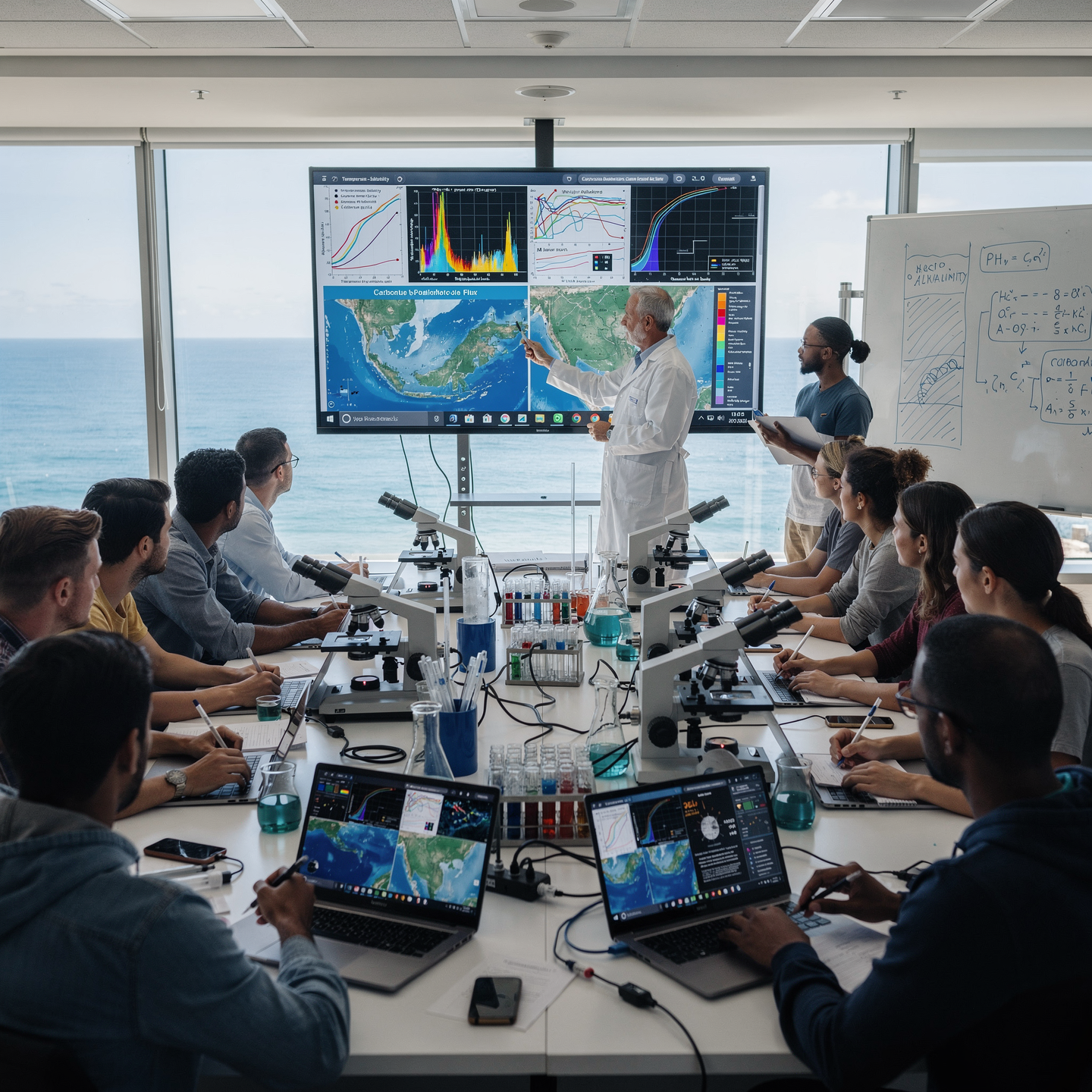
Master’s degree in Chemical Oceanography and Biogeochemistry

Why this master’s programme?

The Master in Chemical Oceanography and Biogeochemistry

This program immerses you in the study of the chemical processes that govern the oceans and their interaction with global biogeochemical cycles. Learn to analyze the chemical composition of seawater, sediments, and marine organisms, and to model the behavior of pollutants and nutrients. This program prepares you to address current environmental challenges, such as climate change, ocean acidification, and marine pollution.

Differential Advantages

  • Multidisciplinary Approach: Integrates chemistry, biology, geology, and modeling for a holistic understanding of the oceans.
  • Cutting-Edge Research: Participates in leading research projects on the effects of global change on marine ecosystems.
  • Advanced Technology: Uses state-of-the-art instrumentation for chemical and biogeochemical analysis in laboratories and aboard oceanographic vessels.
  • International Collaboration: Interact with experts and research centers worldwide to expand your professional network.
  • Career Opportunities: Access job opportunities in environmental management, consulting, academic research, and public administration.
Oceanografía

Master’s degree in Chemical Oceanography and Biogeochemistry

Availability: 1 in stock

Who is it aimed at?

  • Graduates in Chemistry, Biology, Environmental Science, Geology, or related fields who wish to specialize in marine chemical and biological processes.
  • Marine and environmental professionals seeking to expand their knowledge of ocean management and conservation.
  • Marine laboratory researchers and technicians interested in deepening their knowledge of chemical and biogeochemical analysis techniques and methodologies.
  • Environmental consultants and project managers who require a solid understanding of marine biogeochemical cycles for environmental impact assessment.
  • Graduates aspiring to careers in oceanographic research, marine resource management, or environmental consulting with a focus on ocean chemistry and biogeochemistry.

Academic Flexibility

Adapted for professionals and students: online and in-person modality, with accessible educational resources and personalized tutoring.

Oceanografía

Objectives and skills

Develop marine biogeochemical models:

“Implement numerical models that simulate nutrient cycles, phytoplankton and zooplankton, integrating observational oceanographic data and climate projections.”

Assess the impact of pollution on marine ecosystems:

“Analyze water quality, biodiversity, and key species health data to determine the magnitude and scope of polluting effects.”

Analyze biogeochemical cycles in different ocean environments:

“Identify interconnections and feedbacks between carbon, nitrogen, and phosphorus cycles, and assess their impact on the productivity and health of marine ecosystems.”

Design and apply advanced methodologies for ocean chemical analysis:

Implement and validate liquid chromatography and mass spectrometry techniques for the identification and accurate quantification of emerging organic contaminants in seawater samples.

Interpreting oceanographic data to understand global biogeochemical processes:

“Analyze time series of variables such as temperature, salinity, and nutrients to identify trends and anomalies related to climatic events and biological activity.”

Lead oceanographic research projects with a chemical and biogeochemical focus:

“Define clear objectives, manage resources efficiently, and communicate results impactfully, ensuring scientific quality and meeting deadlines.”

Study plan – Modules

  1. Fundamentals of marine chemistry: elemental composition of the ocean and physicochemical properties of seawater
  2. Dissolution and chemical speciation processes in marine environments: acid-base equilibrium, metal complexes, and solubility
  3. Carbon dynamics in the ocean: organic and inorganic carbon cycles, CO₂ capture and storage in marine ecosystems
  4. Biogeochemistry of essential nutrients: nitrogen, phosphorus, silicon, and their role in primary productivity and biogeochemical cycles
  5. Chemical interactions in the euphotic zone: photolysis, redox reactions, and reactive oxygen species production
  6. Mineralization and chemical sedimentation processes: precipitate formation, iron and manganese cycles in marine soils and sediments
  7. Impact of ocean acidification: mechanisms, effects on carbonate chemistry, and consequences on Calcifying organisms
  8. Marine chemical pollutants: sources, transformation, bioavailability, and accumulation in food chains

    Mechanisms of transport and chemical mixing: turbulence, molecular diffusion, and advective processes in water columns and sediments

    Modeling marine chemical processes: mathematical approaches and computational simulation for predictive studies of global change

  1. Fundamental principles of chemical oceanography: composition of seawater, physicochemical properties, and dissolution processes
  2. Biochemical interactions in marine environments: microbial processes and their role in the transformation of chemical compounds
  3. Dynamics of biogeochemical cycles: carbon, nitrogen, phosphorus, and sulfur cycles in marine ecosystems
  4. Advanced methodologies for nutrient analysis: spectrophotometric techniques, ion chromatography, and in situ sensors
  5. Mathematical modeling of biogeochemical processes: balance equations, numerical modeling, and dynamic simulation
  6. Impact of abiotic factors on marine biogeochemistry: temperature, salinity, oxygen, and pH
  7. Biogeochemistry of phytoplankton and bacterioplankton: metabolism, primary production, and remineralization
  8. Sedimentation and diagenesis processes: interaction between
  9. Sediments and water column in nutrient transformation
  10. Advanced applications in environmental monitoring: use of satellite technologies, drones, and autonomous platforms for monitoring biochemical dynamics
  11. Critical analysis of case studies: eutrophication, ocean acidification, and dead zones in different ocean regions
  12. Environmental and sociopolitical implications of nutrient cycles: marine resource management and early warning systems
  13. Development of an experimental proposal for research in marine biochemical dynamics: design, implementation, and results analysis
  1. Fundamentals of marine chemistry: molecular structure of water, dissociation, pH, and physicochemical properties in marine environments
  2. Redox reactions in the ocean: mechanisms and kinetics of oxidative and reductive processes in the water column and sediments
  3. Chemistry of the main trace elements in the ocean: iron, manganese, copper, zinc, and their role in marine biogeochemistry
  4. Fundamental biogeochemical cycles: nitrogen, carbon, phosphorus, and sulfur, microbial metabolic pathways, and their integration into ocean dynamics
  5. Mineralization and carbon sequestration processes: formation of carbonate sediments and the role of the photic zone in CO2 capture
  6. Chemical interactions in coastal zones and estuaries: transport, mixing, and chemical transformation processes in environments with high hydrodynamic variability
  7. Anthropogenic impacts on the Marine chemistry: chemical pollution, eutrophication, and related effects on marine chemical balance

    Dynamics and distribution of essential nutrients: sources, sinks, and factors regulating availability in diverse marine environments

    Advanced methodologies for chemical analysis in oceanography: spectrometric, chromatographic, and in-situ sensor techniques

    Modeling of chemical and biogeochemical processes: integration of chemical data with numerical models for predicting global and local impacts on marine ecosystems

    Case studies: detailed analysis of oceanic chemical change events linked to climatic phenomena and anthropogenic alterations

    Evaluation of strategies for mitigating chemical impacts and promoting sustainability in ocean environments

  1. Fundamentals of mathematical modeling applied to chemical tracers and pollutants: transport equations, fluid dynamics, and diffusion-advection processes in marine environments
  2. Advanced techniques for simulating chemical reactions and biogeochemical processes in the water column and marine sediments, incorporating nonlinear kinetics and multi-scale coupling
  3. Integration and calibration of numerical models with oceanographic data: statistical methods, data assimilation, and validation against experimental observations
  4. Development and application of in situ sensors for continuous and real-time monitoring of pollutants and tracers, including electrochemical, optical, and spectrometric technologies
  5. Design and deployment of autonomous and remote platforms for oceanographic data acquisition: buoys, autonomous underwater vehicles (AUVs), and monitoring systems Integrated
  6. Comprehensive assessment of ecological risk: identification of pollution sources, transport and final fate of contaminants, and analysis of sublethal and lethal effects on marine biota.

  7. Methodologies for quantifying environmental impact using coupled chemical and biological dynamics models, sensitivity analysis, and predictive scenarios in the face of climate change and anthropogenic activities.

  8. Study of the bioaccumulation and biomagnification of contaminants in marine food webs using biochemical and mass transfer models.

  9. Evaluation of the efficiency and selection of environmental remediation strategies considering predictive models and contaminant dispersion simulations.

  10. Development of technical and scientific reports for environmental management decision-making based on modeling results, with an emphasis on effective communication and international standards.

  1. Fundamentals and advances in the detection of emerging contaminants: definition, classification, and environmental relevance
  2. Advanced spectrometric techniques for chemical analysis: gas chromatography coupled to mass spectrometry (GC-MS/MS), tandem mass spectrometry, and nuclear magnetic resonance (NMR)
  3. Use of in situ and remote sensors: underwater drones, optical and fluorometric sensors for continuous and real-time detection
  4. Application of omics technologies in biogeochemical assessment: metabolomics, proteomics, and genomics for ecosystem response studies
  5. Implementation of automated sampling and analysis systems: autonomous platforms and underwater robotics for spatial and temporal monitoring of contaminants
  6. Advanced modeling of the transport and fate of emerging contaminants: geographic information systems (GIS), hydraulic modeling, and numerical simulation
  7. Standardized protocols for sample collection
  8. Samples and data management: quality control, traceability, and analytical validation
  9. Innovative methodologies for monitoring microplastics and nanomaterials in marine environments
  10. Multi-spectral and multidisciplinary data integration strategies for comprehensive environmental quality assessment
  11. Critical analysis of international and ethical regulations in environmental monitoring: compliance, limitations, and future perspectives
  1. Fundamentals of numerical modeling in chemical oceanography and biogeochemistry: mathematical and physical principles applied to marine systems
  2. Dynamics of transport and chemical processes in complex marine environments: analysis of fluxes, mixing, and turbulent diffusion
  3. Advanced hydrodynamic models: integration of physical, chemical, and biological parameters for simulation at multiple temporal and spatial scales
  4. Monitoring of chemical and biogeochemical tracers: precise analytical techniques for tracking trace elements and compounds in oceanic and coastal waters
  5. Application of stable isotopes and radioisotopes as indicators of biogeochemical processes and the origin of pollutants in marine ecosystems
  6. Experimental design strategies for continuous sampling and monitoring using in situ sensors and autonomous platforms
  7. Interaction and feedback between biogeochemical processes and oceanographic dynamics: coupled modeling and validation with empirical data
  8. Transport, transformation, and accumulation processes of organic and inorganic pollutants: predictive models of fate and ecological effects

    Advanced methodologies for assessing remediation and pollutant management in affected marine ecosystems

    Implementation of early warning systems based on modeling and monitoring data for sustainable resource management and mitigation of environmental impacts

  1. Fundamentals of modeling in chemical oceanography and biogeochemistry: mathematical and physical principles applied to marine processes
  2. Key parameters and variables in tracer dynamics: concentration, dispersion, transport, and chemical transformation in marine environments
  3. Numerical modeling of pollutants: types of pollutants, sources, entry pathways, and mechanisms of degradation and bioaccumulation
  4. Biochemical processes in marine ecosystems: carbon, nitrogen, phosphorus, and sulfur cycles; Biogeochemical interactions and their mathematical representation

    Implementation and calibration of hydrodynamic models coupled with biogeochemical models for water quality assessment

    Advanced simulation of sedimentation and remineralization processes in coastal and oceanic zones

    Transport and fate models of emerging pollutants: microplastics, persistent organic pollutants, and heavy metals

    Statistical analysis and validation of results: techniques for evaluating uncertainties and sensitivities in complex models

    Application of modeling for decision-making in environmental management: mitigation plans, monitoring, and ecosystem restoration

    Advanced case studies: comprehensive assessment of marine protected areas, impact of anthropogenic activities, and long-term predictions under variable climate scenarios

  1. Fundamentals of Ocean Chemistry: Physicochemical Properties of Seawater, Acid-Base Balance, Systemic Inorganic Carbon
  2. Advanced Instrumental Techniques in Marine Chemical Analysis: Atomic Absorption Spectroscopy, Inductively Coupled Plasma Mass Spectrometry (ICP-MS), High-Performance Gas and Liquid Chromatography
  3. Sampling and Preservation of Samples in Oceanic Environments: Protocols for Contamination Reduction, Filtration Methods, and Cold Chain Preservation
  4. Analysis of Inorganic and Organic Nutrients: Quantitative Determination of Nitrates, Phosphates, Silicate, Ammonium, and Dissolved Organic Compounds Using Standardized and Emerging Techniques
  5. Detection and Quantification of Trace Metals and Emerging Contaminants: Preconcentration Techniques, Sensitivities, Interferences, and Validation of Analytical Methods
  6. Application of In Situ Sensors and Continuous Monitoring Technologies: Development, Calibration and use of microelectrodes, fluorometry, and optical sensors for biogeochemical parameters

    Modeling and integrated assessment of biogeochemical impacts: multivariate analysis, contaminant transport and transformation models, interaction with biological and climatic processes

    Advanced data interpretation and experimental design: multivariate statistics, spectral analysis, quality control, and reliability assurance in ocean studies

    Case studies on biogeochemical alterations induced by anthropogenic activities and natural phenomena: eutrophication, ocean acidification, bioaccumulation of contaminants

    Instrumentation and emerging technologies in chemical oceanography: autonomous platforms, marine drones, remote sensors, and technological foresight in marine environmental monitoring

  1. Fundamentals of marine chemistry: atomic structure, chemical bonds, and thermodynamic principles applied to the ocean
  2. Geochemical processes in marine environments: biogeochemical cycles of carbon, nitrogen, phosphorus, and sulfur
  3. Dynamics and transformation of pollutants: sources, dispersion mechanisms, photochemical reactions, and biodegradation
  4. Mathematical and numerical modeling: partial differential equations, pollutant transport, and modeling of stochastic processes in marine systems
  5. Advanced use of isotopic and chemical tracer models for tracking biogeochemical fluxes and processes
  6. Application of in situ and remote methodologies for the validation and calibration of oceanographic models
  7. Innovative technologies in ocean monitoring: autonomous sensors, floating platforms, and vehicles Unmanned underwater vehicles (UUVs)

    Development and interpretation of results for environmental impact assessment in polluted marine ecosystems
    Integrated pollution management strategies in coastal and marine protected areas from a multidisciplinary approach
    International regulations and scientific protocols for the conservation and restoration of chemical quality in marine environments

  1. Definition and objectives of the Master’s thesis: a multidisciplinary approach to integrating knowledge in chemical oceanography and biogeochemistry
  2. Advanced methodologies for the collection, analysis, and modeling of marine environmental data: in situ and satellite techniques, chemical, biogeochemical, and physical sampling
  3. Experimental design: hypothesis formulation, oceanographic campaign planning, and standardized protocols for ecological assessment
  4. Data processing and analysis: statistical and geostatistical tools and specialized software for the comprehensive interpretation of chemical and biogeochemical variables
  5. Assessment of anthropogenic and natural impacts on marine systems: chemical pollution, eutrophication, effects of climate change, and biogeochemical alterations
  6. Integration of physical, chemical, and biological parameters for modeling biogeochemical processes and cycles in ecosystems Coastal and open oceans
  7. Development of predictive models for environmental risk assessment and future scenarios; validation and calibration using experimental data

    Application of environmental management criteria and sustainability tools for the conservation and restoration of marine ecosystems, including international regulatory frameworks

    Preparation and presentation of rigorous scientific reports: technical writing, graphic design, effective communication, and oral defense of the final work

    Planning and management of interdisciplinary scientific projects: coordination between teams, quality control, budgeting, and timelines applied to oceanographic research

Career prospects

“`html

  • Research Scientist: Design and execution of research projects in chemical oceanography and biogeochemistry, data analysis, and publication of results.
  • Marine Environmental Project Manager: Assessment of the environmental impact of human activities on the ocean, development of marine management and conservation plans.
  • Environmental Consultant: Advising companies and public bodies on issues related to water quality, marine pollution, and coastal resource management.
  • Oceanographic Data Analyst: Processing and interpretation of oceanographic data for the modeling and prediction of marine phenomena.
  • Marine Chemical Analysis Laboratory Technician: Performing chemical analyses of water, sediment, and marine organism samples.
  • Environmental Educator: Scientific outreach and raising awareness about the importance of conservation. Ocean.
  • Fisheries Resource Manager: Assessment of the status of fish stocks and other marine resources, and development of sustainable management plans.
  • Climate Change and Ocean Specialist: Research and modeling of the effects of climate change on marine ecosystems.

“`

Entry requirements

Academic/professional profile:

Bachelor’s degree in Nautical Science/Maritime Transport, Naval/Marine Engineering or a related qualification; or proven professional experience on the bridge/in operations.

Language proficiency:

Functional Maritime English (SMCP) recommended for simulations and technical materials.

Documentation:

Updated CV, copy of qualification or seaman’s book, national ID/passport, motivation letter.

Technical requirements (for online):

Device with camera/microphone, stable internet connection, monitor ≥ 24” recommended for ECDIS/Radar-ARPA.

Admissions process and dates

Online
application

(form + documents).

Academic review and interview

Admissions decision

Admissions decision

(+ scholarship offer if applicable).

Place reservation

(deposit) and enrolment.

Induction

(access to the virtual campus, calendars, simulator guides).

Scholarships and financial support

  • Comprehensive Ocean Analysis: Master the tools and techniques for studying marine chemical and biological processes.
  • Cutting-Edge Research: Participate in innovative projects on the carbon cycle, marine pollution, and climate change.
  • Modeling and Simulation: Learn to predict the behavior of ocean systems and their impact on the planet.
  • Field Trips and Specialized Laboratories: Hands-on experience in real marine environments and state-of-the-art facilities.
  • Career Opportunities: Expand your career horizons in research, environmental management, consulting, and teaching.
Prepare to lead ocean research and sustainable management.

Testimonials

Frequently asked questions

Yes. The itinerary includes ECDIS/Radar-ARPA/BRM with harbor, ocean, fog, storm, and SAR scenarios.

Online with live sessions; hybrid option for simulator/practical placements through agreements.

Chemical oceanography focuses on the chemical composition of the ocean and its influence on physical and biological processes, while marine biogeochemistry explores the interactions between living organisms and the ocean’s chemical environment, including the cycling of elements and the impact of biological processes on the ocean’s chemical composition. This master’s program integrates both disciplines to understand how they interact.

Recommended functional SMCP. We offer support materials for standard phraseology.

Yes, with a relevant degree or experience in maritime/port operations. The admissions interview will confirm suitability.

Optional (3–6 months) through Companies & Collaborations and the Alumni Network.

Simulator practice (rubrics), defeat plans, SOPs, checklists, micro-tests and applied TFM.

A degree from Navalis Magna University + operational portfolio (tracks, SOPs, reports and KPIs) useful for audits and employment.

  1. Definition and objectives of the Master’s thesis: a multidisciplinary approach to integrating knowledge in chemical oceanography and biogeochemistry
  2. Advanced methodologies for the collection, analysis, and modeling of marine environmental data: in situ and satellite techniques, chemical, biogeochemical, and physical sampling
  3. Experimental design: hypothesis formulation, oceanographic campaign planning, and standardized protocols for ecological assessment
  4. Data processing and analysis: statistical and geostatistical tools and specialized software for the comprehensive interpretation of chemical and biogeochemical variables
  5. Assessment of anthropogenic and natural impacts on marine systems: chemical pollution, eutrophication, effects of climate change, and biogeochemical alterations
  6. Integration of physical, chemical, and biological parameters for modeling biogeochemical processes and cycles in ecosystems Coastal and open oceans
  7. Development of predictive models for environmental risk assessment and future scenarios; validation and calibration using experimental data

    Application of environmental management criteria and sustainability tools for the conservation and restoration of marine ecosystems, including international regulatory frameworks

    Preparation and presentation of rigorous scientific reports: technical writing, graphic design, effective communication, and oral defense of the final work

    Planning and management of interdisciplinary scientific projects: coordination between teams, quality control, budgeting, and timelines applied to oceanographic research

Request information

  1. Complete the Application Form.

  2. Attach your CV/degree certificate (if you have it to hand).

  3. Indicate your preferred cohort (January/May/September) and whether you would like the hybrid option with simulator sessions.

    An academic advisor will contact you within 24–48 hours to guide you through the admission process, scholarships, and compatibility with your professional schedule.

Please enable JavaScript in your browser to complete this form.
Click or drag a file to this area to upload.

Faculty

0
    0
    Tu carrito
    Tu carrito esta vacíoRegresar a la tienda
    Scroll to Top


