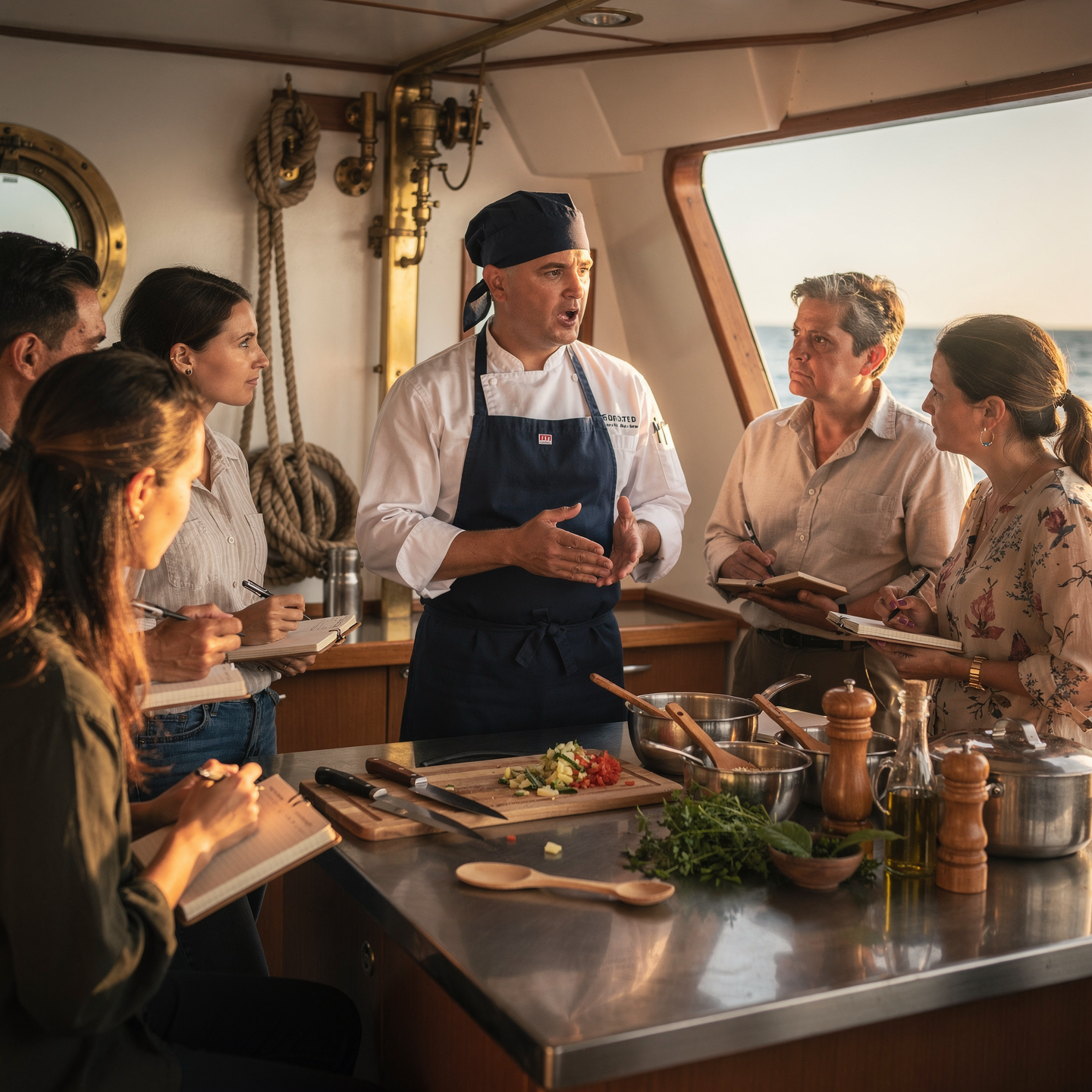
Basic Cooking Course for Crew
Why this course?
The Basic Crew Cooking
course
Is designed to provide the fundamental skills needed to prepare nutritious and tasty meals in maritime environments. Learn everything from menu planning and food handling to essential culinary techniques, adapted to the limitations and challenges of life on board. Master creating balanced dishes that meet safety and hygiene standards, ensuring the well-being and satisfaction of the entire crew.
Differential Advantages
- Adaptation to the Maritime Environment: Specific techniques for cooking in confined spaces and with limited resources.
- Food Safety: Hygiene and storage protocols to prevent foodborne illnesses.
- Menu Planning: Creation of varied and balanced menus that meet the crew’s nutritional needs.
- Inventory Management: Optimization of food usage and reduction of waste on board.
- Practical and Delicious Recipes: Preparation of simple and tasty dishes with readily available basic ingredients.
- Modality: Online
- Level: Cursos
- Hours: 150 H
- Start date: 25-04-2026
Availability: 1 in stock
Who is it aimed at?
- Crew members with no cooking experience who wish to acquire basic skills to prepare simple and nutritious meals on board.
- Deck and engine room personnel who seek to supplement their duties by learning to manage the galley in emergency situations or when staff shortages occur.
- New recruits who need a quick and practical introduction to maritime cooking to efficiently integrate into life on board.
- Provisioners who wish to better understand the crew’s culinary needs to optimize food purchasing and storage.
- Any crew member interested in improving their well-being on board through healthy and economical eating.
Onboard Flexibility
Adapted to maritime life: simple recipes with common ingredients, food preservation techniques, and considerations on small spaces.
Objectives and competencies

Prepare nutritious and tasty food while adhering to hygiene and food safety standards on board.
“To develop balanced menus considering special dietary needs and optimizing available resources, ensuring traceability and allergen control.”

Efficiently manage food and beverage inventory to optimize resources and minimize waste:
Implement demand forecasting, stock control and product rotation (FIFO/FEFO) techniques to reduce losses and optimize profitability.

Adapt menus to the special dietary needs and individual preferences of the crew, taking cultural diversity into account.
“Design balanced and personalized menus, considering allergies, intolerances, religious requirements and personal tastes of each crew member.”

Apply basic culinary techniques to create varied and balanced dishes from available ingredients.
“With creativity and efficiency, adapting recipes and optimizing the use of resources to create nutritious and tasty menus.”

Organize and maintain cleanliness and hygiene in the kitchen and food storage areas according to maritime regulations.
“Implement GMP and SSOPs, managing waste and pest control, according to IMO standards and the ISPS Code.”

Demonstrate skills in preparing breakfasts, lunches, dinners, and snacks, adhering to established schedules and crew demands:
“Plan balanced menus, manage food inventories, and adapt preparations to the crew’s dietary restrictions/preferences, while maintaining hygiene and food safety.”
Curriculum - Modules
- Comprehensive Maritime Incident Management: protocols, roles, and chain of command for coordinated response
- Operational Planning and Execution: briefing, routes, weather windows, and go/no-go criteria
- Rapid Risk Assessment: criticality matrix, scene control, and decision-making under pressure
- Operational Communication: VHF/GMDSS, standardized reports, and inter-agency liaison
- Tactical Mobility and Safe Boarding: RHIB maneuvers, approach, mooring, and recovery
- Equipment and Technologies: PPE, signaling, satellite tracking, and field data logging
- Immediate Care of the Affected: primary assessment, hypothermia, trauma, and stabilization for evacuation
- Adverse Environmental Conditions: swell, Visibility, flows, and operational mitigation
Simulation and training: critical scenarios, use of VR/AR, and exercises with performance metrics
Documentation and continuous improvement: lessons learned, indicators (MTTA/MTTR), and SOP updates
- Introduction to food hygiene: regulations and best practices on board.
- Food safety: prevention of foodborne illnesses.
- Professional kitchen equipment: use, cleaning, and basic maintenance.
- Basic food cutting and preparation techniques: vegetables, meats, fish.
- Stocks and mother sauces: preparation and applications.
- Basic cooking methods: boiling, steaming, grilling, baking, frying.
- Portion control and dish presentation: plating and garnishes.
- Recipe adaptation: quantities, ingredients, and resources available on board.
- Food storage and preservation in confined spaces.
- Inventory management and rotation of fresh and perishables.
‘
- Introduction to Food Hygiene: Safe Food Handling on Board.
- Basic Equipment and Utensils: Selection, Use, and Maintenance.
- Cutting and Preparation Techniques: Vegetables, Fruits, Meats, and Fish.
- Basic Stocks and Sauces: Preparation and Applications in the Kitchen.
- Basic Cooking on Board: Eggs, Rice, Pasta, and Legumes.
- Simple Baking: Making Basic Breads and Rolls on Board.
- Calculating Portions and Planning Menus for Different Voyage Lengths.
- Food Preservation on Board: Refrigerators, Freezers, and Storage Methods.
- Adapting Recipes to Available Ingredients and Limited Resources.
- First aid in the kitchen and accident prevention.
‘
- Food Hygiene: Safe food handling, prevention of cross-contamination.
- Onboard Kitchen Equipment: Use, maintenance, and safety of ovens, stoves, refrigerators, and other equipment.
- Cooking Fundamentals: Basic techniques for cutting, cooking, and preparing food.
- Food Storage: Preservation methods, inventory control, and product rotation.
- Menu Planning: Creating balanced menus, considering nutritional needs and dietary restrictions.
- Procurement: Supplier selection, ordering, and product quality control.
- International Cuisine: Introduction to dishes and culinary techniques from different cultures.
- Adaptation to Maritime Conditions: Special considerations for cooking in an unstable environment.
Waste management: Sustainable practices and compliance with environmental regulations.
Kitchen first aid: Basic procedures for treating burns, cuts, and other accidents.
‘
- Introduction to Food Hygiene: Regulations and Best Practices on Board.
- Food Safety: Prevention of Foodborne Illnesses (FBI).
- Food Storage: Temperature, Humidity, and Ventilation Control.
- Inventory Management: Stock Rotation, Expiration Date Control, and Waste Management.
- Kitchen Equipment: Use, Maintenance, and Cleaning of Ovens, Stoves, Refrigerators, and Freezers.
- Basic Cooking Techniques: Essential Cuts, Cooking Methods, and Preparations.
- Menu Planning: Planning, Adapting to Dietary Needs, and Resource Optimization.
- International Cuisine: Introduction to Basic Dishes from Different Maritime Cultures.
- Dish Presentation: Plating, Decoration, and Serving table.
- Kitchen waste management: separation, recycling, and proper disposal.
‘
- System Architecture and Components: Structural design, materials, and subsystems (mechanical, electrical, electronic, and fluid) with selection and assembly criteria for marine environments
- Fundamentals and Principles of Operation: Physical and engineering foundations (thermodynamics, fluid mechanics, electricity, control, and materials) that explain performance and operating limits
- Safety and Environmental (SHE): Risk analysis, PPE, LOTO, hazardous atmospheres, spill and waste management, and emergency response plans
- Applicable Regulations and Standards: IMO/ISO/IEC requirements and local regulations;
- Conformance criteria, certification, and best practices for operation and maintenance
- Inspection, testing, and diagnostics: Visual/dimensional inspection, functional testing, data analysis, and predictive techniques (vibration, thermography, fluid analysis) to identify root causes
- Preventive and predictive maintenance: Hourly/cycle/seasonal plans, lubrication, adjustments, calibrations, consumable replacement, post-service verification, and operational reliability
- Instrumentation, tools, and metrology: Measuring and testing equipment, diagnostic software, calibration and traceability; selection criteria, safe use, and storage
- Onboard integration and interfaces: Mechanical, electrical, fluid, and data compatibility; Sealing and watertightness, EMC/EMI, corrosion protection, and interoperability testing.
Quality, acceptance testing, and commissioning: process and materials control, FAT/SAT, bench and sea trials, go/no-go criteria, and evidence documentation.
Technical documentation and integrated practice: logs, checklists, reports, and a complete case study (safety → diagnosis → intervention → verification → report) applicable to any system.
Plan de estudio - Módulos
- Comprehensive Maritime Incident Management: protocols, roles, and chain of command for coordinated response
- Operational Planning and Execution: briefing, routes, weather windows, and go/no-go criteria
- Rapid Risk Assessment: criticality matrix, scene control, and decision-making under pressure
- Operational Communication: VHF/GMDSS, standardized reports, and inter-agency liaison
- Tactical Mobility and Safe Boarding: RHIB maneuvers, approach, mooring, and recovery
- Equipment and Technologies: PPE, signaling, satellite tracking, and field data logging
- Immediate Care of the Affected: primary assessment, hypothermia, trauma, and stabilization for evacuation
- Adverse Environmental Conditions: swell, Visibility, flows, and operational mitigation
Simulation and training: critical scenarios, use of VR/AR, and exercises with performance metrics
Documentation and continuous improvement: lessons learned, indicators (MTTA/MTTR), and SOP updates
- Introduction to food hygiene: regulations and best practices on board.
- Food safety: prevention of foodborne illnesses.
- Professional kitchen equipment: use, cleaning, and basic maintenance.
- Basic food cutting and preparation techniques: vegetables, meats, fish.
- Stocks and mother sauces: preparation and applications.
- Basic cooking methods: boiling, steaming, grilling, baking, frying.
- Portion control and dish presentation: plating and garnishes.
- Recipe adaptation: quantities, ingredients, and resources available on board.
- Food storage and preservation in confined spaces.
- Inventory management and rotation of fresh and perishables.
‘
- Introduction to Food Hygiene: Safe Food Handling on Board.
- Basic Equipment and Utensils: Selection, Use, and Maintenance.
- Cutting and Preparation Techniques: Vegetables, Fruits, Meats, and Fish.
- Basic Stocks and Sauces: Preparation and Applications in the Kitchen.
- Basic Cooking on Board: Eggs, Rice, Pasta, and Legumes.
- Simple Baking: Making Basic Breads and Rolls on Board.
- Calculating Portions and Planning Menus for Different Voyage Lengths.
- Food Preservation on Board: Refrigerators, Freezers, and Storage Methods.
- Adapting Recipes to Available Ingredients and Limited Resources.
- First aid in the kitchen and accident prevention.
‘
- Food Hygiene: Safe food handling, prevention of cross-contamination.
- Onboard Kitchen Equipment: Use, maintenance, and safety of ovens, stoves, refrigerators, and other equipment.
- Cooking Fundamentals: Basic techniques for cutting, cooking, and preparing food.
- Food Storage: Preservation methods, inventory control, and product rotation.
- Menu Planning: Creating balanced menus, considering nutritional needs and dietary restrictions.
- Procurement: Supplier selection, ordering, and product quality control.
- International Cuisine: Introduction to dishes and culinary techniques from different cultures.
- Adaptation to Maritime Conditions: Special considerations for cooking in an unstable environment.
Waste management: Sustainable practices and compliance with environmental regulations.
Kitchen first aid: Basic procedures for treating burns, cuts, and other accidents.
‘
- Introduction to Food Hygiene: Regulations and Best Practices on Board.
- Food Safety: Prevention of Foodborne Illnesses (FBI).
- Food Storage: Temperature, Humidity, and Ventilation Control.
- Inventory Management: Stock Rotation, Expiration Date Control, and Waste Management.
- Kitchen Equipment: Use, Maintenance, and Cleaning of Ovens, Stoves, Refrigerators, and Freezers.
- Basic Cooking Techniques: Essential Cuts, Cooking Methods, and Preparations.
- Menu Planning: Planning, Adapting to Dietary Needs, and Resource Optimization.
- International Cuisine: Introduction to Basic Dishes from Different Maritime Cultures.
- Dish Presentation: Plating, Decoration, and Serving table.
- Kitchen waste management: separation, recycling, and proper disposal.
‘
- System Architecture and Components: Structural design, materials, and subsystems (mechanical, electrical, electronic, and fluid) with selection and assembly criteria for marine environments
- Fundamentals and Principles of Operation: Physical and engineering foundations (thermodynamics, fluid mechanics, electricity, control, and materials) that explain performance and operating limits
- Safety and Environmental (SHE): Risk analysis, PPE, LOTO, hazardous atmospheres, spill and waste management, and emergency response plans
- Applicable Regulations and Standards: IMO/ISO/IEC requirements and local regulations;
- Conformance criteria, certification, and best practices for operation and maintenance
- Inspection, testing, and diagnostics: Visual/dimensional inspection, functional testing, data analysis, and predictive techniques (vibration, thermography, fluid analysis) to identify root causes
- Preventive and predictive maintenance: Hourly/cycle/seasonal plans, lubrication, adjustments, calibrations, consumable replacement, post-service verification, and operational reliability
- Instrumentation, tools, and metrology: Measuring and testing equipment, diagnostic software, calibration and traceability; selection criteria, safe use, and storage
- Onboard integration and interfaces: Mechanical, electrical, fluid, and data compatibility; Sealing and watertightness, EMC/EMI, corrosion protection, and interoperability testing.
Quality, acceptance testing, and commissioning: process and materials control, FAT/SAT, bench and sea trials, go/no-go criteria, and evidence documentation.
Technical documentation and integrated practice: logs, checklists, reports, and a complete case study (safety → diagnosis → intervention → verification → report) applicable to any system.
- Introduction to Food Hygiene and Safety on Board
- Mise en Place: Preparation and Organization Techniques in the Kitchen
- Stocks and Mother Sauces: Preparation and Applications in Maritime Cuisine
- Basic Cooking Techniques: Boiling, Roasting, Frying, Braising, Steaming
- Food Handling and Preservation in Confined Spaces
- Planning Balanced Menus Adapted to Nutritional Needs on Board
- Provisioning and Stock Management on Vessels
- Adapting Recipes to Available Ingredients and Sea Conditions
- Basic Bread and Pastry Preparation for Consumption on Board
- Health Regulations and Occupational Risk Prevention in the Kitchen ship
‘
- Introduction to Food Hygiene: Regulations and Best Practices on Board.
- Food Safety: Contamination Prevention, Allergen Control.
- Professional Kitchen Equipment: Use, Maintenance, and Safety.
- Basic Food Cutting and Preparation Techniques: Vegetables, Meat, and Fish.
- Stocks, Sauces, and Dressings: Preparation and Culinary Applications.
- Cooking Methods: Boiling, Steaming, Grilling, Baking, Frying.
- Balanced Menu Planning: Nutritional Considerations for the Crew.
- Food Preservation on Board: Refrigeration, Freezing, and Packaging.
- Stock Management and Cost Control: Minimizing Food Waste.
- Plating Presentation: Basic Plating and Decoration.
‘
- Introduction to Food Hygiene: Safe Handling and Contamination Prevention.
- Nutrition Fundamentals: Macronutrients, Micronutrients, and Balanced Diets for the Crew.
- Basic Cooking Techniques: Essential Cuts, Cooking Methods, and Preparations.
- Onboard Pantry Management: Storage, Rotation, and Inventory Control.
- Balanced Menu Planning: Planning, Adapting to Special Needs and Dietary Restrictions.
- Kitchen Safety: Accident Prevention, Equipment Use, and Tool Handling.
- Culinary First Aid: Responding to Burns, Cuts, and Other Emergencies.
- International Cuisine: Introduction to Different Culinary Cultures and Adapting Recipes.
- Plating: plating, decoration, and techniques to enhance the dining experience.
- Kitchen cleaning and disinfection: protocols, products, and best practices.
‘
- Introduction to Food Hygiene: Basic Concepts and Definitions.
- Food Microbiology: Types of Microorganisms, Growth, and Control.
- Food Hazards: Physical, Chemical, and Biological.
- Foodborne Illnesses (FBI): Causes, Symptoms, and Prevention.
- Receiving and Storing Food: Temperature and Condition Control.
- Food Preparation and Cooking: Safe Methods and Appropriate Temperatures.
- Food Service: Personal Hygiene, Handling, and Allergen Control.
- Cleaning and Disinfection: Products, Techniques, and Frequencies on Board.
- Waste Management: Separation, Storage, and Disposal.
- Food Legislation: National and International Regulations Applicable to Ships.
‘
Career opportunities
- Cook on recreational vessels: Preparing food for passengers and crew on yachts and recreational boats.
- Kitchen assistant on merchant ships: Assisting in menu planning and food preparation on cargo and transport ships.
- Catering staff on cruise ships: Preparing and serving food on cruise ships.
- Cook on oil platforms: Preparing meals for personnel working on offshore platforms.
- Food supplier for vessels: Preparing and supplying food to catering companies that supply ships.
- Cook on oceanographic/research vessels: Preparing food adapted to the needs of the crew on scientific expeditions.
- Kitchen assistant on Fishing vessels: Support in preparing meals on board fishing vessels.
Kitchen cleaning and maintenance staff on vessels: Maintaining hygiene and cleanliness in the kitchen areas on ships.
“`
Admission requirements

Academic/professional profile:
Degree/Bachelor's degree in Nautical Science/Maritime Transport, Naval/Marine Engineering, or a related field; or proven professional experience in bridge/operations.

Language proficiency:
Recommended functional maritime English (SMCP) for simulations and technical materials.

5. Induction
Updated resume, copy of degree or seaman's book, ID card/passport, letter of motivation.

Technical requirements (for online):
Equipment with camera/microphone, stable connection, ≥ 24” monitor recommended for ECDIS/Radar-ARPA.
Admission process and dates

1. Online
application
(form + documents).

2. Academic review and interview
(profile/objectives/schedule compatibility).

3. Admission decision
(+ scholarship proposal if applicable).

4. Reservation of place
(deposit) and registration.

5. Induction
(access to campus, calendars, simulator guides).
Scholarships and grants
- Culinary Fundamentals: Master essential techniques such as cutting, cooking, and basic preparations to create delicious dishes.
- Nutrition and Dietetics: Learn about the importance of a balanced diet on board and how to adapt recipes to meet specific needs.
- Food Safety and Hygiene: Understand the key rules and practices to prevent contamination and ensure food safety.
- Inventory and Cost Management: Optimize the management of food resources, controlling costs and minimizing waste on board.
- Adapted International Recipes: Discover and adapt dishes from different cultures to offer variety and satisfaction to the crew.
Testimonials
I mastered basic crew cooking techniques, including efficient planning of nutritious menus and safe food handling in a maritime environment. My cooking skills improved significantly, allowing me to prepare delicious and balanced meals that met the crew’s dietary requirements, even under challenging conditions.
I mastered specialized culinary techniques for preparing food in aviation environments, achieving consistency and quality in every dish despite space and equipment limitations. Furthermore, I honed my customer service skills, learning to anticipate needs and deliver an exceptional dining experience in a pressurized environment. My outstanding performance in resource management and adapting to diverse culinary cultures earned me the highest grade in my class.
I mastered the essential culinary techniques for feeding a crew efficiently and nutritiously, including planning balanced menus with limited resources, preparing food safely in a mobile environment, and proper storage to prevent waste. I received consistent praise for the taste and presentation of my dishes, contributing to the team’s morale and well-being.
I mastered basic cooking techniques, including hygienic food handling and the efficient preparation of nutritious and balanced meals for a crew of 12 in a simulated offshore environment. My ability to adapt recipes to available supplies and minimize waste was praised by the instructor.

Frequently asked questions
To provide the crew with the skills and knowledge necessary to prepare nutritious and safe meals on board.
Yes. The itinerary includes ECDIS/Radar-ARPA/BRM with harbor, ocean, fog, storm, and SAR scenarios.
Online with live sessions; hybrid option for simulator/practical placements through agreements.
Skills to adapt recipes and maximize the use of limited ingredients, including preservation and storage techniques, as well as preparing nutritious and varied meals with restricted resources.
Recommended functional SMCP. We offer support materials for standard phraseology.
Yes, with a relevant degree or experience in maritime/port operations. The admissions interview will confirm suitability.
Optional (3–6 months) through Companies & Collaborations and the Alumni Network.
Simulator practice (rubrics), defeat plans, SOPs, checklists, micro-tests and applied TFM.
A degree from Navalis Magna University + operational portfolio (tracks, SOPs, reports and KPIs) useful for audits and employment.
- Introduction to Food Hygiene: Basic Concepts and Definitions.
- Food Microbiology: Types of Microorganisms, Growth, and Control.
- Food Hazards: Physical, Chemical, and Biological.
- Foodborne Illnesses (FBI): Causes, Symptoms, and Prevention.
- Receiving and Storing Food: Temperature and Condition Control.
- Food Preparation and Cooking: Safe Methods and Appropriate Temperatures.
- Food Service: Personal Hygiene, Handling, and Allergen Control.
- Cleaning and Disinfection: Products, Techniques, and Frequencies on Board.
- Waste Management: Separation, Storage, and Disposal.
- Food Legislation: National and International Regulations Applicable to Ships.
‘
Request information
- Complete the Application Form
- Attach your CV/Qualifications (if you have them to hand).
- Indicate your preferred cohort (January/May/September) and whether you want the hybrid option with simulator sessions.
Teachers
Eng. Tomás Riera
Full Professor
Eng. Tomás Riera
Full Professor
Eng. Sofía Marquina
Full Professor
Eng. Sofía Marquina
Full Professor
Eng. Javier Bañuls
Full Professor
Eng. Javier Bañuls
Full Professor
Dr. Nuria Llobregat
Full Professor
Dr. Nuria Llobregat
Full Professor
Dr. Pau Ferrer
Full Professor
Dr. Pau Ferrer
Full Professor
Cap. Javier Abaroa (MCA)
Full Professor
Cap. Javier Abaroa (MCA)
Full Professor

