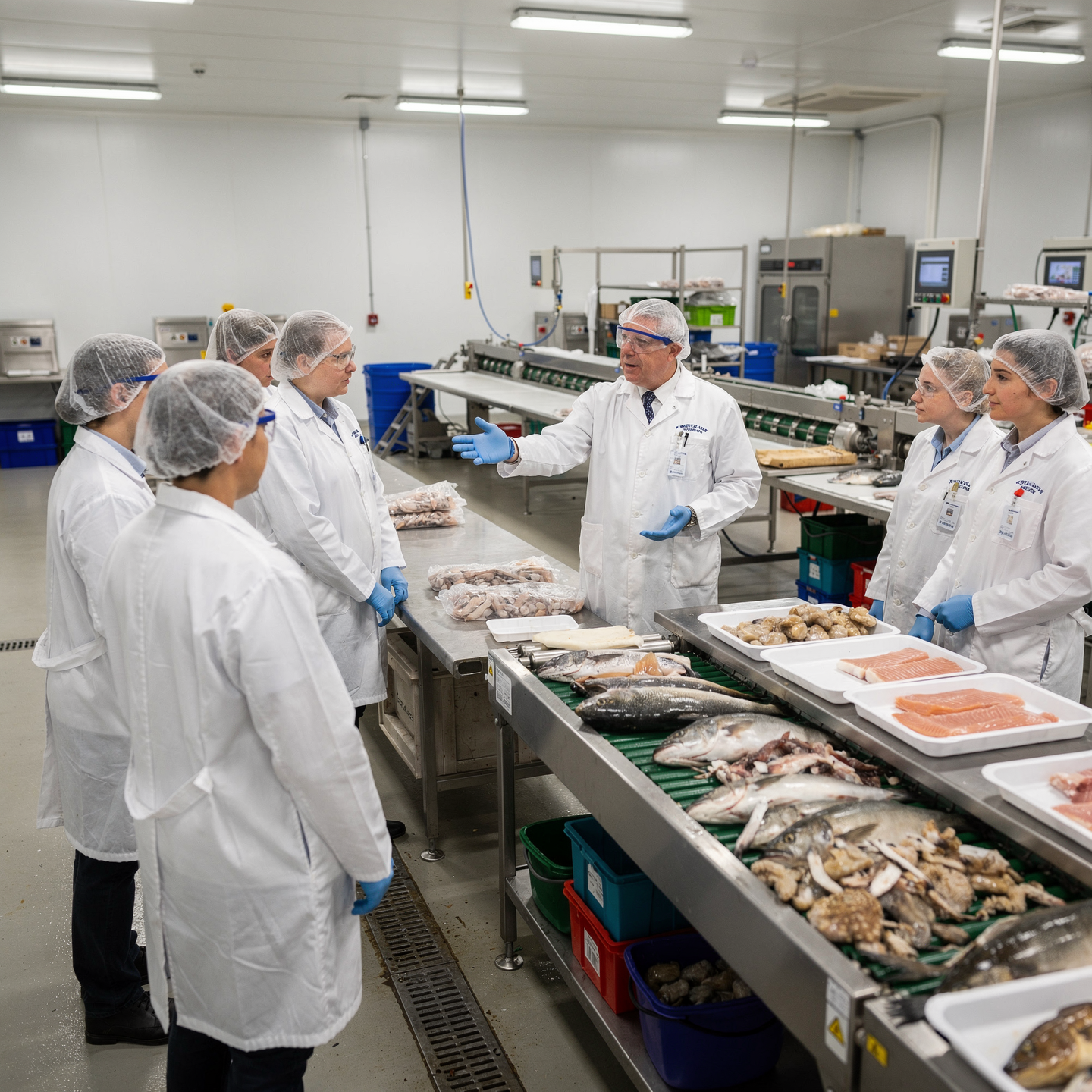
Diploma in Seafood Processing and Preservation
Why this certificate program?
The Diploma in Seafood Processing and Preservation
This program provides you with the tools to innovate and optimize quality in the fishing industry. Learn everything from food science applied to seafood to the most advanced preservation technologies. Master primary and secondary processing techniques, ensuring food safety and nutritional value. Understand current legislation and market trends to boost your professional development.
Differentiating Advantages
- Practical Approach: Specialized laboratories to apply the knowledge acquired.
- Industry Experts: Instructors with extensive experience in companies and research centers.
- Innovation and Development: Learn to formulate new products and optimize existing processes.
- Food Safety: Master HACCP systems and Good Manufacturing Practices (GMP).
- Professional Certification: Validate your skills and stand out in the fishing sector.
- Modality: Online
- Level: Diplomado
- Hours: 800 H
- Start date: 01-10-2026
Availability: 1 in stock
Who is it aimed at?
- Food engineers, aquaculture professionals, and fisheries technicians who want to optimize processes, extend shelf life, and guarantee the quality of seafood products.
- Production and quality control managers in processing plants who seek to implement sanitary regulations and ensure traceability.
- Entrepreneurs and business owners in the sector who aspire to develop new products, diversify their offerings, and conquer demanding markets.
- Health and nutrition professionals interested in deepening their knowledge of the benefits and safety of seafood.
- Students and recent graduates in related fields seeking practical specialization with a focus on innovation and Sustainability.
Flexibility and Application
Designed for active professionals: 24/7 accessible online content, practical case studies, and tools to implement improvements in the short term.
Objectives and competencies

Optimizing the shelf life and quality of seafood products:
Implement and monitor temperature and modified atmosphere control systems during preservation and transport, minimizing bacterial growth and enzymatic degradation.

Apply advanced processing techniques to diversify the supply of seafood products:
“Implement cutting-edge technologies (ultra-freezing, modified atmosphere, osmotic dehydration) to generate new lines of high value-added products and extend shelf life.”

Implement and monitor hygiene and food safety protocols in the fishing industry:
“Develop and implement HACCP plans adapted to fishing operations, ensuring regulatory compliance and product traceability from capture to distribution.”

Develop and manage quality control systems in the seafood value chain:
“Implement and supervise sampling, analysis and sensory evaluation programs, ensuring compliance with health regulations and quality standards at each stage of the chain, from capture to distribution.”

Design innovative conservation strategies to preserve the nutritional and sensory characteristics of seafood products:
Implement non-thermal processing technologies (high pressures, pulsed electric fields) and active/intelligent packaging, monitoring their impact on quality throughout the product lifecycle.

Evaluate and adapt emerging technologies in seafood processing:
“Identify and validate the viability of new technologies (AI, blockchain, advanced sensors) in optimizing the value chain, ensuring traceability, food safety and sustainability.”
Curriculum - Modules
- Comprehensive Maritime Incident Management: protocols, roles, and chain of command for coordinated response
- Operational Planning and Execution: briefing, routes, weather windows, and go/no-go criteria
- Rapid Risk Assessment: criticality matrix, scene control, and decision-making under pressure
- Operational Communication: VHF/GMDSS, standardized reports, and inter-agency liaison
- Tactical Mobility and Safe Boarding: RHIB maneuvers, approach, mooring, and recovery
- Equipment and Technologies: PPE, signaling, satellite tracking, and field data logging
- Immediate Care of the Affected: primary assessment, hypothermia, trauma, and stabilization for evacuation
- Adverse Environmental Conditions: swell, Visibility, flows, and operational mitigation
Simulation and training: critical scenarios, use of VR/AR, and exercises with performance metrics
Documentation and continuous improvement: lessons learned, indicators (MTTA/MTTR), and SOP updates
- Introduction to refrigeration in seafood: Importance and benefits.
- Fundamentals of thermodynamics: Heat, temperature, enthalpy, and entropy.
- Refrigeration cycles: Vapor compression, absorption, and others.
- Refrigerants: Types, properties, environmental impact, and regulations.
- Refrigeration equipment: Compressors, condensers, evaporators, and valves.
- Calculation of thermal loads: Factors that influence the refrigeration of seafood.
- Control systems: Temperature, humidity, and pressure in refrigeration.
- Packaging of seafood: Types of packaging, materials, and modified atmosphere.
- Food safety and regulations: GMP, HACCP, and traceability in the cold chain.
- Maintenance and optimization of refrigeration systems in the fishing industry.
‘
- Introduction to Marine Resources: Types, distribution, and potential.
- Legal and Regulatory Framework: National and international legislation for the sustainable management of marine resources.
- Marine Biotechnology: Applications in food, pharmaceuticals, and cosmetics.
- Marine Farming (Aquaculture): Farmable species, cultivation techniques, and sustainability.
- Processing and Preservation of Fish Products: Refrigeration, freezing, salting, and smoking techniques.
- Algae Utilization: Extraction of bioactive compounds, applications in various industries.
- Valorization of Fish By-products: Obtaining fishmeal, oils, and other value-added products.
- Sustainable Marine Tourism: Ecotourism, responsible diving, and ecosystem conservation.
- Management of Marine Debris: Strategies for reducing, reusing, and recycling plastics and other pollutants.
Innovation and Development in the Marine Industry: New technologies and trends in the use of marine resources.
‘
- Introduction to Hygiene and Sanitation in the Fishing Industry: Importance and Regulatory Framework.
- Microbiology of Fish Products: Types of Microorganisms, Growth, and Influencing Factors.
- Biological, Chemical, and Physical Hazards: Identification, Assessment, and Control in the Production Chain.
- Personal Hygiene and Proper Handling Practices: Handwashing, Clothing, and Conduct.
- Cleaning and Disinfection: Types of Products, Methods, and Frequency in Facilities and Equipment.
- Pest Control: Identification, Prevention, and Control Methods in Processing Plants.
- Quality Assurance: Principles and Quality Management Systems in the Fishing Industry.
- HACCP (Hazard Analysis and Critical Control Points) Critical Control Points (CCPs): Development and implementation in fishery products.
Traceability: Importance, traceability systems, and legal requirements.
Current regulations: National and international legislation on hygiene, sanitation, and quality in fishery products.
‘
- Introduction to Emerging Technologies in the Fishing Industry
- Remote Sensors and Remote Sensing: Types, Applications in Fishing, Data Analysis
- Geographic Information Systems (GIS): Habitat Mapping, Resource Management, Spatial Analysis
- Artificial Intelligence (AI) and Machine Learning (ML): Catch Prediction, Route Optimization, Illegal Fishing Detection
- Internet of Things (IoT) in Fishing: Vessel Monitoring, Sensors in Nets, Traceability
- Blockchain in the Fishing Supply Chain: Traceability, Food Safety, Combating IUU Fishing
- Biotechnology Applied to Aquaculture: Genetic Improvement, Disease Diagnosis, Sustainable Feeding
- Robotics and automation in fishing and aquaculture: underwater robots, automated feeding systems, cage cleaning
Innovative materials in vessel and fishing gear construction: sustainability, efficiency, durability
Virtual reality (VR) and augmented reality (AR) in training and simulation: crew training, equipment design, data visualization
‘
- System Architecture and Components: Structural design, materials, and subsystems (mechanical, electrical, electronic, and fluid) with selection and assembly criteria for marine environments
- Fundamentals and Principles of Operation: Physical and engineering foundations (thermodynamics, fluid mechanics, electricity, control, and materials) that explain performance and operating limits
- Safety and Environmental (SHE): Risk analysis, PPE, LOTO, hazardous atmospheres, spill and waste management, and emergency response plans
- Applicable Regulations and Standards: IMO/ISO/IEC requirements and local regulations;
- Conformance criteria, certification, and best practices for operation and maintenance
- Inspection, testing, and diagnostics: Visual/dimensional inspection, functional testing, data analysis, and predictive techniques (vibration, thermography, fluid analysis) to identify root causes
- Preventive and predictive maintenance: Hourly/cycle/seasonal plans, lubrication, adjustments, calibrations, consumable replacement, post-service verification, and operational reliability
- Instrumentation, tools, and metrology: Measuring and testing equipment, diagnostic software, calibration and traceability; selection criteria, safe use, and storage
- Onboard integration and interfaces: Mechanical, electrical, fluid, and data compatibility; Sealing and watertightness, EMC/EMI, corrosion protection, and interoperability testing.
Quality, acceptance testing, and commissioning: process and materials control, FAT/SAT, bench and sea trials, go/no-go criteria, and evidence documentation.
Technical documentation and integrated practice: logs, checklists, reports, and a complete case study (safety → diagnosis → intervention → verification → report) applicable to any system.
- Introduction to Fish Preservation: History and Fundamentals
- Fish Microbiology: Spoilage and Food Safety
- Salting Fish: Types of Salt, Salting Methods (Dry, Wet, Mixed)
- Drying Fish: Factors Influencing Drying, Traditional and Industrial Methods
- Smoking Fish: Types of Smoking (Cold, Hot), Woods Used and Their Influence
- Equipment and Facilities for Salting, Drying, and Smoking: Design and Maintenance
- Quality Control in Processes: Sensory, Physicochemical, and Microbiological Analysis
- Legislation and Regulations Applicable to Fish Preservation
- Packaging and Storage of Salted, Dried, and Smoked Products
- Safety and hygiene in the handling of fish and fish products
‘
Career opportunities
- Quality Control Technician: Supervision and analysis of seafood quality during processing and preservation.
- Processing Plant Supervisor: Management and coordination of operations in seafood processing plants.
- New Product Developer: Research and formulation of new seafood-based products, enhancing their added value.
- Food Preservation Technician: Application of preservation techniques to extend the shelf life of seafood.
- Technical Advisor in the Fishing Industry: Consulting and advising companies in the fishing sector on processing and preservation.
- Food Safety Manager: Implementation and monitoring of food safety management systems in the seafood industry (HACCP, etc.).
- Seafood Marketer: Management of the sale and distribution of seafood products, both nationally and internationally.
- Researcher in Processing and Preservation Technologies: Development of new technologies and methods to improve the processing and preservation of seafood products.
“`
Admission requirements

Academic/professional profile:
Degree/Bachelor's degree in Nautical Science/Maritime Transport, Naval/Marine Engineering, or a related field; or proven professional experience in bridge/operations.

Language proficiency:
Recommended functional maritime English (SMCP) for simulations and technical materials.

Documentation:
Updated resume, copy of degree or seaman's book, ID card/passport, letter of motivation.

Technical requirements (for online):
Equipment with camera/microphone, stable connection, ≥ 24” monitor recommended for ECDIS/Radar-ARPA.
Admission process and dates

1. Online
application
(form + documents).

2. Academic review and interview
(profile/objectives/schedule compatibility).

3. Admission decision
(+ scholarship proposal if applicable).

4. Reservation of place
(deposit) and registration.

5. Induction
(access to campus, calendars, simulator guides).
Scholarships and grants
- Master the Techniques: Learn the most advanced methods in processing, packaging, and preservation of seafood products.
- Food Safety: Implement HACCP and GMP systems to guarantee the quality and safety of your products.
- Process Optimization: Increase the profitability of your business by reducing waste and continuous improvement.
- Market Trends: Discover the latest innovations and consumer demands in the fishing industry.
- Industry Experts: Learn from professionals with extensive experience in the sector and expand your network Contacts.
Testimonials
This diploma program provided me with the necessary theoretical and practical tools to optimize the processes at my processing plant. I implemented new preservation techniques, extending the shelf life of our products by 20% and reducing waste by 15%, which resulted in a significant increase in profitability and competitiveness in the market.
The Diploma in Fisheries & Aquaculture provided me with the necessary tools to optimize the performance of my fish farm. Thanks to the knowledge I gained in genetics, nutrition, and health management, I increased production by 30% and reduced fish mortality by 15% in the first year after completing the program.
This diploma program exceeded my expectations. I acquired crucial practical and theoretical knowledge, from raw material handling to the latest preservation technologies, which allowed me to implement significant improvements in my plant’s processes, increasing the efficiency and quality of our products.
This diploma program provided me with the theoretical and practical tools I needed to optimize processes at my processing plant. Thanks to the preservation techniques I learned, we were able to extend the shelf life of our products by 20%, reducing waste and increasing business profitability.

Frequently asked questions
The processing and preservation of seafood products.
Yes. The itinerary includes ECDIS/Radar-ARPA/BRM with harbor, ocean, fog, storm, and SAR scenarios.
Online with live sessions; hybrid option for simulator/practical placements through agreements.
Seafood, which implies salt water.
Recommended functional SMCP. We offer support materials for standard phraseology.
Yes, with a relevant degree or experience in maritime/port operations. The admissions interview will confirm suitability.
Optional (3–6 months) through Companies & Collaborations and the Alumni Network.
Simulator practice (rubrics), defeat plans, SOPs, checklists, micro-tests and applied TFM.
A degree from Navalis Magna University + operational portfolio (tracks, SOPs, reports and KPIs) useful for audits and employment.
- Introduction to Seafood Preservation: History and Evolution of Techniques.
- Basic Microbiology: Relevant microorganisms in food spoilage, growth, and control.
- Smoking: Types of smoking (cold, hot), woods and smoke generation, equipment, and processes.
- Salting: Dry salt and brine, types of salt, salting methods, factors influencing salt penetration.
- Drying: Natural and artificial drying methods, factors influencing dehydration, equipment, and process control.
- Raw Materials: Selection, quality, freshness, and preparation of seafood products.
- Additives and Spices: Use and function in preservation techniques, current legislation.
- Food Safety: HACCP in smoking processes, Salting and drying, control of biological, chemical, and physical hazards.
Packaging and storage: types of packaging, modified atmosphere, shelf life, storage conditions.
Legislation and regulations: traceability, labeling, food safety, and specific regulations for seafood.
‘
Request information
Complete the Application Form.
Attach your CV/degree certificate (if you have it to hand).
Indicate your preferred cohort (January/May/September) and whether you would like the hybrid option with simulator sessions.
An academic advisor will contact you within 24–48 hours to guide you through the admission process, scholarships, and compatibility with your professional schedule.
Faculty
Eng. Tomás Riera
Full Professor
Eng. Tomás Riera
Full Professor
Eng. Sofía Marquina
Full Professor
Eng. Sofía Marquina
Full Professor
Eng. Javier Bañuls
Full Professor
Eng. Javier Bañuls
Full Professor
Dr. Nuria Llobregat
Full Professor
Dr. Nuria Llobregat
Full Professor
Dr. Pau Ferrer
Full Professor
Dr. Pau Ferrer
Full Professor
Cap. Javier Abaroa (MCA)
Full Professor
Cap. Javier Abaroa (MCA)
Full Professor

