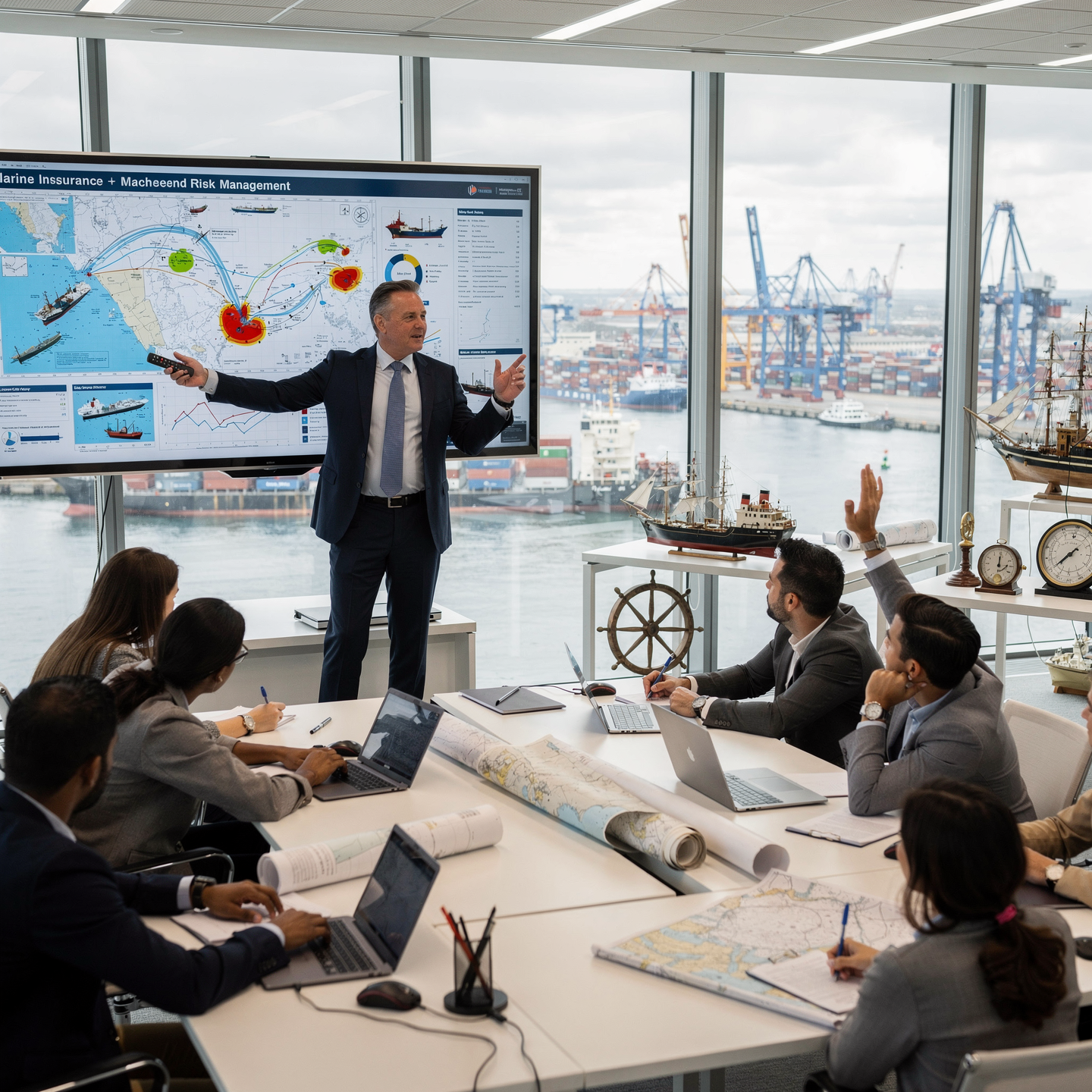
Master’s Degree in Marine Insurance and Risk Management
Why this master’s programme?
The Master in Marine Insurance and Risk Management
This program offers comprehensive training for professionals seeking to lead in the complex world of marine insurance. You will learn to assess and manage risks in maritime transport, from hull and machinery coverage to civil liability and protection and indemnity (P&I). You will master international legislation, claims analysis, and prevention strategies to optimize risk management and profitability.
Differentiating Advantages
- Practical Approach: Real-world cases and simulations to apply your knowledge.
- Industry Experts: Professors with extensive experience in insurance companies, brokerages, and maritime consultancies.
- Networking: Contacts with key professionals in the sector at a national and international level.
- Global Perspective: Analysis of the marine insurance market and emerging trends.
- Flexibility: Online format compatible with your professional development.
- Modality: Online
- Level: Masters
- Hours: 1600 H
- Start date: 25-04-2026
Availability: 1 in stock
Who is it aimed at?
- Insurance professionals (underwriters, adjusters, brokers) seeking to specialize in the complexity of marine risks.
- Maritime lawyers and consultants wishing to deepen their understanding of maritime legislation, case law, and claims management.
- Logistics, transportation, and international trade managers who need to understand and mitigate the risks associated with maritime freight transport.
- Executives of shipping lines, port terminals, and maritime service companies seeking to optimize risk management and asset protection.
- Graduates in Law, Business Administration, Economics, or Engineering aspiring to a career in the dynamic world of marine insurance.
Flexibility and applicability
Program designed for professionals in Active: flexible online format, practical cases based on the reality of the sector and networking with industry experts.
Objectives and skills

Assessing and mitigating risks in maritime operations:
“Manage emergencies (fire, flood, abandonment) by applying ISM procedures and coordinating with SAR authorities.”

Manage marine insurance claims efficiently:
“Analyze policies, assess damages, negotiate with involved parties and process payments efficiently, minimizing costs and maximizing customer satisfaction.”

Optimize the comprehensive management of the maritime supply chain:
Implement port inventory optimization strategies and intermodal logistics coordination to reduce costs and delivery times, considering variables such as storage capacity, demand fluctuations, and customs regulations.

Designing tailored insurance strategies for maritime projects:
Evaluate project-specific risks (climate, geography, cargo type) and develop detailed contingency plans with clear protocols and emergency drills.

Mastering the legal and regulatory framework of the marine insurance sector:
“Identify and apply relevant national and international legislation, including IMO conventions, codes and resolutions, as well as understand the roles and responsibilities of regulatory authorities.”

Leading the digital transformation in the marine insurance sector:
“Implement agile and innovative strategies to optimize underwriting, claims management and customer service through emerging technologies.”
Study plan – Modules
- Fundamentals and principles of underwriting in marine insurance: technical analysis, acceptance criteria, and rate calibration
- Advanced marine risk assessment: identification, qualitative and quantitative analysis, and probabilistic modeling
- Risk assessment methodologies for ships and cargo: classification, technical inspections, and international protocols
- Application of regulatory criteria and international standards in underwriting: IMCA, IACS, OCIMF, and their impact on premiums and terms
- Design and development of specific terms and clauses for international marine policies
- Assessment of catastrophic risk and its mitigation: use of hazard maps, geospatial analysis, and natural disaster modeling
- Integration of emerging technologies in risk assessment: big data, artificial intelligence, and maritime telemetry
- Management of multiple exposures and correlations Interramos for portfolio optimization
Dynamic pricing methodologies and continuous adjustment based on claims experience and global marine market trends
Practical case studies: detailed analysis of complex claims and their impact on underwriting and renegotiation decisions
Digital tools and specialized platforms for underwriting and risk assessment: functionalities, integration, and cybersecurity
Legal and regulatory aspects of international underwriting: jurisdiction, arbitration, and critical contractual clauses
Risk mitigation and transfer strategies through retrocession and advanced marine reinsurance
Impact of climate change on marine risks and proactive adjustments to underwriting policies
Developing skills for effective negotiation with international brokers and clients: technical communication and expectation management
Comparative analysis of regional and global marine insurance markets: trends and risks emerging opportunities
- Legal and Contractual Foundations in Maritime Claims: detailed analysis of policies, specific clauses, general conditions, and applicable exclusions
- Claims Filing and Management Procedures: notification protocols, evidence gathering, technical documentation, and witnesses
- Technical Damage Assessment in Marine Insurance: methodologies for inspection, expert appraisal, loss estimation, and economic quantification
- Investigation and Contingency Management: identification of emerging risks, responses to complex claims, and coordination with port authorities and insurers
- Optimization of Claims Settlement Processes: application of specialized software, workflows, response times, and associated cost control
- Comprehensive Management of Civil and Criminal Liability in Claims Cases: analysis of contractual liability, maritime negligence, and legal consequences
- Negotiation Advanced and Alternative Dispute Resolution (ADR): Mediation, arbitration, and conciliation techniques for complex maritime claims
Policies and Strategies for Contingency Prevention: Development of security protocols, audit programs, and continuous risk monitoring
Impact of International Regulations and Maritime Conventions on Claims Management: SOLAS, HNS Convention, CMR, and other relevant regulations
Case Studies and Simulations: Analysis of real-world situations, decision-making, and application of comprehensive solutions in multicultural and multifactorial scenarios
- Fundamentals of maritime risk assessment: classification, identification, and quantification of risks inherent in international operations
- Advanced models for risk assessment: probabilistic, deterministic, and extreme scenario-based
- Innovative underwriting methodologies for complex maritime risks: applied statistical analysis, big data, and machine learning
- Impact of macroeconomic and geopolitical factors on the assessment and underwriting of international marine policies
- Assessment of specific risks: liquid cargo, dry cargo, containers, and associated environmental risks
- International regulations and regulatory frameworks: implications for underwriting and risk management in marine insurance
- Disruptive technologies in risk management: maritime IoT, telemetry, blockchain, and their relevance for advanced underwriting
- Simulation and modeling of complex maritime claims: stochastic methods and their application in the assessment of Premiums
Assessment of catastrophic exposure: underwater earthquakes, tsunamis, and other high-impact events on coverage and underwriting
Integration of expert technical reports into decision-making for advanced underwriting
Dynamic management of the marine insurance portfolio: continuous analysis, risk adjustment, and strategic reinsurance
Relevant international case studies and research on innovation in marine risk underwriting and assessment
- Fundamentals of Marine Reinsurance: key concepts, types of reinsurance (proportional and non-proportional), roles in risk mitigation, and contractual structures in the international maritime sector.
- Modeling of Natural Disasters and Advanced Techniques: probabilistic analysis of extreme events (hurricanes, tsunamis, severe storms), use of specialized software for stochastic simulation and scenario analysis with a focus on port facilities and commercial fleets.
- Actuarial and Statistical Tools Applied to Marine Insurance: selection and calibration of probability distributions for catastrophic losses, risk assessment according to meteorological, geographical, and market parameters.
- International Reinsurance Markets: dynamics of Lloyd’s of London, the Bermuda Reinsurance Exchange, and major global brokers; Analysis of facultative contracts and treaties with an emphasis on cross-border maritime risk.
Financial Models for Risk Management: structuring of innovative financial solutions such as cat bonds, ILS (Insurance Linked Securities), and marine derivatives for transferring and optimizing insurance capital.
Assessment of Exposure and Mitigation in Cargo and Hull Risks: techniques for quantifying potential financial impacts and risk diversification strategies through reinsurance and parametric coverage.
Global Regulatory Framework and Compliance: detailed study of international regulations (Solvency II, IFRS 17), as well as specific maritime transport regulations and compliance assurance in multinational programs.
Active Risk Management: design and implementation of comprehensive plans that combine risk prevention, transfer, and retention, including methodologies for real-time monitoring and post-event evaluation.
Analysis of Real Case Studies: review Critique of high-impact maritime disasters, responses from the insurance market, and adaptations in reinsurance contracts.
Integration of Artificial Intelligence and Big Data in Risk Modeling: application in the prediction of catastrophic events and optimization of pricing and risk selection for reinsurance programs.
- Comprehensive Risk Analysis in Commercial Fleets: Identification, Classification, and Assessment of Maritime, Logistical, and Financial Vulnerabilities
- Advanced Marine Insurance Programming Models: Design, Adjustment, and Optimization of Policies for Specific Coverage of Cargo, Hull, Machinery, and Civil Liability
- Quantitative Techniques for Risk Mitigation: Use of Applied Statistics, Monte Carlo Simulations, and Probabilistic Modeling in Maritime Scenarios
- Comprehensive Operational Risk Management: Prevention and Control of Losses Associated with Delays, Accidental Damage, Pollution, and Cyber Risks in Maritime Transport
- Contractual Instruments and Standard Clauses: Detailed Analysis of Institute, BIMCO, and Other International Standards for Optimal Coverage
- Evaluation and Strategic Selection of Brokers and Insurers Specialized in International Markets: Technical and Financial Criteria for Cost and Benefit Optimization
- Advanced Insurance Audit Practices and Management of Claims: Protocols for coverage verification, documentation support, and efficient claims resolution
Integration of blockchain and big data technology in policy management and maritime risk prevention: Disruptive trends and success stories
International regulations and standards impacting marine insurance coverage: SOLAS, MARPOL, ISM, ISPS, and their influence on risk management
Practical case studies: Detailed analysis of complex marine claims with a focus on optimizing insurance policies for fleets and international transport
- Fundamentals and historical evolution of marine insurance underwriting: trend analysis and adaptation to globalized markets
- Advanced risk assessment methodologies: quantitative and qualitative techniques and probabilistic models applied to the maritime industry
- Design and structure of complex policies: specific clauses, exclusions, special conditions, and their impact on risk transfer
- Technical evaluation of the vessel and cargo: inspections, certifications, valuation of gross and net tonnage, and analysis of condition and age
- Operational and navigational risks: identification of inherent hazards, route analysis, adverse weather conditions, and their impact on underwriting
- Application of risk management models: Value at Risk (VaR), scenario analysis, and stress testing in maritime contexts
- Integration of disruptive technologies for risk mitigation: use of Big Data, artificial intelligence, and systems of
- Real-time monitoring
- Legal and regulatory management in international marine insurance: review of regulatory frameworks, international conventions, and their implications for underwriting and claims
- Reinsurance and coinsurance strategies: portfolio optimization, catastrophic risk transfer, and analysis of the marine reinsurance market
- Advanced pricing and rate-setting models: actuarial techniques, premium adjustments based on risk profiles, and emerging industry trends
- Loss mitigation and prevention protocols: safety audits, claims management, and contingencies in the maritime logistics chain
- Impact of climate change and environmental risks on marine underwriting: adaptation and compliance with international environmental standards
- Comprehensive crisis management and ensuring business continuity: response and post-claims recovery plans
- Development of negotiation skills and decision-making in uncertain contexts: tools for underwriters and Risk managers
- Real case studies and jurisprudential analysis: lessons learned from significant losses and litigation trends in the maritime market
- Advanced Foundations of Marine Insurance Underwriting: Quantitative and Qualitative Analysis of Risks Inherent in International Navigation
- Statistical and Probabilistic Models for Marine Risk Assessment: Simulation Techniques, Stress Analysis, and Adverse Scenarios
- Application of Artificial Intelligence and Machine Learning in Claims Prediction and Premium Optimization
- Strategic Negotiation in Marine Insurance Contracts: Specific Clauses, Exclusions, and Conditional Coverages
- International Regulatory Framework and Compliance: Key Regulations (Hague-Visby, Hamburg Rules, Rotterdam Rules) and Their Impact on Policy Underwriting
- Marine Environmental Risk Assessment: Analysis of Ecosystems, Pollution, Spills, and Their Impact on Civil Liability
- Comprehensive Risk Management in Port Operations and Multimodal Transport: Coordination Among Insurers, Operators, and Authorities
- Analysis and mitigation of technological and cyber risks in modern fleets: protection against cyberattacks and system failures
Innovations in retrocession and marine reinsurance policies: structures, strategies, and assessment of accumulated risk in global markets
Methodologies for the audit and continuous monitoring of underwritten risks: key indicators, technical reports, and early warning systems
- Conceptual and regulatory framework of marine insurance: international conventions, applicable legislation, and marine insurance contracts
- Advanced methodologies for the identification and assessment of risks in global maritime operations
- Quantitative risk analysis: statistical models, scenario simulations, and use of specialized software
- Instruments and techniques for dynamic risk management: real-time monitoring, predictive alarms, and early warning systems
- Design and structuring of comprehensive marine insurance programs: coverages, exclusions, and specific clauses
- Policy and claims management: procedures, negotiation with insurers, and handling of complex claims
- Financial assessment of the impact of risk: cost-benefit analysis, technical reserves, and risk capital
- Integration of emerging technologies for risk mitigation: IoT, big data, blockchain, and predictive analytics
- Risk transfer and retention strategies: traditional insurance versus alternative solutions and reinsurance programs
- Case studies and benchmarking in marine risk management and insurance in different international markets
- Fundamentals of Marine Underwriting: Technical and Financial Analysis Applied to the Naval Sector
- Advanced Risk Assessment of Vessels: Technical, Historical, and Actuarial Criteria
- Quantitative Models for Valuing Exposures in International Marine Insurance
- Global Regulatory Context: SOLAS, IMO, and Essential Maritime Conventions for Risk Management
- Classification of Cargoes and Specific Risks: Chemicals, Bulk Cargo, Dangerous Goods, and General Cargo
- Technological Tools in Underwriting: Big Data, Artificial Intelligence, and Predictive Analytics Applied to Claims Analysis
- Policy Design and Optimization: Coverages, Exclusions, and Specific Clauses for High-Risk Markets
- Reinsurance Strategies and Risk Allocation: Quotas, Facultatives, and Stop-Loss Contracts
- Methodologies for Risk Mitigation: Security Assessment Maritime, technical inspections, and predictive audits
Comprehensive claims management: identification, quantification, negotiation, and resolution in international contexts
Analysis of the impact of external factors: geopolitics, extreme weather conditions, and changes in trade routes
Implementation of risk management systems aligned with specific ISO standards in marine insurance
Case study: underwriting and evaluation of a complex maritime project with multifactorial risk
Innovation in products and services for covering emerging risks in the maritime industry
Governance and compliance regulations in underwriting: fraud and money laundering prevention in the maritime market
- Conceptual and regulatory framework of marine insurance: detailed analysis of contracts, specific clauses, and applicable international standards (Institute Cargo Clauses, P&I Clubs, general average clauses)
- Technical foundations of financial modeling in marine insurance: introduction to stochastic models, Monte Carlo simulation, Value at Risk (VaR), and Expected Shortfall applied to complex marine risks
- Integration of risks into strategic management: identification, assessment, and quantification of marine risks (operational, environmental, political, and market) and their impact on underwriting and pricing
- Technological innovation in the marine insurance industry: application of emerging technologies (blockchain, artificial intelligence, big data analytics) for process automation, improved fraud detection, and portfolio optimization
- Predictive models and advanced analytics for claims prevention and mitigation: use of machine learning and real-time data analysis for Anticipating and minimizing losses
Assessment of exposure to climate and geopolitical risk: incorporating climate change scenarios and geostrategic risks into the valuation and coverage of international marine insurance
Legal, contractual, and compliance aspects: rights and obligations of the parties, international claims management, and regulatory compliance in multifaceted regulatory environments
Advanced claims management strategies: protocols for efficient claims management, coordination with adjusters and liquidators, and analysis of landmark cases for optimal risk transfer
Design and development of a comprehensive marine risk management plan: creating policies, procedures, and contingency plans adapted to market and technological evolution
Presentation, critical analysis, and oral defense of the final project: interdisciplinary integration of technical, financial, and strategic elements for effective decision-making in marine insurance
Career prospects
“`html
- Marine Insurance Underwriter: Risk assessment, pricing, and policy management for vessels, cargo, and civil liability.
- Marine Claims Manager: Investigation and processing of claims related to maritime incidents, damage, collisions, and losses.
- Marine Insurance Broker: Intermediation between insurers and clients, advice on insurance procurement, and management of insurance programs.
- Marine Risk Management Consultant: Identification, analysis, and assessment of risks in maritime operations, development of mitigation plans, and crisis management.
- Marine Insurance Adjuster: Inspection and assessment of damage to vessels and cargo, determination of causes, and valuation of losses.
- Marine Insurance Compliance Officer: Ensuring compliance with applicable regulations and laws in the marine insurance sector.
Marine Reinsurance Manager: Negotiating and managing reinsurance contracts to protect marine insurers.
Risk Analyst in Financial Institutions: Evaluating risks related to the financing of ships and maritime projects.
“`
Entry requirements

Academic/professional profile:
Bachelor’s degree in Nautical Science/Maritime Transport, Naval/Marine Engineering or a related qualification; or proven professional experience on the bridge/in operations.

Language proficiency:
Functional Maritime English (SMCP) recommended for simulations and technical materials.

Documentation:
Updated CV, copy of qualification or seaman’s book, national ID/passport, motivation letter.

Technical requirements (for online):
Device with camera/microphone, stable internet connection, monitor ≥ 24” recommended for ECDIS/Radar-ARPA.
Admissions process and dates

Online
application
(form + documents).

Academic review and interview
Admissions decision

Admissions decision
(+ scholarship offer if applicable).

Place reservation
(deposit) and enrolment.

Induction
(access to the virtual campus, calendars, simulator guides).
Scholarships and financial support
- Comprehensive Maritime Risk Analysis: Master the assessment and management of specific risks in the maritime sector, including cargo, vessels, and liabilities.
- In-Depth Marine Insurance: Gain a detailed understanding of the different types of policies, clauses, and coverages, optimizing the protection of assets and interests.
- International Legal and Regulatory Framework: Acquire expert knowledge of international maritime law, conventions, and applicable regulations.
- Claims and Claims Management: Develop practical skills for the efficient management of maritime claims, from investigation to settlement.
- Development of Prevention Strategies: Learn to implement proactive strategies for risk prevention and loss minimization in the maritime sector. Maritime.
Testimonials
This master’s program provided me with the tools and knowledge necessary to lead risk management in my company. Thanks to the specialization in marine insurance, I was able to optimize our policies, reducing costs by 15% and significantly improving our coverage against potential claims. Furthermore, the network of contacts I established during the program has been invaluable to my professional development.
During my Master’s in Finance and the Blue Economy, I developed a financial model for a sustainable aquaculture company seeking funding. My analysis, which integrated environmental and social risk factors, was crucial in securing the necessary investment for the company, demonstrating the project’s viability and its potential positive impact on the blue economy.
This master’s program provided me with the tools and knowledge necessary to lead risk management in my company. I implemented a new risk analysis protocol that reduced incidents by 15% and optimized insurance costs by 10% in the first year.
This master’s degree provided me with the necessary tools and knowledge to lead the negotiation of a marine insurance contract for a fleet of oil tankers, significantly minimizing the company’s risk exposure and generating a 15% savings in annual premiums.

Frequently asked questions
Insurance and maritime risk management.
Yes. The itinerary includes ECDIS/Radar-ARPA/BRM with harbor, ocean, fog, storm, and SAR scenarios.
Online with live sessions; hybrid option for simulator/practical placements through agreements.
It focuses primarily on maritime transport, although it may address aspects of other modes of transport related to logistics and international trade in the context of supply chains.
Recommended functional SMCP. We offer support materials for standard phraseology.
Yes, with a relevant degree or experience in maritime/port operations. The admissions interview will confirm suitability.
Optional (3–6 months) through Companies & Collaborations and the Alumni Network.
Simulator practice (rubrics), defeat plans, SOPs, checklists, micro-tests and applied TFM.
A degree from Navalis Magna University + operational portfolio (tracks, SOPs, reports and KPIs) useful for audits and employment.
- Conceptual and regulatory framework of marine insurance: detailed analysis of contracts, specific clauses, and applicable international standards (Institute Cargo Clauses, P&I Clubs, general average clauses)
- Technical foundations of financial modeling in marine insurance: introduction to stochastic models, Monte Carlo simulation, Value at Risk (VaR), and Expected Shortfall applied to complex marine risks
- Integration of risks into strategic management: identification, assessment, and quantification of marine risks (operational, environmental, political, and market) and their impact on underwriting and pricing
- Technological innovation in the marine insurance industry: application of emerging technologies (blockchain, artificial intelligence, big data analytics) for process automation, improved fraud detection, and portfolio optimization
- Predictive models and advanced analytics for claims prevention and mitigation: use of machine learning and real-time data analysis for Anticipating and minimizing losses
Assessment of exposure to climate and geopolitical risk: incorporating climate change scenarios and geostrategic risks into the valuation and coverage of international marine insurance
Legal, contractual, and compliance aspects: rights and obligations of the parties, international claims management, and regulatory compliance in multifaceted regulatory environments
Advanced claims management strategies: protocols for efficient claims management, coordination with adjusters and liquidators, and analysis of landmark cases for optimal risk transfer
Design and development of a comprehensive marine risk management plan: creating policies, procedures, and contingency plans adapted to market and technological evolution
Presentation, critical analysis, and oral defense of the final project: interdisciplinary integration of technical, financial, and strategic elements for effective decision-making in marine insurance
Request information
Complete the Application Form.
Attach your CV/degree certificate (if you have it to hand).
Indicate your preferred cohort (January/May/September) and whether you would like the hybrid option with simulator sessions.
An academic advisor will contact you within 24–48 hours to guide you through the admission process, scholarships, and compatibility with your professional schedule.
Faculty
Eng. Tomás Riera
Full Professor
Eng. Tomás Riera
Full Professor
Eng. Sofía Marquina
Full Professor
Eng. Sofía Marquina
Full Professor
Eng. Javier Bañuls
Full Professor
Eng. Javier Bañuls
Full Professor
Dr. Nuria Llobregat
Full Professor
Dr. Nuria Llobregat
Full Professor
Dr. Pau Ferrer
Full Professor
Dr. Pau Ferrer
Full Professor
Cap. Javier Abaroa (MCA)
Full Professor
Cap. Javier Abaroa (MCA)
Full Professor

