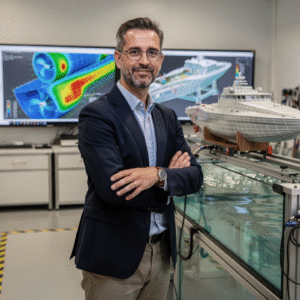
Diploma in Basic Naval Electricity
Why this certificate program?
The Diploma in Basic Naval Electricity
This program provides you with the essential foundations to understand and apply electricity in the maritime environment. Learn from basic principles to the operation of onboard electrical systems, preparing you to diagnose, maintain, and repair equipment safely and efficiently. This program is ideal for those seeking a solid foundation in naval electricity or wishing to expand their technical knowledge in the industry.
Key Benefits
- Solid Foundations: Master the key concepts of electrical circuits, components, and measurements.
- Practical Application: Learn to interpret electrical schematics and perform preventive and corrective maintenance tasks.
- Electrical Safety: Understand the rules and procedures for working safely with electricity on board.
- Marine Equipment: Become familiar with common electrical systems on vessels, such as generators, motors, and lighting systems.
- Career Development: Boost your career in the marine industry with specialized and in-demand training.
- Modality: Online
- Level: Diplomado
- Hours: 800 H
- Start date: 11-06-2026
Availability: 1 in stock
Who is it aimed at?
- Naval maintenance and repair personnel seeking to expand their knowledge of basic electrical systems and troubleshooting.
- Electronics and electrical technicians wishing to specialize in the maritime environment and naval regulations.
- Naval engineering students and related fields requiring a solid foundation in electrical principles applied to ships and vessels.
- Vessel operators and deck personnel interested in understanding the operation and preventive maintenance of electrical systems.
- Naval inspectors and experts needing to update their knowledge of new technologies and electrical regulations in the sector.
Study flexibility
Designed for professionals and students: Live online classes, downloadable materials, and 24-hour access to the platform.
Objectives and competencies

Apply naval electrical safety regulations:
“Following IEC 60092 standards, verifying protections, insulation and lockout/tagout (LOTO) procedures.”

Interpreting naval electrical plans and diagrams:
“Identify symbols, components and systems, understanding their operation and interconnection in the ship’s electrical network.”

Perform preventive and corrective maintenance on basic electrical systems in vessels:
“Identify faults, repair components and verify safe operation, complying with regulations and optimizing system availability.”

Diagnosing and troubleshooting common faults in basic naval electrical circuits:
“Identify defective components using multimeter testing and replace/repair according to technical manuals.”

Install and configure basic electrical components on boats according to technical specifications:
“Following maritime electrical safety regulations and using appropriate tools.”

Select and use electrical measuring tools and instruments safely and efficiently:
Know and apply electrical safety standards, select the appropriate instrument according to the magnitude to be measured, and perform accurate measurements while minimizing risks.
Curriculum - Modules
- Comprehensive Maritime Incident Management: protocols, roles, and chain of command for coordinated response
- Operational Planning and Execution: briefing, routes, weather windows, and go/no-go criteria
- Rapid Risk Assessment: criticality matrix, scene control, and decision-making under pressure
- Operational Communication: VHF/GMDSS, standardized reports, and inter-agency liaison
- Tactical Mobility and Safe Boarding: RHIB maneuvers, approach, mooring, and recovery
- Equipment and Technologies: PPE, signaling, satellite tracking, and field data logging
- Immediate Care of the Affected: primary assessment, hypothermia, trauma, and stabilization for evacuation
- Adverse Environmental Conditions: swell, Visibility, flows, and operational mitigation
Simulation and training: critical scenarios, use of VR/AR, and exercises with performance metrics
Documentation and continuous improvement: lessons learned, indicators (MTTA/MTTR), and SOP updates
- Basic Electricity: current, voltage, resistance, Ohm’s Law.
- Series and Parallel Circuits: calculation and applications in naval systems.
- Electrical Components: fuses, switches, relays, diodes.
- Batteries: types, maintenance, charging, discharging, and safety.
- Generators: operating principles, types (AC/DC), maintenance.
- Onboard Electrical Distribution Systems: panels, wiring, protection.
- Electrical Safety: risks, prevention, first aid in case of electrocution.
- Marine Electrical Standards and Regulations (ABYC, IEC).
- Lighting Systems: types of lamps, energy efficiency, control.
- Grounding systems: types, importance for safety and operation.
‘
- Fundamentals of Naval Electricity: Current, voltage, resistance, Ohm’s law.
- Electrical Circuits in Ships: Series, parallel, and mixed circuits.
- Onboard Power Generation: Diesel generators, emergency systems, and alternative power sources.
- Electrical Distribution: Electrical panels, switches, fuses, and overcurrent protection.
- Cables and Connections: Types of marine cables, connection techniques, and safety standards.
- Lighting Systems: Types of luminaires, energy efficiency, and maintenance.
- Marine Electrical Equipment: Motors, pumps, ventilation, and heating systems.
- Onboard Electrical Safety: Electrical hazards, first aid, and safety procedures.
- Standards and Regulations: International (IEC, IEEE) and local standards applicable to marine electrical installations.
- Preventive and Corrective Maintenance: Troubleshooting, repair, and testing of electrical equipment.
Power and Energy Calculation.
‘
- Fundamentals of Electricity: current, voltage, resistance, Ohm’s Law
- Series and Parallel Circuits: calculation and problem-solving
- Basic Electrical Components: resistors, capacitors, inductors, diodes
- Electrical Safety: risks, protection, safety equipment
- Electrical Standards and Regulations in the Maritime Sector
- Batteries and Charging Systems: types, maintenance, safety
- Electric Generators: operating principles, maintenance
- Onboard Electrical Distribution Systems: AC/DC, wiring, protection
- Onboard Lighting: types, efficiency, safety
- Electrical Propulsion Systems and Auxiliary Equipment
‘
- Introduction to electricity: basic concepts (voltage, current, resistance, power) and units.
- Electrical circuits: series, parallel, and mixed circuits. Ohm’s and Kirchhoff’s Laws.
Electrical Components: resistors, capacitors, inductors, diodes, transistors.
Measuring Tools and Equipment: multimeter, ammeter, voltmeter, megohmmeter.
Electrical Safety: electrical hazards, protective measures (grounding, residual current devices, insulation).
Onboard Electrical Safety Regulations (IEC 60092, etc.).
Electrical Generators: operating principles, types, basic maintenance.
Batteries: types, charging, discharging, maintenance, and safety.
Lighting Systems: types of lamps, ballasts, wiring.
Preventive Maintenance: inspections, Testing, lubrication, cleaning.
‘
- System Architecture and Components: Structural design, materials, and subsystems (mechanical, electrical, electronic, and fluid) with selection and assembly criteria for marine environments
- Fundamentals and Principles of Operation: Physical and engineering foundations (thermodynamics, fluid mechanics, electricity, control, and materials) that explain performance and operating limits
- Safety and Environmental (SHE): Risk analysis, PPE, LOTO, hazardous atmospheres, spill and waste management, and emergency response plans
- Applicable Regulations and Standards: IMO/ISO/IEC requirements and local regulations;
- Conformance criteria, certification, and best practices for operation and maintenance
- Inspection, testing, and diagnostics: Visual/dimensional inspection, functional testing, data analysis, and predictive techniques (vibration, thermography, fluid analysis) to identify root causes
- Preventive and predictive maintenance: Hourly/cycle/seasonal plans, lubrication, adjustments, calibrations, consumable replacement, post-service verification, and operational reliability
- Instrumentation, tools, and metrology: Measuring and testing equipment, diagnostic software, calibration and traceability; selection criteria, safe use, and storage
- Onboard integration and interfaces: Mechanical, electrical, fluid, and data compatibility; Sealing and watertightness, EMC/EMI, corrosion protection, and interoperability testing.
Quality, acceptance testing, and commissioning: process and materials control, FAT/SAT, bench and sea trials, go/no-go criteria, and evidence documentation.
Technical documentation and integrated practice: logs, checklists, reports, and a complete case study (safety → diagnosis → intervention → verification → report) applicable to any system.
- Fundamentals of Marine Electricity: Current, voltage, resistance, Ohm’s Law, series and parallel circuits.
- Onboard Electrical Systems: Generation, distribution, protection, and consumption of electrical power.
- Marine Electrical Equipment: Motors, generators, transformers, batteries, lighting and heating systems.
- Electrical Safety in the Naval Environment: Electrical hazards, lockout/tagout (LOTO) procedures, personal protective equipment (PPE).
- Electrical Safety Regulations and Standards: Compliance with national and international regulations (SOLAS, IMO).
- First Aid in Case of Electrical Accidents: Victim rescue, CPR, treatment of electrical burns.
- Maneuvers Basic Navigation: Compass use, course calculation, position estimation.
Safety in Naval Maneuvers: Communication, signaling, emergency procedures.
Safety Equipment on Board: Life jackets, life rafts, firefighting equipment, emergency communication systems.
Occupational Risk Prevention in the Naval Environment: Risk identification and assessment, preventive measures, safety management.
‘
Career opportunities
- Onboard Marine Electrician: Maintenance and repair of electrical systems on ships.
- Shipyard Maintenance Technician: Repair and modernization of naval electrical systems.
- Vessel Electrical Systems Installer: Installation of wiring, panels, and electrical equipment in new constructions.
- Support Technician in Marine Equipment Companies: Technical assistance and maintenance of marine electrical equipment.
- Marine Electrical Installations Inspector: Verification of compliance with electrical safety regulations and standards.
- Offshore Power Systems Operator: Maintenance and operation of electrical systems on offshore oil and wind platforms.
- Naval Automation Technician: Design, installation, and maintenance of automated systems in ships.
- Technical Salesperson for Marine Electrical Equipment: Advising on and selling electrical equipment for the naval industry.
“`
Admission requirements

Academic/professional profile:
Degree/Bachelor's degree in Nautical Science/Maritime Transport, Naval/Marine Engineering, or a related field; or proven professional experience in bridge/operations.

Language proficiency:
Recommended functional maritime English (SMCP) for simulations and technical materials.

Documentation:
Updated resume, copy of degree or seaman's book, ID card/passport, letter of motivation.

Technical requirements (for online):
Equipment with camera/microphone, stable connection, ≥ 24” monitor recommended for ECDIS/Radar-ARPA.
Admission process and dates

1. Online
application
(form + documents).

2. Academic review and interview
(profile/objectives/schedule compatibility).

3. Admission decision
(+ scholarship proposal if applicable).

4. Reservation of place
(deposit) and registration.

5. Induction
(access to campus, calendars, simulator guides).
Scholarships and grants
- Electrical Fundamentals: Master the basic principles of electricity and their application in naval systems.
- Naval Circuits: Learn to identify, analyze, and troubleshoot specific electrical circuits on vessels.
- Instrumentation and Measurement: Use diagnostic and measurement tools for preventive and corrective maintenance.
- Electrical Safety: Apply safety standards to prevent risks and accidents in naval electrical environments.
- Electrical Maintenance: Perform predictive, preventive, and corrective maintenance tasks on naval electrical equipment.
Testimonials
This diploma program provided me with the theoretical and practical foundation I needed to understand naval electrical systems. Thanks to the training I received, I was able to diagnose and resolve a critical failure in the main power system during a voyage, preventing a potential emergency and demonstrating the effectiveness of the knowledge I had acquired.
I applied the knowledge from the diploma in Electricity & Electronics to automate the irrigation system of my greenhouse, which resulted in a 30% saving in water consumption and a 15% increase in production in the first quarter.
This diploma program provided me with the essential theoretical and practical tools to understand naval electrical systems. I applied the knowledge I gained to solving complex electrical wiring and distribution problems, optimizing energy efficiency on board and minimizing system failures during operations.
This diploma provided me with a solid foundation in marine electricity. I mastered electrical diagrams, the operation of essential equipment, and safety procedures, enabling me to contribute effectively to the installation and maintenance of electrical systems in my current onboard position.
Frequently asked questions
Electrical systems for vessels and offshore platforms.
Yes. The itinerary includes ECDIS/Radar-ARPA/BRM with harbor, ocean, fog, storm, and SAR scenarios.
Online with live sessions; hybrid option for simulator/practical placements through agreements.
Naval vessels, including warships, aircraft carriers, submarines and auxiliary vessels.
Recommended functional SMCP. We offer support materials for standard phraseology.
Yes, with a relevant degree or experience in maritime/port operations. The admissions interview will confirm suitability.
Optional (3–6 months) through Companies & Collaborations and the Alumni Network.
Simulator practice (rubrics), defeat plans, SOPs, checklists, micro-tests and applied TFM.
A degree from Navalis Magna University + operational portfolio (tracks, SOPs, reports and KPIs) useful for audits and employment.
- Fundamentals of Electricity: Current, voltage, resistance, Ohm’s law.
- Electrical Circuits: Series, parallel, mixed. Calculation and analysis.
Protection devices: Fuses, circuit breakers, residual current devices (RCDs).
Electrical safety: Risks, prevention measures, personal protective equipment (PPE).
Onboard power generation: Generators, backup systems.
Electrical distribution onboard: Panels, wiring, grounding.
Batteries and charging systems: Types, maintenance, safety.
Lighting systems: Types of lamps, energy efficiency, regulations.
Communication and navigation systems: Radio, GPS, radar. Food and protection.
- Preventive and corrective maintenance: Procedures, tools, documentation.
‘
Request information
Complete the Application Form.
Attach your CV/degree certificate (if you have it to hand).
Indicate your preferred cohort (January/May/September) and whether you would like the hybrid option with simulator sessions.
An academic advisor will contact you within 24–48 hours to guide you through the admission process, scholarships, and compatibility with your professional schedule.
Faculty
Eng. Tomás Riera
Full Professor
Eng. Tomás Riera
Full Professor
Eng. Sofía Marquina
Full Professor
Eng. Sofía Marquina
Full Professor
Eng. Javier Bañuls
Full Professor
Eng. Javier Bañuls
Full Professor
Dr. Nuria Llobregat
Full Professor
Dr. Nuria Llobregat
Full Professor
Dr. Pau Ferrer
Full Professor
Dr. Pau Ferrer
Full Professor
Cap. Javier Abaroa (MCA)
Full Professor
Cap. Javier Abaroa (MCA)
Full Professor