Master’s Degree in Metaverse and Virtual Reality for Nautical Training
Why this master’s programme?
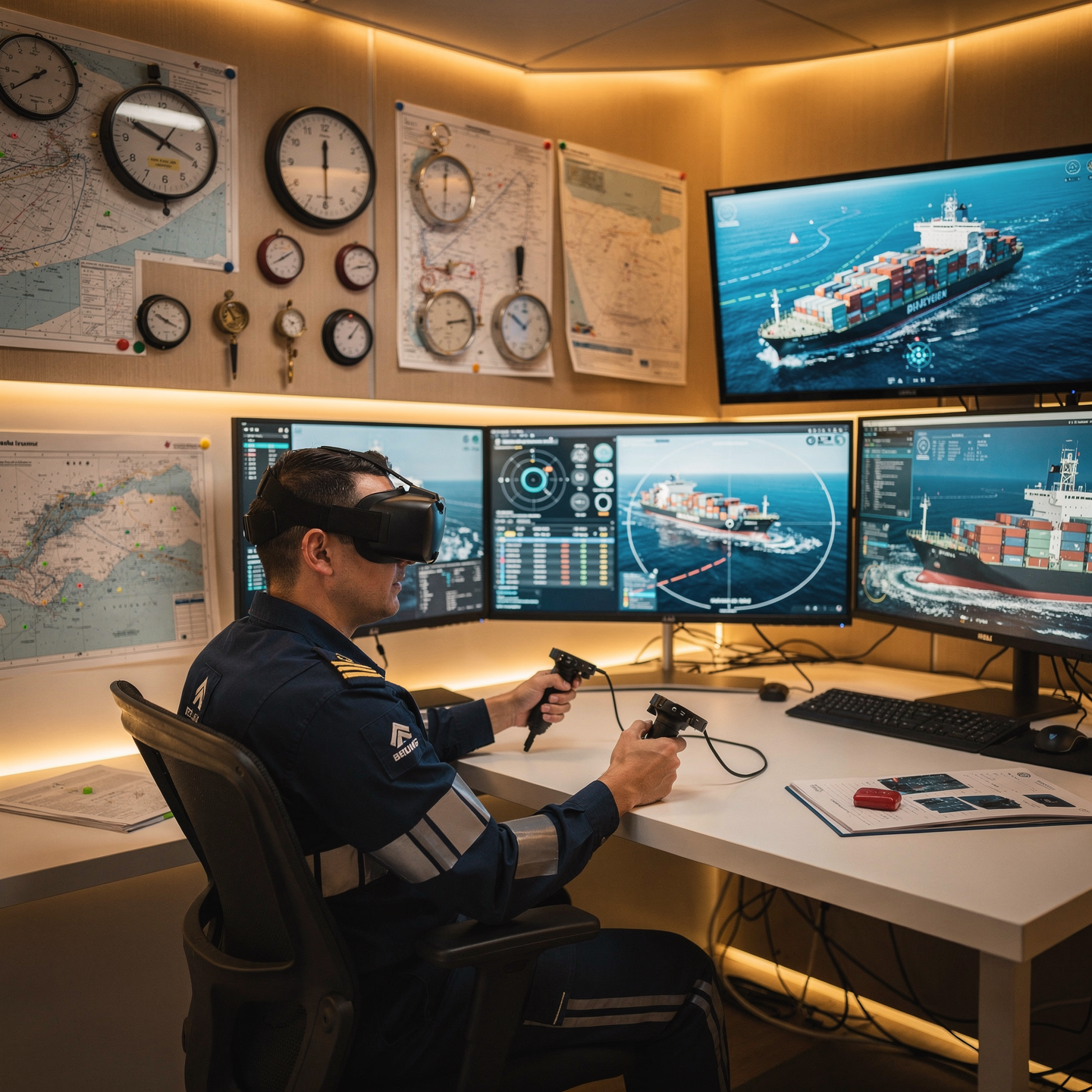
The Master’s in Metaverse and Virtual Reality for Nautical Training
Prepares you to lead the digital transformation of the maritime sector. Learn to design and implement immersive experiences and realistic simulations for the training of naval professionals. This program provides you with the skills necessary to create innovative and efficient virtual learning environments.
Differentiating Advantages
- Nautical Virtual Environment Design: Master the tools and techniques to create high-fidelity simulations of ships, ports, and maritime scenarios.
- Virtual Reality Applied to Navigation: Develop VR applications for training in navigation, maneuvers, emergency management, and maritime safety.
- Metaverse for Remote Collaboration: Learn to build collaborative virtual spaces for distance learning, meetings, and drills.
- User Experience Optimization: Apply UX/UI design principles to ensure the effectiveness and appeal of immersive experiences.
- Case Studies and Real Projects: Work on practical projects that will allow you to apply your knowledge and build a professional portfolio.
- Modality: Online
- Level: Masters
- Hours: 1600 H
- Start date:
Availability: 1 in stock
Who is it aimed at?
- Maritime professionals (captains, officers, naval engineers) interested in applying the latest metaverse and virtual reality technologies to improve onboard training and safety.
- Nautical instructors and trainers looking to innovate their teaching methods with immersive tools and advanced simulations.
- Software developers and 3D designers who wish to specialize in creating virtual environments for the maritime industry.
- Shipping companies and maritime simulation centers that want to implement virtual reality solutions to optimize their staff training.
- Graduates in Nautical Studies, Maritime Engineering, or related fields seeking cutting-edge specialization in Immersive technologies applied to the naval sector.
Flexibility
Adapted to your pace: online format with live and recorded classes, 24/7 access to interactive resources, and personalized tutoring.
Objectives and skills

Designing immersive experiences for maritime emergency simulation:
Integrate photorealistic 3D modeling and advanced physical dynamics to recreate complex and realistic maritime risk scenarios, including weather effects and fluid behaviors.

Develop digital twins of vessels for advanced maintenance training:
Accurately model mechanical, electrical, and hydraulic systems, simulating realistic failures and their effects in real time for effective diagnosis and repair.

Implement realistic navigation simulations for training in adverse weather conditions:
Anticipate risks, execute safe evasive maneuvers and communicate effectively with other vessels and coastal stations, adapting to degrading visibility and increasing sea state.

Integrating XR technologies to optimize instruction in docking and anchoring maneuvers:
“Simulating realistic and complex scenarios, adapting the difficulty to the student’s progress and evaluating their performance in real time using objective metrics.”

Create interactive virtual environments for onboard safety and risk prevention training:
“Design immersive emergency simulations (fires, spills, man overboard) evaluating the response to procedures and the use of safety equipment.”

Evaluate and certify nautical skills using virtual reality:
“Maneuver the vessel safely and efficiently in different weather conditions and simulated traffic scenarios.”
Study plan – Modules
- Fundamentals of immersive virtual reality: concepts, hardware, software, and specialized platforms for nautical simulation
- Advanced 3D modeling and physical simulation: creating accurate maritime environments with realistic fluid dynamics, meteorology, and oceanographic conditions
- Instructional design for VR simulators: pedagogical methodologies, design of immersive learning experiences, and assessment of nautical skills
- Multisensory integration: application and synchronization of spatial audio, haptics, and visual feedback to enhance immersion and realism in training
- Programming and development of interactivity: using graphics engines (Unreal Engine, Unity) for programming scenarios, navigation, and maneuvers in virtual environments
- Implementation of motion tracking and control systems: optical and inertial tracking technology and the use of wearable devices to simulate bridge movements and nautical maneuvers
- Simulation of navigation systems
- Electronics: Incorporation of virtual ECDIS, radars, AIS, and real-time communications with standardized maritime protocols
- Development of emergency scenarios and crisis protocols: Simulation of technical failures, adverse conditions, and safety procedures for reactive and proactive training
- Performance evaluation and analysis methodologies: Real-time data capture, statistical analysis, and generation of detailed reports for continuous training improvement
- Technical aspects of hardware and VR system maintenance: Performance optimization, calibration, update management, and preventative diagnostics for simulated nautical environments
- Fundamentals of haptic technologies: physical principles, types of actuators, tactile feedback, and their relevance in nautical simulation environments
- Haptic devices applied to navigation: gloves, suits, steering wheels, and rudders with tactile and force feedback to replicate real maritime conditions
- Biometric sensors in simulations: monitoring heart rate, electromyographic activity (EMG), galvanic skin response, and their integration into virtual reality environments
- Modeling human-machine interaction: algorithms for interpreting biometric data in real time to adjust simulated scenarios according to the user’s physiological state
- Integration of haptic and biometric systems in nautical VR platforms: software architectures, middleware, communication protocols, and data synchronization for an immersive and responsive experience
- Optimizing performance in nautical training through biometric feedback: analysis of Stress, fatigue, and decision-making under pressure supported by haptic and biometric data.
Practical applications in maritime safety: emergency simulation, early warning based on biometric parameters, and haptic feedback for training critical maneuvers and safety protocols.
Evaluation and validation of simulators with haptic and biometric technologies: quantitative metrics, user experience (UX) quality, and international standards for nautical training.
Development of training content in a nautical metaverse: integration of advanced 3D environments, precise maritime physics, and adaptability according to individual biometric profiles.
Future trends and technological challenges: artificial intelligence applied to biometric interpretation, improvement of haptic actuators, and mass deployment in professional nautical training.
- Fundamentals of technological innovation applied to nautical simulators: historical evolution and current state of the art in virtual reality and metaverse.
- Advanced design of immersive virtual environments: integration of 3D modeling, fluid physics, and marine dynamics systems to replicate real-world navigation conditions.
- Architecture and frameworks for sensory simulation: implementation of haptic technologies, spatialized 3D audio, and stereoscopic visualization to maximize immersion.
- Development and integration of biometric sensors and telemetry for real-time analysis of sailor performance in virtual environments.
- Optimization of graphics and physics engines for nautical simulators: balancing realism, latency, and user experience on VR platforms and metaverse devices.
- Interoperability and compatibility protocols in simulation ecosystems: open standards, synchronization networks, and multiplayer in collaborative nautical training environments.
- Application of artificial intelligence and machine learning for adaptive training personalization, critical error detection, and dynamic scenario generation.
- Validation and certification methodologies for immersive nautical simulators according to international standards (STCW, IMO) and training effectiveness criteria.
- Data management and cybersecurity in virtual training environments: protection of sensitive information, privacy, and prevention of unauthorized access.
- Implementation of multisensory feedback and mixed reality for advanced training in complex maneuvers, emergencies, and operations in ports and on the high seas.
- Digital Twins in Navigation: Fundamentals, Real-Time Dynamic Modeling, and Synchronization with Maritime Sensor Data
- Artificial Intelligence Applied to Navigation: Predictive Algorithms, Machine Learning for Risk Detection, and Route Optimization in Virtual Environments
- Systems Integration Architecture and Protocols in the Virtual Bridge: Communication Between Simulators, IoT Sensors, and Metaverse Platforms
- Cybersecurity in Digital Nautical Environments: Vulnerability Analysis, Protection Against Cyberattacks, and Operational Resilience Strategies
- International Regulations and Standards in Metaverse Platform Certification: SOLAS and IMO Compliance, and ISO Certifications for Virtual Nautical Training
- Advanced Simulation for Decision-Making in the Virtual Bridge: Crisis Scenarios, Maritime Traffic Management, and Emergency Response
- Human-Machine Interface in the Maritime Metaverse: Ergonomic Design for Immersive Experiences and Reduction of Cognitive Fatigue
- Remote control and monitoring: tools for virtual fleet supervision and real-time performance analysis
- Competency assessment and certification in metaverse environments: practical and theoretical validation methodologies with technological support
- Implementation of digital operational safety protocols: risk management, audits, and continuous updates on nautical VR platforms
- Fundamentals of 3D modeling applied to nautical environments: geometry, texturing, lighting, and optimization for metaverse platforms
- Advanced physics simulation techniques: fluid dynamics, wind-sea interaction, waves, turbulence, and vessel behavior in virtual scenarios
- Integration of hydrographic and oceanographic data: use of real-world databases for creating accurate bathymetry, tides, currents, and real-time weather conditions
- Implementation of specialized physics engines for maritime simulation: configuration of forces, hydrodynamic resistance, stability, and maneuverability in immersive simulators
- Development and programming of interactive scenarios for practicing navigation and complex maneuvers in highly detailed virtual environments
- Methodologies for the objective, real-time evaluation of critical skills using motion sensors, telemetry, and behavioral analysis within the metaverse
- Use of artificial intelligence and machine learning for the automatic generation of emergency situations and decision-making under pressure in nautical training
- Design and calibration of haptic interfaces and VR/AR devices to improve sensory perception and feedback during practical training
- Interoperability standards and protocols for the integration of nautical simulators with metaverse platforms and learning management systems (LMS)
- Validation and certification of simulations through benchmarking with real data and international standards to ensure maximum fidelity and training value
- Fundamentals of Virtual Reality (VR) and the Metaverse: Technological Architecture, State-of-the-Art Devices, and Digital Ecosystems Applied to Nautical Training
- Advanced Immersive Simulations: Integration of Real-Time Graphics Engines (Unreal Engine, Unity) and Stereoscopic Rendering to Replicate Maritime Conditions with Absolute Fidelity
- Modeling and Georeferencing of Nautical Environments: Creation of Precise Bathymetry, Wave Dynamics, and Realistic Visibility Analysis in Virtual Scenarios
- Haptic and Sensory Interactivity: Implementation of Tactile Feedback, Simulation of Hydrodynamic Forces, and Motion Devices for Kinesthetic Training in Complex Maneuvers
- Big Data and Machine Learning in Nautical Simulators: Analysis of Behavioral Patterns for Adaptive Personalization and Performance Improvement in Training
- Multi-User Systems in the Nautical Metaverse: Design of Collaborative Environments for Coordinated Training
Crew management, real-time communications, and role management in critical scenarios
Augmented reality (AR) applied to nautical training: data overlay on physical bridges and simulators for situational awareness and tactical decision-making
Hardware-software integration protocols: interoperability between sensors, navigation systems, simulators, and 5G networks for low latency and high fidelity in the training experience
International regulations and standards for VR simulators in the maritime sector: STCW and IMO compliance, and competency assessment through objective metrics and telemetry monitoring
Professional assessment and certification: design of immersive tests, crisis and emergency simulations with dynamic scenarios for training and validation of nautical officers in advanced training
- Fundamentals of immersive technologies: VR, AR and MR; Specifics in nautical applications
Design and development of virtual environments for nautical simulation: graphics engines, 3D modeling, and applied physics
Advanced navigation simulators: integration of real sensors, vessel dynamics, and environmental response
Cybersecurity protocols in virtual environments: authentication, encryption, and access management for training platforms
Implementation of secure networks for integrated simulators: VPNs, firewalls, and segmentation of specialized networks
Evaluation and mitigation of specific cyber risks in virtual nautical training systems
Interactivity and haptic feedback: motion sensors, tactile response devices, and their incorporation into simulation
Immersive virtual reality for training in complex maneuvers and critical maritime scenarios
Standardization and compatibility of simulation platforms: open protocols and formats in the nautical industry
International standards and Technological standards applied to virtual nautical training and its cybersecurity
Development of real-time performance monitoring and analysis systems during immersive sessions
Integration of artificial intelligence for personalization and dynamic adaptation of training scenarios
Advanced cybersecurity practices: detection and response to threats in connected simulators
Case studies: successful application of immersive simulators in officer and crew training
Technological future: emerging trends in virtual reality, simulation, and cybersecurity for maritime training
- Technical Foundations of Augmented Reality (AR) and Mixed Reality (MR): Hardware, Software, Sensors, and Sensor Fusion Algorithms in Nautical Environments
- Design and Development of Immersive Virtual Environments for Simulating Complex Maritime Spaces: Integration of Geospatial Data and Ocean Dynamics in Real Time
- Advanced 3D Modeling of Vessels and Coastal Environments: Optimization for Interactive VR/AR Platforms and High-Fidelity Real-Time Rendering Techniques
- Implementation of Natural Interaction in Nautical Simulators: Hand Tracking, Gesture Control, and Voice Commands for Tactical Decision-Making
- Positioning and Navigation Systems in AR/MR: GNSS Fusion, Inertial Sensors, and Calibration for Millimeter Accuracy in Training Simulators
- Optimizing Nautical Training Through Mixed Environments: Simulation of Critical Maneuvers, Emergencies, and Response to Adverse Conditions with Feedback Haptic and visual feedback.
Development of collaborative multi-user scenarios on metaverse platforms: synchronization, communication protocols, and security in distributed networks.
Advanced methodologies for performance evaluation and analysis in nautical training with AR/RM: quantitative metrics, data analytics, and generation of customized reports.
Integration of artificial intelligence and machine learning for dynamic adaptation of training programs based on user profile and progress.
International regulations and standards applicable to nautical training in virtual and extended reality environments: regulatory compliance and professional certifications.
- Overview and historical evolution of immersive technologies applied to nautical training: virtual reality (VR), augmented reality (AR), and mixed reality (MR)
- Technical foundations of VR systems: specialized hardware, resolution, latency, spatial tracking, and integrated haptic controllers
- Software architecture for advanced nautical simulations: graphics engines, 3D modeling, real-time rendering, and marine environment physics
- Integration of oceanographic and meteorological data in virtual environments to replicate real-world navigation conditions
- Design and development of interactive multiplayer scenarios for collaborative training in complex maritime operations
- Simulation models for emergencies and critical failures: response to fires, collisions, leaks, and maneuvers in adverse conditions
- Application of artificial intelligence for adaptive training personalization and predictive analysis of student performance
- Security protocols in virtual environments: mitigating cyber risk, data privacy, and preventing VR sickness
- International regulations and standards for nautical simulators: compliance with STCW and IMO requirements and official certifications
- Pedagogical strategies based on total immersion to maximize retention, skills transfer, and objective assessment in nautical training
- Implementation of performance metrics in simulators: telemetry, error analysis, and real-time feedback for continuous improvement
- Comprehensive management of VR platforms in training centers: maintenance, content updates, and specialized technical support
- Case studies and benchmarking of leading virtual reality projects for nautical training in leading global institutions and shipowners
- Future of immersive technologies in the maritime industry: blockchain for accreditation, digital twins, and extended reality for distance learning
- Conceptualization and design of the virtual environment: definition of objectives, target users, and functional analysis of the immersive nautical simulator
- Integration of hybrid technologies: combination of virtual reality, augmented reality, and haptic sensors to maximize the sensory experience and operational realism
- Development of artificial intelligence-based algorithms for dynamic simulation of complex maritime scenarios, autonomous and adaptive decision-making
- Implementation of advanced cybersecurity systems: defense-in-depth architecture to protect user data, virtual assets, and real-time communication
- Detailed 3D modeling of vessels, ports, and weather conditions using state-of-the-art CAD software and graphics engines
- Design and execution of the nautical skills assessment plan using objective metrics and performance analysis on immersive platforms
- Integration of interoperability protocols for connection with real nautical systems, ECDIS, and Navigation sensors for synchronized training
Configuration of real-time feedback modules for instruction, correction, and continuous improvement of the learner in the virtual environment
Optimization of the environment for different VR devices and multisensory hardware, ensuring compatibility, minimal latency, and operational fluidity
Agile project management methodologies applied to the development of immersive environments, including sprints, quality control, and user testing
Comprehensive technical documentation of the system, including user manuals, support protocols, and evolutionary update guides
Ethical and legal considerations in technological development for nautical training: privacy, intellectual property, and international compliance
Simulation of nautical emergencies and crisis situations with AI for training in decision-making under pressure and coordination of virtual teams
Analysis of effectiveness and usability metrics of the training environment: interpretation of KPIs and generation of executive reports for stakeholders
- Preparation and presentation of the final project with technical defense and proposal of future improvements based on results and expert feedback
Career prospects
“`html
- Designer and Developer of Nautical Virtual Environments: Creation of realistic simulations for training in navigation, maneuvers, and emergency situations.
- Nautical Training Instructor in Virtual Environments: Delivery of courses and workshops using virtual reality and metaverse platforms to improve understanding and knowledge retention.
- Consultant on the Implementation of Metaverses in Nautical Training: Advising companies and organizations in the nautical sector on the adoption of virtual reality and metaverse technologies to improve their training programs.
- Developer of Educational Content in Virtual Reality for the Nautical Sector: Creation of interactive and immersive educational materials for training in maritime safety, navigation, and port operations.
- Specialist in Simulation and Scenario Modeling Nautical: Design and development of virtual models of ports, channels, and navigation areas for simulating different weather conditions and maritime traffic situations.
Researcher in Virtual Reality and Metaverse Applications in Nautical Training: Development of research projects to explore the potential of these technologies in improving the efficiency and safety of training professionals in the nautical sector.
Technician in Support and Maintenance of Virtual Reality Platforms for Nautical Training: Installation, configuration, and maintenance of virtual reality equipment and software used in nautical training.
Project Manager for Nautical Training in Virtual Environments: Planning, coordination, and management of training projects that use virtual reality and metaverse technologies.
“`
Entry requirements

Academic/professional profile:
Bachelor’s degree in Nautical Science/Maritime Transport, Naval/Marine Engineering or a related qualification; or proven professional experience on the bridge/in operations.

Language proficiency:
Functional Maritime English (SMCP) recommended for simulations and technical materials.

Documentation:
Updated CV, copy of qualification or seaman’s book, national ID/passport, motivation letter.

Technical requirements (for online):
Device with camera/microphone, stable internet connection, monitor ≥ 24” recommended for ECDIS/Radar-ARPA.
Admissions process and dates

Online
application
(form + documents).

Academic review and interview
Admissions decision

Admissions decision
(+ scholarship offer if applicable).

Place reservation
(deposit) and enrolment.

Induction
(access to the virtual campus, calendars, simulator guides).
Scholarships and financial support
- Master Immersive Technologies: Learn to design VR and Metaverse experiences applied to maritime training.
- Advanced Simulations: Create realistic virtual environments for training in navigation, maneuvers, and emergencies.
- Immersive Pedagogy: Discover how to improve learning and retention through gamification and virtual interaction.
- Professional Tools: Master industry-leading software such as Unity, Unreal Engine, and Metaverse development platforms.
- Success Stories: Analyze real-world implementations and learn from experts in nautical training with VR and Metaverse.
Testimonials
This master’s program provided me with the tools and knowledge necessary to revolutionize my nautical training practices. Thanks to the integration of virtual reality and the metaverse, I can now simulate complex and realistic navigation scenarios, allowing my students to gain invaluable practical experience in a safe and controlled environment. I have seen a significant improvement in their understanding of nautical concepts and their ability to respond to critical situations, resulting in more comprehensive and effective training.
The Master’s in Digital Innovation & Maritime Proptech provided me with the tools and knowledge necessary to lead the digital transformation in my company. Thanks to the program, I successfully implemented an IoT-based solution that optimized our fleet management, reducing operating costs by 15% and improving efficiency by 20%. Furthermore, the network I established during the program opened doors to new collaboration and investment opportunities.
This master’s program provided me with the tools and knowledge necessary to revolutionize my nautical training practices. Thanks to the integration of virtual reality and the metaverse, I was able to create immersive simulations that allowed my students to experience realistic sailing situations and acquire practical skills safely and effectively, resulting in a significant increase in their understanding and preparedness for the real world.
This master’s program provided me with the tools and knowledge necessary to revolutionize my nautical training practices. The integration of virtual reality and the metaverse allowed me to create immersive and personalized simulations, significantly improving student comprehension and retention. I have observed a remarkable increase in learning effectiveness and greater student motivation thanks to the interactive and engaging experience I can now offer.

Frequently asked questions
Yes. The itinerary includes ECDIS/Radar-ARPA/BRM with harbor, ocean, fog, storm, and SAR scenarios.
Online with live sessions; hybrid option for simulator/practical placements through agreements.
Nautical and training sector.
Recommended functional SMCP. We offer support materials for standard phraseology.
Yes, with a relevant degree or experience in maritime/port operations. The admissions interview will confirm suitability.
Optional (3–6 months) through Companies & Collaborations and the Alumni Network.
Simulator practice (rubrics), defeat plans, SOPs, checklists, micro-tests and applied TFM.
A degree from Navalis Magna University + operational portfolio (tracks, SOPs, reports and KPIs) useful for audits and employment.
- Conceptualization and design of the virtual environment: definition of objectives, target users, and functional analysis of the immersive nautical simulator
- Integration of hybrid technologies: combination of virtual reality, augmented reality, and haptic sensors to maximize the sensory experience and operational realism
- Development of artificial intelligence-based algorithms for dynamic simulation of complex maritime scenarios, autonomous and adaptive decision-making
- Implementation of advanced cybersecurity systems: defense-in-depth architecture to protect user data, virtual assets, and real-time communication
- Detailed 3D modeling of vessels, ports, and weather conditions using state-of-the-art CAD software and graphics engines
- Design and execution of the nautical skills assessment plan using objective metrics and performance analysis on immersive platforms
- Integration of interoperability protocols for connection with real nautical systems, ECDIS, and Navigation sensors for synchronized training
Configuration of real-time feedback modules for instruction, correction, and continuous improvement of the learner in the virtual environment
Optimization of the environment for different VR devices and multisensory hardware, ensuring compatibility, minimal latency, and operational fluidity
Agile project management methodologies applied to the development of immersive environments, including sprints, quality control, and user testing
Comprehensive technical documentation of the system, including user manuals, support protocols, and evolutionary update guides
Ethical and legal considerations in technological development for nautical training: privacy, intellectual property, and international compliance
Simulation of nautical emergencies and crisis situations with AI for training in decision-making under pressure and coordination of virtual teams
Analysis of effectiveness and usability metrics of the training environment: interpretation of KPIs and generation of executive reports for stakeholders
- Preparation and presentation of the final project with technical defense and proposal of future improvements based on results and expert feedback
Request information
Complete the Application Form.
Attach your CV/degree certificate (if you have it to hand).
Indicate your preferred cohort (January/May/September) and whether you would like the hybrid option with simulator sessions.
An academic advisor will contact you within 24–48 hours to guide you through the admission process, scholarships, and compatibility with your professional schedule.
Faculty
Eng. Tomás Riera
Full Professor
Eng. Tomás Riera
Full Professor
Eng. Sofía Marquina
Full Professor
Eng. Sofía Marquina
Full Professor
Eng. Javier Bañuls
Full Professor
Eng. Javier Bañuls
Full Professor
Dr. Nuria Llobregat
Full Professor
Dr. Nuria Llobregat
Full Professor
Dr. Pau Ferrer
Full Professor
Dr. Pau Ferrer
Full Professor
Cap. Javier Abaroa (MCA)
Full Professor
Cap. Javier Abaroa (MCA)
Full Professor

