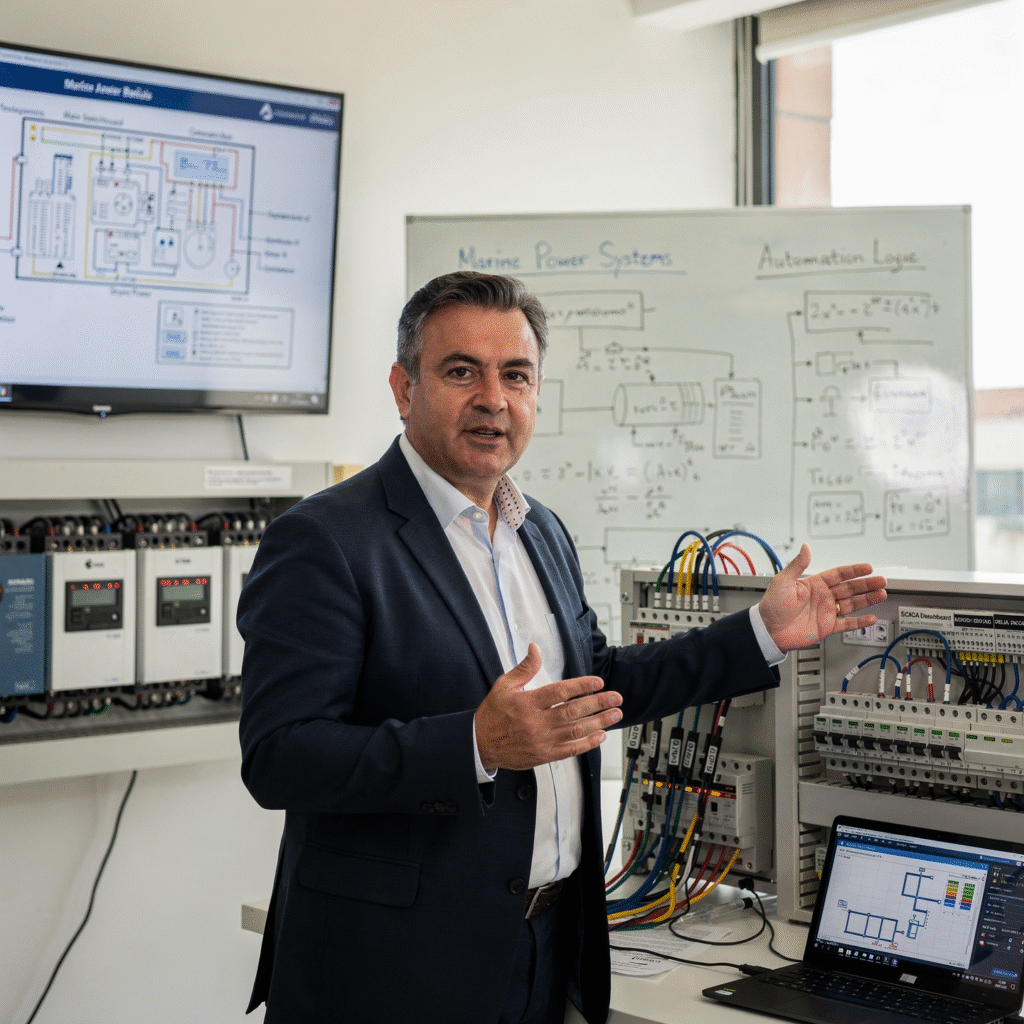
Master’s Degree in Automation and Naval Surveillance Drones

Why this master’s programme?

The Master’s in Automation and Naval Surveillance Drones

Prepares you to lead the way in optimizing maritime operations. Master the integration of automated systems and the effective deployment of drones for inspection and surveillance. Acquire advanced skills in data analysis, remote control, and regulatory compliance, driving efficiency and safety in the naval industry. This program equips you with the knowledge and tools to meet the challenges of the future in maritime supervision.

Differentiating Advantages

  • Practical Applications: hull inspection, cargo monitoring, search and rescue.
  • Cutting-Edge Technology: use of specialized software for image processing and predictive analysis.
  • Safety and Regulations: risk management, aviation legislation, and naval industry standards.
  • Simulation and Training: drone practice in simulated and real-world environments for comprehensive learning.
  • Professional Development: networking opportunities and access to the latest trends in the maritime sector.

Master’s Degree in Automation and Naval Surveillance Drones

Availability: 1 in stock

Who is it aimed at?

  • Naval and electronic engineers seeking to specialize in the development and integration of automated systems and drones in naval environments.
  • Merchant and military marine officers interested in optimizing maritime monitoring and safety through advanced technologies.
  • Offshore and marine renewable energy professionals needing to implement automation and remote monitoring solutions.
  • Fleet technicians and managers wishing to reduce operating costs and improve efficiency in naval asset management.
  • Graduates in engineering and related sciences aspiring to an innovative career in the naval sector with a focus on automation and drones.

Study Flexibility
Adapted to the needs of professionals: online modality, 24/7 access to content and personalized tutoring.

Objectives and skills

Managing naval automation projects:

“Implement redundancy strategies and contingency plans, ensuring the continuous operation of the system in the event of failures or cyberattacks.”

Inspecting and maintaining naval structures with drones:

“Identify deterioration (corrosion, cracks, deformations) and document it for later analysis.”

Develop and implement autonomous control systems for naval operations:

Integrate advanced sensors (LiDAR, radar, cameras) and sensor fusion algorithms for robust situational awareness, adapting to variable environmental conditions and minimizing dependence on GPS through inertial navigation and SLAM techniques.

Analyzing data collected by drones to optimize naval operational efficiency:

“Identify maritime traffic patterns, optimize navigation routes, and detect anomalies to improve safety and efficiency in patrol and rescue operations.”
Design and integrate automation solutions into existing ships and naval systems:

“Adapt communication protocols (e.g., Modbus, Ethernet/IP) and programming languages ​​(e.g., PLC, Python) to optimize equipment performance and minimize system response latency.”

Assess and mitigate risks associated with drone operations in naval environments:

“Implement risk analyses (e.g., HAZID, HAZOP) adapted to the naval environment, considering electromagnetic interference, adverse weather conditions, and the presence of critical vessels and structures.”

Study plan – Modules

  1. Advanced Architecture for Autonomous Systems Integration: Communication Protocols, Middleware, and Time Synchronization
  2. Drone Networks in Maritime Environments: Topologies, Interoperability, Optimization, and Redundancy for Continuous Operations
  3. Maritime Multispectral Sensing and LiDAR: Calibration, Data Fusion, and Real-Time Processing
  4. Autonomous Navigation Algorithms: SLAM, Adaptive Route Planning, and Obstacle Avoidance in Oceanic Conditions
  5. Distributed Control Systems for Drone Fleets: Architecture, Scalability, and Fault Tolerance
  6. Intelligent Naval Monitoring Protocols: International Standards, Transmission Security, and Validation of Critical Data
  7. Implementation of Artificial Intelligence and Machine Learning for Predictive Maintenance Analysis and Anomaly Detection
  8. Integration with Naval Systems
  9. Traditional systems: Interoperability with radar, AIS, SCADA systems, and command and control platforms

    Automated drone deployment and recovery: Techniques, logistics, and power management in hostile environments

    Cybersecurity in marine autonomous systems: Protection against attacks, end-to-end encryption, and access management

    Environmental impact assessment and mitigation through responsible drone use in naval surveillance

    Regulations and certifications applicable to the operation of autonomous drones in maritime military and civilian environments

    Advanced simulation and realism for operational training in the integration of autonomous systems and drones

    Case studies and real-world deployment: Analysis of successful missions, common problems, and innovative solutions

    Interdisciplinary work: Coordination between naval engineering, robotics, electronics, and artificial intelligence

  1. Fundamentals of Autonomous Networks: Topologies, Protocols, and Distributed Architectures Adapted to Naval Environments
  2. Design of Communication Systems for Drones: Data Links, Advanced Modulation, Frequency, and Electromagnetic Spectrum in Maritime Environments
  3. Implementation of Mesh and Ad Hoc Networks for Dynamic and Mobile Operations in Naval Surveillance Scenarios
  4. Integration of Sensors and Networked Navigation Systems: Differentiated GNSS, INS, LIDAR, Short-Range Radar, and Optical Communication Systems
  5. Platforms and Frameworks for Drone Fleet Management: Task Distribution, Flight Orchestration, and Real-Time Data Synchronization
  6. Security in Autonomous Networks: Encryption Protocols, Mutual Authentication, Resistance to Interference and Cyberattacks in Naval Environments
  7. Optimization of Bandwidth and Critical Latency for Video, Telemetry, and Command Transmission in Distributed Networks
  8. Design of scalable and resilient architectures for continuous operation in adverse maritime and electromagnetic conditions
  9. Advanced telemetry and real-time data analytics for monitoring and autonomous decision-making with embedded artificial intelligence
  10. Practical case studies: implementation of networks for surveillance, rescue, naval infrastructure inspection, and environmental monitoring missions with interconnected drones
  1. Fundamentals of Autonomous Systems in Naval Environments: principles of autonomy, integrated sensors, and adaptive decision-making algorithms in adverse maritime conditions
  2. Design and Architecture of Naval Drone Platforms: selection of multi-spectral sensors, secure communication modules, and redundant systems for offshore operation
  3. Communication Protocols and Autonomous Networks: implementation of mesh networks and low-latency protocols for real-time coordination between multiple drones and naval control centers
  4. Integration of Artificial Intelligence for Autonomous Monitoring: anomaly detection algorithms, deep learning applied to maritime surveillance, and predictive warning systems
  5. Distributed Systems Architecture for Coordinated Missions: task synchronization, UAV fleet management, and the use of blockchain for traceability and data security
  6. Route Optimization and Autonomous Navigation: Use of digital marine charts, differential GNSS, and SLAM systems for critical positioning maintenance in dynamic environments.

    Cybersecurity in Naval Drone Networks: Advanced encryption, intrusion detection, and resilient protocols against electromagnetic interference and targeted attacks in naval operations.

    Integration of Autonomous Platforms with Naval Information Systems: Interoperability with ECDIS, AIS, and land-based control stations for comprehensive monitoring and multisensory decision-making.

    Simulation Models and Virtual Training: Digital environments for planning and testing drone operations in real-world scenarios and complex maritime contingencies.

    Development and Management of Naval Automation Projects: Strategic planning, assessment of technical and regulatory risks, and agile methodology applied to innovative solutions in maritime monitoring and control.

  1. Fundamentals and evolution of the command and control system in naval operations: from centralized to distributed architectures and their adaptation to unmanned platforms
  2. Advanced integration of artificial intelligence for multi-source sensor fusion: real-time processing of data from radar, LIDAR, electro-optical and infrared cameras
  3. machine learning algorithms for automatic recognition and classification of maritime and aerial targets in complex environments
  4. Robust strategies for GNSS-denied navigation: complementary use of INS, SLAM, stereoscopic vision, and collaborative sensor networks
  5. Resilient cybersecurity architectures in naval drones: protection against spoofing, jamming, and data integrity breaches
  6. Protocols Advanced secure communications and end-to-end encryption to ensure the link between platform and control center.

    Implementation of AI-based Mission Management Systems (MMS) to facilitate autonomous and supervised control of drone fleets.

    Simulation and validation of complex scenarios with digital twins to predict behavior and optimize operational decisions in real time.

    Integration of distributed sensor networks to increase the range and accuracy of collaborative sensor fusion.

    Self-learning and self-calibration techniques for sensor systems and platforms for predictive maintenance and continuous optimization.

    Compliance with international regulations and technological standards applied to command and control technologies in naval environments.

    Development and analysis of real-world cases and future trends in Naval surveillance drones with an emphasis on artificial intelligence and operational safety.

  1. Naval Drone Communication Systems Architecture: Ad hoc networks, Mesh and MIMO protocols applied to maritime environments
  2. Advanced telemetry systems: Real-time bidirectional data transmission, compression, encoding, and multiplexing methods to optimize bandwidth under dynamic conditions
  3. Modulation and multiple access techniques: OFDM, DSSS, CDMA, and their adaptation to ensure robustness against electromagnetic interference and multipath propagation in complex naval environments
  4. Secure communication networks: Implementation of AES-256 encryption, TLS/DTLS protocols for data integrity and confidentiality in maritime surveillance drones
  5. Integration of GNSS systems with complementary positioning technologies: RTK, PPP, and the use of inertial sensors to improve location and tracking accuracy in coastal and open areas
  6. Drone-specific data link protocols
  7. Naval communications: Extended MAVLink, adaptations for high-latency environments and rapid mobility

    Implementation and optimization of multiband antennas: types, radiation patterns, and configurations to maximize coverage on naval platforms and under constant motion

    Dynamic management of the radio spectrum: adaptive frequency hopping techniques and real-time interference detection to ensure operational continuity

    Telemetry in adverse conditions: techniques to compensate for atmospheric effects, propagation in saline media, and nautical physical obstacles

    Integration of redundant communication systems and automated failover to ensure continuous operation in critical naval surveillance missions

    Real-time monitoring and analysis of link parameters: signal quality, BER, latency, and jitter for continuous optimization of UAV communications

    International regulations and standards applicable to naval drone communications: compliance with ITU, IMO, and specific regulations for interoperability and security Networks

  8. Practical cases and advanced simulations of communication scenarios in dynamic naval environments with extreme weather conditions and platform movements
  9. Design and implementation of drone control centers with satellite link capabilities, terrestrial radio frequency, and integration with naval systems
  10. Predictive maintenance and calibration strategies for communication and telemetry equipment to maximize its lifespan and operational performance at sea
  1. Fundamentals of communication architectures in autonomous systems: topologies, protocols, and OSI layers applied to naval drones
  2. Secure protocols for data transmission in maritime environments: TLS/DTLS, IPSec, and low-latency encrypted communications
  3. Vehicle ad-hoc networks (VANETs) and mesh networks applied to drone swarms for coverage and resilience in complex maritime areas
  4. Cryptography applied to naval surveillance drones: symmetric and asymmetric algorithms, key management, and robust authentication
  5. International standards and regulations on security in maritime communications and unmanned systems (IMO, ETSI, IEEE)
  6. Integration and synchronization of multiple sensors: LIDAR, maritime radar, multispectral cameras, acoustic sensors, and GNSS for advanced sensor fusion
  7. Sensory data fusion techniques: extended Kalman filters, convolutional neural networks, and real-time decision-making algorithms for naval detection and tracking
  8. Distributed onboard processing: edge computing and dedicated embedded systems for reduced latency and increased autonomy
  9. Resilience and redundancy in sensor and communication architectures to ensure operational continuity in the face of electromagnetic interference and adverse conditions
  10. Rapid response protocols and dynamic route updates based on artificial intelligence for threat evasion and patrol optimization
  11. Analysis of specific cyber threats to drones in naval environments and advanced methods for intrusion detection and mitigation
  12. Advanced simulation and modeling of secure communications and sensor fusion in maritime environments for the validation and optimization of deployed systems
  13. Real-world implementation case studies in naval forces: deployment, monitoring, and maintenance of secure networks
  14. for autonomous drone fleets

    Future trends and emerging technologies in secure communications and sensor fusion applied to naval surveillance: maritime 5G, quantum systems, and post-quantum quantum computing

    Design and development of integrated projects: development of a functional prototype that combines secure communications and sensor fusion for autonomous operations in naval surveillance and defense

  1. Fundamentals of autonomous integration in naval UAV platforms: modular architecture, internal communication protocols, and interface standards
  2. Design and development of multi-agent systems for collaborative operations in complex maritime environments
  3. Secure networks for unmanned aerial platforms: implementation of advanced cryptographic protocols and end-to-end encryption techniques
  4. Redundant communication protocols and fault tolerance in high-latency maritime data links
  5. Implementation of distributed architectures for autonomous control and real-time monitoring of drone swarms
  6. Assessment and mitigation of specific cyber vulnerabilities in naval surveillance drones: risk analysis and penetration testing
  7. Advanced countermeasures against interference and denial-of-service (DoS) attacks on drone networks and maritime base stations
  8. Detection and response systems for Intrusion detection systems (IDS/IPS) adapted to maritime and maritime-air environments.

    Frameworks for secure data management and ensuring information integrity during autonomous operational missions.

    Integration of artificial intelligence and machine learning for predictive detection of cyber threats on naval UAV platforms.

    Compliance with international cybersecurity standards and regulations applied to autonomous systems and naval military communications.

    Advanced simulation and testing in virtual environments to validate the resilience and operational security of drone networks in real naval scenarios.

    Procedures and protocols for rapid response to cybersecurity incidents in automated naval operations.

    Cryptographic key management, multi-factor authentication, and access control for maritime autonomous systems.

    Implementation of secure remote control and monitoring systems for supervising drone fleets in coastal surveillance and operations. naval

  1. Fundamentals of algorithmic optimization in distributed drone systems: theory and applications in maritime environments
  2. Design and development of autonomous architectures for drone fleets: decentralized and hierarchical control models
  3. Advanced inertial navigation and high-precision GNSS systems: error mitigation in dynamic naval environments
  4. Integration of multiscale sensors for naval surveillance: electro-optical cameras, LIDAR, short-range radar, and acoustic systems
  5. Secure and redundant communication protocols between drones and ground stations: analysis of latency, interference, and cybersecurity
  6. Artificial intelligence algorithms for real-time planning of autonomous routes and tasks in variable maritime conditions
  7. Implementation of swarm intelligence techniques for heterogeneous drone coordination in strategic maritime surveillance missions
  8. Intelligent Energy Management: Optimizing Consumption and Extending Autonomy in Prolonged Operations over Open Waters
  9. Modeling Complex Naval Scenarios with Predictive Simulation for Automatic and Adaptive Fleet Response
  10. Automatic Recovery and Contingency Protocols: Fault Detection, Basic Self-Repair, and Safe Landing Procedures on Naval Platforms
  11. Interoperability with Conventional Naval Systems and Command and Control Platforms: Standards, Integration, and Real-Time Data Flows
  12. Environmental Impact Analysis and International Regulations Applicable to Drone Operations in Maritime Environments
  13. Development of Specialized Software for Autonomous Fleet Management: Graphical Interfaces, Telemetry, and Post-Operational Analysis
  14. Case Studies and Analysis of Real-World Deployments: Lessons Learned and Continuous Optimization of Operational Strategies
  15. Comprehensive Assessment of Operational Risks and Safety in Autonomous Fleet Management: Emergency and Rapid Response Protocols in Various Environments dynamic
  1. Advanced Fundamentals of Autonomous Systems: Modular Architecture, Control Algorithms, and Distributed Decision Logic
  2. Integration and Synchronization of Multimodal Sensors for Naval Drones: LiDAR, Maritime Radar, Hyperspectral Cameras, and Electro-Optical Detection Systems
  3. Design and Optimization of Secure Communication Networks: Cryptographic Protocols, Mutual Authentication, and Resistance to Jamming Attacks in Harsh Marine Environments
  4. Real-Time Data Transmission Protocols: Optimization for Low Latency, Automatic Redundancy, and Quality of Service (QoS) in High-Mobility Networks
  5. Artificial Intelligence and Machine Learning Applied to Naval Surveillance Drones: Automatic Anomaly Detection, Pattern Recognition, and Threat Prediction
  6. Specific Cybersecurity Architectures for Naval Autonomous Systems: Intrusion Protection, Sandboxing, and Continuous Integrity Monitoring
  7. Interoperability Between Unmanned Vessels and Manned platforms: standardization of communication protocols and levels of collaborative autonomy

    Dynamic mesh networks for operations in large maritime areas: self-configuration algorithms, load balancing, and network failure recovery

    Development and application of robust positioning and navigation systems: GNSS augmented with inertial sensors and sensor fusion methods for accuracy and resilience

    Modeling and simulation of naval surveillance scenarios with autonomous drones: performance evaluation under adverse conditions and electronic interference scenarios

  1. Advanced design and architecture of the integrated system: Modular integration of autonomous platforms and high-security naval communications networks
  2. Multimodal sensor fusion: Algorithms for the real-time combination of data from LiDAR, radar, hyperspectral cameras, and acoustic and magnetic sensors
  3. Development and calibration of artificial intelligence models for predictive analysis and autonomous detection of threats and anomalies in complex marine environments
  4. Secure communications networks: Implementation of advanced cryptographic protocols and techniques for resistance to interference and cyberattacks for autonomous naval operations
  5. Automation of real-time control and monitoring of drone fleets for surveillance, reconnaissance, and rapid response missions
  6. Unmanned aerial platforms and their propulsion, stability, and mathematical navigation systems for operations over territorial waters and exclusion zones
  7. Advanced simulation and Digital training environments for testing and commissioning the integrated system before real-world field implementation.

    Human-machine interface (HMI) for platform management and data analysis: design, usability, and automated alerting systems.

    Validation, performance evaluation, and certification procedures under international regulations and maritime standards.

    Real-world case studies and practical application: development of a complete project based on strategic and operational naval needs, with presentation and defense of the system before a panel of experts.

Career prospects

“`html

  • Naval Automation Specialist: Design, implementation, and maintenance of automated systems on ships and offshore platforms.
  • Maritime Drone Pilot: Inspection of naval infrastructure, coastal surveillance, search and rescue, and support for maritime operations.
  • Drone Operations Supervisor: Flight planning and management, analysis of collected data, and coordination with land and sea teams.
  • Naval Automation and Drone Consultant: Technical advice to companies in the maritime sector on the implementation of new technologies.
  • Marine Robotics Researcher and Developer: Participation in R&D projects for the creation of new systems and applications in the naval field.
  • Naval Automation Project Manager: Leadership and coordination of modernization projects and optimization of ships and naval systems.
  • Maritime Safety Inspector with Drones: Assessment of the condition of naval infrastructure and compliance with safety regulations using drones.
  • Maritime Data Analyst with AI: Processing and analysis of data collected by drones and automated systems for strategic decision-making.

“`

Entry requirements

Academic/professional profile:

Bachelor’s degree in Nautical Science/Maritime Transport, Naval/Marine Engineering or a related qualification; or proven professional experience on the bridge/in operations.

Language proficiency:

Functional Maritime English (SMCP) recommended for simulations and technical materials.

Documentation:

Updated CV, copy of qualification or seaman’s book, national ID/passport, motivation letter.

Technical requirements (for online):

Device with camera/microphone, stable internet connection, monitor ≥ 24” recommended for ECDIS/Radar-ARPA.

Admissions process and dates

Online
application

(form + documents).

Academic review and interview

Admissions decision

Admissions decision

(+ scholarship offer if applicable).

Place reservation

(deposit) and enrolment.

Induction

(access to the virtual campus, calendars, simulator guides).

Scholarships and financial support

  • Comprehensive Naval Automation: Master the implementation and management of automated systems on ships and vessels.
  • Advanced Surveillance Drones: Learn to pilot, maintain, and analyze data captured by drones in maritime environments.
  • Operations Optimization: Improve the efficiency and safety of navigation through cutting-edge technology.
  • Simulations and Real-World Practice: Apply your knowledge in simulated environments and practical projects with real drones.
  • Professional Certification: Obtain a recognized certification that will boost your career in the naval and maritime sectors. Automation.
Boost your career and become an expert in the naval monitoring of the future with drones and automation.

Testimonials

Frequently asked questions

Maritime, with emphasis on naval surveillance using drones.

Yes. The itinerary includes ECDIS/Radar-ARPA/BRM with harbor, ocean, fog, storm, and SAR scenarios.

Online with live sessions; hybrid option for simulator/practical placements through agreements.

In both cases, the automation of vessels and the use of drones for naval surveillance.

Recommended functional SMCP. We offer support materials for standard phraseology.

Yes, with a relevant degree or experience in maritime/port operations. The admissions interview will confirm suitability.

Optional (3–6 months) through Companies & Collaborations and the Alumni Network.

Simulator practice (rubrics), defeat plans, SOPs, checklists, micro-tests and applied TFM.

A degree from Navalis Magna University + operational portfolio (tracks, SOPs, reports and KPIs) useful for audits and employment.

  1. Advanced design and architecture of the integrated system: Modular integration of autonomous platforms and high-security naval communications networks
  2. Multimodal sensor fusion: Algorithms for the real-time combination of data from LiDAR, radar, hyperspectral cameras, and acoustic and magnetic sensors
  3. Development and calibration of artificial intelligence models for predictive analysis and autonomous detection of threats and anomalies in complex marine environments
  4. Secure communications networks: Implementation of advanced cryptographic protocols and techniques for resistance to interference and cyberattacks for autonomous naval operations
  5. Automation of real-time control and monitoring of drone fleets for surveillance, reconnaissance, and rapid response missions
  6. Unmanned aerial platforms and their propulsion, stability, and mathematical navigation systems for operations over territorial waters and exclusion zones
  7. Advanced simulation and Digital training environments for testing and commissioning the integrated system before real-world field implementation.

    Human-machine interface (HMI) for platform management and data analysis: design, usability, and automated alerting systems.

    Validation, performance evaluation, and certification procedures under international regulations and maritime standards.

    Real-world case studies and practical application: development of a complete project based on strategic and operational naval needs, with presentation and defense of the system before a panel of experts.

Request information

  1. Complete the Application Form.

  2. Attach your CV/degree certificate (if you have it to hand).

  3. Indicate your preferred cohort (January/May/September) and whether you would like the hybrid option with simulator sessions.

    An academic advisor will contact you within 24–48 hours to guide you through the admission process, scholarships, and compatibility with your professional schedule.

Please enable JavaScript in your browser to complete this form.
Click or drag a file to this area to upload.

Faculty

0
    0
    Tu carrito
    Tu carrito esta vacíoRegresar a la tienda
    Scroll to Top