Master’s degree in AI applied to Autonomous Navigation

Why this master’s programme?

The Master’s in AI Applied to Autonomous Navigation

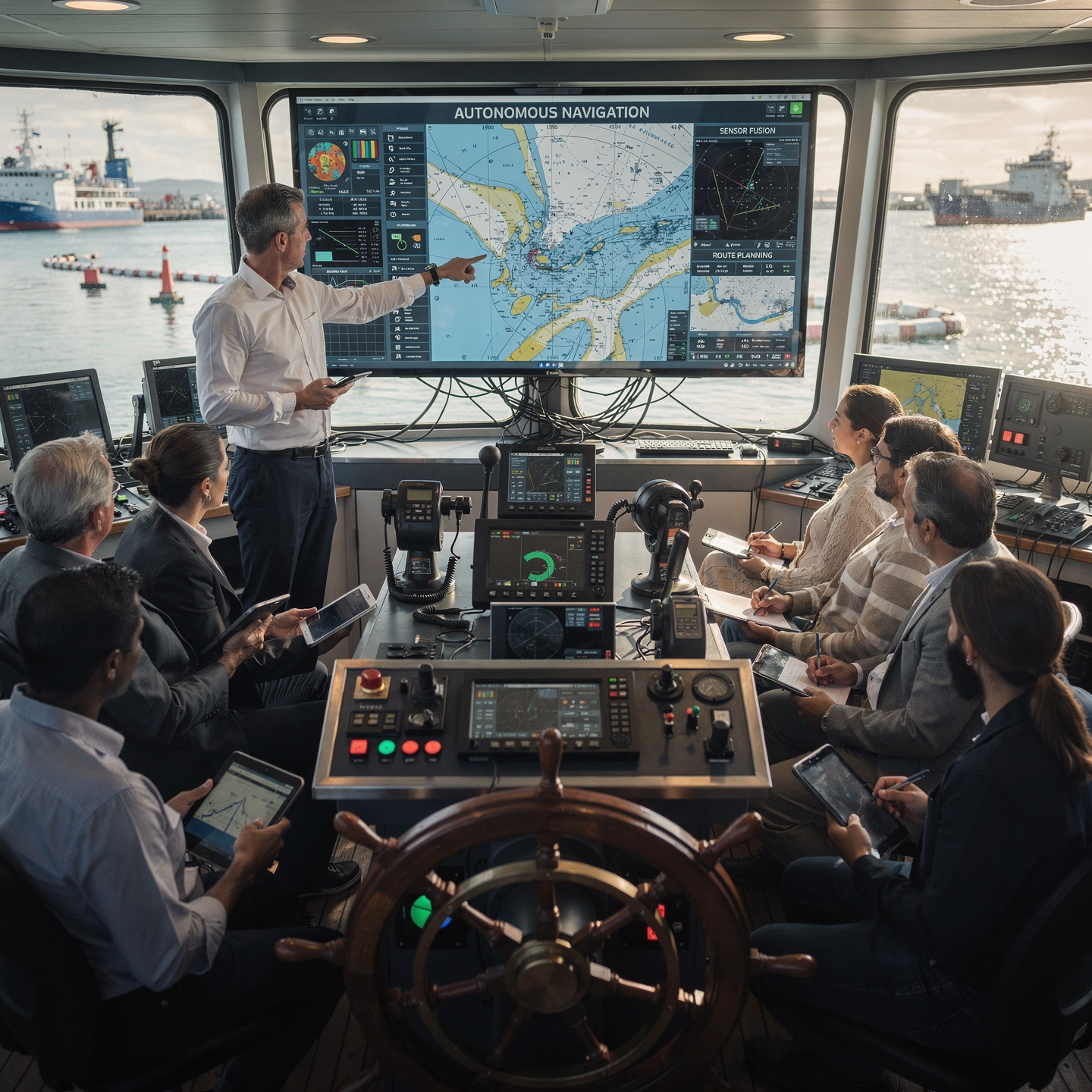
Is your gateway to the future of maritime robotics. Master the techniques of Artificial Intelligence, Machine Learning, and Deep Learning applied to the design and development of autonomous navigation systems for vessels. Learn to create perception, route planning, and control algorithms to ensure safe and efficient navigation in complex environments.

Differentiating Advantages

  • Development of real-world projects: Apply your knowledge in simulations and prototypes of autonomous navigation.
  • Comprehensive training: Covers everything from AI theory to its implementation in maritime control systems.
  • Expert instructors: Learn from industry and academic leaders with extensive experience in AI and naval robotics.
  • Networking: Connect with industry professionals and explore career opportunities in innovative companies.
  • Cutting-edge tools: Use state-of-the-art software and simulation platforms for your development.

Master’s degree in AI applied to Autonomous Navigation

Availability: 1 in stock

Who is it aimed at?

  • Naval and software engineers seeking to specialize in the development and implementation of autonomous systems for ships.
  • Merchant marine officers and captains interested in understanding and leading the transition to autonomous navigation.
  • Researchers and academics wishing to delve deeper into AI and machine learning algorithms applied to the maritime environment.
  • Maritime and technology companies seeking to innovate and optimize their operations through AI and automation.
  • Graduates in engineering, computer science, and related fields aspiring to a cutting-edge career in the navigation of the future.

Flexibility of Study

Adapted for professionals: online format with live and recorded classes, 24/7 access to digital resources, and personalized tutoring.

Objectives and skills

Implement advanced perception systems:

Integrate data from multiple sensors (radar, lidar, cameras) to create a robust environmental model and use sensor fusion algorithms to improve the accuracy and reliability of object detection and tracking.

Develop robust control algorithms:

Implement predictive and adaptive control strategies, integrating data from multiple sensors and actuators, minimizing the impact of external disturbances and optimizing system performance under uncertainty.

Optimize real-time decision-making:

Integrate data from multiple sources (radar, AIS, ECDIS, sensors) to anticipate risks, assess scenarios, and execute safe maneuvers with effective communication to the bridge.

Integrating AI into complex navigation architectures:

“Adapting AI to dynamic route management, considering fuel optimization, adverse weather conditions and compliance with environmental regulations, with human supervision and intervention capabilities.”
Ensuring the reliability and safety of autonomous systems:

Implement redundancy in critical components, conduct thorough validation and verification tests, and establish response protocols for contingencies and cyberattacks.

Adapting navigation to dynamic and uncertain environments:

Anticipating risks, assessing human, technical and environmental factors, and effectively communicating decisions to the crew.

Study plan – Modules

  1. Mathematical and statistical foundations for Machine Learning applied to autonomous navigation: linear algebra, differential calculus, probability, and Bayesian statistics
  2. Preprocessing and cleaning of sensory data: noise filtering, normalization, balancing, and anomaly detection in radar, LiDAR, camera, and GNSS data
  3. Design of supervised, unsupervised, and reinforcement model architectures adapted to dynamic maritime environments
  4. Practical implementation of classical algorithms: logistic regression, SVM, decision trees, and Random Forest for obstacle detection and route classification
  5. Deep neural networks and convolutional neural networks (CNNs) for object recognition and underwater and aerial image processing
  6. Reinforcement learning models for real-time decision-making in autonomous navigation, including Q-learning and policy-based methods
  7. Optimization of Hyperparameters using advanced techniques: grid search, Bayesian optimization, and evolutionary algorithms to maximize system accuracy and efficiency.

    Integration of sensor fusion algorithms to improve system robustness and resilience in adverse and uncertain environments.

    Deployment of models on onboard hardware: considerations of real-time computing, power consumption, and latency in autonomous navigation systems.

    Performance validation and testing: metrics specific to autonomous navigation, simulations in virtual environments, and real-world field testing.

    Self-tuning and online learning algorithms for continuous adaptation to changes in maritime conditions and the presence of new obstacles.

    Challenges and solutions in the interpretability and explainability of AI models in critical navigation systems.

    Case studies and real-world applications: route optimization, maritime traffic management, and collision avoidance using advanced machine learning.

    Cybersecurity aspects in the implementation of AI algorithms, protection against Adversarial attacks and manipulation of sensory data in autonomous systems

    International regulations and standards for the integration of AI in navigation systems: SOLAS, IMO, and emerging AI-specific regulations

  1. Fundamentals of Smart Sensors: Types, Physical Principles, and Operational Characteristics in Maritime Environments
  2. Architecture of Multisensor Systems: Design, Integration, and Time Synchronization for Autonomous Navigation
  3. Advanced Signal Processing: Adaptive Filtering, Data Fusion, and Noise Reduction for LiDAR, Radar, and Sonar Sensors
  4. Implementation of Deep Neural Networks for Real-Time Sensor Data Classification and Segmentation
  5. Dynamic Calibration and Self-Tuning Algorithms for Sensors to Ensure Accuracy in Changing Sea Conditions
  6. Multimodal Sensor Fusion: Bayesian Techniques, Extended Kalman Filters, and Neural Networks for Robust State Estimation
  7. Integration of Inertial Measurement Units (IMUs), High-Accuracy GNSS, and Visual Navigation Systems for Positioning Optimization
  8. Obstacle Detection and Tracking Models Using Data from Heterogeneous Sensors
  9. Distributed processing and edge computing to minimize latency and maximize energy efficiency in autonomous marine platforms
  10. Communication protocols and standards for secure and reliable data transmission between sensors and central systems
  11. Diagnostics and fault management in smart sensors: redundancy, self-testing, and error recovery techniques
  12. Practical applications: case studies in unmanned marine vehicles and advanced simulations of real-world scenarios
  13. Regulatory and normative aspects related to the integration of smart sensors in autonomous platforms
  14. Emerging trends in smart sensors: nanotechnology, integrated photonics, and quantum sensors for future navigation
  15. Final module project: design and implementation of a sensor integration system for autonomous navigation with a focus on robustness and scalability
  1. Fundamentals of Machine Learning for Autonomous Navigation: Supervised, Unsupervised, and Reinforcement Learning Algorithms Applied to Onboard Systems
  2. Deep Neural Networks (DNNs): Advanced Architectures, Optimization, and Regularization Specific for Onboard Real-Time Processing
  3. Probabilistic and Bayesian Inference Models for Uncertainty in Perception and Decision-Making in Dynamic Marine Environments
  4. Multimodal Sensor Integration: Fusion of Data from LiDAR, Radar, GNSS, RGB-D Cameras, IMUs, and Acoustic Sensors for Robust Perception
  5. Calibration and Time-Synchronization Algorithms for Heterogeneous Sensors on Autonomous Maritime Mobile Platforms
  6. Convolutional Neural Networks (CNNs) for Obstacle Detection and Recognition, Maritime Signaling, and Environmental Condition Analysis
  7. Application of Advanced Techniques of SLAM (Simultaneous Localization and Mapping) and semantic mapping for navigation in coastal and port environments

    Trajectory optimization based on deep reinforcement learning for safe and efficient autonomous maneuvers in complex scenarios

    Evaluation and mitigation of sensory errors using advanced Bayesian filters: Extended Kalman Filter (EKF), Particle Filter (PF), and their combination with neural networks

    Hybrid system architectures for integrating predictive models and reactive planning in autonomous decision-making

    Implementation and validation of algorithms on embedded hardware: optimization of computational resources and energy consumption under adverse maritime conditions

    Advanced simulation and digital twin environments for training, testing, and validating AI models in autonomous navigation with realistic maritime scenarios

    Safety and reliability aspects: early detection of Failures, sensor redundancy, and distributed intelligence for critical systems

    International standards and regulations applicable to the integration of AI and autonomous systems in the modern maritime industry

    Development of practical case studies and integrated projects for real-world applications of machine learning and sensor technology in unmanned maritime vehicles (USVs)

  1. Fundamentals of predictive control in autonomous systems: Model Predictive Control (MPC), objective functions, and constraints in maritime navigation
  2. Dynamic modeling of autonomous vehicles: mathematical representation of maritime systems, kinematic and dynamic modeling, and adaptation to variable environments
  3. Optimal trajectory planning: search algorithms, heuristic search, continuous optimization, and their application in autonomous maritime routes
  4. Sensor integration for planning: fusion of LiDAR, radar, GNSS, and camera data for accurate map and obstacle generation
  5. Resilient autonomous navigation systems: uncertainty management, fault detection, and redundant strategy design
  6. Advanced simulation for system validation: real-time simulation tools, digital twins, and virtual environments for control and planning testing
  7. Testing and verification methodologies: functional testing, formal validation, and stress testing under real and virtual conditions extremes
  8. Certification of autonomous navigation systems: international regulations, technical standards, and audit protocols for the approval of autonomous control systems

    Implementation of predictive control in embedded hardware: computational optimization, latency, and robust design for critical marine environments

    Professional practices and case studies: detailed analysis of real-world implementations, lessons learned, and best practices in predictive control and trajectory planning

  1. Fundamentals and types of deep neural networks: multilayer perceptrons, convolutional neural networks (CNNs), recurrent neural networks (RNNs), LSTMs, and Transformers applied to navigation systems
  2. Advanced mathematical theory for the design of neural architectures: activation functions, non-convex optimization, regularization, backpropagation, and stochastic gradient descent
  3. Design and parameterization of control agents based on Deep Reinforcement Learning for decision-making in dynamic autonomous navigation environments
  4. Multi-sensor integration in neural networks: processing and fusion of data from LiDAR, radar, cameras, GNSS, IMUs, and sonar for robust environmental perception
  5. Hybrid architectures for predictive control: combining neural networks with physical models and classical controllers to ensure safety and operational efficiency
  6. Advanced training and validation techniques: handling synthetic datasets and
  7. Real-world applications, data augmentation techniques, class balancing, and strategies to avoid overfitting in maritime contexts
  8. Implementation of automatic attention systems and interpretation mechanisms (explainability) for explaining neural network decisions in autonomous navigation
  9. Computational optimization and hardware: implementation on GPUs, TPUs, and FPGAs to guarantee real-time inference and low latency in onboard systems
  10. Robustness and fault tolerance: error detection and mitigation techniques, adversarial learning, and testing under extreme conditions (adverse weather, electromagnetic interference)
  11. Case studies and industrial frameworks for the implementation of deep neural networks in autonomous navigation platforms: from simulation to open-sea validation
  1. Advanced machine learning fundamentals applied to autonomous navigation: supervised, unsupervised, and reinforcement learning, with an emphasis on adaptation in dynamic maritime environments
  2. Design and innovation in algorithms for environmental perception: convolutional neural networks (CNNs), recurrent neural networks (RNNs), and Transformers for real-time sensory processing
  3. Advanced multisensor integration: fusion of data from LiDAR, radar, hyperspectral cameras, GNSS systems, and inertial sensors for the construction of accurate digital models
  4. Model-based predictive control (MPC) for safe maneuvering, route optimization, and adaptive response to hydrodynamic and meteorological disturbances
  5. Design of hybrid control architectures: combining classical PID control with deep learning techniques for improved stability and energy efficiency
  6. Implementation of collision detection and avoidance systems using trajectory planning algorithms based on Deep Reinforcement Learning and Genetic Algorithms

    Large-scale simulation and model training: creating digital environments for virtual validation using digital twins and high-fidelity marine simulators

    Real-time optimization and parameter self-tuning: adaptive mechanisms for maintaining accuracy under changing operating conditions

    Performance evaluation and key metrics in autonomous navigation: positional accuracy, computational efficiency, fault robustness, and tolerance to sensory errors

    Technical and regulatory aspects for the safe and reliable integration of intelligent systems on maritime platforms: interoperability, standards, and specialized communication protocols

  1. Advanced Machine Learning Fundamentals for Autonomous Navigation: Supervised, Unsupervised, and Reinforcement Algorithms Applied to Dynamic Maritime Environments
  2. Implementation of Deep Neural Networks (Deep Learning) for Real-Time Obstacle Recognition and Classification
  3. Multispectral Sensor Fusion: Integration of LiDAR, Synthetic Aperture Radar (SAR), Hyperspectral Cameras, and Ultrasonic Sensors for Environmental Perception
  4. Time Series Predictive Modeling to Anticipate Wave Patterns, Ocean Currents, and Adverse Weather Conditions
  5. Design and Optimization of Model Predictive Control (MPC) for Active Stabilization and Maneuverability of Autonomous Vessels in High-Uncertainty Scenarios
  6. Calibration and Cross-Validation Protocols for Specialized Maritime Sensors to Ensure Accuracy and Redundancy
  7. Integration of Adaptive and Autonomous Algorithms for Continuous Decision-Making in Navigation Systems with Multiple heterogeneous variables
  8. Robust digital simulation: creating realistic virtual environments for training and testing AI models applied to complex maritime routes

    Advanced embedded systems and edge computing architectures for real-time processing and latency reduction in the autonomous bridge

    Cybersecurity strategies and operational resilience in autonomous platforms against attacks and sensor or actuator failures

    Performance evaluation and key metrics for high-performance autonomous navigation systems: accuracy, robustness, and energy efficiency

    Real-world implementation case studies and emerging trends in the convergence of AI, advanced sensors, and predictive control in the naval industry

  1. Fundamentals of Multimodal Perception: Principles, Sensory Modalities, and Challenges in Dynamic Environments
  2. Sensor Technologies for Autonomous Navigation: LiDAR, Radar, RGB-D Cameras, Ultrasound, and Inertial Sensors
  3. Advanced Signal Processing: Filtering, Calibration, and Correction of External Sensor Data
  4. Sensor Fusion Based on Probabilistic Models: Kalman Filters, Particle Filters, and Bayesian Networks for Robust Integrations
  5. Real-Time Mapping and Generation of 3D Spatial Representations: SLAM (Simultaneous Localization and Mapping) and its Variants
  6. Object Detection and Classification Using Deep Learning: CNN, RNN, and Transformer Architectures Applied to Navigation
  7. Semantic Segmentation and Obstacle Detection Algorithms in Complex Coastal and Maritime Scenarios
  8. Heterogeneous Data Fusion: Temporal Synchronization, Spatial Alignment, and Quality Assessment of Multiple Sources
  9. Multimodal Perception-Based Decision-Making Methods for Safe and Efficient Autonomous Maneuvers
  10. Real-Time Implementation: Embedded Hardware, Computational Optimization, and Parallelization Techniques
  11. Uncertainty Management and Resilience to Sensor Failure and Noise in Changing Marine Environments
  12. Application of Standard Frameworks and Communication Protocols for Sensor Integration in Navigation Systems
  13. Case Studies and Advanced Simulations: Autonomous Navigation in Heavy Maritime Traffic and Adverse Weather Conditions
  14. Performance Assessment and Reliability Metrics in Multimodal Perception Systems
  15. Future Perspectives and Trends in Advanced Sensors, AI, and Data Fusion for the Evolution of Autonomous Navigation
  1. Mathematical and statistical foundations applied to autonomous navigation: linear algebra, vector calculus, and probability theory
  2. Design and optimization of multi-source perception algorithms: integration of LiDAR, radar, camera, and inertial sensor data
  3. Deep neural networks and reinforcement learning for decision-making in dynamic marine environments
  4. Modeling and simulation of kinematic and dynamic systems of autonomous maritime vehicles using nonlinear systems and adaptive control
  5. Implementation of advanced sensor fusion algorithms to improve accuracy in estimating the state of the vehicle and environment
  6. Development of resilient and redundant AI-based navigation systems for fault mitigation and robustness against external interference
  7. Application of real-time optimal route planning algorithms considering environmental, safety, and energy efficiency constraints
  8. Evaluation and validation using simulators of High realism and testbeds in virtual maritime environments

    Integration of advanced computer vision techniques for the recognition, classification, and tracking of moving objects and obstacles

    International regulations, standards, and protocols for the implementation of autonomous systems in the maritime sector: practical application and regulatory challenges

  1. Definition and specifications of the final project: comprehensive objectives, scope, and evaluation criteria for a comprehensive autonomous system.
  2. Advanced perception: multimodal integration of LiDAR sensors, RGB-D cameras, radar, and ultrasonic sensors for robust real-time environmental recognition.
  3. Sensory processing and fusion: algorithms for data cleaning, 3D reconstruction, semantic segmentation, and pose estimation using supervised and unsupervised learning.
  4. Deep neural networks: design and optimization of CNN, RNN, and Transformer architectures for contextual interpretation and detection of dynamic and static objects.
  5. Development of predictive models for anticipating the movements and behaviors of human agents and vehicles in unstructured environments.
  6. Pathway planning: formulation and solution of multi-objective optimization problems in high-dimensional spaces, using reinforcement learning techniques Deep and tree-based search algorithms.
  7. Incorporation of kinematic and dynamic constraints to ensure route viability and safety in complex urban, maritime, or aerial scenarios.

    Adaptive and robust control: Implementation of predictive control algorithms based on models, neural networks, and hybrid methods for stabilization and efficient maneuverability of the autonomous vehicle.

    Advanced simulation and virtual validation: Realistic simulation platforms with connected digital environments to evaluate performance, resilience, and behavior in edge cases.

    System integration and architecture: Modular and scalable design for the synergistic coupling of perception, planning, and control, with secure communication and redundant protocols.

    Evaluation of ISO 26262 and IEC 61508 criteria for critical systems of functional safety and regulatory compliance in autonomous vehicles.

    Failure analysis and recovery strategies: Identification of critical points, development of fallback procedures, and real-time self-diagnostic algorithms.

    Optimization of energy consumption and thermal management of the onboard computing system in autonomous mobile platforms.

    Technical documentation: complete preparation of technical reports, project documentation, user manuals, and documentation for certification and regulatory audits.

    Presentation and defense of the final project before an expert committee, with discussion of results, innovative contributions, and projections for industrial and commercial applications.

Career prospects

“`html

  • Autonomous Navigation Data Engineer/Scientist: Development and application of AI algorithms for autonomous navigation systems.
  • Marine Robotics Specialist: Design, development, and maintenance of underwater robots and autonomous marine vehicles.
  • AI Consultant for the Maritime Industry: Advising companies on the implementation of AI solutions for navigation and fleet management.
  • AI and Navigation Researcher: Development of new techniques and algorithms to improve the accuracy and safety of autonomous navigation.
  • Software Developer for Autonomous Navigation Systems: Creation and maintenance of software for the control and monitoring of autonomous vehicles.
  • Navigation Systems Simulation and Modeling Specialist: Development of models and simulations to test and validate autonomous navigation systems.
  • AI R&D Project Manager for Navigation: Planning and managing research and development projects in the field of autonomous navigation.
  • Navigation Data Analyst: Analyzing data collected by navigation systems to identify patterns and improve performance.

“`

Entry requirements

Academic/professional profile:

Bachelor’s degree in Nautical Science/Maritime Transport, Naval/Marine Engineering or a related qualification; or proven professional experience on the bridge/in operations.

Language proficiency:

Functional Maritime English (SMCP) recommended for simulations and technical materials.

Documentation:

Updated CV, copy of qualification or seaman’s book, national ID/passport, motivation letter.

Technical requirements (for online):

Device with camera/microphone, stable internet connection, monitor ≥ 24” recommended for ECDIS/Radar-ARPA.

Admissions process and dates

Online
application

(form + documents).

Academic review and interview

Admissions decision

Admissions decision

(+ scholarship offer if applicable).

Place reservation

(deposit) and enrolment.

Induction

(access to the virtual campus, calendars, simulator guides).

Scholarships and financial support

  • Intelligent Navigation: Master AI algorithms for autonomous decision-making in complex maritime environments.
  • Sensors and Perception: Delve into the use of LiDAR, radar, and cameras for creating accurate environmental models.
  • Simulation and Testing: Learn to develop and validate autonomous navigation systems through advanced simulation and testing in controlled environments.
  • Regulation and Ethics: Understand the legal framework and ethical challenges associated with AI in maritime navigation.
  • Practical Projects: Apply your knowledge to real-world navigation system development projects. Autonomous.
Boost your career in the future of maritime navigation with the Master in AI applied to Autonomous Navigation.

Testimonials

Frequently asked questions

Yes. The itinerary includes ECDIS/Radar-ARPA/BRM with harbor, ocean, fog, storm, and SAR scenarios.

Online with live sessions; hybrid option for simulator/practical placements through agreements.

Recommended functional SMCP. We offer support materials for standard phraseology.

Yes, with a relevant degree or experience in maritime/port operations. The admissions interview will confirm suitability.

Optional (3–6 months) through Companies & Collaborations and the Alumni Network.

Simulator practice (rubrics), defeat plans, SOPs, checklists, micro-tests and applied TFM.

A degree from Navalis Magna University + operational portfolio (tracks, SOPs, reports and KPIs) useful for audits and employment.

  1. Definition and specifications of the final project: comprehensive objectives, scope, and evaluation criteria for a comprehensive autonomous system.
  2. Advanced perception: multimodal integration of LiDAR sensors, RGB-D cameras, radar, and ultrasonic sensors for robust real-time environmental recognition.
  3. Sensory processing and fusion: algorithms for data cleaning, 3D reconstruction, semantic segmentation, and pose estimation using supervised and unsupervised learning.
  4. Deep neural networks: design and optimization of CNN, RNN, and Transformer architectures for contextual interpretation and detection of dynamic and static objects.
  5. Development of predictive models for anticipating the movements and behaviors of human agents and vehicles in unstructured environments.
  6. Pathway planning: formulation and solution of multi-objective optimization problems in high-dimensional spaces, using reinforcement learning techniques Deep and tree-based search algorithms.
  7. Incorporation of kinematic and dynamic constraints to ensure route viability and safety in complex urban, maritime, or aerial scenarios.

    Adaptive and robust control: Implementation of predictive control algorithms based on models, neural networks, and hybrid methods for stabilization and efficient maneuverability of the autonomous vehicle.

    Advanced simulation and virtual validation: Realistic simulation platforms with connected digital environments to evaluate performance, resilience, and behavior in edge cases.

    System integration and architecture: Modular and scalable design for the synergistic coupling of perception, planning, and control, with secure communication and redundant protocols.

    Evaluation of ISO 26262 and IEC 61508 criteria for critical systems of functional safety and regulatory compliance in autonomous vehicles.

    Failure analysis and recovery strategies: Identification of critical points, development of fallback procedures, and real-time self-diagnostic algorithms.

    Optimization of energy consumption and thermal management of the onboard computing system in autonomous mobile platforms.

    Technical documentation: complete preparation of technical reports, project documentation, user manuals, and documentation for certification and regulatory audits.

    Presentation and defense of the final project before an expert committee, with discussion of results, innovative contributions, and projections for industrial and commercial applications.

Request information

  1. Complete the Application Form.

  2. Attach your CV/degree certificate (if you have it to hand).

  3. Indicate your preferred cohort (January/May/September) and whether you would like the hybrid option with simulator sessions.

    An academic advisor will contact you within 24–48 hours to guide you through the admission process, scholarships, and compatibility with your professional schedule.

Please enable JavaScript in your browser to complete this form.
Click or drag a file to this area to upload.

Faculty

0
    0
    Tu carrito
    Tu carrito esta vacíoRegresar a la tienda
    Scroll to Top