Diploma in Coastal Mapping and Monitoring
Why this certificate program?
The Diploma in Coastal Mapping and Monitoring
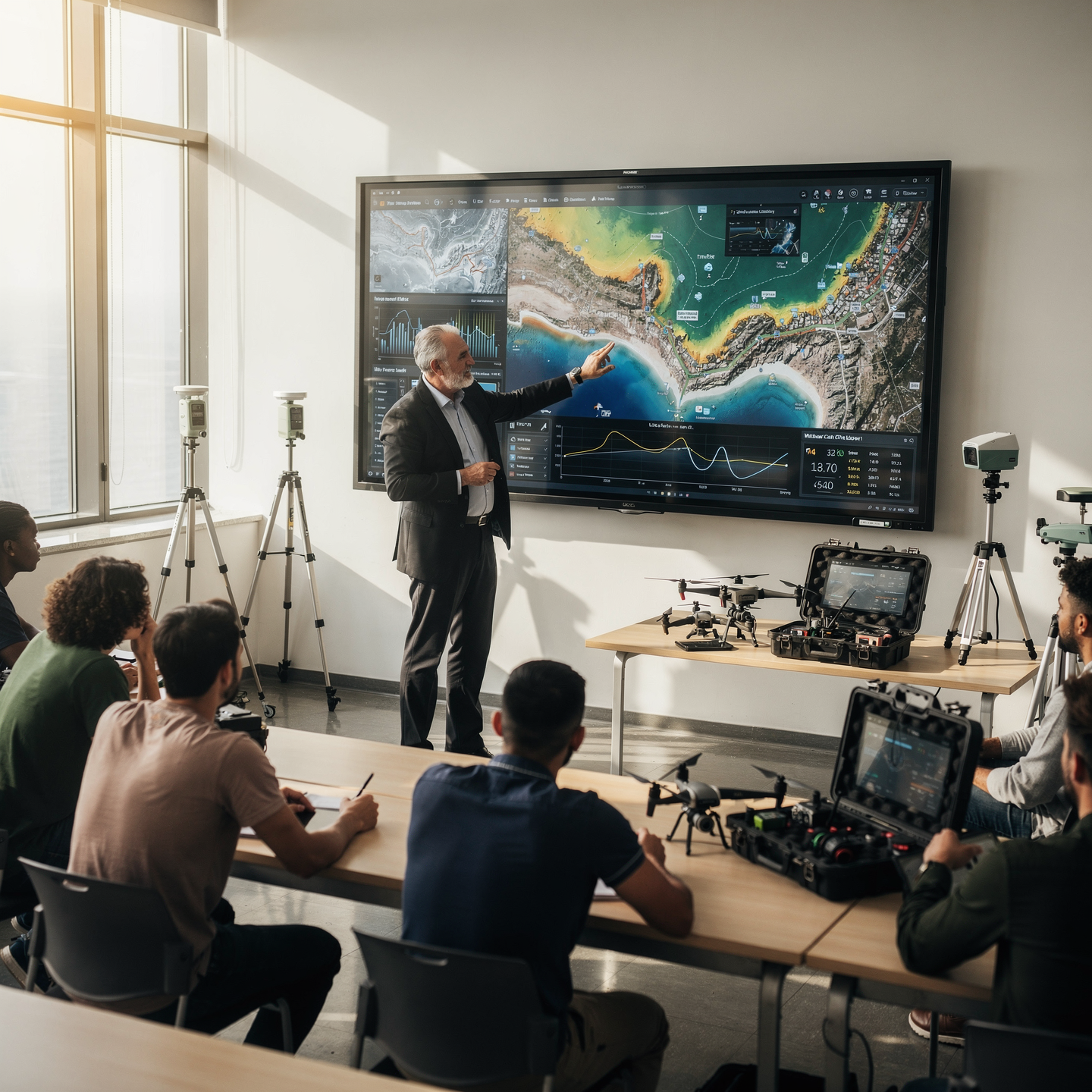
This program provides you with the essential tools for the sustainable management of coastal zones. Learn to apply cutting-edge technologies for coastal analysis and modeling, including drones, GIS, and remote sensing. Master techniques for monitoring erosion, flooding, and land-use change, and contribute to climate change planning and adaptation. This program prepares you to face the environmental and socioeconomic challenges of the coast with a solid scientific foundation and practical skills.
Differential Advantages
- Application of geospatial technologies: satellite image processing, LiDAR analysis, and 3D modeling.
- Specialized software tools: proficiency in ArcGIS, QGIS, and other geoenvironmental analysis platforms.
- Analysis of oceanographic and meteorological data: interpretation of information for integrated coastal management.
- Development of mapping and monitoring projects: design and implementation of solutions for real-world coastal problems.
- Multidisciplinary approach: integration of knowledge in geography, oceanography, engineering, and environmental sciences.
- Modality: Online
- Level: Diplomado
- Hours: 800 H
- Start date: 19-06-2026
Availability: 1 in stock
Who is it aimed at?
- Geomatics and cartography professionals seeking to specialize in the analysis and management of coastal zones.
- Environmental and civil engineers needing tools for the design of sustainable coastal infrastructure projects.
- Marine biologists and oceanographers interested in the monitoring of coastal ecosystems and the impact of climate change.
- Government officials and urban planners responsible for coastal management and land-use planning.
- Students and recent graduates wishing to acquire practical skills in the use of coastal mapping and monitoring technologies.
Learning flexibility
Designed for active professionals: online classes in live access to 24/7 learning materials and personalized tutoring for learning at your own pace.
Objectives and competencies

Applying geospatial technologies for the sustainable management of coastal areas:
“Develop predictive models of coastal environmental impact, integrating remote sensing data, GIS and numerical modeling to optimize planning and risk mitigation.”

Assess coastal vulnerability to climate change and propose adaptation measures:
“Analyze data on sea level rise, erosion, and extreme events to identify high-risk areas and design coastal protection strategies such as habitat restoration and the construction of resilient infrastructure.”

Implement coastal monitoring systems for the early detection of environmental risks:
Integrating sensor data (meteorological, oceanographic, water quality) into GIS platforms, calibrating predictive models of flooding, erosion and pollution to generate early warnings and contingency plans.

Generate detailed and up-to-date maps of coastal ecosystems:
“Using GIS and remote sensing technologies for habitat classification, modeling of shoreline changes, and analysis of the distribution of key species.”

Develop comprehensive management strategies for the conservation of coastal biodiversity:
Implement participatory monitoring programs, involving local communities in data collection and surveillance for the early detection of threats to biodiversity.

Interpreting oceanographic and atmospheric data for the optimization of coastal activities:
“Analyze meteorological and oceanographic information (waves, currents, tides) to assess risks and optimize the planning of maritime routes and port operations.”
Curriculum - Modules
- Comprehensive Maritime Incident Management: protocols, roles, and chain of command for coordinated response
- Operational Planning and Execution: briefing, routes, weather windows, and go/no-go criteria
- Rapid Risk Assessment: criticality matrix, scene control, and decision-making under pressure
- Operational Communication: VHF/GMDSS, standardized reports, and inter-agency liaison
- Tactical Mobility and Safe Boarding: RHIB maneuvers, approach, mooring, and recovery
- Equipment and Technologies: PPE, signaling, satellite tracking, and field data logging
- Immediate Care of the Affected: primary assessment, hypothermia, trauma, and stabilization for evacuation
- Adverse Environmental Conditions: swell, Visibility, flows, and operational mitigation
Simulation and training: critical scenarios, use of VR/AR, and exercises with performance metrics
Documentation and continuous improvement: lessons learned, indicators (MTTA/MTTR), and SOP updates
- Introduction to marine cartography: history, evolution, and standards
- Reference systems: datum, map projections, and geoid
- Remote sensing: physical principles, sensor types, and platforms
- Coastal GIS: basic concepts, components, and functionalities
- Data acquisition: bathymetry, topography, and remote sensing
- Image processing: geometric and atmospheric corrections
- Image classification and analysis: algorithms and techniques
- Digital terrain modeling (DTM) and slope analysis
- Spatial analysis: overlay, proximity, and connectivity
- GIS applications Coastal: Resource Management, Planning, and Risks
‘
- Introduction to coastal mapping: history, evolution, and applications.
- Fundamentals of remote sensing: electromagnetic spectrum, sensors, and platforms.
- Drones (RPAS) in coastal environments: types, regulations, and safety.
- Data acquisition with drones: flight planning and onboard sensors (RGB, multispectral, LiDAR).
- Aerial image processing: orthorectification, georeferencing, and digital model generation.
- Multispectral image analysis: vegetation indices, supervised and unsupervised classification.
- Generation of thematic coastal maps: habitats, erosion, and shoreline changes.
- LiDAR data integration: elevation model creation High resolution.
- Applications of coastal mapping with drones: risk management, environmental conservation, and urban planning.
- Case studies: real-world coastal mapping projects using drones and remote sensing.
‘
- Introduction to Marine Cartography: History, Evolution, and Standards
- Geodetic Reference Systems: Datum, Map Projections, and Coordinates
- Nautical Charts: Types, Scales, Information Represented, and Symbology
- Sounding and Bathymetry: Measurement, Interpretation, and Representation Techniques
- GIS Software Management: Tools for Visualizing and Analyzing Spatial Data
- Applied Remote Sensing: Interpretation of Satellite and Aerial Images for the Coastline
- Digital Terrain Models (DTMs): Creation, Analysis, and Applications in the Marine Environment
- Legislation and Regulations: European and National Directives on Coastal Management
- Maritime Spatial Planning: Instruments and processes for integrated management
Spatial data management: quality, storage, access, and dissemination
‘
- Introduction to marine cartography: history, projection, and datum.
- Spatial Reference Systems: Geodetic and Projected.
- Nautical charts: types, formats (raster and vector), production, and updating.
- Cartographic symbology: interpretation of symbols, abbreviations, and conventions.
- Geographic Information Systems (GIS): principles, components, and functionalities.
- Acquisition and management of geospatial data: data sources, formats, and processing.
- Spatial analysis in GIS: analysis, interpolation, and modeling tools.
- Digital Terrain Modeling (DTM) and bathymetry: creation and analysis.
- Coastal Early Warning Systems: Concepts, Types, and Monitoring Systems.
- Applications of Marine Mapping, GIS, and Early Warning Systems in Coastal Management: Examples and Case Studies.
‘
- System Architecture and Components: Structural design, materials, and subsystems (mechanical, electrical, electronic, and fluid) with selection and assembly criteria for marine environments
- Fundamentals and Principles of Operation: Physical and engineering foundations (thermodynamics, fluid mechanics, electricity, control, and materials) that explain performance and operating limits
- Safety and Environmental (SHE): Risk analysis, PPE, LOTO, hazardous atmospheres, spill and waste management, and emergency response plans
- Applicable Regulations and Standards: IMO/ISO/IEC requirements and local regulations;
- Conformance criteria, certification, and best practices for operation and maintenance
- Inspection, testing, and diagnostics: Visual/dimensional inspection, functional testing, data analysis, and predictive techniques (vibration, thermography, fluid analysis) to identify root causes
- Preventive and predictive maintenance: Hourly/cycle/seasonal plans, lubrication, adjustments, calibrations, consumable replacement, post-service verification, and operational reliability
- Instrumentation, tools, and metrology: Measuring and testing equipment, diagnostic software, calibration and traceability; selection criteria, safe use, and storage
- Onboard integration and interfaces: Mechanical, electrical, fluid, and data compatibility; Sealing and watertightness, EMC/EMI, corrosion protection, and interoperability testing.
Quality, acceptance testing, and commissioning: process and materials control, FAT/SAT, bench and sea trials, go/no-go criteria, and evidence documentation.
Technical documentation and integrated practice: logs, checklists, reports, and a complete case study (safety → diagnosis → intervention → verification → report) applicable to any system.
- Introduction to Coastal Cartography: History, Evolution, and Applications
- Fundamentals of Marine Remote Sensing: Electromagnetic Spectrum, Sensors, and Platforms
- Reference Systems and Map Projections: Datum, Ellipsoids, and Transformations
- Bathymetric Data Acquisition: Single-Beam and Multibeam Sounders, Processing, and Quality Control
- Optical Remote Sensing: Satellite Image Analysis, Classification, and Information Extraction
- Digital Image Processing: Geometric and Radiometric Corrections, Enhancement, and Segmentation
- Spatial Analysis and Cartographic Modeling: Interpolation, Map Algebra, and Multicriteria Analysis
- Radar Remote Sensing: Principles, Polarimetry, and Applications in the Detection of Spills and waves
Geographic Information Systems (GIS): Data structures, management, and analysis of coastal information
Applications of coastal mapping and marine remote sensing in integrated coastal zone management
‘
Career opportunities
- Geographic Information Systems (GIS) Technician: Creation and analysis of coastal maps for various applications.
- Environmental Consultant: Environmental impact assessment in coastal areas and mitigation proposals.
- Coastal Project Manager: Planning and execution of coastal development and conservation projects.
- Scientific Researcher: Study of coastal dynamics, erosion, flooding, and changes in the coastline.
- Geospatial Data Analyst: Processing and analysis of remote sensing data applied to the coast.
- Natural Resource Management Technician: Sustainable management of coastal and marine resources.
- Cartographer: Creation of thematic maps and nautical charts of coastal areas.
- Coastal Modeling Specialist: simulation of coastal processes for risk prediction and planning.
- Environmental Inspector: monitoring and enforcement of environmental regulations in the coastal zone.
“`
Admission requirements

Academic/professional profile:
Degree/Bachelor's degree in Nautical Science/Maritime Transport, Naval/Marine Engineering, or a related field; or proven professional experience in bridge/operations.

Language proficiency:
Recommended functional maritime English (SMCP) for simulations and technical materials.

Documentation:
Updated resume, copy of degree or seaman's book, ID card/passport, letter of motivation.

Technical requirements (for online):
Equipment with camera/microphone, stable connection, ≥ 24” monitor recommended for ECDIS/Radar-ARPA.
Admission process and dates

1. Online
application
(form + documents).

2. Academic review and interview
(profile/objectives/schedule compatibility).

3. Admission decision
(+ scholarship proposal if applicable).

4. Reservation of place
(deposit) and registration.

5. Induction
(access to campus, calendars, simulator guides).
Scholarships and grants
- Advanced Mapping Techniques: Master the latest tools and methodologies for creating accurate and detailed coastal maps.
- Coastal Environmental Monitoring: Learn to identify and analyze key indicators of the health of coastal ecosystems.
- Applied Remote Sensing and GIS: Use satellite imagery and geographic information systems for coastal zone monitoring and management.
- Integrated Coastal Zone Management: Acquire the skills necessary for the sustainable planning and management of coastal resources.
- Real-World Case Studies: Apply your knowledge to real-world projects and tackle common challenges in coastal zone management.
Testimonials
The Diploma in Coastal Mapping and Monitoring provided me with the tools and knowledge necessary to lead the coastal erosion analysis project in my municipality. Thanks to the techniques I learned, we were able to generate high-precision maps that identified the areas of greatest risk—crucial information for developing mitigation strategies and protecting key infrastructure. This project has been recognized regionally for its impact and accuracy, and my participation was highlighted thanks to the solid training I received in the diploma program.
The Diploma in Aeronautics & Maritime Drones exceeded my expectations. I acquired solid theoretical and practical knowledge, from regulations to the specialized operation of drones in maritime environments. The training enabled me to successfully lead the integration of drones into my company’s operations, optimizing the inspection of offshore infrastructure and the collection of oceanographic data, resulting in a significant improvement in efficiency and safety.
The Diploma in Coastal Mapping and Monitoring provided me with the tools and knowledge necessary to lead the coastal erosion assessment project in my community. By applying the techniques I learned, we were able to generate high-precision maps that identified the most vulnerable areas—crucial information for developing mitigation strategies and the sustainable management of our coastline. Thanks to this diploma, I now actively contribute to the protection of our coastal ecosystem.
This diploma program exceeded my expectations. I acquired practical skills in using GIS and remote sensing tools to analyze coastal dynamics. I applied this knowledge to a real-world project, mapping erosion along a vulnerable coastal stretch, which allowed me to propose effective mitigation measures. The combination of theory and practice was key to my professional development.

Frequently asked questions
The main focus of the diploma course is to provide participants with the skills and knowledge necessary to perform coastal mapping and monitoring using modern tools and techniques.
Yes. The itinerary includes ECDIS/Radar-ARPA/BRM with harbor, ocean, fog, storm, and SAR scenarios.
Online with live sessions; hybrid option for simulator/practical placements through agreements.
Recommended functional SMCP. We offer support materials for standard phraseology.
Yes, with a relevant degree or experience in maritime/port operations. The admissions interview will confirm suitability.
Optional (3–6 months) through Companies & Collaborations and the Alumni Network.
Simulator practice (rubrics), defeat plans, SOPs, checklists, micro-tests and applied TFM.
A degree from Navalis Magna University + operational portfolio (tracks, SOPs, reports and KPIs) useful for audits and employment.
- Introduction to marine cartography: history, evolution, and standards.
- Reference systems: Datum, map projections, and coordinates.
- Nautical charts: types, symbology, abbreviations, and corrections.
- Drones in the marine environment: types, sensors, and platforms.
- Drone photogrammetry: principles, processing, and orthomosaic generation.
- Lidar data acquisition with drones: fundamentals, calibration, and classification.
- Coastal analysis: geomorphology, coastal dynamics, and natural hazards.
- Satellite image processing for coastal studies.
- GIS software: data management, spatial analysis, and visualization Cartographic.
- Applications of marine cartography, drones, and coastal analysis: coastal management, climate change, and environmental monitoring.
‘
Request information
Complete the Application Form.
Attach your CV/degree certificate (if you have it to hand).
Indicate your preferred cohort (January/May/September) and whether you would like the hybrid option with simulator sessions.
An academic advisor will contact you within 24–48 hours to guide you through the admission process, scholarships, and compatibility with your professional schedule.
Faculty
Eng. Tomás Riera
Full Professor
Eng. Tomás Riera
Full Professor
Eng. Sofía Marquina
Full Professor
Eng. Sofía Marquina
Full Professor
Eng. Javier Bañuls
Full Professor
Eng. Javier Bañuls
Full Professor
Dr. Nuria Llobregat
Full Professor
Dr. Nuria Llobregat
Full Professor
Dr. Pau Ferrer
Full Professor
Dr. Pau Ferrer
Full Professor
Cap. Javier Abaroa (MCA)
Full Professor
Cap. Javier Abaroa (MCA)
Full Professor

